
On this page
Start here
Quick answer
Stop adding water and identify whether only the American Standard sink is slow or whether nearby fixtures also back up. If the bowl is safe to handle, remove the stopper or strainer and clear only visible hair, food, or soap without pushing it farther into the drain. Seal the overflow opening on a bathroom sink and use a correctly sized cup plunger; a brief improvement points toward a local soft blockage, while no change, rapid refill, gurgling, or backup in several fixtures points farther down the branch or building drain. Do not mix drain chemicals, use a plunger after pouring chemical opener unless the product instructions explicitly allow it, or remove the trap when caustic liquid may still be present. An accessible P-trap can be inspected only after chemical use is ruled out and a bucket is ready; a hard object, recurring blockage, sewage backup, leak at a fitting, or blockage beyond the trap needs a licensed plumber.
Before you begin
Safety first
- This article supports stopping water use, removing plainly accessible debris, inspecting the visible stopper and opening, using a sealed cup plunger only without chemical residue, and observing an accessible intact trap. A licensed plumber should handle chemical-contaminated drains, corroded or pressurized connections, branch or main clearing, disposal disassembly, pipe cutting, and final leak testing.
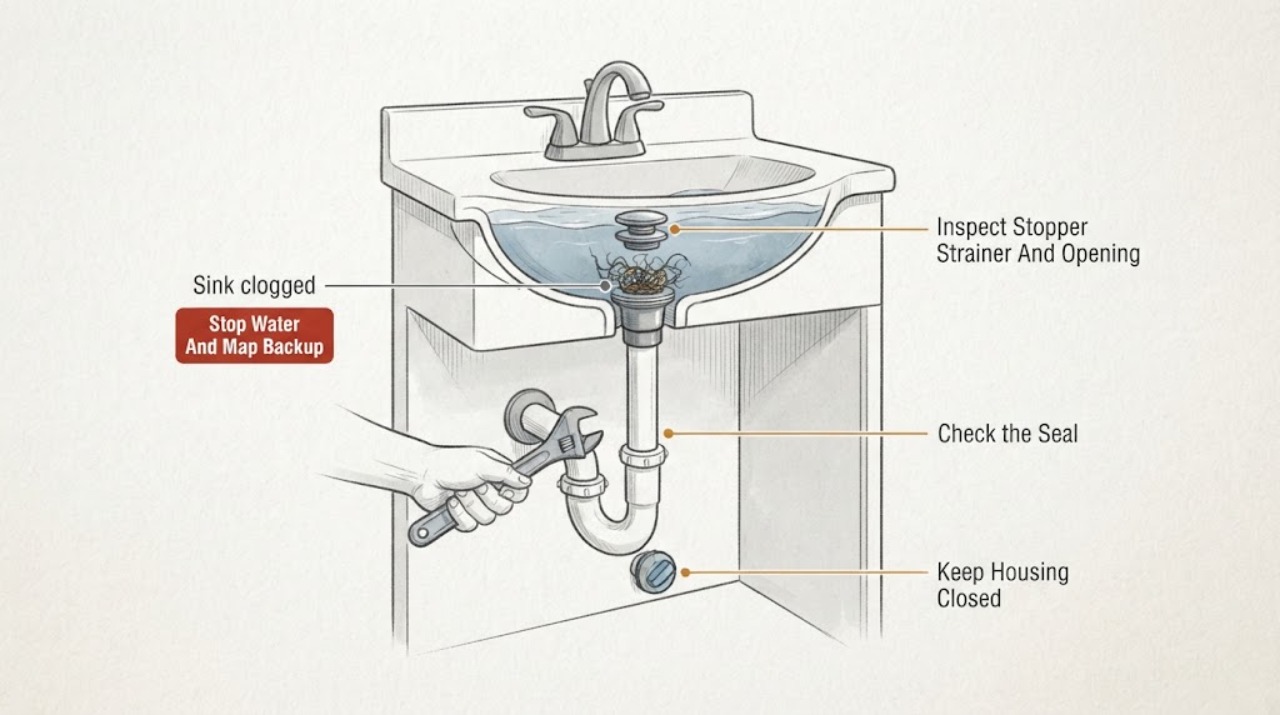
Work through in order
Diagnostic checks
Use only checks that match the exact appliance or system and its official guide.
-
Check 1
Stop running water at the clogged sink and look at nearby sinks, tubs, toilets, and floor drains. If the bowl is full, remove only enough standing water to work without splashing and keep children and pets away; do not add cleaner or boiling water.
Expected result: Record one slow sink, no drainage, water rising in another fixture, gurgling, sewage odor, visible dirty backflow, or a leak under the cabinet.
Next step: Use no more water if more than one fixture backs up, dirty water returns, a leak is active, or the blockage follows a shared branch. Arrange plumbing service; otherwise continue with the sink opening check.
Stop if: Do not keep filling the sink, run a disposal connected to the same branch, or touch contaminated water without suitable protection.
Why this matters
Why: One affected sink makes a stopper, strainer, trap, or local branch blockage more likely. Several fixtures, dirty backflow, or water appearing at a floor drain points farther downstream or to a shared drain. A leak under the cabinet can make plunging unsafe and can be a failed fitting rather than a clog alone.
-
Check 2
Remove or open the American Standard stopper or strainer only as its installed design permits. Use a flashlight to inspect the drain opening and underside of the stopper for hair, soap, food, a small object, or a stopper that is not rising fully; remove only material that is plainly accessible.
Expected result: Record a dirty stopper, a stopper that moves but leaves little opening, a clear opening with standing water, a hard object, damaged linkage, or a missing or displaced seal.
Next step: Clean the accessible stopper and reinstall it in the same orientation, then add no chemical and test with a small amount of clean water. If the bowl remains slow or the stopper cannot be removed safely, use the plunger branch or arrange service.
Stop if: Do not push debris into the tailpiece, pry a fixed stopper with a sharp tool, or remove linkage parts when a model-specific manual is unavailable.
Why this matters
Why: Debris attached to the stopper or a stopper that does not open fully can create a local slow drain. A clear opening with standing water shifts attention toward the trap or pipe. A hard object, damaged linkage, or missing seal can require component service rather than force.
-
Check 3
If the stopper and opening are clear and no drain chemical was used, place a cup plunger over the sink drain. On an American Standard bathroom sink, cover the overflow opening with a wet cloth or other secure seal, add enough water to cover the cup, and make controlled strokes without lifting the cup out of the water.
Expected result: Record a quick drop, a temporary drop followed by slow refill, no movement, water forcing through the overflow, water rising in another fixture, or a new leak at the trap or drain body.
Next step: Flush with a small amount of clean water only if drainage is restored and no fitting leaks. Stop and arrange service for no change, recurrence, cross-fixture backup, contaminated water, or any leak.
Stop if: Do not plunge after chemical opener residue unless the product label specifically allows it and you have suitable protection; never increase force against a leaking or fragile drain assembly.
Why this matters
Why: A quick drop after a sealed plunge makes a local soft blockage more likely. A temporary improvement suggests material remains in the trap or branch. No movement, cross-fixture rise, or a new leak means the blockage or fitting needs a different method and should not be forced.
-
Check 4
Before looking below the sink, establish whether drain opener, bleach, acid, solvent, or another cleaner was poured into the drain. If no such product was used, place a bucket and towels under the P-trap and inspect the trap, slip nuts, tailpiece, and drain-body connections for standing water, blockage clues, cracks, or active leaks; do not loosen a fitting that is corroded or under strain.
Expected result: Record no chemical history and a dry trap, standing water in the trap, visible debris at a removable connection, a cracked or corroded trap, a wet drain body, or unknown chemical history.
Next step: If the trap is intact, chemical-free, and the connection is serviceable, a plumber may remove and clean it using the correct model and material procedure. For chemicals, corrosion, cracks, stuck nuts, or a blockage beyond the trap, keep the sink unused and arrange service.
Stop if: Do not put hands into standing chemical water, mix products, use a torch or heat, force slip nuts, or open the trap when residue may be caustic.
Why this matters
Why: Standing water and debris in an intact trap can explain a single-sink clog. A dry trap with water above it can shift the blockage into the tailpiece or branch. A leak or unknown chemical history creates a chemical-exposure or fitting-failure boundary, not a routine cleaning task.
-
Check 5
After the sink opening and safe local checks, note whether the clog returns immediately, whether another fixture gurgles or rises, and whether the sink shares a disposal, dishwasher connection, or branch with another drain. Do not run a large volume of water to test a suspected shared blockage.
Expected result: Record one sink that stays clear, a recurring slow drain, several fixtures affected, sewage-colored backup, a disposal that hums or will not turn, or a branch connection that leaks.
Next step: Keep water use low and arrange a licensed plumber for recurring, shared, contaminated, or inaccessible blockages. Do not dismantle a disposal, cut a pipe, or feed a long snake into an unknown branch.
Stop if: Do not send chemical opener into a shared line, run repeated disposal cycles, or remove a cleanout cap that is under pressure or likely to release contaminated water.
Why this matters
Why: A recurrence after local clearing suggests material remains in the branch. Several fixtures or sewage-colored backup indicate a shared or main drain problem. A disposal or branch connection issue can restrict flow without being a clog at the sink opening.
-
Check 6
Photograph the American Standard drain opening, stopper or strainer, trap connections, and any standing or dirty water without exposing yourself to chemical residue. Record the sink type, whether it has an overflow, what was poured into it, the result of plunging, and which other fixtures were affected.
Expected result: Provide the exact faucet or drain model if visible, local versus shared symptoms, chemical history, trap condition, leak location, and whether the blockage clears temporarily or not at all.
Next step: Keep the sink unused and arrange a licensed plumber for a hard object, recurring clog, blockage beyond the trap, shared backup, sewage return, chemical exposure, cracked fitting, or unresolved slow drainage.
Stop if: Do not keep adding water, use a powered snake without knowing the pipe path, cut the drain, or replace the American Standard drain assembly before the obstruction and model fit are confirmed.
Why this matters
Why: These details help the plumber choose between stopper cleaning, trap service, branch clearing, disposal inspection, or a shared-drain assessment. A branded pop-up drain does not establish that the clog is in the drain body; the symptom pattern and first obstruction do.
Use your observations
Decision map
Find the observation that best matches what you see, then follow the next safe action.
-
PATH 01Safety boundary
What you see
Only this sink is affected, the bowl is stable, and hair, soap, food, or a stopper that does not open fully is visible at the American Standard drain opening.
Do this next
Remove only accessible debris, clean and reinstall the stopper in its original orientation, then test with a small amount of clean water. Use a sealed cup plunger if the opening is clear and no chemical was used.
Why this path and its safety boundary
Why it matters: A local stopper or opening blockage is more likely than a branch or main-line blockage.
Safety stop: Stop for a hard object, damaged linkage, a missing seal, or any need to pry or push material into the pipe.
-
PATH 02Safety boundary
What you see
The stopper and opening are clear, no drain chemical was used, the overflow is sealed, and the bowl drops quickly after controlled plunger strokes.
Do this next
Use a small clean-water test and monitor the next few uses. Stop and arrange service if the flow slows again, gurgling starts, or another fixture rises.
Why this path and its safety boundary
Why it matters: A soft local blockage is more likely, but temporary improvement means material may remain in the trap or branch.
Safety stop: Do not switch to chemical opener or increase force when the drain begins leaking or backs up elsewhere.
-
PATH 03Safety boundary
What you see
The sink alone remains blocked after opening and plunging, standing water is present in the P-trap, or a drain-body or slip-nut connection is wet or visibly damaged.
Do this next
Keep the sink unused. Only a chemical-free, intact, accessible trap may be serviced with a bucket and correct procedure; use a licensed plumber for corrosion, a stuck connection, a damaged drain body, or an obstruction that does not safely clear.
Why this path and its safety boundary
Why it matters: A trap, tailpiece, drain body, or nearby fitting is more likely than the stopper alone. A leak can be the primary fault even when the bowl is slow.
Safety stop: Do not open a trap after chemical use, force corroded nuts, or use heat or a sharp object near plastic or finished American Standard parts.
-
PATH 04Safety boundary
What you see
Several fixtures back up or gurgle, dirty water returns, the clog recurs immediately after local clearing, or a shared disposal or branch connection is involved.
Do this next
Stop using affected fixtures, limit water into the plumbing system, protect the area from contaminated water, and arrange licensed drain service. Report which fixtures rise first and whether the backup is clean or dirty.
Why this path and its safety boundary
Why it matters: A downstream branch or main drain blockage is more likely than a clog inside the American Standard drain opening.
Safety stop: Do not pour chemicals into the shared line, run a disposal, remove a pressurized cleanout cap, or continue plunging against sewage backup.
-
PATH 05Safety boundary
What you see
Drain opener or another cleaner was used, the product history is unknown, the bowl contains contaminated water, or a leak exposes skin or nearby materials.
Do this next
Do not add another product or open the trap. Keep people and pets away, follow the product label and local poison or emergency guidance, and tell the plumber exactly what was used and when.
Why this path and its safety boundary
Why it matters: Chemical exposure or contaminated-water risk overrides ordinary unclogging. Mechanical action can splash residue and mixing products can create a dangerous reaction.
Safety stop: Never mix drain opener with bleach, vinegar, ammonia, or another cleaner; do not use a plunger or snake unless the product label and a qualified professional confirm it is safe.
Helpful context
Understand the symptom
Separate the stopper from the pipe blockage
An American Standard bathroom sink may use a push pop-up or a lift-rod drain. The stopper can collect hair and soap at the opening, while the trap or branch line can hold a deeper obstruction. A bowl that drains slowly by itself differs from several fixtures backing up together; the first pattern is more local, while the second requires less water use and a wider drain assessment.
Plunging depends on a sealed opening
A cup plunger works by moving water through a localized blockage. On a sink with an overflow, the overflow opening must be covered so pressure does not escape. Use enough water to cover the cup, keep the stopper or strainer arrangement from blocking the cup, and stop if water rises into another fixture or a fitting begins to leak.
Chemical history changes what is safe
Drain opener residue can burn skin and eyes and can remain in a trap or standing water. EPA recommends avoiding chemical openers for a clogged drain and warns that incompatible household products can react. Ask what was poured into the sink before using a plunger, opening a trap, or calling a plumber, and tell the plumber about any product and approximate time.
Safety boundary
Stop conditions
- Stop water use and call a licensed plumber for several fixtures backing up, sewage-colored return, recurring blockage, a blockage beyond the trap, an active leak, or a hard object that cannot be safely removed.
- Do not mix drain opener with bleach, vinegar, ammonia, or another product; do not plunge, snake, or open the trap when caustic residue may remain unless the label and a qualified professional make the method safe.
- Do not force an American Standard stopper, drain body, slip nut, trap, or cleanout; do not cut pipe, run a disposal repeatedly, or use heat near finished or plastic plumbing.
- Keep children and pets away from standing or contaminated water, protect skin and eyes, and follow local poison or emergency guidance for chemical contact, fumes, or an uncontrolled leak.
Only after diagnosis
Potential parts
- American Standard pop-up stopper or drain linkage
Consider this category only when the stopper fails to rise, its linkage is damaged, or debris remains attached after the drain opening is inspected.
Confirm the exact American Standard faucet or drain model, stopper style, linkage or cable arrangement, finish, and seal before selection; a push pop-up and lift-rod assembly are not interchangeable. - American Standard sink drain body or tailpiece
Consider this category only when the drain body, flange, tailpiece, or seal is cracked, obstructed, leaking, or confirmed by service as the cause.
Confirm overflow configuration, tailpiece diameter, sink opening, drain style, gasket arrangement, finish, and exact model before selection; do not replace a sound drain body to treat a downstream clog. - sink P-trap or trap washer
Consider this category only when the trap is cracked, corroded, leaking, or cannot be resealed after a confirmed trap obstruction is removed.
Confirm drain size, material, configuration, slip-joint dimensions, washer profile, and local code requirements before selection; do not disturb a chemical-contaminated trap. - sink strainer or overflow component
Consider this category only when a damaged strainer, stopper seat, or overflow component is confirmed to restrict flow or leak after the clog is cleared.
Confirm sink style, overflow arrangement, opening dimensions, seal surfaces, and exact American Standard model; a strainer or overflow part does not clear a branch-line obstruction.
When checks do not resolve it
Need a professional?
Arrange licensed plumbing service for a hard object, a clog that returns after stopper cleaning and sealed plunging, standing water that does not clear, a trap or drain-body leak, corroded or stuck connections, chemical history, contaminated backup, or several affected fixtures. A single local clog can be handled with accessible debris removal or a correctly sealed plunger only when the sink is stable and free of chemical residue.
Safety scope: This article supports stopping water use, removing plainly accessible debris, inspecting the visible stopper and opening, using a sealed cup plunger only without chemical residue, and observing an accessible intact trap. A licensed plumber should handle chemical-contaminated drains, corroded or pressurized connections, branch or main clearing, disposal disassembly, pipe cutting, and final leak testing.
Common questions
FAQ
Why is my American Standard sink clogged but the other fixtures drain?
A stopper, strainer, tailpiece, P-trap, or local branch blockage is more likely when only one sink is slow. Inspect the accessible stopper and opening first, then use a cup plunger with the overflow sealed if no chemical was used. A clear opening with no plunger response or a recurring clog needs plumbing service.
How do I clear an American Standard pop-up drain?
Use the installed design's instructions to open or remove the pop-up stopper, then lift away only visible hair, soap, or other loose debris. American Standard describes push pop-up drains that open again when pushed for removal and cleaning, but not every drain uses that design. Do not pry a fixed stopper or push debris into the tailpiece.
Should I use chemical drain opener in a clogged sink?
Avoid it as a first response. EPA recommends a plunger or drain snake instead and warns against harmful household chemicals entering drains. Never mix products. If opener was already used, do not plunge or open the trap until the label and a qualified professional confirm a safe method.
When should I remove the P-trap under an American Standard sink?
Only consider trap service when chemical use is ruled out, the trap is accessible and intact, and you can contain standing water with a bucket. A cracked or corroded trap, stuck fitting, unknown chemical history, contaminated water, or a blockage beyond the trap calls for a licensed plumber.
What does it mean if several fixtures back up with the sink?
A shared branch or main drain blockage is more likely than a clog in the American Standard stopper. Stop using affected fixtures, limit water, keep people away from dirty return, and arrange licensed drain service. Do not pour chemicals into the shared line or keep running a disposal.
Read the exact guide
Official sources
- Easy InstallationAmerican Standard · Official American Standard installation information; it describes Speed Connect drains and does not replace the installed product guide.
- Edgeline Single Hole Single-Handle Bathroom FaucetAmerican Standard · Official American Standard product page for the Edgeline faucet; the push-drain details are model-specific and do not identify every American Standard sink drain.
- Household Hazardous Waste (HHW)U.S. Environmental Protection Agency · Official EPA household hazardous-waste guidance; product labels and local emergency or poison guidance control any exposure response.
- Pop-Up DrainAmerican Standard · Official American Standard product page; the listed pop-up drain is one design and installed sink hardware varies by model.
- How to Care for Your Septic SystemU.S. Environmental Protection Agency · Official EPA septic and household drain guidance; local plumbing rules and the installed system determine the appropriate service method.
Community feedback
Share a repair observation
Share a plain-text repair observation. Accepted observations are published automatically; this page may take a moment to update.