
On this page
Start here
Quick answer
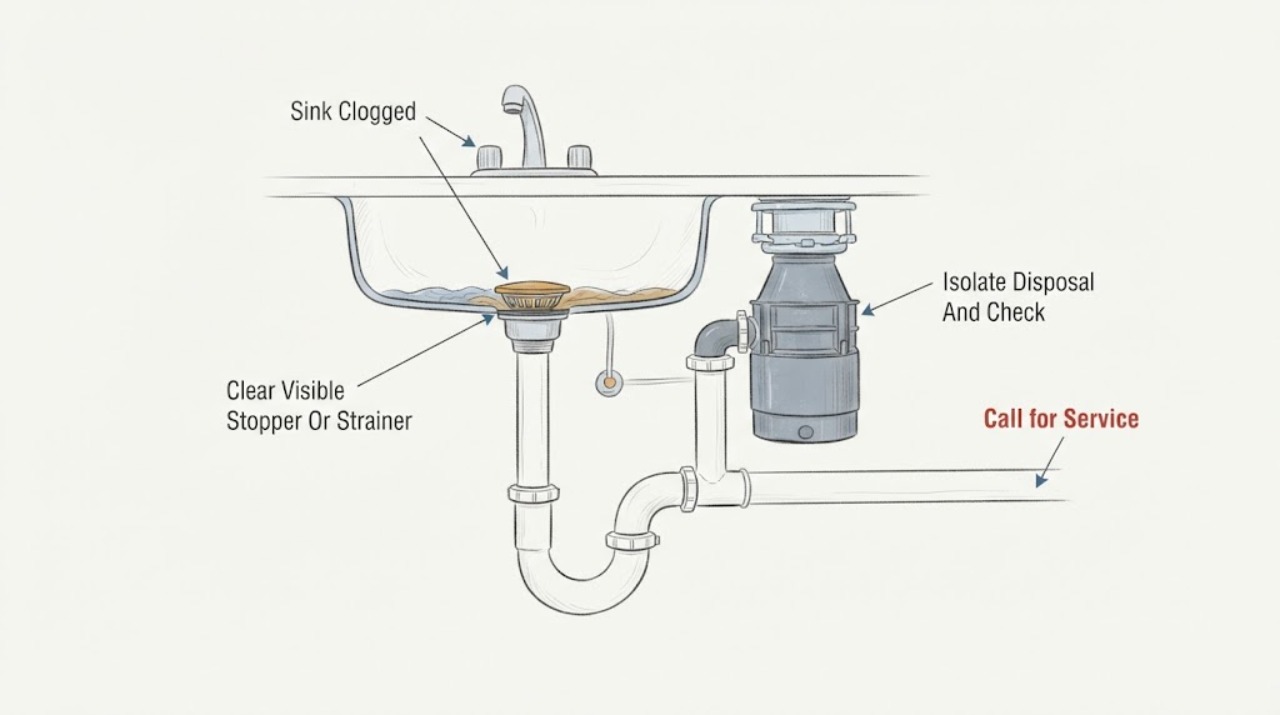
A clogged Kohler sink is usually blocked at the stopper or strainer, the trap, a disposal connection, or farther downstream. First stop adding water and identify whether the basin is fully blocked or only slow, whether one bowl or both bowls are affected, whether a disposal is installed, and whether other fixtures also back up. Kohler's sink guidance shows that drain designs vary and that a pop-up stopper is linked to an under-sink rod and ball assembly; its installation and troubleshooting material identifies a plugged drain or trap as a cause of slow or absent drainage. Remove only loose surface debris or an accessible stopper component covered by the exact model instructions. With a disposal, turn off and isolate power before looking near the opening and never put a hand inside. A gentle, model-appropriate plunger check may help with a shallow clog, but do not mix or pour drain chemicals, loosen a full trap, or force fittings. Arrange qualified plumbing service for a deep or recurring clog, sewage backup, leaks, multiple affected fixtures, or any repair that requires pipe or disposal disassembly.
Work through in order
Diagnostic checks
Use only checks that match the exact appliance or system and its official guide.
-
Check 1
Stop adding water and note whether the Kohler sink is fully blocked or only slow, whether water rises in one bowl or both, whether the sink is a bathroom or kitchen configuration, and whether it has a pop-up stopper, basket strainer, or disposal. Check whether another nearby fixture drains normally without adding more water.
Expected result: Only the affected basin is slow; both kitchen bowls rise; a stopper does not move or seal; the disposal basin rises; or several nearby fixtures back up.
Next step: Choose the matching branch and keep water use low. Do not run a disposal, add more water, or disassemble plumbing to locate the restriction.
Stop if: Stop for an overflowing basin, sewage-colored water, an active leak, water near electrical equipment, or a fixture that cannot be isolated safely.
Why this matters
Why: A local stopper, strainer, trap, or disposal connection is more likely when one basin is affected. Both bowls or multiple fixtures point farther downstream. A stuck stopper can physically limit the opening, while a disposal does not prove that the blockage is inside the grinding chamber.
-
Check 2
With water off, inspect the drain opening. Lift or remove only a stopper or strainer that is plainly user-accessible and described by the exact Kohler instructions, then remove loose hair, food, or soap residue from the visible part. For a pop-up drain, do not force the linkage, ball rod, or retaining nut.
Expected result: Debris is visible and the stopper or strainer moves normally; the stopper is stuck or does not close; the opening looks clear; or access requires tools, removing the rod, or reaching into a disposal.
Next step: Reinstall the accessible part exactly as the manual shows and test only with a small amount of water. If the drain remains blocked, do not force the mechanism; continue to the safe plunger or service branch.
Stop if: Stop for a cracked drain, sharp or broken metal, a seized linkage, a loose flange, chemical residue, or any need to place a hand inside a disposal.
Why this matters
Why: Visible debris or a mispositioned stopper can reduce drainage at the opening. A clear opening shifts attention to the trap or downstream line. A stuck linkage may need model-specific adjustment, while disposal access requires electrical isolation and a separate appliance safety boundary.
-
Check 3
If the kitchen sink has a garbage disposal, turn off its wall switch and isolate power according to the disposal's instructions before looking into the opening. From above, use a flashlight to note only a plainly visible object, damage, or an abnormal prior sound; never put a hand into the chamber and do not operate the disposal against standing water.
Expected result: The disposal previously hummed or stopped; a visible object is present; the chamber looks clear and the motor ran normally; or power cannot be isolated confidently.
Next step: Follow only the exact disposal maker's safe jam or reset procedure when the model is known. If the drain remains blocked, the disposal is abnormal, or power cannot be isolated, leave it off and arrange service.
Stop if: Never put a hand inside the disposal, use a knife or sharp tool, reset repeatedly, or continue after damaged wiring, a burnt smell, a cracked housing, or water near the electrical connection.
Why this matters
Why: A hum or stop can indicate a jam or motor problem, while a normally running disposal with water that does not drain makes a drain-path restriction more likely. A clear chamber does not rule out a trap or downstream clog. Uncertain power isolation is a safety stop.
-
Check 4
If there is no disposal hazard, no chemical residue, and the sink configuration permits it, use a gentle plunger check for a shallow clog. Remove enough standing water to prevent splashing; on a double-bowl sink, seal the other opening; and stop if the sink, seal, or plumbing moves. Do not use force or chemical cleaner.
Expected result: Water drains after gentle plunging; the basin stays full; water returns through the second bowl; pressure escapes at a connection; or the restriction briefly improves and then returns.
Next step: Run only a small amount of clean water to confirm flow after the basin empties. If the backup returns or the clog is not shallow, stop and arrange qualified plumbing service.
Stop if: Stop for sewage backup, a full basin that will not drain, chemical exposure, a leaking or moving drain assembly, or any need to use a snake or disconnect a pipe.
Why this matters
Why: Improvement supports a shallow restriction near the drain opening but does not prove the line is clear. No improvement, cross-bowl return, escaping pressure, or recurrence makes a trap, branch, or deeper clog more likely.
-
Check 5
Record the complete Kohler sink and drain model if visible, sink material and bowl count, stopper or strainer type, disposal presence, clog timing, visible debris, plunger result, under-sink leak observations, recent installation work, and whether other fixtures are affected. Photograph only labels and visible, dry conditions.
Expected result: The clog persists or returns; more than one fixture is affected; water leaks under the sink; the stopper, trap, disposal, or downstream line is suspected; or the model-specific procedure is unclear.
Next step: Limit water use on the affected branch, keep a disposal off, and arrange qualified plumbing service. Provide the model, configuration, symptom pattern, and results of safe visible checks.
Stop if: Do not loosen a full trap, remove a disposal or flange, mix chemicals, force fittings, or continue around active water damage or electrical hazards.
Why this matters
Why: The remaining possibilities include a trap or branch obstruction, displaced seal, damaged drain assembly, disposal fault, vent or shared drain issue, or a deeper blockage. The Kohler brand and sink appearance do not identify a compatible replacement part or safe repair.
Use your observations
Decision map
Find the observation that best matches what you see, then follow the next safe action.
-
PATH 01Next step
What you see
Do this next
Remove only the accessible stopper or strainer component described by the exact Kohler instructions, clear loose surface debris, and retest with a small amount of water. Escalate if the linkage is seized or the drain remains blocked.
Why this path and its safety boundary
Why it matters: A local opening restriction or pop-up linkage problem is more likely than a main drain blockage.
-
PATH 02Next step
What you see
Do this next
Keep water use low and arrange qualified plumbing service for trap or drain clearing if the shallow check does not restore sustained flow. Do not loosen a trap full of water as a first step.
Why this path and its safety boundary
Why it matters: A restriction in the trap, tailpiece, or local drain path is more likely. Kohler's troubleshooting material identifies a plugged drain or trap as a likely cause of slow or absent drainage.
-
PATH 03Next step
What you see
Do this next
Stop adding water and do not run a disposal. A gentle plunger check is reasonable only when safe and model-appropriate; recurring or multi-fixture backup needs a qualified plumber.
Why this path and its safety boundary
Why it matters: The restriction is more likely in the shared trap, branch, vent, or building drain than at the Kohler sink opening.
-
PATH 04Next step
What you see
Do this next
Isolate disposal power, keep hands out, and follow the exact disposal manual's jam boundary. Arrange plumbing or appliance service if the drain remains blocked or the motor is abnormal.
Why this path and its safety boundary
Why it matters: A disposal jam, overload, discharge connection restriction, trap clog, or downstream blockage may be involved. The sink itself and the disposal flange do not identify which component failed.
-
PATH 05Next step
What you see
Do this next
Stop using the sink, ventilate as appropriate without mixing products, keep people and pets away from residue, and arrange qualified plumbing service. Tell the technician what product was used and when.
Why this path and its safety boundary
Why it matters: Further plunging or disassembly can spread contaminated water, damage seals or finishes, or expose a person to chemical residue. An unknown drain configuration also makes part selection unreliable.
Helpful context
Understand the symptom
Find the restriction before choosing a clearing method
A fully full basin, a slow drain, and water returning through a second bowl are different patterns. A bathroom sink may be restricted by the stopper or its linkage; a kitchen sink may have food debris in the strainer, trap, or disposal connection. If several fixtures are slow, the restriction may be in a shared branch or building drain. Kohler's guidance emphasizes that sink and drain designs vary, so identify the configuration before moving any part.
Protect the surface, plumbing, and disposal
Remove standing water only as needed to prevent overflow and protect the cabinet. Use nonabrasive methods on a Kohler sink surface, and do not pour chemical drain cleaner into a sink when the material, trap, disposal, or prior chemical exposure is unknown. If a disposal is installed, isolate its electrical power before inspecting the opening and never put a hand inside. A trap full of water should not be loosened casually.
Stop at visible, model-approved checks
A removable stopper, visible hair or food at the drain opening, or a gentle plunger check may resolve a shallow restriction. Kohler's pop-up guidance describes a linkage and ball-rod assembly, but the exact drain may differ from the example. Under-sink trap, disposal, flange, and downstream work should follow the exact installation instructions or be handled by a qualified plumber, especially when there is a leak or standing water.
Safety boundary
Stop conditions
- Stop using the sink for sewage-colored backup, uncontrolled overflow, an active cabinet or wall leak, water near electrical equipment, or a drain assembly that cannot be isolated safely.
- Never place a hand into a garbage disposal; isolate its power before inspection and use only the exact disposal manual's model-specific jam procedure.
- Do not mix or pour chemical drain cleaners, use sharp tools, force a stopper or flange, or plunge when chemical residue, damaged plumbing, or an unsecured disposal is present.
- Do not loosen a trap, tailpiece, flange, or disposal while it is full, pressurized, corroded, or unable to be isolated; stop if water begins leaking at a connection.
- Arrange qualified service when a shallow approved check does not restore sustained flow, the clog affects multiple fixtures, or diagnosis requires trap, branch, disposal, vent, or wall-pipe access.
Only after diagnosis
Potential parts
- Kohler pop-up stopper, linkage, or ball-rod assembly
Consider this part class only when the exact sink drain uses a pop-up mechanism and inspection confirms a damaged, missing, or nonmoving stopper or linkage after approved adjustment.
Stopper shape, rod length, nut, clip, overflow arrangement, and drain body vary by Kohler model; identify the complete drain before selecting a part. - Kohler basket strainer, drain flange, or gasket
Consider this part class only when qualified inspection confirms a damaged, leaking, or obstructed strainer or drain connection after the clog location is established.
Sink material, opening, flange, strainer, o-ring, gasket, and disposal-flange configuration vary by model; do not substitute from appearance alone. - Sink tailpiece, P-trap, or drain connection
Consider this part class only when a visible or professional inspection confirms a cracked, obstructed, misaligned, or leaking connection is causing the clog or backup.
Pipe size, material, trap style, bowl arrangement, disposal or dishwasher branch, and local requirements vary; use the exact installation documentation.
When checks do not resolve it
Need a professional?
Call qualified plumbing service when gentle approved checks do not restore flow, the clog returns, both bowls or multiple fixtures are affected, a trap or branch is suspected, an under-sink connection leaks, a disposal is jammed or abnormal, or work requires disconnecting pipes, a flange, or the disposal. Seek urgent help for sewage backup, uncontrolled water, major leak, or chemical exposure.
Have this ready
- Complete Kohler sink, drain, stopper, strainer, or disposal model if visible
- Sink type, material, bowl count, and whether a disposal is installed
- Whether the basin is fully blocked or slow and whether one or multiple fixtures are affected
- Visible debris, stopper or strainer movement, gentle plunger result, and under-sink leak observations
- Recent installation work, chemical use, abnormal disposal sound, and any water or electrical hazard
Common questions
FAQ
Why is my Kohler sink clogged but the stopper looks clear?
The restriction may be in the trap, tailpiece, branch, disposal connection, or farther downstream. Kohler's troubleshooting guide identifies a plugged drain or trap as a likely cause of slow or absent drainage. Keep water use low and arrange service if a gentle approved check does not restore flow.
Can I remove the pop-up stopper from a Kohler bathroom sink?
Only if the exact drain instructions describe that design and procedure. Kohler explains that pop-up drains use a linkage and ball-rod assembly and that drain designs vary. Do not force the rod, retaining nut, or stopper; stop if the drain is seized or leaking.
What if both bowls of my Kohler kitchen sink back up?
Both bowls rising usually makes a shared trap, branch, or downstream restriction more likely than a single strainer obstruction. Stop adding water and do not run a disposal. Use only a safe, gentle check permitted by the configuration, then arrange qualified plumbing service if flow does not stay clear.
Should I pour drain cleaner into a clogged Kohler sink?
Do not use it as a generic first step, especially when the sink material, trap, disposal, or prior chemical exposure is unknown. Chemical residue can make later plumbing work hazardous and does not locate the clog. Use visible, model-approved checks and tell the plumber if any chemical was already used.
When should I call a plumber for a Kohler sink clog?
Call when the clog returns, a gentle approved check does not restore sustained flow, both bowls or multiple fixtures are affected, the trap or branch is suspected, a connection leaks, the disposal is abnormal, or clearing the drain requires disconnecting pipes or accessing the wall line.
Read the exact guide
Official sources
- I don't know my Kitchen Sink Drain model | Sinks | Kohler AssistKohler Assist · Official Kohler identification guidance used to distinguish drain and disposal-flange configurations; the page does not establish a universal part fit or clog cause.
- Adjusting Pop-Up Drains | Sinks | Kohler AssistKohler Assist · Official Kohler Assist guidance for pop-up drain designs; use only when the installed sink has the same type of linkage and follow the exact drain instructions.
- How to Install a Kitchen Sink | Step-by-Step Guide | KOHLERKohler Co. · Official Kohler kitchen-sink installation guide used for the model-specific documentation, under-sink drain connections, and leak-check boundary; it is not a clog-specific manual for every sink.
- InstallationKohler Co. · Official Kohler PDF for a documented cook-sink installation; used narrowly for its plugged-drain or trap troubleshooting and service boundary, not as a universal sink manual.
Community feedback
Share a repair observation
Share a plain-text repair observation. Accepted observations are published automatically; this page may take a moment to update.