
On this page
Start here
Quick answer
If an American Standard sink is slow or blocked and the P-trap appears to be involved, stop adding water and inspect only from the outside first. Note standing water, a wet or corroded trap, and whether another fixture also backs up. An American Standard P-trap may be a decorative exposed design with a removable trap eye, while an American Standard lavatory may use a push pop-up drain and tailpiece; those model differences do not make every part interchangeable. If no chemical drain product was used and the sink is stable, a correctly sealed cup plunger may help a local soft blockage. Do not loosen a trap with chemical residue, force corroded fittings, use a powered snake, or continue when sewage, an active leak, or several affected fixtures are present. Arrange plumbing service for a recurring clog, a blockage beyond the trap, damaged connections, or any unsafe condition.
Before you begin
Safety first
- Keep the sink unused for sewage, chemical residue, active leaks, uncontrolled backup, or water near electrical equipment. Do not loosen the trap, mix products, force corroded fittings, cut pipe, or use heat or powered drain equipment.
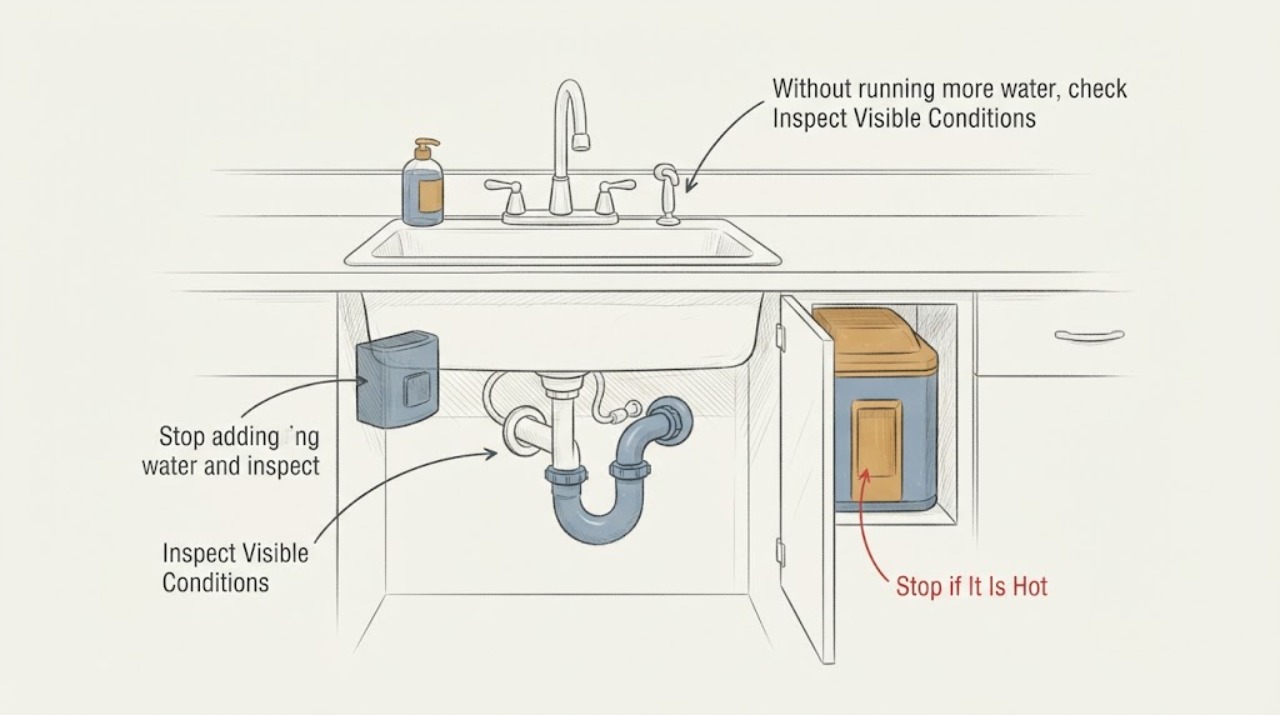
Work through in order
Diagnostic checks
Use only checks that match the exact appliance or system and its official guide.
-
Check 1
Stop adding water and inspect the sink basin, cabinet floor, visible P-trap, and wall connection from a dry position. Use a flashlight or phone camera without loosening any fitting or reaching into standing waste.
Expected result: Record slow drainage or no drainage, standing water in the bowl or trap, a dry or wet cabinet, a drip at a joint, corrosion, sewage odor, or no visible leak.
Next step: Keep the sink unused and photograph the visible arrangement. Stop and arrange service for an active leak, sewage, water near electrical equipment, or a fitting that looks fragile.
Why this matters
Why: Standing water supports a drainage blockage, while a wet cabinet or corroded joint may be a leak or failed fitting as well as a clog. A dry exterior does not locate the obstruction.
-
Check 2
Without running more water, check whether a nearby sink, tub, shower, toilet, or floor drain has slow flow, gurgling, standing water, or backup. Note whether the affected fixtures appear to share a branch or room.
Expected result: One American Standard sink is affected, or several fixtures show a related symptom; record clean versus dirty water and which fixture changed first.
Next step: For several affected fixtures or wastewater return, stop water use in the area and arrange plumbing service. For a single stable sink, continue only with the safe opening and chemical-history checks.
Why this matters
Why: A single sink is more consistent with a stopper, tailpiece, P-trap, or local branch obstruction. Several fixtures, gurgling, or dirty backup make a shared branch, vent, or main drain more likely than an isolated P-trap.
-
Check 3
Inspect the top of the sink drain and the visible stopper or strainer without forcing it. If the installed American Standard drain is a push pop-up design, observe whether it opens fully and whether hair, soap, food, or a small object is plainly accessible at the opening.
Expected result: Record accessible debris, a stopper that does not open fully, a clear opening with standing water, a damaged linkage, or a hard object.
Next step: Remove only loose material that is plainly accessible and reinstall the stopper in its original orientation. Do not push debris deeper, pry a fixed stopper, or dismantle the drain when the model procedure is unknown.
Why this matters
Why: A dirty or partly closed stopper can cause a local slow drain; a clear opening with water remaining shifts attention toward the tailpiece, P-trap, or branch. A hard object or damaged linkage needs careful service rather than force.
-
Check 4
Before using any mechanical clearing method, determine whether drain opener, bleach, acid, solvent, or another cleaner was poured into the sink. Check the container or household record without touching residue or leaning over the drain.
Expected result: Answer yes if a product was used or the history is unknown; answer no if no chemical treatment entered the sink.
Next step: For yes or unknown, do not plunge, snake, loosen the P-trap, or add another product; keep people and pets away and provide the product and timing to a plumber. For no, continue only if there is no sewage, active leak, or fragile fitting.
Why this matters
Why: A yes creates splash and exposure hazards and changes what a plumber can safely open. A no leaves a correctly sealed cup plunger as a possible low-risk observation step if the sink and fittings are stable.
-
Check 5
If the sink is chemical-free, stable, and has no sewage or leak, seal the overflow on a bathroom sink and place a cup plunger over the drain. Use controlled strokes with enough clean water to seal the cup; stop if the cabinet, trap, or wall connection begins to leak.
Expected result: Record a quick drop, temporary improvement, no movement, water through the overflow, water rising in another fixture, or a new leak.
Next step: Use only a small clean-water test if flow returns and no fitting leaks. Keep the sink unused and arrange service for recurrence, no change, cross-fixture backup, contaminated water, or any leak.
Why this matters
Why: A quick drop makes a local soft blockage more likely. Temporary relief can leave material in the P-trap or branch. No movement, cross-fixture rise, or a new leak makes force inappropriate and points toward a deeper blockage or fitting problem.
-
Check 6
Identify the visible American Standard sink and trap arrangement from the faucet or drain markings, exposed trap shape, model paperwork, and the location of the wall connection. If a decorative P-trap has a visible trap eye, record that feature without removing it or opening the assembly.
Expected result: Record whether the trap is exposed or concealed, whether a removable trap eye is visible, whether the drain has a push pop-up tailpiece, and whether the pipe is plastic, brass, or visibly corroded.
Next step: Give the photos, model evidence, chemical history, and symptom pattern to a qualified plumber. Do not order a P-trap kit or drain part from appearance alone, and do not force the trap eye or slip connections.
Why this matters
Why: American Standard documents multiple sink-drain arrangements. The model and material affect safe access, replacement compatibility, and whether a clog is likely to be serviceable at the trap versus farther downstream.
Use your observations
Decision map
Find the observation that best matches what you see, then follow the next safe action.
-
PATH 01Next step
What you see
Only the American Standard sink is affected, the trap and cabinet are dry and intact, no chemical was used, and the stopper or opening has visible debris.
Do this next
Remove only accessible debris, restore the stopper as installed, and use a correctly sealed cup plunger if the sink remains stable. Arrange service if flow does not improve or quickly slows again.
Why this path and its safety boundary
Why it matters: A local stopper or drain-opening blockage is more likely than a shared branch or main-line blockage.
-
PATH 02Next step
What you see
The opening is clear, the sink is chemical-free, and controlled plunging produces a quick drop without a leak.
Do this next
Use a small clean-water check only once drainage is stable. Stop for recurrence, gurgling, cross-fixture rise, or cabinet moisture and arrange plumbing service.
Why this path and its safety boundary
Why it matters: A soft local blockage is more likely, but temporary improvement does not prove that the P-trap or branch is clear.
-
PATH 03Next step
What you see
The sink remains blocked, standing water appears to remain in the P-trap, or a visible trap eye or connection is wet, cracked, corroded, or stuck.
Do this next
Keep the sink unused and have a plumber perform safe trap and drain diagnosis. Do not loosen the American Standard trap, force a trap eye, or use heat on a finished or plastic assembly.
Why this path and its safety boundary
Why it matters: A P-trap, tailpiece, drain body, or local connection may be involved, and a leak or damaged fitting may be the primary fault.
-
PATH 04Next step
What you see
Several fixtures gurgle, drain slowly, or back up; dirty water returns; or the clog recurs immediately after local clearing.
Do this next
Stop using affected fixtures, limit water entering the system, keep people and pets away from wastewater, and arrange licensed plumbing service. Do not pour chemicals or remove a pressurized cleanout cap.
Why this path and its safety boundary
Why it matters: A downstream branch, vent, or main drain problem is more likely than an isolated American Standard P-trap blockage.
-
PATH 05Next step
What you see
Drain opener or an unknown product was used, sewage or contaminated water is present, water is near electrical equipment, or the trap is leaking uncontrollably.
Do this next
Do not add another product, plunge, snake, or open the trap. Keep clear, follow the product label or local emergency guidance for exposure, and tell the plumber exactly what happened.
Why this path and its safety boundary
Why it matters: Chemical exposure, contamination, water damage, or electrical risk overrides ordinary unclogging.
Helpful context
Understand the symptom
A P-trap clog is not always inside the trap
The P-trap is the U-shaped section beneath a sink that holds water to limit sewer-gas entry. A blockage can instead be at the stopper or tailpiece above it, the branch drain beyond the wall connection, or a shared line. One sink that drains slowly is a different decision from several fixtures that gurgle or back up together. External observation can narrow the path but cannot prove the exact obstruction.
American Standard drain hardware varies by model
American Standard's Decorative P-Trap page describes brass construction and a removable trap eye for that exposed design. Its Pop-Up Drain page describes a push pop-up drain body with a tailpiece. Use visible markings and the installed layout to identify what is present; do not assume a decorative trap, tailpiece, stopper, or replacement kit fits another sink because it looks similar.
Keep a chemical and contamination boundary
Before any plunger or trap access, establish whether drain opener, bleach, acid, solvent, or another treatment entered the sink. Chemical history or unknown liquid changes the safe procedure. Do not mix products, put hands into standing waste, or open the trap when residue, sewage, corrosion, or an active leak is present; tell the plumber what was used and when.
Safety boundary
Stop conditions
- Stop water use and arrange plumbing service for several fixtures backing up, sewage or dirty return, a recurring blockage, a blockage beyond the visible trap, an active leak, or water near electrical equipment.
- Do not mix drain opener with bleach, vinegar, ammonia, or another product; do not plunge, snake, or open the P-trap when chemical residue or unknown liquid may remain.
- Do not force an American Standard stopper, trap eye, slip nut, drain body, or wall connection; do not cut pipe, use heat, run a powered snake, or remove a pressurized cleanout cap.
- Keep children and pets away from standing or contaminated water. Seek appropriate emergency or poison guidance for fumes, burns, eye exposure, or an uncontrolled leak.
Only after diagnosis
Potential parts
- sink plunger
Consider this only for a stable, chemical-free sink with no sewage or active leak, after the stopper and overflow arrangement are understood; it is not a remedy for a shared-line blockage.
Use a sink-appropriate cup style and follow safe instructions. Do not plunge unknown chemicals, contaminated water, a leaking fitting, or a fragile exposed trap. - p-trap kit
Consider this only after qualified diagnosis confirms that the P-trap is damaged, corroded, or must be replaced during safe access; replacing a trap does not clear a downstream branch blockage.
Match the exact sink model, trap design, material, connection layout, and local installation requirements. Do not select a kit by appearance or open a trap after chemical use. - drain snake
Consider this only when a qualified diagnosis identifies a suitable mechanical blockage and no chemical or contamination hazard is present; a long or powered snake can damage a fragile or shared drain.
Match the tool to the accessible drain path and pipe material. Confirm safe use before passing it through an American Standard drain, trap, or branch connection.
When checks do not resolve it
Need a professional?
Call a plumber for persistent or recurring American Standard sink blockage, a leaking or corroded P-trap, a hard object, chemical treatment, contaminated water, several affected fixtures, or a clog that cannot be localized safely.
Safety scope: Keep the sink unused for sewage, chemical residue, active leaks, uncontrolled backup, or water near electrical equipment. Do not loosen the trap, mix products, force corroded fittings, cut pipe, or use heat or powered drain equipment.
Have this ready
- Provide photos of the sink opening and visible P-trap, model or trim markings, sink type, whether it has an overflow or push pop-up drain, water and odor observations, fixture pattern, onset and recurrence, plunger result, and the exact product and timing of any chemical treatment.
Common questions
FAQ
How can I tell whether the American Standard P-trap is clogged?
A single sink with standing water and no visible leak can be consistent with a local trap or nearby drain blockage, but an external check cannot prove the location. Several fixtures backing up points farther downstream.
Does every American Standard sink use the same P-trap?
No. American Standard documents different drain and trap arrangements, including a decorative exposed P-trap and lavatory pop-up drain hardware. Use the exact model and installed layout before selecting a part.
Can I open the P-trap to clean it?
This article stays at observation level. Do not open it after chemical treatment, with contaminated water, corrosion, a leak, or a stuck connection. Have a plumber perform safe access when the trap needs removal or cleaning.
Should I use a plunger for a clogged P-trap?
Only consider a correctly sealed cup plunger when the sink is stable, chemical-free, free of sewage, and not leaking. Stop for no movement, cross-fixture backup, a new leak, or recurrence.
Why are multiple fixtures backing up when one sink is clogged?
Several fixtures with gurgling, slow drainage, or backup suggest a shared branch, vent, or main drain problem rather than one American Standard P-trap. Limit water use and call a plumber.
What if drain cleaner was already poured into the sink?
Do not add another product, plunge, snake, or loosen the trap. Keep people and pets away, follow the product label or local emergency guidance for exposure, and tell the plumber the exact product and timing.
When is a clogged sink an emergency?
Seek prompt help for sewage return, uncontrolled water, water near electrical equipment, fumes or chemical exposure, a trap that is splitting, or an active leak that cannot be stopped safely.
Read the exact guide
Official sources
- Sewer Smarts and Plumbing BasicsCity of Superior, Wisconsin · Household P-trap role, sink drain arrangement, and distinction between fixture and downstream plumbing
- Pop-Up DrainAmerican Standard · American Standard lavatory pop-up drain body and tailpiece identity
- Safety and maintenance tipsCity of Minneapolis · P-trap identification and purpose, shared-drain warning signs, and grease-clog prevention
- Decorative P-TrapAmerican Standard · American Standard exposed decorative P-trap construction and model-specific cleaning access
Community feedback
Share a repair observation
Share a plain-text repair observation. Accepted observations are published automatically; this page may take a moment to update.