
On this page
Start here
Quick answer
A clogged American Standard sink stopper is often a debris restriction around the stopper head or drain opening, but a blockage farther down the trap or branch drain can feel the same. First stop adding water and identify whether the stopper is stuck down, lifts but drains slowly, or lifts normally while the basin remains full. With no chemical drain opener in the line and no active leak, remove or lift the stopper only as the exact American Standard instructions allow, clear visible hair or residue, then use a plain cup plunger with a good seal over the sink drain. If the stopper will not move, the clog returns, more than one fixture is slow, water leaks under the sink, or chemical cleaner has already been used, stop and have a qualified plumber diagnose it. American Standard's own part pages also require model confirmation before selecting a stopper assembly.
Before you begin
Safety first
- A plumber should distinguish a stopper obstruction from a trap, branch-line, venting, or leaking connection issue before selecting a stopper assembly or drain component.
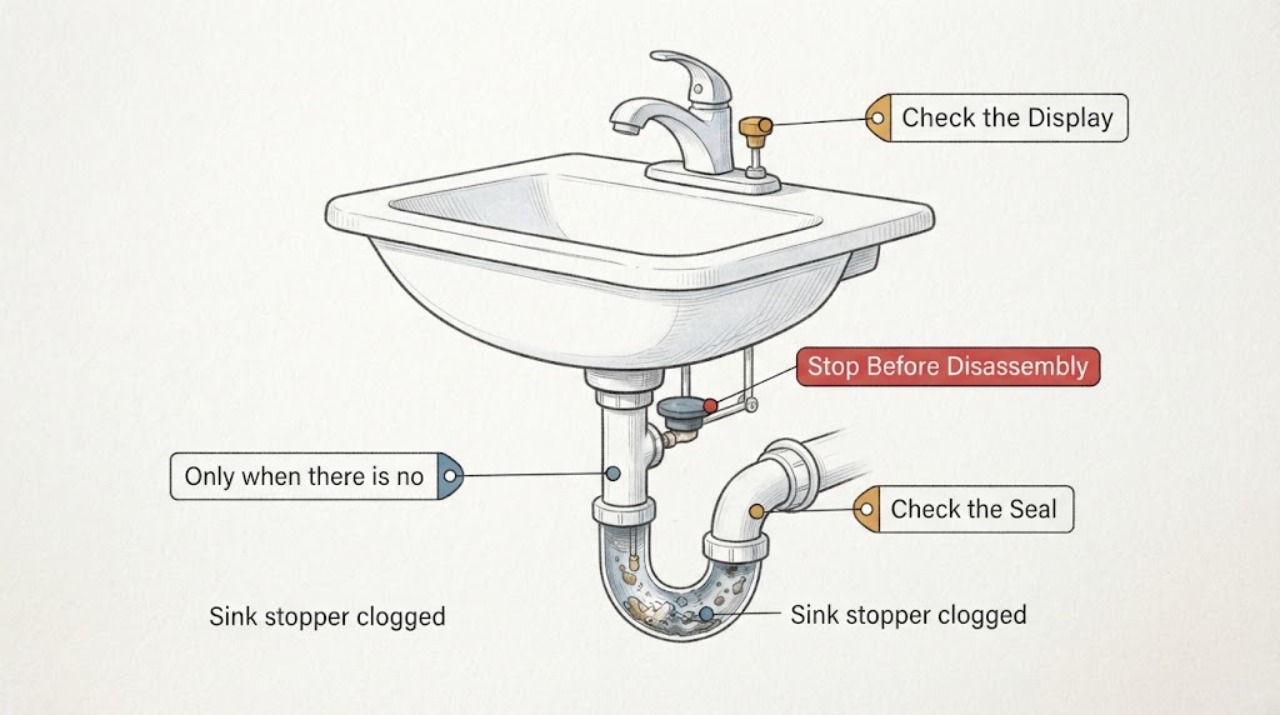
Work through in order
Diagnostic checks
Use only checks that match the exact appliance or system and its official guide.
-
Check 1
Stop adding water and operate the sink stopper control gently once, without forcing it; note whether the stopper is stuck down, lifts only partway, or lifts fully while the basin remains full.
Expected result: The stopper does not lift or the control moves without lifting it.
Next step: Do not force the control or reach blindly under the basin. Use the exact American Standard model instructions or arrange qualified plumbing service for the linkage.
Why this matters
Why: A jammed stopper head, lift rod, pivot, cable, or linkage is more likely than a simple clog at the open drain.
-
Check 2
Only when there is no chemical cleaner in the drain and the water is stable, lift the stopper or remove its visible upper piece according to the exact American Standard instructions; inspect the stopper head and drain opening for hair, soap residue, or a small object.
Expected result: Debris is wrapped around the stopper or visibly fills the opening, and the stopper can be removed without forcing the mechanism.
Next step: Clear only the visible debris, rinse the removable piece, and reseat it as instructed. If the stopper cannot be removed or the blockage is below the opening, stop and use the plumber branch.
Why this matters
Why: The restriction is likely local to the stopper or drain opening rather than a failed sink body.
-
Check 3
If no chemical opener has been used, cover the sink overflow opening with a damp cloth, add only enough water for a seal, and place a plain cup plunger over the drain opening; use controlled up-and-down strokes without splashing.
Expected result: The water level drops and the sink drains normally after the seal is released.
Next step: Rinse the basin and confirm the stopper opens and closes without binding. If the slow drain returns, do not keep escalating force; investigate the trap or call a plumber.
Why this matters
Why: A movable obstruction in or near the drain may have responded to pressure changes, although the stopper mechanism should still be checked for free movement.
-
Check 4
With the stopper open and the disposal or other nearby fixtures unused, observe whether the basin drains freely and whether water appears around the tailpiece, trap, or visible drain joints below the sink.
Expected result: The basin remains slow with the stopper open, more than one fixture is slow, or a joint leaks when water is present.
Next step: Stop using the sink and arrange qualified plumbing service. Do not loosen a concealed connection or continue plunging against a leaking joint.
Why this matters
Why: A deeper trap or branch-line restriction, or a leaking drain connection, is more likely than a stopper-only clog.
-
Check 5
Record the complete American Standard sink or faucet model, stopper style, whether a lift rod or cable is present, what was observed at the drain opening, and whether any chemical cleaner was used.
Expected result: The model information is available, or the stopper assembly does not match the current product documentation.
Next step: Use American Standard support or a qualified plumber to identify the exact assembly and drain configuration before ordering a part or changing the linkage.
Why this matters
Why: American Standard uses different stopper assemblies and mechanisms; a visually similar part may not fit or correct the clog.
Use your observations
Decision map
Find the observation that best matches what you see, then follow the next safe action.
-
PATH 01Next step
What you see
The stopper is stuck down or the lift control moves without lifting it.
Do this next
Stop forcing the control, follow the exact model instructions, or arrange qualified plumbing service for the stopper mechanism.
-
PATH 02Next step
What you see
The stopper lifts, visible debris is found at the head or opening, and the basin drains after careful cleaning or a properly sealed cup-plunger attempt.
Do this next
Reseat the stopper according to the model instructions and monitor the next few uses. Stop if the clog returns or the linkage binds.
-
PATH 03Next step
What you see
The stopper is open but the basin remains slow, several fixtures are affected, or the trap or drain joints leak.
Do this next
Stop using the fixture and call a qualified plumber rather than applying more force or opening an unfamiliar trap.
-
PATH 04Next step
What you see
Chemical drain opener was used, the stopper cannot be safely removed, the blockage returns quickly, or water is backing up into another fixture.
Do this next
Do not plunge, mix products, or disassemble the drain. Keep people away from splashing water and tell the qualified plumber exactly what happened.
Helpful context
Understand the symptom
The stopper is only the first place to look
A sink can stay full because debris is wrapped around the stopper, because the stopper does not lift high enough, or because the water cannot pass the trap or branch drain below it. The control symptom matters: a stopper that will not lift points toward the stopper mechanism, while a stopper that lifts freely but leaves a full basin points toward the opening or downstream drain. Do not force a linkage that is not identified.
Keep chemicals and mechanical clearing separate
Do not plunge or disassemble a drain after a chemical opener has been poured into it; splashing or trapped product can injure someone. Tell the plumber what product was used. If no chemical has been used, a plain cup plunger and a visible stopper cleaning are reasonable first checks, while concealed trap or branch-line work belongs with a professional.
Only after diagnosis
Potential parts
- American Standard sink stopper assembly
Consider this category only if the stopper is damaged, missing, or confirmed by model-specific diagnosis to be the restriction or failed mechanism.
American Standard states that the model number must be checked for compatibility; a similar-looking stopper is not proof of fit. - stopper lift linkage or cable assembly
Consider this category only if the stopper head is clear but the lift control cannot raise or hold the stopper and qualified diagnosis identifies a linkage fault.
Confirm the exact American Standard drain mechanism and model before ordering; pop-up and cable-controlled designs are not interchangeable by appearance alone.
When checks do not resolve it
Need a professional?
Call a qualified plumber when the stopper will not move, the clog returns after visible cleaning and a properly sealed cup-plunger attempt, the basin remains slow with the stopper open, more than one fixture is affected, any drain joint leaks, water backs up elsewhere, or chemical drain opener has been used. Do not mix drain products, plunge a drain containing chemical cleaner, force the lift mechanism, or remove a concealed drain connection without appropriate guidance.
Safety scope: A plumber should distinguish a stopper obstruction from a trap, branch-line, venting, or leaking connection issue before selecting a stopper assembly or drain component.
Common questions
FAQ
How do I know whether the American Standard stopper or the drain is clogged?
If the stopper is stuck down or the lift control moves without raising it, suspect the stopper mechanism. If it lifts fully but the basin stays full, inspect visible debris at the opening and then consider the trap or branch drain if flow remains slow.
Can I remove an American Standard sink stopper to clean it?
Only follow the removal method for the exact installed model. If the stopper can be lifted or removed without force and no chemical cleaner is in the drain, clear visible debris and reseat it as instructed. Stop if the linkage is unfamiliar or binds.
What kind of plunger should I use on a clogged sink?
The Connecticut household guide identifies a plain cup plunger as suitable for sink openings. Seal the drain and overflow, use controlled strokes, and do not plunge if chemical drain opener is in the line.
Should I buy a replacement American Standard stopper because the sink is clogged?
Not automatically. Confirm whether the restriction is at the stopper, farther down the drain, or in the lift mechanism. American Standard says to check the exact model number for compatibility before selecting a stopper assembly.
Read the exact guide
Official sources
- 4. Knows how to use a plunger to unstop a toilet or sinkState of Connecticut · Government guidance on a cup plunger, sink drain sealing, controlled plunging, and when to avoid chemicals
- Stopper Kit, Metal Sc DrainAmerican Standard · American Standard product identification and model-specific compatibility for a metal stopper kit
- SupportAmerican Standard · American Standard support route for product answers, diagrams, manuals, and model-specific help
- Stopper AssemblyAmerican Standard · American Standard product identification and model-specific compatibility for a stopper assembly
Community feedback
Share a repair observation
Share a plain-text repair observation. Accepted observations are published automatically; this page may take a moment to update.