
On this page
Start here
Quick answer
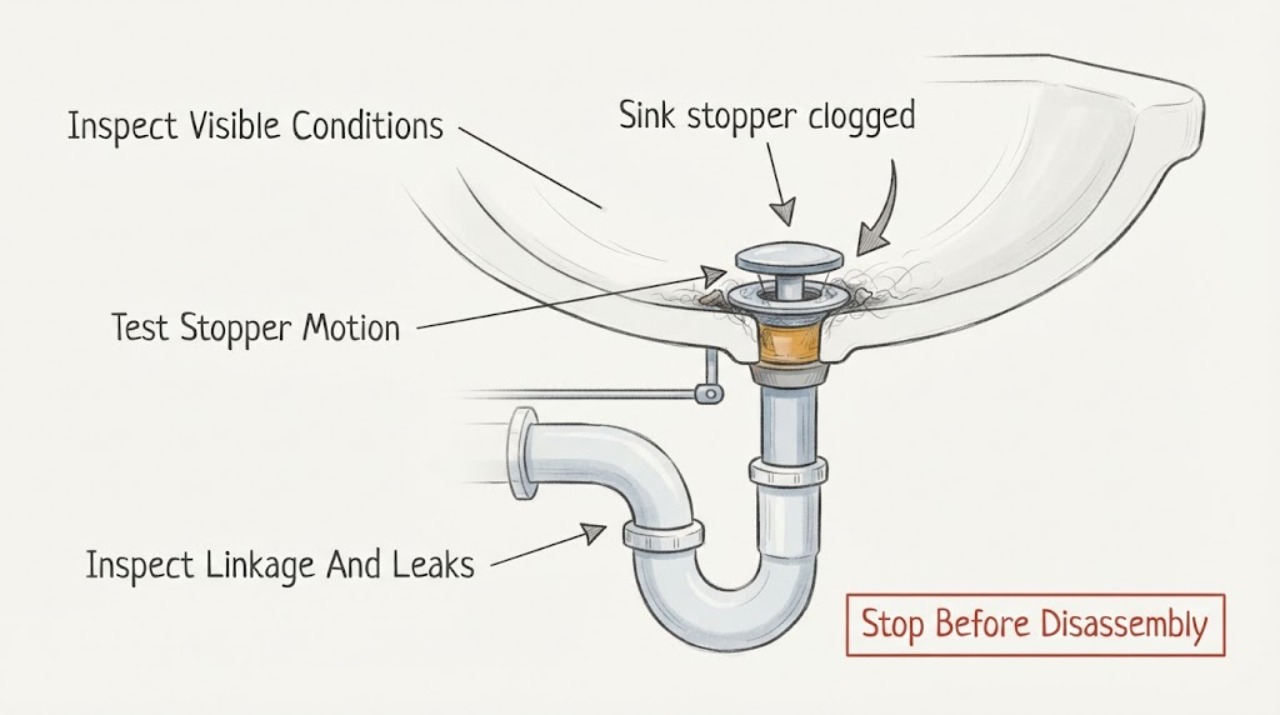
A clogged sink stopper can be caused by hair or residue around the stopper, a lift-rod or pop-up linkage that is not opening the stopper fully, or a blockage farther down the drain. First record whether the stopper moves and whether water drains slowly or not at all. Use only safe, visible checks from above and below the sink; do not force the stopper, pour aggressive chemicals into standing water, or disconnect the drain to guess at the cause. If the stopper is stuck, the linkage is detached, water leaks below the sink, or the basin remains blocked after the visible condition is addressed, arrange qualified plumbing service.
Work through in order
Diagnostic checks
Use only checks that match the exact appliance or system and its official guide.
-
Check 1
From above the sink, photograph the stopper and drain opening, then observe the water level and how quickly it changes without adding tools or chemicals.
Expected result: Note whether the stopper is fully closed, partly raised, visibly tilted, surrounded by hair or residue, or apparently clear; record whether water drains normally, slowly, or not at all.
Next step: Keep the observation and a photo for the next check; remove only loose, visible surface debris if it can be reached without forcing the stopper or pushing material into the drain.
Stop if: Stop for contaminated standing water, broken glass or sharp fragments, chemical residue, overflow, or any need to reach into an unsafe or inaccessible basin.
Why this matters
Why: Debris at the stopper or a partly closed stopper supports a local obstruction or movement problem. A fully raised stopper with a basin that still remains full makes a downstream drain blockage more likely.
-
Check 2
Operate the sink's lift rod or push mechanism gently through its normal range while watching the stopper from above; do not force a stiff control or continue cycling a jammed part.
Expected result: The stopper may rise and close fully, move only partway, fail to move, wobble, or move while the control feels disconnected.
Next step: If movement is incomplete or disconnected, record the result and consult the fixture instructions or a plumber before touching the linkage below the sink.
Stop if: Stop if the control binds, the stopper twists, the drain body moves, or normal operation produces a leak or sharp movement.
Why this matters
Why: A stopper that does not travel with the control points toward linkage, ball-rod, clip, or adjustment trouble. A stopper that moves normally but leaves the basin blocked points farther down the drain.
-
Check 3
From an ordinary standing or kneeling position, look under the sink while another person gently operates the control, if safe. Do not unthread the rod nut, pull the ball rod, loosen the trap, or remove the drain body as part of this observation.
Expected result: Look for a detached clip or rod, a linkage that does not follow the control, moisture at the drain connection, puddling, corrosion, or an area that cannot be viewed safely.
Next step: Photograph the linkage or leak and request plumbing service when the assembly is detached, wet, corroded, or inaccessible.
Stop if: Stop immediately for active leaking near electrical equipment, sewage or contaminated water, unstable cabinetry, sharp corrosion, or any need to force a fitting.
Why this matters
Why: A disconnected linkage can explain a stopper that will not open or close, while moisture below the sink indicates a separate leak risk. No visible linkage fault does not rule out a hidden obstruction or misadjustment.
-
Check 4
Identify whether the sink has a lift-rod pop-up, push-pop, or another stopper design from the visible control and the fixture documentation; record the brand, model, finish, and any safely visible dimensions.
Expected result: The stopper may have a lift rod and ball linkage, a push-to-open cap, a removable top, or an unknown design; the exact fixture information may be available or missing.
Next step: Give the design and fixture information to the manufacturer, installer, or plumber before ordering a stopper, seal, linkage, or complete drain assembly.
Stop if: Stop if identification requires removing the stopper against resistance, disconnecting plumbing, contacting contamination, or entering a confined cabinet space.
Why this matters
Why: Different drain assemblies use different stopper shapes and attachment methods. An apparent fit by diameter or finish alone does not confirm that a replacement will work with the linkage or drain body.
-
Check 5
Compare the stopper position with the drainage result after one gentle normal operation, then leave the sink in a safe state and record whether the basin clears, remains blocked, or leaks below.
Expected result: The stopper may open but the basin remains full, the basin may drain slowly and then stop, the issue may clear once and recur, or water may appear under the sink.
Next step: Use the complete observation record to request plumbing service and ask the plumber to distinguish stopper, linkage, drain, trap, and leak causes before selecting a part.
Stop if: Stop use and seek prompt service for an overflowing basin, active leak, sewage odor or backup, contaminated water, or a jammed mechanism.
Why this matters
Why: A free-moving stopper with persistent slow drainage makes a downstream obstruction more likely; recurrence or a leak means the assembly needs diagnosis rather than repeated force or chemical treatment.
Use your observations
Decision map
Find the observation that best matches what you see, then follow the next safe action.
-
PATH 01Next step
What you see
The lift rod or push control moves, but the stopper stays closed, rises only partway, or appears disconnected from the linkage.
Do this next
Follow the exact fixture instructions or arrange a plumber to inspect the linkage; do not force the rod or pull the ball rod without confirming the assembly.
Why this path and its safety boundary
Why it matters: A linkage, clip, ball-rod, or adjustment issue is more likely than a blockage at the open drain alone.
-
PATH 02Next step
What you see
The stopper moves normally or is partly raised, but hair or residue is visibly collected around the drain opening and water drains slowly.
Do this next
Remove only loose surface debris that is safely reachable without tools or force; arrange service if flow remains restricted or the stopper must be removed.
Why this path and its safety boundary
Why it matters: A local obstruction at the stopper is plausible, but material may also extend into the drain body.
-
PATH 03Next step
What you see
The stopper opens fully and the opening looks clear, but the basin remains full or drains slowly.
Do this next
Stop repeated testing and ask a plumber to assess the drain path; do not pour aggressive chemicals into standing water or dismantle a contaminated trap.
Why this path and its safety boundary
Why it matters: The restriction is more likely farther down the drain or trap than in the stopper mechanism.
-
PATH 04Next step
What you see
Water is leaking under the sink, the basin is overflowing or backing up, the water is contaminated, the mechanism is sharp or jammed, or access is unsafe.
Do this next
Stop using the sink, keep people away from the affected water, and arrange prompt qualified plumbing service; seek emergency help when the area creates immediate danger.
Why this path and its safety boundary
Why it matters: The problem has crossed from a stopper observation into a leak, sanitation, or injury risk.
Helpful context
Understand the symptom
A stopper problem can be mechanical or hydraulic
A sink stopper sits in the drain opening, but the symptom does not identify the blockage location. Hair or residue can collect around the stopper, a lift-rod linkage can leave it partly closed, or water can be held up farther down the drain. Separate what the stopper does from how the basin drains before choosing a repair.
Know which stopper you have
Common bathroom sink designs include lift-rod pop-up drains and push-pop drains, and their parts are not interchangeable by appearance alone. Manufacturer guidance notes that drain designs vary and that a replacement stopper should be matched by the drain design, body material, dimensions, and finish information.
Keep the diagnostic boundary narrow
The safe first pass is visual: watch the stopper, observe the lift rod or push mechanism, look for accessible debris, and check for leaks below the sink. If the next step requires removing a ball rod, nut, drain body, trap, or contaminated water, follow the exact fixture instructions or call a plumber rather than forcing the assembly.
Safety boundary
Stop conditions
- Do not force a stuck stopper, lift rod, ball rod, nut, drain body, or trap.
- Do not pour aggressive chemical cleaner into standing water or mix drain chemicals while the cause is unknown.
- Stop for active leaking, overflow, sewage backup or odor, contaminated water, sharp fragments, unstable cabinetry, or water near electrical equipment.
- Keep the sink out of use and arrange qualified plumbing service when the blockage persists, recurs, or requires concealed or contaminated work.
Only after diagnosis
Potential parts
- matching sink stopper
Consider this category only after the stopper is confirmed damaged or missing and the drain design and dimensions are identified.
Match the drain type, body material, dimensions, finish, overflow configuration, and linkage attachment; appearance alone is not enough. - pop-up linkage clip or ball rod
This category is relevant only when the lift-rod observation and fixture instructions identify a detached or damaged linkage component.
Confirm the exact faucet and drain assembly before selecting a clip, rod, nut, or replacement linkage. - stopper seal or drain assembly
Consider a seal or complete assembly only when inspection confirms a worn, damaged, incompatible, or unserviceable stopper or drain body.
Verify model, dimensions, overflow arrangement, materials, and installation instructions; do not substitute a generic seal into an unknown drain.
When checks do not resolve it
Need a professional?
Arrange qualified plumbing service when the stopper will not move, the linkage is detached, the sink remains blocked after safe visible debris removal, water leaks below the sink, the issue recurs, or the drain design or replacement part is unknown. Call promptly for overflow, sewage backup or odor, contaminated water, sharp damage, or water near electrical equipment.
Common questions
FAQ
Is a clogged sink stopper always caused by hair or debris?
No. The stopper may be partly closed because its lift-rod linkage is disconnected or misadjusted, or the restriction may be farther down the drain. Check stopper movement separately from the basin's drainage result.
Why does the sink stay clogged even though the stopper rises?
If the stopper opens fully and the drain opening looks clear, the restriction may be in the drain body or farther downstream. Do not keep forcing the mechanism or add aggressive chemicals to standing water; arrange plumbing assessment if flow stays restricted.
Can I remove the sink stopper to clean it?
Some pop-up designs can be removed through the ball-rod and nut, but designs vary. Read the exact fixture instructions first, and stop if the part resists, the water is contaminated, or removal would disturb a leak-prone connection.
How do I buy a replacement sink stopper?
Identify the drain design, body material, dimensions, finish, overflow arrangement, and linkage style before ordering. A stopper that looks similar may not fit the drain body or connect to the lift mechanism.
When should I stop checking a clogged sink stopper?
Stop for active leaking, overflow, sewage backup or odor, contaminated water, sharp fragments, a jammed mechanism, unstable cabinetry, water near electrical equipment, or any step that requires forcing or dismantling the drain.
Read the exact guide
Official sources
- Adjusting Pop-Up DrainsKohler Assist · Kohler pop-up drain guidance; other drain designs may differ and require their own instructions.
- Identify the Correct Bathroom Sink StopperKohler Assist · Kohler stopper identification examples; they illustrate why fixture-specific matching is needed and do not establish compatibility with another brand.
- Home MaintenanceU.S. Environmental Protection Agency, WaterSense · General household plumbing maintenance guidance; it does not diagnose a specific stopper or drain assembly.
Community feedback
Share a repair observation
Share a plain-text repair observation. Accepted observations are published automatically; this page may take a moment to update.