
On this page
Start here
Quick answer
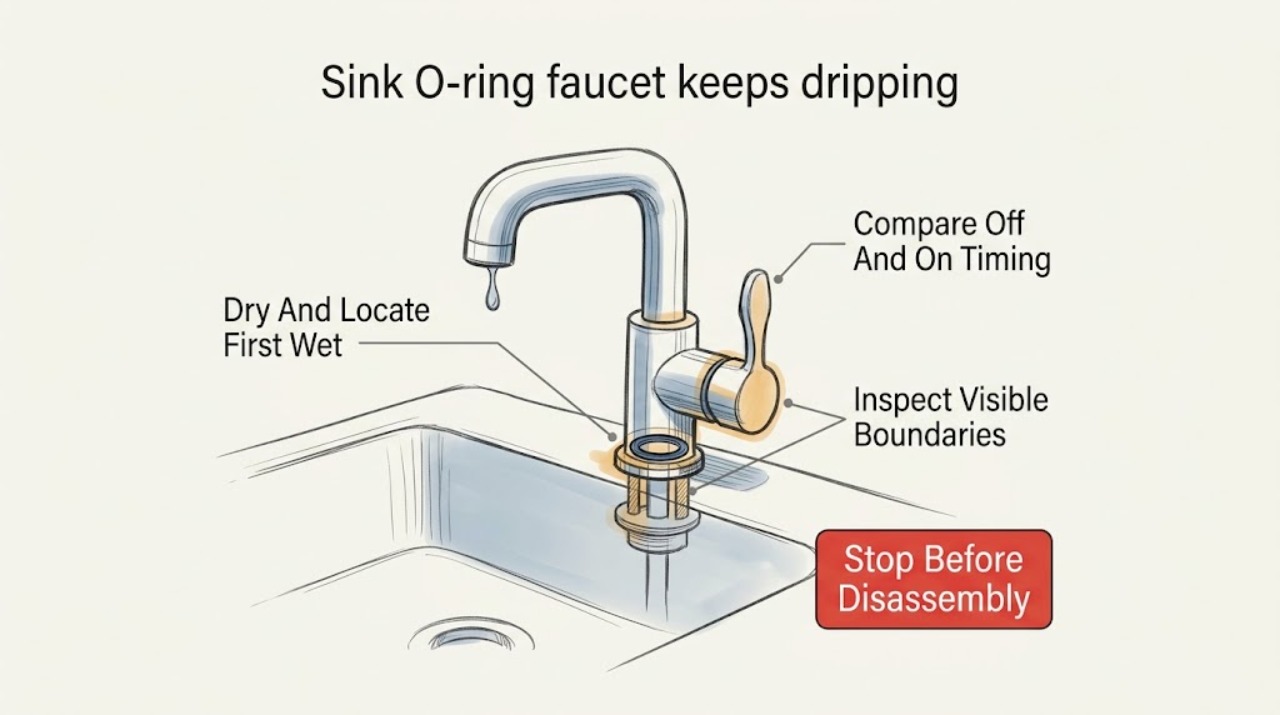
An American Standard sink faucet that keeps dripping is not automatically an O-ring problem. First dry the faucet and identify whether water comes from the spout outlet with the handles off, from the rotating spout base or handle area, or from a supply connection below the sink. An O-ring or spout seal is more plausible when the leak is at a moving spout or handle boundary; a drip from the outlet after shutoff more often points toward a cartridge, valve seat, or valve-stem seal. American Standard lists different model-specific O-rings and spout seal kits, so do not choose a seal by appearance or assume a handle O-ring fits a spout. Keep the cabinet dry, avoid forcing corroded shutoff valves, and do not disassemble a pressurized faucet. If water is continuous, reaches the cabinet or floor, comes from a supply connection, or the model and isolation method are unclear, stop and call a qualified plumber.
Work through in order
Diagnostic checks
Use only checks that match the exact appliance or system and its official guide.
-
Check 1
Close both faucet handles normally, wipe the spout outlet, handle bases, spout base, faucet deck, and the visible area under the sink completely dry, then place a dry towel below the faucet without touching supply connections.
Expected result: Note where water appears first: at the spout tip, around a handle, around a swiveling spout base, at the faucet deck, at a supply connection, or nowhere after the faucet is off.
Next step: Photograph the first wet point and continue only with the matching branch. Keep the faucet off for a supply leak or a drip that continues without use.
Stop if: Stop for active spray, a rapidly spreading leak, water near electrical equipment, a wet cabinet base, or any need to touch a pressurized connection.
Why this matters
Why: The first wet point identifies the likely sealing boundary. A tip drip points toward an internal valve or cartridge path; a moving base or handle leak makes an O-ring or seal more plausible; a supply-side wet spot is not an O-ring diagnosis.
-
Check 2
From outside the wet area, observe the faucet during ordinary use and again after both handles are closed. Do not deliberately flex the spout, force a handle, or run water longer than needed to see the symptom.
Expected result: The leak appears only while water is flowing, follows a swiveling spout or handle, drips from the outlet after shutoff, or continues below the deck after the faucet is off.
Next step: Use the timing pattern with the location from the first check; stop use and arrange service for a continuing or supply-side leak rather than repeating the test.
Stop if: Stop if the faucet handle becomes hard to turn, water volume increases, the spout or body moves at its mount, or a connection begins to spray.
Why this matters
Why: Use-dependent water at a moving joint supports an external seal or O-ring check. An outlet drip after shutoff suggests the valve or cartridge is not closing fully. A continuing under-deck leak suggests a supply, mounting, or body connection that an O-ring replacement may not address.
-
Check 3
With the faucet dry and assembled, use a flashlight to inspect the visible handle base, spout base, escutcheon, deck contact, and faucet body for a displaced edge, mineral buildup, cracking, corrosion, or a gap. Do not pry out a seal or scrape the finish.
Expected result: A rubber edge or seal is visibly pinched, split, hardened, displaced, or missing; the spout or handle rocks; or the visible boundaries look intact while the outlet still drips.
Next step: Record the faucet family and the visible condition. Use the exact repair-parts diagram or arrange a plumber; do not apply caulk or substitute a generic O-ring over an unresolved leak.
Stop if: Stop if the faucet is cracked, the deck is soft or swollen, the seal is inaccessible without disassembly, or inspection would require loosening a handle, retaining clip, cartridge, or spout.
Why this matters
Why: A visible defect at the same boundary where water first appears supports a model-specific O-ring or spout-seal diagnosis. Movement or corrosion can prevent a new seal from seating. An intact exterior with an outlet drip makes an internal valve or cartridge issue more likely.
-
Check 4
From a dry, stable position under the sink, inspect the faucet mounting area, hot and cold supply hoses, shutoff valves, and the underside of the deck without moving or disconnecting anything.
Expected result: The towel remains dry, or water appears at a supply hose, valve, mounting nut, faucet body, or deck opening while the faucet is off.
Next step: For any under-sink leak, keep the faucet off and call a plumber. If everything remains dry, use the above-deck timing and model check rather than tightening random nuts.
Stop if: Stop for corrosion, a seized shutoff, wet wiring, a hose bulge, active dripping, or any need to use a wrench on the supply or mounting hardware.
Why this matters
Why: A supply, valve, mounting, or body leak is outside the narrow O-ring diagnosis. A dry underside does not rule out a seal at the spout or handle, but it makes the leak location above the deck more likely when paired with the first-wet-point check.
-
Check 5
Record the American Standard faucet name or model number from visible documentation, the faucet body, or the original installation information. Compare it with the manufacturer's repair-parts information and determine whether the listed O-ring is for a handle, a spout, a mounting boundary, or another location.
Expected result: The model-specific parts information names a matching O-ring or spout seal kit, or the model is unknown and several similar faucet families are possible.
Next step: Save the model and diagram information for a manufacturer-directed repair or plumber. If the procedure requires removing the cartridge or spout, perform it only when water isolation is known and the exact instructions apply; otherwise stop.
Stop if: Stop if identifying the model would require removing trim, forcing a handle, opening a wall, or operating a shutoff that is stuck or not clearly associated with the faucet.
Why this matters
Why: A matching diagram can connect the observed leak boundary to the correct seal category and installation procedure. An unknown model means dimensions and placement are unverified; a generic O-ring is not a safe compatibility assumption.
-
Check 6
Prepare a service note with the faucet model, handle style, whether the spout swivels, the first wet point, the timing relative to handle shutoff, photos of the visible seal boundary, and any cabinet or countertop damage. Keep the faucet off while waiting when the drip is continuous.
Expected result: The note clearly separates an outlet drip, moving-joint leak, deck or mounting leak, and supply-side leak, and records whether the accessible shutoffs are known and move normally.
Next step: Give the note and photos to a qualified plumber or American Standard support. Treat a continuous leak or any building-material damage as a prompt service issue.
Stop if: Do not resume use just to collect more evidence, and do not tighten, cut, glue, or seal over a leak whose source is not confirmed.
Why this matters
Why: This information helps a plumber choose between a cartridge or valve repair, a model-specific O-ring or spout seal, and a supply or mounting repair without repeating risky disassembly.
Use your observations
Decision map
Find the observation that best matches what you see, then follow the next safe action.
-
PATH 01Next step
What you see
Water first appears around the rotating spout base or handle while the faucet is being used, the outlet does not continue dripping after shutoff, and the underside of the sink stays dry.
Do this next
Confirm the exact faucet model and seal location in the American Standard repair-parts information. Use the manufacturer's procedure or a plumber; do not pry out the seal, force the spout, or use a generic ring.
-
PATH 02Next step
What you see
The faucet body and deck are dry, but water keeps forming at the spout outlet after both handles are closed.
Do this next
Stop unnecessary use, record whether one handle or both affect the drip, and arrange faucet service for the model-specific valve or cartridge. Do not replace an external O-ring without confirming the source.
-
PATH 03Next step
What you see
Water first appears under the sink at a supply hose, shutoff valve, mounting area, faucet body, or deck opening, including when the handles are off.
Do this next
Keep the faucet off and call a qualified plumber. If a clearly identified accessible stop can be closed without force or hazard, follow the property's safe water-isolation procedure; do not force a seized valve or disconnect a wet line.
-
PATH 04Next step
What you see
The leak starts or worsens when a swivel spout moves, the surrounding deck is wet, and the spout feels stiff, loose, or uneven.
Do this next
Stop swiveling the spout, dry the deck, photograph the movement and leak path, and use the exact model repair guidance or plumbing service. Do not add lubricant, caulk, or force to the joint unless the model instructions explicitly allow it.
-
PATH 05Next step
What you see
The model is unknown, the O-ring cannot be seen, the faucet has corrosion or a cracked body, or accessing the seal would require removing a cartridge, spout, retaining part, or supply connection.
Do this next
Leave the faucet assembled, keep it off if the leak is continuous, and provide model details and photos to qualified plumbing service or American Standard support for a model-specific procedure.
Helpful context
Understand the symptom
An O-ring leak and an outlet drip are different symptoms
An O-ring seals a boundary such as a handle or a swivel spout, so water at that boundary can wet the faucet body or the deck while the faucet is running or while the spout moves. Water that continues to form at the spout outlet after both handles are closed is a different path and may involve the cartridge, valve, or seat rather than an external O-ring. Water below the sink can also come from a supply hose, mounting area, or body connection. Find the first wet location before treating the word O-ring as a diagnosis.
American Standard parts are not interchangeable by appearance
The official American Standard parts pages identify separate O-rings and spout seal kits for named faucet families, and the support page directs users to FAQs and product information for technical questions. A similar-looking rubber ring may have a different diameter, cross-section, location, or installation sequence. Record the faucet model and use its repair-parts diagram; if the model cannot be confirmed, leave the faucet assembled and have a plumber or manufacturer support identify the correct seal.
Water isolation is the boundary before disassembly
American Standard's spout-seal guide starts by turning off the water before removing the handle, cartridge, and spout. That is model-specific repair guidance, not permission to remove parts from an unknown faucet. If the hot and cold stops are accessible, clearly labeled, and turn normally without force, a plumber can use them as part of a controlled repair. Do not force a seized valve, disconnect a wet supply line, or work where a leak could spray into the cabinet or onto electrical equipment.
Safety boundary
Stop conditions
- Stop using the faucet for a continuous stream, an enlarging leak, water in the cabinet or floor, a wet countertop or wall, or any leak near electrical equipment.
- Do not force hot or cold shutoff valves, disconnect supply hoses, remove a cartridge or spout under pressure, or work on a wet connection as an improvised diagnostic.
- Do not pry, scrape, glue, caulk, lubricate, or substitute a generic O-ring before the leak boundary and exact faucet model are confirmed.
- Stop and call a qualified plumber when the faucet body or deck is cracked, the spout or handle is loose, corrosion prevents access, the source is under the sink, or water isolation is not clearly understood.
Only after diagnosis
Potential parts
- handle O-ring
Only consider this category when water begins at the handle boundary during use, the outlet is not the source, and the exact model's parts information places an O-ring at that handle.
Confirm the faucet model, handle assembly, seal location, and dimensions from American Standard information; an O-ring listed for one handle or series is not proof of fit elsewhere. - swivel spout seal kit
Consider this only when the leak begins around a moving spout base and a model-specific diagram identifies a spout seal or O-ring there.
Match the exact faucet family and spout design. A model-specific seal kit may contain more than one seal, and it does not address a cartridge, supply, or mounting leak. - cartridge or valve sealing component
This category applies when water continues from the spout outlet after shutoff or a plumber confirms that the internal closing valve is the source rather than an external O-ring.
Verify the faucet model, valve type, handle arrangement, and manufacturer repair information before selecting a cartridge or seal; do not infer fit from the exterior finish. - supply hose or mounting seal
A plumber may consider this category when the first wet point is beneath the sink at a supply connection, mounting boundary, or faucet-body connection.
Confirm the installed faucet, hose ends, shutoff connection, deck thickness, and sealing arrangement. This is not a substitute for identifying a continuous internal drip.
When checks do not resolve it
Need a professional?
Call a qualified plumber promptly when water appears below the faucet, at a supply connection, from a cracked or moving body, or continues after shutoff. Call when the shutoff valves are seized or unclear, the model is unknown, or repair would require removing a cartridge or spout. For a slow leak isolated to a confirmed moving-spout or handle boundary, American Standard support or a plumber can identify the model-specific O-ring or seal procedure; keep the area dry and limit use until then.
Have this ready
- American Standard faucet name or model number if known
- Handle style and whether the spout swivels
- First wet point and whether the leak continues after shutoff
- Photos of the spout base, handle base, deck, and dry under-sink area
- Whether an accessible hot and cold shutoff is clearly identified and moves normally
- Any corrosion, cracked finish, loose mount, cabinet damage, or recent installation work
Common questions
FAQ
Does a dripping American Standard faucet always need a new O-ring?
No. A leak at a moving spout or handle boundary can involve an O-ring or spout seal, but water dripping from the outlet after shutoff more often points to the cartridge or valve, and water below the sink points to a supply or mounting path. Find the first wet point before choosing a part.
How do I tell whether the O-ring is at the handle or the spout?
Dry the faucet and observe where water first appears while the faucet is used. A handle-base leak follows the handle boundary; a swivel-spout leak follows the spout base and often changes when the spout moves. Use the exact American Standard model diagram because the same-looking faucet may use a different seal arrangement.
Why does water keep dripping from the spout after I turn the handles off?
Water remaining in the spout can make a short-lived drip, but a continuing or recurring outlet drip is more consistent with an internal cartridge, valve, or seat that is not closing fully than with an external O-ring. Arrange model-specific service if it does not stop after the trapped water drains.
Can I pull the spout off and replace the O-ring myself?
Only a model-specific procedure with understood water isolation should guide that repair. American Standard's spout-seal guide starts by turning off water and removing the handle and cartridge, so do not attempt it on an unknown or pressurized faucet, with seized shutoffs, or when water is already escaping below the sink.
Can I use any rubber O-ring that looks the same?
No. American Standard lists separate O-rings and seal kits for particular faucet parts and families. Confirm the model, location, dimensions, and approved procedure; a close-looking ring can leak, bind the spout, or leave the actual source unrepaired.
When is a dripping sink faucet urgent?
Treat it as urgent when the leak is a stream, continues with the faucet off, reaches the cabinet or floor, comes from a supply connection, or is near electrical equipment. Stop using it and call a qualified plumber rather than forcing a shutoff or continuing disassembly.
Read the exact guide
Official sources
- Parts StoreAmerican Standard · American Standard technical support, parts categories, and model-oriented repair resources
- Faucet Swing Spout Seal KitAmerican Standard · American Standard swing-spout seal kit and named faucet-series applicability
- How to Replace the Spout Seal Kit for Your Reliant FaucetAmerican Standard · American Standard model-specific spout seal replacement sequence and water shutoff boundary
- SupportAmerican Standard · American Standard consumer support and product information for troubleshooting and parts questions
- 9 x 1.5-mm O-Ring for HandleAmerican Standard · American Standard handle O-ring repair-part category
Community feedback
Share a repair observation
Share a plain-text repair observation. Accepted observations are published automatically; this page may take a moment to update.