
On this page
Start here
Quick answer
A Delta sink faucet that keeps dripping with the handle off may have a worn or contaminated cartridge, but the drip location and faucet design matter before choosing a part. First distinguish a short-lived drop of retained water from a continuous drip, then classify whether water comes from the spout, around the handle or base, or underneath the sink. Delta's parts guidance lists single-handle cartridges for drips from the spout, base, or under the handle, while two-handle faucets can use a different stem, seat, and spring arrangement. Identify the exact model before any repair, shut off the accessible supply valves before disturbing a water connection, and arrange qualified plumbing service when the leak is under the counter, the valve is concealed, the faucet is touch- or electronic-controlled, or the correct cartridge is uncertain.
Before you begin
Safety first
- This article is limited to safe leak classification, model identification, visible inspection, and isolation of an accessible supply. A qualified professional should handle cartridge or stem removal, pressurized disassembly, concealed plumbing, and wet electrical or electronic-faucet conditions.
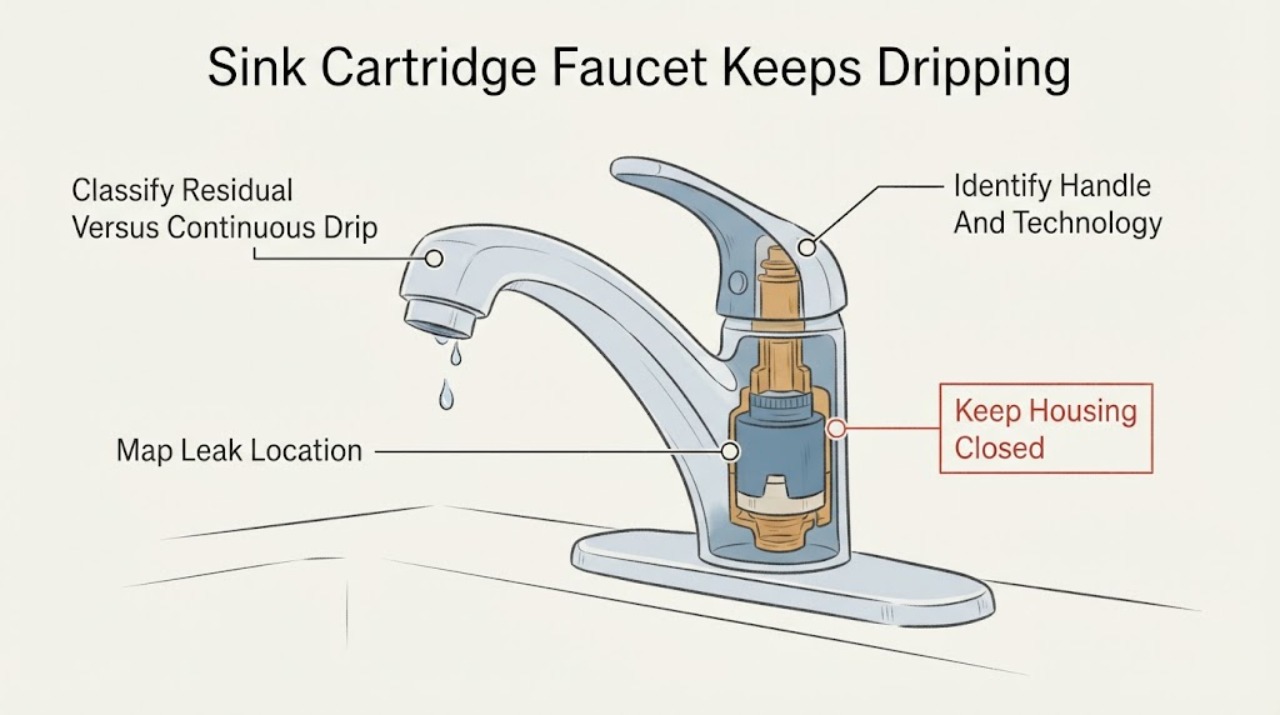
Work through in order
Diagnostic checks
Use only checks that match the exact appliance or system and its official guide.
-
Check 1
With the faucet handle or handles fully off, watch the spout from a safe position long enough to distinguish a few retained drops from a drip that continues; do not place fingers under unknown-temperature water.
Expected result: The drops stop quickly, continue at a regular interval, become a thin stream, or water appears somewhere other than the spout.
Next step: Record the duration and location. Arrange prompt service for a continuous stream, a leak reaching the cabinet or wall, or any faucet that cannot shut off; otherwise continue with model and location checks.
Stop if: Stop using the faucet if the leak can damage cabinetry or flooring, or if the handle cannot control the flow safely.
Why this matters
Why: A short-lived drop can be retained water, while a continuous drip with the control off indicates that a valve-closing part, cartridge, stem, seat, or debris condition needs investigation. A leak elsewhere is not automatically a cartridge fault.
-
Check 2
Dry the accessible faucet, countertop, and cabinet area, then operate the faucet normally for a brief observation while watching the first place that becomes wet: spout outlet, handle, faucet base, hose connection, supply connection, or cabinet surface.
Expected result: Water begins at the spout with the handle off, around the handle or base only while open, at a visible hose or supply connection, or from an area that cannot be seen.
Next step: Photograph the first wet point and close the local supply valves if a connection leak is active. Give the location and timing to a plumber or use the exact Delta model documentation before selecting a part.
Stop if: Do not reach into a wet cabinet near electrical equipment, loosen fittings, or continue operating a leak that is spreading.
Why this matters
Why: Delta's parts guidance associates single-handle cartridge categories with drips from the spout, base, or under the handle, but a base or under-counter leak can also be a seal, hose, connection, or installation issue. An unseen wet point requires service rather than more testing.
-
Check 3
From outside the faucet, record whether the sink faucet has one handle or two, whether it uses touch or electronic features, and any visible Delta model marking; photograph the underside or packaging only if it can be done without disconnecting anything.
Expected result: The faucet is a single-handle cartridge design, a two-handle stem or seat-and-spring design, a touch or electronic model, or an unidentified arrangement.
Next step: Use the model identity with Delta's product and parts documentation, or supply the photos to a qualified plumber. Do not order a cartridge solely because it is labeled Delta or resembles the installed part.
Stop if: Stop if identification requires removing the handle, bonnet, escutcheon, electronics, hoses, or concealed valve parts.
Why this matters
Why: Delta provides different leak paths and parts by handle and technology family. A known single-handle faucet keeps a cartridge in consideration; a two-handle or electronic design may need different service parts and procedures. An unknown design is a compatibility uncertainty.
-
Check 4
With the faucet off, inspect only visible supply valves, braided hoses, Quick-Snap connections if present, and the underside of the faucet for water trails; if a supply leak is active, close the accessible valves without forcing them.
Expected result: The connections stay dry while the spout drips, a hose or connection becomes wet, the faucet base leaks onto the counter, or the shutoff valve will not close.
Next step: Leave the local supply closed for an active under-counter leak and arrange plumbing service. If connections are dry, continue only with model identification; do not remove the cartridge as a diagnostic shortcut.
Stop if: Do not overtighten, disconnect, or wrench a stuck valve or fitting, and do not work in a wet cabinet near electrical equipment.
Why this matters
Why: A dry connection with a continuing spout drip keeps the faucet's internal closing parts in consideration. A wet hose, connection, or base shifts attention toward seals, fittings, or installation. Delta warns not to overtighten connections, and a shutoff that will not close increases water-damage risk.
-
Check 5
If the drip is only a short-lived residual drop or the stream is uneven, inspect the visible aerator and spout outlet for scale or debris after the faucet is off; clean only by the exact Delta care instructions and do not use a blockage as a reason to force the valve.
Expected result: The outlet is visibly obstructed, the stream is normal but the drip continues with the handle off, or the aerator cannot be removed without force.
Next step: Restore the outlet only as the model instructions permit and reassess the drip. Arrange service when the drip continues, the aerator is damaged, or cleaning would require force or disassembly.
Stop if: Do not poke deeply into the valve, use harsh chemicals, scratch sealing surfaces, or force the aerator or spout apart.
Why this matters
Why: An aerator can affect the stream but does not usually explain a continuous leak past a closed valve. A normal stream with an ongoing drip keeps the cartridge, seats, stem, seals, or valve body in consideration; forced removal can create a second leak.
-
Check 6
Use the exact Delta model number and the leak location to read its parts diagram or maintenance guidance; compare the documented component category without removing the installed cartridge or substituting a visually similar part.
Expected result: The documentation identifies a compatible cartridge or another closing assembly for the model, identifies a two-handle seat-and-spring or stem path, or does not identify the faucet confidently.
Next step: Give the model, photos, drip location, and documentation result to a qualified plumber or Delta support. Isolate the water before any professional disassembly and retain the original parts for fit verification.
Stop if: Do not pull a cartridge, remove a retaining nut, disconnect a hose, or reassemble pressurized plumbing unless the exact instructions and your skill level make the work safe; use professional service when uncertain.
Why this matters
Why: A documented model path makes the corresponding repair category plausible, but it does not prove that replacing a part will fix a damaged valve body, debris, seal, or connection. No confident match means the cartridge identity and fit remain unresolved.
Use your observations
Decision map
Find the observation that best matches what you see, then follow the next safe action.
-
PATH 01Safety boundary
What you see
A single-handle Delta sink faucet drips continuously from the spout with the handle fully off, while visible supply connections remain dry.
Do this next
Use the exact model documentation and arrange qualified service or a model-confirmed cartridge repair. Isolate the supply before disassembly and do not choose a part by appearance.
Why this path and its safety boundary
Why it matters: The cartridge or its sealing surfaces becomes a leading repair category, but debris, valve-body damage, model mismatch, and installation conditions still need confirmation.
Safety stop: Stop use if the drip becomes a stream or water reaches the cabinet, wall, or floor.
-
PATH 02Safety boundary
What you see
The faucet has two handles and the drip continues from the spout after one or both controls are closed.
Do this next
Identify whether the hot or cold side correlates with the drip and use the exact model instructions or a plumber for the correct closing assembly.
Why this path and its safety boundary
Why it matters: Delta's two-handle guidance points to seats, springs, and stem assemblies for that design rather than assuming a single-handle cartridge path.
Safety stop: Do not force a handle or use a single-handle cartridge in a two-handle valve.
-
PATH 03Safety boundary
What you see
Water appears at the faucet base, hose, supply connection, or inside the cabinet rather than only at the spout.
Do this next
Close accessible local supplies, dry and photograph the first wet point, and arrange plumbing service. Do not over-tighten or disconnect fittings as a test.
Why this path and its safety boundary
Why it matters: A seal, hose, connection, mounting, or installation issue is more likely than a spout-closing cartridge alone; an under-counter leak can cause hidden water damage.
Safety stop: Stop operating the faucet when water is spreading, the shutoff will not close, or wetness is near electrical equipment.
-
PATH 04Safety boundary
What you see
Only a brief drop remains after closing or the stream is uneven and visible outlet debris is present, with no continuing leak at the base or cabinet.
Do this next
Follow the exact model care instructions for the visible outlet and observe whether the drops stop. Escalate if dripping continues, the outlet is damaged, or cleaning needs force.
Why this path and its safety boundary
Why it matters: Retained water or an outlet obstruction is more plausible than an established cartridge failure, but a drip that continues should be reclassified rather than ignored.
Safety stop: Do not enlarge the outlet, scratch sealing surfaces, or use harsh chemicals.
-
PATH 05Safety boundary
What you see
The faucet model, handle technology, or cartridge identity cannot be confirmed, or the faucet has touch electronics or concealed plumbing.
Do this next
Leave the faucet intact, close the local supply if needed, and provide photos and markings to a qualified plumber or Delta support for identification.
Why this path and its safety boundary
Why it matters: Part fit and repair procedure are unresolved; a generic cartridge or disassembly can create a leak or damage electronic controls.
Safety stop: Do not order by visual similarity or open the faucet body to discover its design.
Helpful context
Understand the symptom
A drip is a symptom, not a universal cartridge diagnosis
A few drops immediately after closing can be water retained in the spout or aerator. A drip that continues with the control fully off is different. Water from the spout points toward the valve's closing parts, while water around the handle, faucet base, hose, or supply connection can indicate a seal or connection problem. Delta's parts tool separates single-handle cartridges from two-handle cartridges and other leak parts, so the faucet style and model must be established first.
Single-handle and two-handle Delta faucets are not interchangeable
Delta's two-handle lavatory guidance describes seats, springs, and stem assemblies for that design. Delta also lists single-handle cartridge categories for drips from the spout, base, or under the handle, including distinct technology families. That is why a cartridge that looks similar, or a part that works on one Delta faucet, is not evidence of fit for another faucet.
Keep water damage and pressurized disassembly out of the first check
Use a dry towel and a flashlight to locate the first wet point from a safe position. If water is collecting in the cabinet, protect stored items and close the local supply valves if they are clearly accessible and labeled. Do not loosen a bonnet, pull a cartridge, or disconnect a hose while the line is pressurized, and do not continue using a leak that can reach the counter, cabinet, wall, or floor.
Safety boundary
Stop conditions
- Close the accessible local water supplies and stop using the faucet for a stream, a leak into the cabinet, wall, or floor, or a shutoff that will not close.
- Do not disconnect hoses, pull a cartridge, remove a retaining nut, or open pressurized plumbing as a casual diagnostic test.
- Do not force handles, aerators, fittings, or shutoff valves, and do not overtighten a connection to stop a leak.
- Do not choose a Delta cartridge by brand or appearance alone; verify the exact model, handle design, and technology family first.
- Stop work near wet electrical equipment, touch or electronic faucet controls, concealed valves, or any condition that exceeds ordinary safe access.
Only after diagnosis
Potential parts
- Delta-compatible faucet cartridge
Consider this category only when a single-handle Delta faucet has a continuous spout or handle drip, the exact model is confirmed, and qualified diagnosis supports a cartridge-related leak.
Confirm exact model, handle technology, cartridge family, revision, and manufacturer's fit information; do not substitute a visually similar cartridge. - faucet stem, seat, and spring assembly
Consider this category only for a model-specific two-handle Delta design when the drip pattern points to the closing assembly rather than a supply or base connection.
Confirm the exact faucet model and documented assembly; do not apply two-handle parts to a single-handle cartridge faucet. - faucet seal or O-ring
Consider this category only when inspection or qualified diagnosis locates the leak at the handle, base, spout hub, or connection and identifies a damaged or displaced seal.
Confirm the exact location, dimensions, material, and model fit; do not stop a connection leak by overtightening or adding unapproved sealant.
When checks do not resolve it
Need a professional?
Arrange qualified plumbing service when a Delta sink faucet continues dripping with the control off, the leak is at the base or under the counter, the model or cartridge is uncertain, a shutoff will not close, or a repair requires cartridge or stem removal. Seek prompt service when water is spreading into cabinetry or building materials, and isolate the supply before the leak worsens.
Safety scope: This article is limited to safe leak classification, model identification, visible inspection, and isolation of an accessible supply. A qualified professional should handle cartridge or stem removal, pressurized disassembly, concealed plumbing, and wet electrical or electronic-faucet conditions.
Common questions
FAQ
Does a Delta sink faucet that drips with the handle off always need a cartridge?
No. A continuous spout drip can involve a cartridge or another closing assembly, but a base, hose, supply, or cabinet leak may be a seal or connection problem. Identify the leak location, handle design, and exact model before choosing a part.
Why does my Delta faucet drip from the spout after I turn it off?
A brief drop can be retained water, but a continuing drip means the valve is not fully stopping flow or another leak is being misidentified. Delta lists different repair paths for single-handle cartridges and two-handle seats, springs, and stems.
Can I use any Delta cartridge in my sink faucet?
No. Delta's parts guidance separates cartridges by handle and technology family. Use the exact model and parts diagram; a part that fits another Delta faucet may not fit yours.
What should I do if my Delta faucet is leaking under the sink?
Close the accessible local supply valves if they operate normally, protect the cabinet, dry and photograph the first wet point, and arrange plumbing service. Do not over-tighten or disconnect a wet connection as a test.
When should I stop trying to fix the dripping faucet myself?
Stop for a stream, spreading cabinet or wall water, a shutoff that will not close, wet electrical equipment, electronic faucet controls, concealed plumbing, damaged parts, or an uncertain model. Keep the supply isolated when safe and use qualified service.
Read the exact guide
Official sources
- My two-handle widespread lavatory faucet is dripping underneath the counter. How can I fix it?Delta Faucet · Official Delta guidance for a widespread lavatory faucet leaking under the counter; used for separating connection or installation leaks from a spout cartridge symptom.
- Find Parts and Identify Your ProductDelta Faucet · Official Delta Faucet parts and identification tool; used to distinguish single-handle and two-handle leak parts and to require model confirmation before part selection.
- Cartridge - DIAMOND™ Valve - 1HDelta Faucet · Official Delta product page for one specific single-handle cartridge family; used only to show why a cartridge's valve technology, model identity, and documentation matter, not as a generic fit claim.
- What do I do about water dripping from the spout of my two-handle lavatory faucet?Delta Faucet · Official Delta guidance for a two-handle lavatory faucet; used to distinguish the two-handle repair path from a single-handle cartridge and to frame replacement as model/design dependent.
Community feedback
Share a repair observation
Share a plain-text repair observation. Accepted observations are published automatically; this page may take a moment to update.