
On this page
Start here
Quick answer
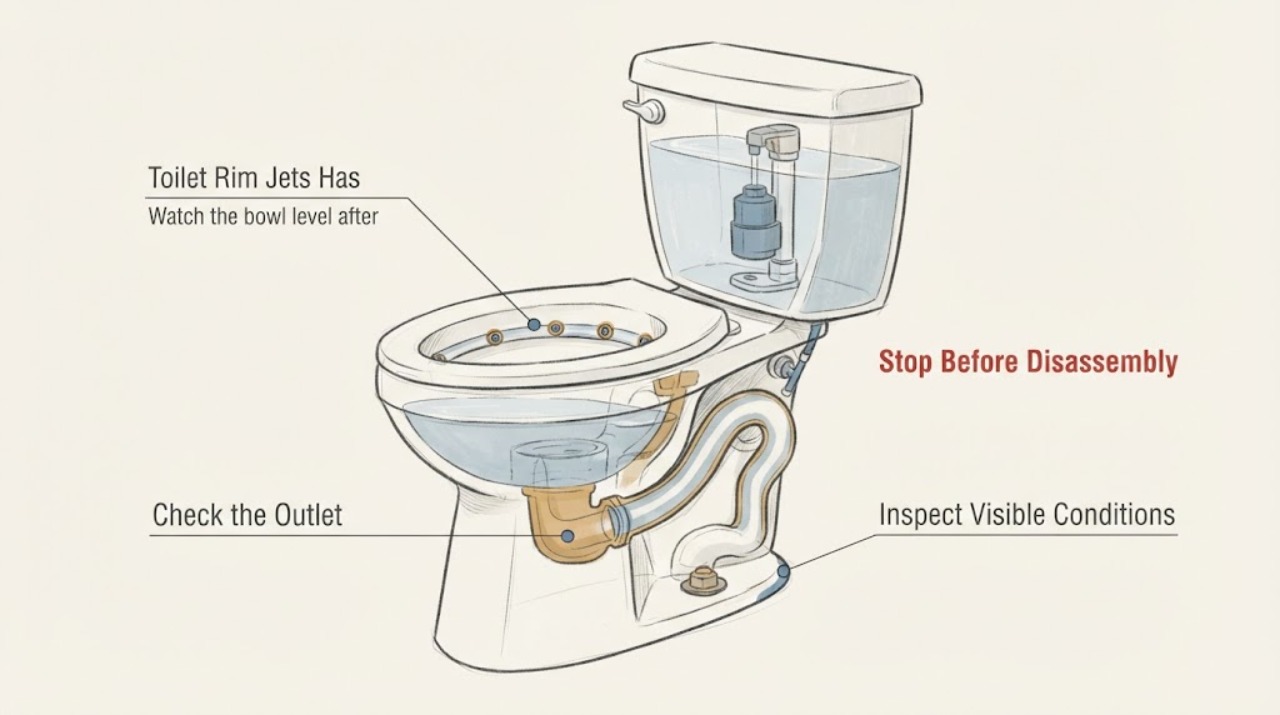
A weak flush that has little swirl or little water from the bowl rim can come from blocked conventional rim holes, but first identify whether this American Standard toilet actually uses conventional holes or a VorMax jetted design. Stop flushing if the bowl rises. With a safe bowl level, watch the rim during one flush, inspect the tank water level and flapper movement, and clean only accessible mineral or loose debris with a soft toilet brush or a manufacturer-approved method. If the tank releases normally but some rim outlets stay dry, the rim passages are restricted; if all outlets are weak, the tank fill, flush valve, water supply, or trapway is more likely. Do not drill, pry porcelain, or use a drain snake through rim passages. Persistent weakness, a damaged flush valve, or any overflow or leak needs a plumber.
Work through in order
Diagnostic checks
Use only checks that match the exact appliance or system and its official guide.
-
Check 1
Watch the bowl level after a flush attempt and close the toilet supply valve if the water rises or the bowl drains slowly.
Expected result: The bowl rises toward the rim, stays at a normal level but the flush is weak, or the bowl drains normally after a small flush.
Next step: Do not keep flushing a high bowl. Continue only when the water level is safe; use the bowl-clog branch if drainage is slow or the level returns.
Stop if: Stop immediately for an approaching overflow, water on the floor, or a supply valve that will not close.
Why this matters
Why: A rising bowl points to a bowl or trapway restriction and can overflow; it is not proof that the rim jets are clogged. A normal bowl with a weak swirl leaves the tank and rim paths as the next leads.
-
Check 2
Identify the flush design from the bowl shape, tank or bowl label, and American Standard model information before cleaning any outlet.
Expected result: The bowl has several conventional openings under the rim, a VorMax-style outlet or injector, or the model cannot be identified.
Next step: Use the conventional-rim branch only when the openings are present. If the design is VorMax or unclear, use the model guide and inspect only the visible, named outlet.
Stop if: Stop if identifying the model would require removing the tank, bowl, or a concealed valve.
Why this matters
Why: Conventional rim holes and VorMax jetted systems move water differently. A model that cannot be identified should not be treated as a generic rim-hole toilet.
-
Check 3
Run one flush with the tank lid safely in place and observe the water pattern around the rim or jetted outlet from a distance.
Expected result: Water exits evenly around the conventional rim, several outlets are dry, one area has a thin stream, or the named jetted outlet has little movement.
Next step: For a conventional rim, continue with gentle visible cleaning. For a jetted design, stop generic rim-hole work and follow the model-specific care or service instructions.
Stop if: Stop if the flush splashes outside the bowl, the tank leaks, or the bowl level rises unexpectedly.
Why this matters
Why: A localized dry section supports a restricted rim passage. Even but weak water makes the tank release, water level, flush valve, supply, or trapway more likely. A VorMax outlet must be evaluated by its specified jet pattern rather than by conventional holes.
-
Check 4
For visible conventional rim openings only, brush away loose material with a soft toilet brush or soft nylon brush and rinse the area with clean water; do not insert metal or a cable.
Expected result: Loose material comes away, mineral buildup remains hard at the opening, the opening is clear but the flush is still weak, or porcelain is chipped.
Next step: Stop after gentle visible cleaning and retest once. If buildup remains or the outlet is damaged, record the model and arrange service rather than enlarging the opening.
Stop if: Stop if a brush catches, porcelain chips, a chemical produces fumes, or cleaning requires force or drilling.
Why this matters
Why: Loose debris can reduce a local outlet, while hard buildup may extend into the passage beyond safe reach. A clear visible opening with a weak flush shifts the diagnosis upstream or toward the trapway.
-
Check 5
Lift the tank lid and watch the water level, flapper or flush valve, and refill behavior during one controlled flush without putting hands into moving parts.
Expected result: The tank starts full, the flush valve opens fully, the flapper or valve closes promptly, the tank stops below its normal level, or the flush releases only a small amount of water.
Next step: Correct only an obvious external chain tangle or a plainly incomplete handle movement. Use the model guide for fill-level or valve adjustments; do not force a valve or change a setting without its instructions.
Stop if: Stop if the tank part is cracked, the handle or valve binds, the supply connection leaks, or the water cannot be shut off.
Why this matters
Why: A normal tank release with weak or uneven rim flow keeps the rim passage in play. A low tank level, incomplete valve lift, chain interference, or early closure can make the whole flush weak even when the rim is clean.
-
Check 6
After the rim and tank checks, perform one flush with a safe bowl level and note whether the bowl clears, drains slowly, or backs up again.
Expected result: The flush clears after cleaning, remains weak but drains, or the bowl swirls and then rises or drains slowly.
Next step: Use the rim-cleaning result to decide whether a model-matched component is relevant. If the bowl remains restricted, stop flushing and use a toilet plunger only at a safe level; arrange service if it does not clear.
Stop if: Stop after the first failed retest if the bowl rises, wastewater backs up elsewhere, or the toilet begins leaking.
Why this matters
Why: Improvement after local cleaning supports a rim restriction. A weak but draining flush points to water delivery or flush-valve performance. A rise or slow drain points to the trapway or drain path, not merely the rim jets.
Use your observations
Decision map
Find the observation that best matches what you see, then follow the next safe action.
-
PATH 01Next step
What you see
Do this next
Keep the model information and repeat only gentle visible cleaning when needed. Consider a model-specific service visit if buildup extends beyond reach or quickly returns.
-
PATH 02Next step
What you see
Do this next
Follow the toilet model's tank and flush-valve guidance or have a plumber evaluate it; do not enlarge rim outlets or replace a bowl component first.
-
PATH 03Next step
What you see
Do this next
Use the exact model's care and repair information, then arrange service if the jet remains weak or the system needs concealed access.
-
PATH 04Next step
What you see
Do this next
Stop repeated flushing, use a toilet plunger only with a safe water level, and call a plumber if the blockage persists or returns.
Helpful context
Understand the symptom
Confirm what kind of rim you have
On a conventional bowl, small openings under the rim send water around the bowl. American Standard's VorMax design is different: its documentation says it eliminates conventional rim holes and uses a powerful jet instead. Do not poke a conventional-rim cleaning method into a VorMax outlet or assume that an empty-looking rim is blocked.
Weak flush is not always a rim-jet problem
If the tank does not release enough water, if the bowl drains slowly, or if the water level is too low before a flush, the rim may look weak even when its passages are open. Use the water pattern, tank movement, and bowl-drain behavior together before choosing a part.
Protect the porcelain and stop before damage
Rim passages are part of the ceramic bowl and may be difficult to access. Use gentle, visible cleaning only. Do not drill, hammer, pry, or feed a cable through a rim outlet. A damaged bowl, persistent blockage, or repeated overflow is a plumbing service boundary.
Safety boundary
Stop conditions
- Stop flushing when the bowl water is rising or near the rim; close the toilet supply to prevent an overflow.
- Stop if a rim opening is chipped, a tank or flush valve is cracked, a supply connection leaks, or a valve will not close.
- Stop any rim cleaning that requires drilling, metal probing, harsh chemicals, force, or access inside a concealed jet or valve.
- Stop and arrange plumbing service for a persistent weak flush after the tank and visible-rim checks, a slow drain, or backup at another fixture.
Only after diagnosis
Potential parts
- model-specific flush valve or flapper
Consider this only when the rim outlets are visibly open but the tank does not release or seal correctly during the controlled flush test.
Match the exact toilet model and flush design; American Standard tank parts are not interchangeable solely by brand or appearance. - model-specific rim or jet service component
Consider this only when model documentation identifies a removable rim or jet component and the visible flow test confirms that component is restricted or damaged.
Confirm whether the toilet uses conventional rim holes, a VorMax jet, or another design before selecting any part; do not alter ceramic passages. - toilet fill valve
Consider this only when the tank does not refill to its normal marked level or the fill control does not shut off, while the bowl and rim passages are clear.
Verify the toilet model and water-control design, and use a plumber for a leaking or seized supply connection.
When checks do not resolve it
Need a professional?
Call a plumber when the flush remains weak after the visible rim and tank checks, the model uses a jetted design that needs internal access, a flush valve or bowl is damaged, the bowl drains slowly or backs up, or an overflow or supply leak cannot be controlled.
Common questions
FAQ
How can I tell whether my American Standard toilet has rim jets?
Look for several small openings under the bowl rim and confirm the toilet model. Some American Standard VorMax toilets eliminate conventional rim holes and use a jetted outlet, so use the model information before cleaning.
Can blocked rim jets cause a weak flush?
They can reduce the water pattern from a conventional rim, especially when only some openings are dry or thin. If all outlets are weak, check tank release, water level, flush valve, and bowl drainage too.
What is safe to use to clean toilet rim openings?
Use gentle, visible cleaning with a soft toilet brush or soft nylon brush and clean water. Do not drill, pry porcelain, insert metal, or force a cable into the rim.
Why is the flush weak even though the rim openings look clear?
The tank may not release enough water, the valve may not open fully, or the bowl trapway may drain slowly. Compare tank movement and bowl drainage before treating the rim as the cause.
When should I stop troubleshooting a weak flush?
Stop for a rising bowl, uncontrolled water, a leaking or seized supply, damaged porcelain or flush parts, a jetted design that needs concealed access, or a blockage that remains after safe plunging. Call a plumber for those conditions.
Read the exact guide
Official sources
- How To Unclog A ToiletAmerican Standard · Official American Standard guidance used to separate bowl or trapway blockage from a rim-jet symptom and set a safe stop boundary.
- Right Height® Elongated bowl w/ 2 bolt coversAmerican Standard · Official American Standard bowl page showing a conventional PowerWash rim, siphon action, and trapway for a named model; not a claim about the assigned toilet model.
- Cadet 3 FloWise Round Front 1.28 gpf Complete Toilet (Bone)American Standard · Official American Standard product page for a named Cadet model; used to show that a toilet's flush valve and flapper design are model-specific.
- VorMax Flushing TechnologyAmerican Standard · Official American Standard technology page; it distinguishes VorMax jetted systems from toilets with conventional rim holes.
- SupportAmerican Standard · Official American Standard support page with model-based toilet parts and technical-help resources.
Community feedback
Share a repair observation
Share a plain-text repair observation. Accepted observations are published automatically; this page may take a moment to update.