
On this page
Start here
Quick answer
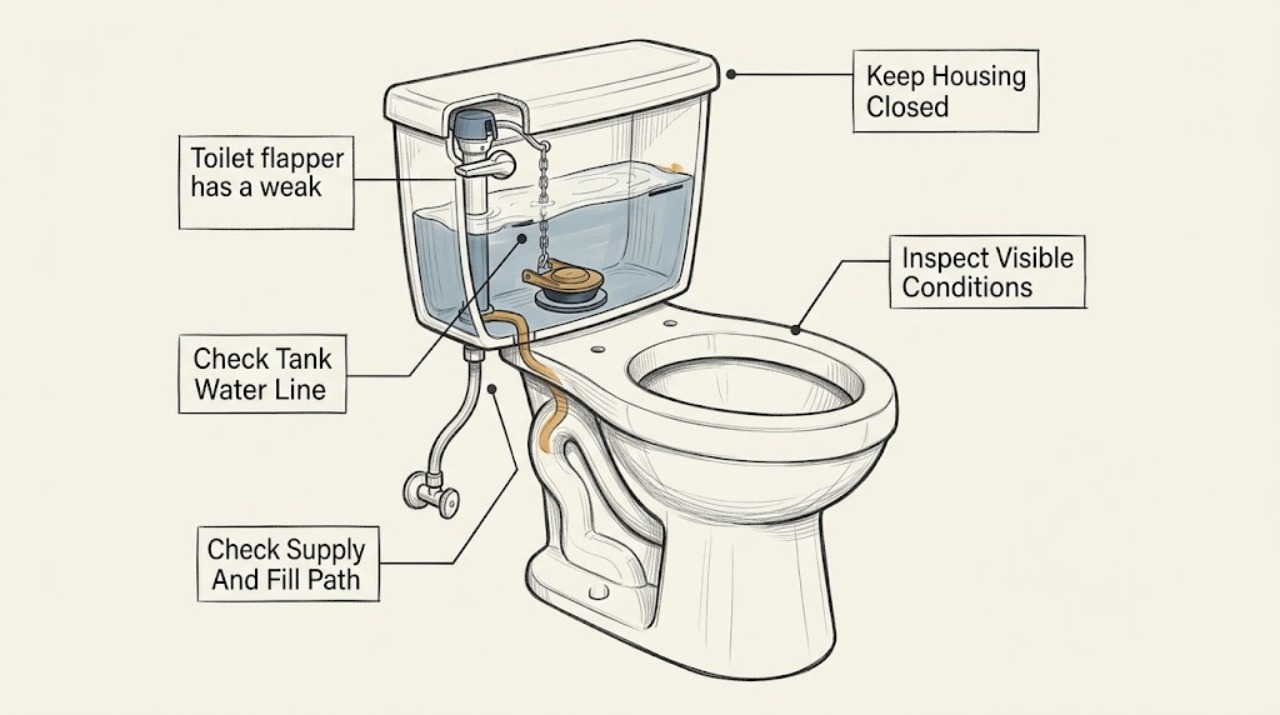
A Glacier Bay toilet that flushes weakly can have a low tank level, a flapper that does not lift fully, a chain that is too long or tangled, a worn flapper seal, or a bowl or drain restriction. Start by checking the tank water against its marked level and observing one flush with the lid off. The flapper should lift enough to release the tank water and then close without the chain holding it open. If the tank level is correct but the flapper barely lifts, the chain or handle linkage is the focused check; if the flapper lifts normally but the flush remains weak, inspect the seal and distinguish a tank-release problem from a bowl or drain restriction. Do not force the flush valve or reach into a drain. Arrange plumbing service when the valve or porcelain is damaged, water leaks, the bowl backs up, the cause is not clear, or a replacement must be matched to the exact Glacier Bay assembly.
Before you begin
Safety first
- This article supports ordinary top-access observation only. Do not use tank chemicals, reach into a blocked drain, force the flush assembly, open walls, remove the toilet, or make a repair when a leak, overflow, damaged porcelain, or uncertain part fit is present.
Work through in order
Diagnostic checks
Use only checks that match the exact appliance or system and its official guide.
-
Check 1
Remove the tank lid carefully and compare the resting water level with the manufacturer's marked water line or fill-level mark inside the tank; do not adjust the fill valve yet.
Expected result: Record whether the water is below the mark, at the mark, above the mark, or continually falling, and note any visible water running into the bowl.
Next step: If the level is low, continue to the supply and fill-path check; if it is correct or falling, observe one flush with the lid still off and keep hands clear of moving parts.
Stop if: Stop if the tank, porcelain, fill valve, or supply connection leaks or is cracked; do not remove the tank or force a valve.
Why this matters
Why: A level below the mark can reduce the water released on a flush. A level at the mark with a weak flush shifts attention toward flapper lift, seal, flush-valve opening, or the bowl. A falling level or water running into the bowl suggests a leak-through seal or fill problem rather than a simple weak-flush setting.
-
Check 2
From ordinary access, verify that the toilet's supply stop is not visibly closed and that the flexible supply line is not kinked; observe a refill without loosening the connection.
Expected result: Note whether water enters the tank promptly, fills to the marked line, trickles slowly, or stops before the line; check for moisture at the stop and hose connections.
Next step: If refill remains slow after confirming the visible stop and line are not obviously restricted, arrange plumbing diagnosis rather than disassembling the stop or fill valve.
Stop if: Stop for a leaking connection, a seized or damaged stop, a split supply line, or any need to open the wall or alter water service.
Why this matters
Why: A slow or incomplete refill supports a supply, stop, line, or fill-valve issue that can leave too little water for the next flush. A normal refill makes a persistent weak flush less likely to be caused by the supply path and increases the value of observing flapper lift and bowl behavior.
-
Check 3
With the lid off, operate the handle once and watch the flapper, chain, and handle arm from above; keep fingers, clothing, and tools out of the tank while the parts move.
Expected result: Classify the flapper as lifting fully and staying open briefly, lifting only slightly, lifting but dropping immediately, or failing to move; note whether the chain is tangled, taut at rest, disconnected, or has a small amount of slack.
Next step: If the chain is visibly tangled or disconnected, stop and use the exact Glacier Bay instructions for the identified model; if the flapper or pegs are damaged, treat replacement as conditional and do not force the valve assembly.
Stop if: Do not pull hard on the handle, bend the flush-valve tower, cut the chain without model instructions, or reach into the tank while the mechanism is moving.
Why this matters
Why: A small lift or immediate drop can release too little tank water and makes the chain, handle linkage, or flapper hinge the focused check. A tangled or taut chain can keep the seal from opening or closing correctly. A full lift with normal movement makes a linkage problem less likely and shifts attention to the seal, tank level, flush valve, or bowl.
-
Check 4
After the tank is quiet and only from safe top access, visually inspect the flapper and its seating area for warping, splits, mineral residue, a displaced hinge, or a chain that prevents the seal from resting flat; do not pry the flush valve.
Expected result: Record whether the flapper lies flat and seals, has visible damage or buildup, leaks water into the bowl, or cannot be assessed without removing the flush-valve assembly.
Next step: Match any replacement only after identifying the exact Glacier Bay model and installed flush-valve arrangement; request qualified service when the seat, pegs, valve, or porcelain is damaged or the fit is uncertain.
Stop if: Do not scrape aggressively, pry the flush valve, or continue using the toilet if a leak could damage the floor or ceiling below.
Why this matters
Why: A damaged or poorly seating flapper can leak tank water and change the next flush's available volume. A clean, intact seal that opens fully makes the flapper itself less likely to be the main restriction; an inaccessible or damaged flush valve creates a parts-fit and service boundary.
-
Check 5
Observe the bowl during one flush without adding chemicals or reaching into the trap, and compare the water movement with the tank's flapper lift and refill result.
Expected result: Note whether the bowl water rises unusually high then drains slowly, swirls weakly but never threatens to overflow, or clears normally while the tank-side flush is visibly incomplete.
Next step: If the bowl rises, stop flushing and arrange plumbing service; if the bowl drains normally but the tank release is incomplete, provide the flapper and chain observations to manufacturer support or a plumber for model-specific repair.
Stop if: Stop immediately if the bowl approaches overflow, wastewater backs up, porcelain cracks, or clearing the restriction would require chemical drain opener or trap disassembly.
Why this matters
Why: A rise followed by slow drainage makes a bowl or drain restriction more likely than a flapper-only fault. A normal bowl drain with a visibly short tank release points back to tank level, chain, flapper, or flush-valve behavior.
Use your observations
Decision map
Find the observation that best matches what you see, then follow the next safe action.
-
PATH 01Safety boundary
What you see
The tank rests below its marked line, the supply path is visibly restricted, or refill is slow and incomplete.
Do this next
Document the water level, refill behavior, and any moisture, then arrange plumbing diagnosis if the visible stop and line do not explain the restriction.
Why this path and its safety boundary
Why it matters: The toilet may not have enough stored water for a full flush; a supply, stop, line, or fill-valve issue is more likely than a flapper seal alone.
Safety stop: Stop for a leak, damaged stop, split supply line, or work requiring water-service or wall access.
-
PATH 02Safety boundary
What you see
The tank is at the marked line, but the handle produces only a small flapper lift, the chain is tangled or taut, or the flapper drops immediately.
Do this next
Use the exact model instructions to identify the intended chain slack and linkage arrangement; replace a damaged flapper only after confirming the model and fit, or call a plumber if the mechanism is forced or unclear.
Why this path and its safety boundary
Why it matters: The handle-to-flapper linkage or hinge is limiting the tank release, so a weak flush is not established as a drain blockage.
Safety stop: Do not pull hard, bend the flush valve, or improvise a chain length or attachment that could leave the flapper open.
-
PATH 03Safety boundary
What you see
The flapper lifts normally but the tank level falls, water is heard or seen entering the bowl between flushes, or the seal is visibly warped or damaged.
Do this next
Identify the exact Glacier Bay model, keep the old part and any clips together, and obtain manufacturer-specific or qualified service guidance before selecting a replacement.
Why this path and its safety boundary
Why it matters: A leak-through flapper or flush-valve seal can reduce the water available for a flush and may waste water; the seal or seat needs model-specific assessment.
Safety stop: Stop if water can reach the floor or ceiling below, porcelain or the flush valve is cracked, or a part cannot be removed without force.
-
PATH 04Safety boundary
What you see
The tank reaches its mark, the flapper lifts and seals normally, but the bowl rises and drains slowly or the flush fails to carry water through the trap.
Do this next
Stop flushing and arrange qualified plumbing service for the bowl or drain. Do not use chemical drain opener or reach into the trap.
Why this path and its safety boundary
Why it matters: The symptom pattern makes a bowl or drain restriction more likely than a flapper problem; repeated flushing could create an overflow.
Safety stop: Keep the toilet out of service if the bowl is rising, wastewater backs up, or there is a sanitation or overflow risk.
-
PATH 05Safety boundary
What you see
The mechanism is damaged, the toilet model cannot be identified, prior work altered the chain or flapper, or the flush valve cannot be assessed from safe access.
Do this next
Photograph the tank markings and mechanism without removing parts, then ask Glacier Bay support or a qualified plumber to identify the compatible assembly and repair path.
Why this path and its safety boundary
Why it matters: The correct part and repair boundary are unresolved; a generic flapper or adjustment may fit poorly, leak, or change the flush behavior.
Safety stop: Do not force, cut, pry, or substitute parts in the flush-valve assembly, and stop using the toilet if it leaks.
Helpful context
Understand the symptom
Separate weak tank release from a bowl restriction
A flapper problem affects how much water leaves the tank and how quickly it enters the bowl. A low tank level, a chain that leaves the flapper partly closed, or a flapper that seals too early can make the flush feel weak. If the flapper opens normally and the tank refills to its marked level but the bowl still swirls without carrying waste, the restriction may be in the bowl or drain instead. Do not put hands or chemicals into a drain; stop if the bowl level rises toward an overflow.
Use model-specific Glacier Bay instructions
Glacier Bay toilet families use different assemblies, and official support lists separate single-flush flapper models and poor-flush troubleshooting topics. Record the model marking inside the tank or on the documentation before ordering a flapper or flush valve. A replacement is conditional: the seal shape, hinge or pegs, chain connection, and flush-valve opening must match the installed assembly. If the model cannot be identified or the valve is cracked, use manufacturer support or a qualified plumber rather than forcing a generic part.
Stop when the repair boundary is unclear
A weak flush does not identify a particular replacement by appearance alone. If the flapper, chain, seat, flush valve, or porcelain is damaged, or the mechanism will not move through ordinary access, record the model marking and stop rather than forcing the assembly. Manufacturer support or a qualified plumber can identify the correct repair boundary.
Safety boundary
Stop conditions
- Do not use chemical drain opener or reach into a drain; a drain chemical does not diagnose a weak flush.
- Stop flushing if the bowl rises toward overflow, drains slowly with wastewater, or backs up.
- Stop for a cracked tank or bowl, a leaking supply or flush-valve connection, water reaching the floor or ceiling below, or a damaged shutoff.
- Do not pry, bend, drill, cut, or force the flush valve, flapper hinge, porcelain, supply stop, or wall plumbing.
- Do not order a replacement solely by appearance; identify the Glacier Bay model and installed flush-valve arrangement first.
Only after diagnosis
Potential parts
- Glacier Bay-compatible toilet flapper
Consider this category only if the flapper is visibly warped, split, poorly sealing, or otherwise confirmed as the source of tank water loss after the model and flush-valve arrangement are identified.
Confirm the exact Glacier Bay model, hinge or peg arrangement, seal profile, chain attachment, and manufacturer's fit information before ordering. - toilet flapper chain or handle linkage
Consider this category only if the chain or handle linkage is disconnected, damaged, or unable to lift the flapper as observed during a normal flush.
Confirm the exact tank mechanism and intended linkage geometry; do not use a substitute that leaves the flapper held open or prevents a complete seal. - Glacier Bay toilet flush valve assembly
Consider this category only if the flush valve, seat, pegs, or surrounding assembly is damaged or the identified model instructions call for valve replacement after other causes are excluded.
Confirm the exact tank model, valve opening and seal arrangement, and manufacturer guidance; replacement may require qualified plumbing work. - toilet fill valve
Consider this category only when the tank cannot refill to its marked line and the visible supply stop and hose are not the cause, with the fill-valve fault confirmed by model-specific diagnosis.
Confirm the exact tank, inlet connection, refill-tube arrangement, and manufacturer's instructions before ordering or changing the fill path.
When checks do not resolve it
Need a professional?
Arrange qualified plumbing or manufacturer service when the tank cannot refill to its marked level, the flapper or flush valve is damaged or does not match the identified model, water leaks into the bowl or onto the floor, the bowl rises or backs up, the weak flush remains after the tank-side observations, the mechanism was altered by prior work, or safe access is not enough to identify the repair.
Safety scope: This article supports ordinary top-access observation only. Do not use tank chemicals, reach into a blocked drain, force the flush assembly, open walls, remove the toilet, or make a repair when a leak, overflow, damaged porcelain, or uncertain part fit is present.
Common questions
FAQ
Can a bad flapper cause a weak toilet flush?
Yes. A flapper that does not lift fully, drops immediately, or leaks between flushes can reduce the tank water released for a flush. Check the tank level, chain movement, and seal pattern before selecting a model-compatible replacement.
How much chain slack should a Glacier Bay toilet flapper have?
The chain should let the flapper close fully while allowing the handle to lift it during a flush. Use the exact Glacier Bay instructions for the model; a chain that is tangled, taut at rest, or too long can interfere with opening or sealing.
Why is the tank full but the toilet still flushes weakly?
If the tank reaches its mark, observe whether the flapper lifts and stays open long enough. A limited lift or leaking seal points to the flapper or linkage; normal tank release with a bowl that rises or drains slowly points more toward a bowl or drain restriction.
Should I force or pry the Glacier Bay flush assembly if the flapper does not move?
No. Stop at ordinary top-access observation when the flapper, hinge, flush valve, or porcelain will not move without force. Record the model marking and ask manufacturer support or a qualified plumber to identify the compatible repair.
When should I call a plumber for a weak Glacier Bay toilet flush?
Arrange service for a rising or backing-up bowl, any leak or cracked porcelain, a damaged or unidentified flush assembly, a tank that will not refill to its mark, a weak flush that persists after the tank-side checks, or any repair that requires force, wall access, or uncertain part matching.
Read the exact guide
Official sources
- Troubleshooting, Help and SupportNiagara Conservation Corporation · Official manufacturer support index that lists Glacier Bay toilet families, including single-flush flapper toilets and poor-flush-related topics.
- What should I do if the water continuously runs or ghost flushes for my Single Flush Glacier Bay Made in Mexico Toilets (340-995 or 686-826)?Globe Union · Official Globe Union support article for the listed Glacier Bay single-flush toilet models; use exact model instructions for other Glacier Bay assemblies.
Community feedback
Share a repair observation
Share a plain-text repair observation. Accepted observations are published automatically; this page may take a moment to update.