
On this page
Start here
Quick answer
A weak-flushing Glacier Bay toilet can be caused by a tank water level below the marked line, a flush button, handle, or chain that does not open the flush valve fully, restricted rim holes, a leaking or obstructed seal, or a trapway, drain, or vent problem. First prevent an overflow, identify whether the flush is weak because too little water leaves the tank or because the bowl drains slowly, then check only visible, model-appropriate parts against the tank's marked waterline. If the bowl rises, other fixtures gurgle or back up, the flush remains weak after the visible checks, or the model has a dual-flush or pressure-assisted mechanism you cannot identify, stop testing and arrange qualified plumbing service. Do not use chemical drain cleaner, force tools against the porcelain, or assume a replacement valve fits every Glacier Bay model.
Before you begin
Safety first
- This article is limited to overflow prevention, ordinary-access observation, the marked tank waterline, visible control alignment, and model-approved care. A professional must handle persistent drain or vent restrictions, toilet removal, leaks, damaged porcelain, and unfamiliar dual-flush, power-flush, or pressure-assisted internals.
Work through in order
Diagnostic checks
Use only checks that match the exact appliance or system and its official guide.
-
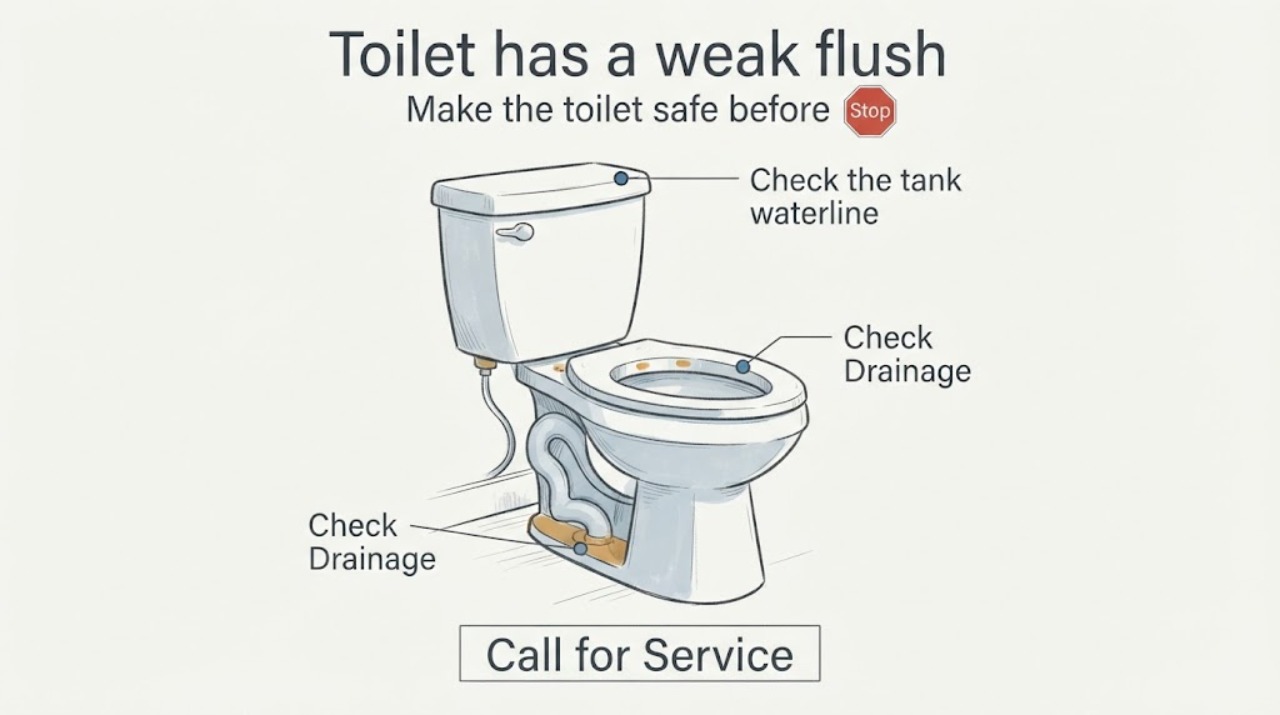
Make the toilet safe before a flush test
Do not keep pressing the handle or flush button if the bowl is high. If water is still entering, close the nearby supply stop by hand if it operates normally, keep the floor clear, and wait until the bowl is stable before opening the tank lid.
Expected result: Record whether the bowl is stable, rising, overflowing, draining slowly, or accompanied by water at the base or a continuous refill.
Next step: Leave the toilet out of service for overflow, sewage contamination, a cracked bowl, a base leak, or a supply stop that will not close; arrange prompt plumbing service. Continue only when the bowl and floor are safe.
Stop if: Stop if water is spreading, contaminated water reaches electrical equipment, or the floor is slippery or unsafe.
Why this matters
Why: A high or rising bowl is an overflow-control problem, not a normal weak-flush test. A base leak or continuous refill may be a separate seal, valve, or supply issue.
-
Separate low flush volume from slow bowl drainage
After the bowl is stable, observe one normal flush without repeated cycling. Watch the tank and bowl from a safe position: note whether the tank was at its marked waterline, whether the valve opens fully, whether the bowl rises and then falls slowly, and whether water leaves the bowl with normal force.
Expected result: Classify the result as low tank level or slow refill, incomplete valve opening, normal tank level with a weak bowl action, or normal bowl action with poor evacuation.
Next step: Use the matching check below and record the model number before changing any setting. If the bowl rises or another fixture backs up, stop using connected fixtures and call a plumber.
Stop if: Do not repeat flushes to force waste through a bowl that is rising or draining slowly.
Why this matters
Why: A low tank level or incomplete valve opening limits flush volume. A full tank with a weak swirl or slow evacuation points toward rim holes, the trapway, drain, or vent instead of the fill valve alone.
-
Check the tank waterline and refill path
With the tank lid removed only after the bowl is stable, compare the resting tank water with the waterline printed on the flush-valve overflow tube. Check that the supply valve is fully open and note whether the tank refills normally after the flush; do not raise the level above the marked line.
Expected result: The tank rests below the line, at the line, above the line, or refills unusually slowly; note any water continuing into the overflow tube.
Next step: Follow the exact model instructions for a minor fill adjustment only when the adjustment is clearly documented. If the tank is at the line but the flush is weak, move to the valve and rim or drain checks; if the whole bathroom has low flow, arrange plumbing service.
Stop if: Do not adjust an unknown mechanism, remove the fill valve, or continue if the tank, supply connection, or floor leaks.
Why this matters
Why: Globe Union says water below the marked line can make the flush less effective, while water above it can enter the overflow and cause continuous refill. Slow refill can arise from a partially closed supply, fill-valve debris, a leaking flapper or seal, or low bathroom flow.
-
Check handle, button, chain, and flush-valve movement
Identify whether the toilet uses a handle, a single button, or a dual-flush button. From ordinary access, observe whether the handle lifts the flapper fully or, on the dual-flush model covered by Globe Union, whether each push rod merely contacts its matching valve panel and the refill tube is not in its path; do not force the lid or rods.
Expected result: The chain is excessively slack or tight, the flapper or valve opens only partway, a button rod is misaligned or obstructed, or the valve opens and closes normally.
Next step: Use only the adjustment described for the exact model and restore the tank lid without binding the controls. If the mechanism is damaged, the model is unknown, or the valve seal is warped, stop and arrange compatible service.
Stop if: Do not bend rods, force a stuck button, replace a valve by appearance, or operate with a seal that leaks into the bowl.
Why this matters
Why: A control that opens the valve only partway can produce a weak flush even when the tank level is correct. A normally opening valve shifts suspicion toward the rim, trapway, drain, vent, or water supply.
-
Inspect visible rim flow and valve-seal clues
Once the tank is safe to inspect, look at the bowl rim and visible flush openings for mineral deposits or restricted flow. On a dual-flush unit, inspect the valve seal only as the model instructions allow for debris, bubbles, or warping; do not use a sharp tool, abrasive, or chemical cleaner.
Expected result: Rim openings appear restricted, the flush-valve seal has debris or visible warping, or both the rim and seal look clear and intact.
Next step: Clean only as the exact Glacier Bay instructions permit. If a seal is warped or the valve cannot be restored without disassembly, document the model and request a compatible part or plumber assessment.
Stop if: Do not scrape porcelain or seal surfaces with metal, pour chemicals into the bowl or tank, or dismantle an unfamiliar valve assembly.
Why this matters
Why: Restricted rim flow can reduce the bowl's flushing action. Debris or a warped seal can interfere with the valve's operation, but clear visible parts make a deeper trapway, drain, vent, or supply problem more likely.
-
Evaluate the trapway, drain, and vent pattern
After the tank and visible controls are normal, note whether the bowl drains slowly, rises during the flush, bubbles persist, nearby fixtures gurgle or back up, or the weak action is isolated to this toilet. Do not access a roof vent, remove the toilet, or push an improvised tool into the trapway.
Expected result: The weak flush is isolated with normal bowl evacuation, or it is accompanied by slow evacuation, bubbling, gurgling, repeated clogs, or another affected fixture.
Next step: Call a qualified plumber for persistent weak flush, shared drain or vent symptoms, or a bowl that does not evacuate. Provide the model, tank-level result, control behavior, and video of a safe flush if available.
Stop if: Stop flushing if the bowl rises and stop all DIY tests for overflow, sewage, a base leak, or any need to open concealed plumbing.
Why this matters
Why: An isolated weak flush supports further model-specific fixture or rim checks. Slow evacuation or multi-fixture symptoms make a trapway, drain, or vent restriction more likely and cannot be solved safely by adjusting tank hardware.
Use your observations
Decision map
Find the observation that best matches what you see, then follow the next safe action.
-
PATH 01Safety boundary
What you see
The tank rests below the marked waterline, the supply is partly closed, or refill is slow while nearby bathroom flow is normal.
Do this next
Confirm the supply is open and follow only the exact model's documented waterline or fill-valve check. Request service when the tank cannot reach its line, leaks, or refills poorly after the permitted check.
Why this path and its safety boundary
Why it matters: The flush may lack available water volume because of the local supply, fill valve, debris, or a leaking seal rather than a bowl blockage.
Safety stop: Do not set the level above the line, use an unknown replacement valve, or keep flushing a tank that is not refilling correctly.
-
PATH 02Safety boundary
What you see
The tank is at its line but the handle, chain, button rod, or refill tube prevents the flush valve from opening fully.
Do this next
Use the exact Glacier Bay model instructions to restore alignment or permitted slack. If a seal is warped, a button binds, or the mechanism is unfamiliar, stop for compatible service.
Why this path and its safety boundary
Why it matters: The control path is limiting the flush volume or timing, and the symptom is more consistent with incomplete valve actuation than with low bathroom pressure.
Safety stop: Do not bend, force, or interchange control components based on appearance.
-
PATH 03Safety boundary
What you see
The tank level and control movement are normal, but rim flow is visibly restricted or a dual-flush seal has debris or warping.
Do this next
Follow the Glacier Bay instructions for permitted cleaning or ask a plumber to identify the correct valve or seal. Re-test only after the part is restored and no leak is present.
Why this path and its safety boundary
Why it matters: The visible fixture hardware can reduce flush action even though the tank has enough water; this is a model-specific cleaning or replacement decision.
Safety stop: Do not scrape with metal, use tank chemicals, or install a generic valve without model confirmation.
-
PATH 04Safety boundary
What you see
The tank reaches its line and the controls open normally, but the bowl rises or drains slowly, the clog recurs, bubbles persist, or another fixture is affected.
Do this next
Keep the toilet and connected fixtures out of service as needed and arrange qualified drain and vent assessment.
Why this path and its safety boundary
Why it matters: A trapway, drain, or vent restriction is more likely than a tank adjustment. Repeated flushes can turn a weak-flush complaint into an overflow.
Safety stop: Do not access concealed plumbing, the roof vent, or the toilet base as a household test.
-
PATH 05Safety boundary
What you see
The toilet is weak and the bathroom has low flow, the model or flush mechanism is unknown, or all visible fixture checks are normal.
Do this next
Stop changing parts, record the model and a safe flush video, and request a qualified plumber or manufacturer support assessment.
Why this path and its safety boundary
Why it matters: A broader supply condition or model-specific valve, power-flush, or installation issue cannot be distinguished safely from the available observations.
Safety stop: Do not use a replacement part based solely on brand name, open unfamiliar internal assemblies, or keep operating a toilet with leaks or unstable flushing.
Helpful context
Understand the symptom
Define weak flush before changing a part
Watch the next safe, ordinary flush only after the bowl is stable. If the tank does not refill to its marked line, the valve may not be delivering enough water for the intended flush. If the tank is at the line but the bowl rises, drains slowly, or leaves water and waste behind, a trapway or drain restriction is more likely. If the handle, button, or chain moves only partway, the flush valve may not be opening fully. These patterns lead to different checks, so a valve replacement is not the first assumption.
Glacier Bay flush mechanisms vary by model
Glacier Bay toilets may use a single handle, a dual-flush button assembly, or a power-flush design. Globe Union's dual-flush guidance is model-specific: the rods must merely contact the matching flush-valve panel, and a refill tube that obstructs rod movement can reduce the discharged flush volume. Use the model number and its own instructions before adjusting a button, rod, seal, or valve.
Small bubbles and recurring symptoms change the diagnosis
Small bubbles can occur during a flush, but persistent bubbling, gurgling, a bowl that rises and falls slowly, or more than one affected fixture can indicate restricted venting or a shared drain path. A one-time weak flush with a low tank level is a different situation from a toilet that flushes weakly every time even though the tank reaches its line. Escalate the second pattern instead of repeatedly cycling the toilet.
Safety boundary
Stop conditions
- Stop flushing when the bowl is high, rising, slow to drain, or another fixture is backing up; close the supply stop if it operates normally.
- Do not pour chemical drain cleaner into the toilet or tank, mix cleaners, scrape with metal, or push an improvised tool into the trapway or rim openings.
- Do not set tank water above the marked line, force a handle or button, bend control rods, or interchange a flush valve without exact model confirmation.
- Do not remove the toilet, access a concealed drain or vent, or open a pressure-assisted or power-flush mechanism as an ordinary-user test.
- Call a plumber for overflow, sewage contamination, cracked porcelain, base or supply leaks, persistent weak flush after visible checks, recurring clogs, or multiple affected fixtures.
Only after diagnosis
Potential parts
- Glacier Bay fill valve
Consider this category only if the tank is below its marked line or refills slowly after the supply is open and the model-specific check identifies a restricted or failed fill valve.
Confirm the exact toilet model and manufacturer fit information; a fill valve for one Glacier Bay mechanism may not suit another. - Glacier Bay flush valve or seal
Consider this category only if the exact model's flush valve does not open or close correctly, or its seal is visibly warped or damaged after the tank and controls are safely checked.
Confirm the model, flush type, valve design, and manufacturer instructions before ordering; do not infer compatibility from appearance. - toilet supply stop
Consider this category only when the supply stop cannot open fully, will not close for overflow control, or leaks independently of the weak-flush symptom.
Have a plumber confirm the pipe connection, valve type, and local plumbing requirements before replacement.
When checks do not resolve it
Need a professional?
Arrange qualified plumbing service when the bowl rises or does not evacuate, the weak flush remains after the tank, controls, and visible rim checks, the tank cannot reach its marked line, a seal or valve is damaged, flow is low across the bathroom, the clog recurs, or bubbles, gurgling, or backup indicate a drain or vent problem. Use the exact model instructions or manufacturer support for an unfamiliar dual-flush, power-flush, or pressure-assisted mechanism.
Safety scope: This article is limited to overflow prevention, ordinary-access observation, the marked tank waterline, visible control alignment, and model-approved care. A professional must handle persistent drain or vent restrictions, toilet removal, leaks, damaged porcelain, and unfamiliar dual-flush, power-flush, or pressure-assisted internals.
Common questions
FAQ
Why does my Glacier Bay toilet have a weak flush?
Common diagnostic possibilities include a tank level below the marked line, a partially opening handle or button mechanism, restricted rim flow, debris or damage at the flush-valve seal, or a trapway, drain, vent, or supply problem. Watch whether the tank lacks water or the bowl drains slowly before replacing a part.
How do I check the water level on a Glacier Bay toilet?
After making sure the bowl is stable, remove the tank lid and compare the resting water with the line printed on the flush-valve overflow tube. Do not set it above the line. Use the exact model instructions for any adjustment, and stop for service if the tank cannot reach the line or leaks.
Can a loose chain or button cause a weak flush?
Yes. If the handle, chain, or dual-flush push rod opens the flush valve only partly, the bowl may receive less water even when the tank level is correct. Check movement from ordinary access and use only the adjustment documented for the exact Glacier Bay model.
Why does my Glacier Bay toilet bubble or drain slowly during a weak flush?
Small bubbles can be normal, but persistent bubbles, slow evacuation, gurgling, recurring clogs, or backup at another fixture make a rim, trapway, drain, or vent restriction more likely. Stop repeated flushing and arrange qualified plumbing assessment when those patterns appear.
Should I replace the flush valve to fix a weak Glacier Bay flush?
Only after the model-specific checks show that the flush valve or seal is damaged or does not actuate correctly. Glacier Bay mechanisms differ, so confirm the exact model and flush type before ordering; a full tank with normal valve movement points elsewhere.
Read the exact guide
Official sources
- What should I do if my Glacier Bay Made in Mexico Dual Flush Toilet 215-583 is having a flushing performance issue?Globe Union · Model-specific guidance used for control-rod alignment, refill-tube clearance, tank waterline, and dual-flush seal inspection; it is not asserted to cover every Glacier Bay toilet.
- Why are bubbles forming in the water during a flush cycle in toilet?Globe Union · Official manufacturer support guidance used for interpreting bubbles and restricted rim flow; persistent or multi-fixture symptoms still require professional drain and vent assessment.
- What should I do if the water continuously runs or ghost flushes for my Single Flush Glacier Bay Made in Mexico Toilets 340-995 or 686-826?Globe Union · Model-specific official guidance used for single-flush tank and seal clues; it is not asserted to cover dual-flush or power-flush mechanisms.
- What should I do if my toilet tank is refill slowly than usual?Globe Union · Official support guidance used to distinguish slow refill, marked tank level, local fill-valve debris, and broader bathroom flow; it informs the weak-flush diagnosis without assigning a model not supplied in the topic.
Community feedback
Share a repair observation
Share a plain-text repair observation. Accepted observations are published automatically; this page may take a moment to update.