
On this page
Start here
Quick answer
A weak Kohler toilet flush usually comes from one of four different conditions: the tank is not reaching its marked waterline, the supply valve or handle mechanism is limiting the flush, the rim holes or jet are restricted, or the bowl trapway, waste line, or vent is restricting flow. First note whether the bowl rises and drains slowly or whether it simply lacks a strong swirl. If the bowl rises toward the rim, bubbles, gurgles, or needs repeated flushing, stop flushing and treat it as a possible blockage or vent problem. If the bowl drains normally, check the tank waterline and fully open the toilet supply valve, then inspect the model-specific flapper, canister, chain, rod, and refill-hose arrangement. Do not force porcelain hardware or pour drain chemicals into the toilet.
Work through in order
Diagnostic checks
Use only checks that match the exact appliance or system and its official guide.
-
Check 1
Watch one flush only if the bowl is at its normal level and there is no overflow risk. Observe the starting water level, the height of the bowl water during the flush, how quickly it falls, and whether the flush is weak from the start or loses force midway.
Expected result: The bowl rises high and falls slowly, bubbles or gurgles, or needs repeated flushes; or the bowl drains normally but the water movement is weak.
Next step: For a high or slow bowl, do not flush again or add chemical opener; keep the toilet available for a plumber or use only a suitable toilet tool without force if the blockage path is clear. For a normal-draining bowl, continue with the tank and flush-mechanism checks.
Why this matters
Why: A rising, slow-falling, bubbling, or frequently clogged bowl makes a trapway, waste-line, or vent restriction more likely than a tank adjustment. A normally draining bowl keeps the tank, actuator, rim holes, and jet in the leading branches.
-
Check 2
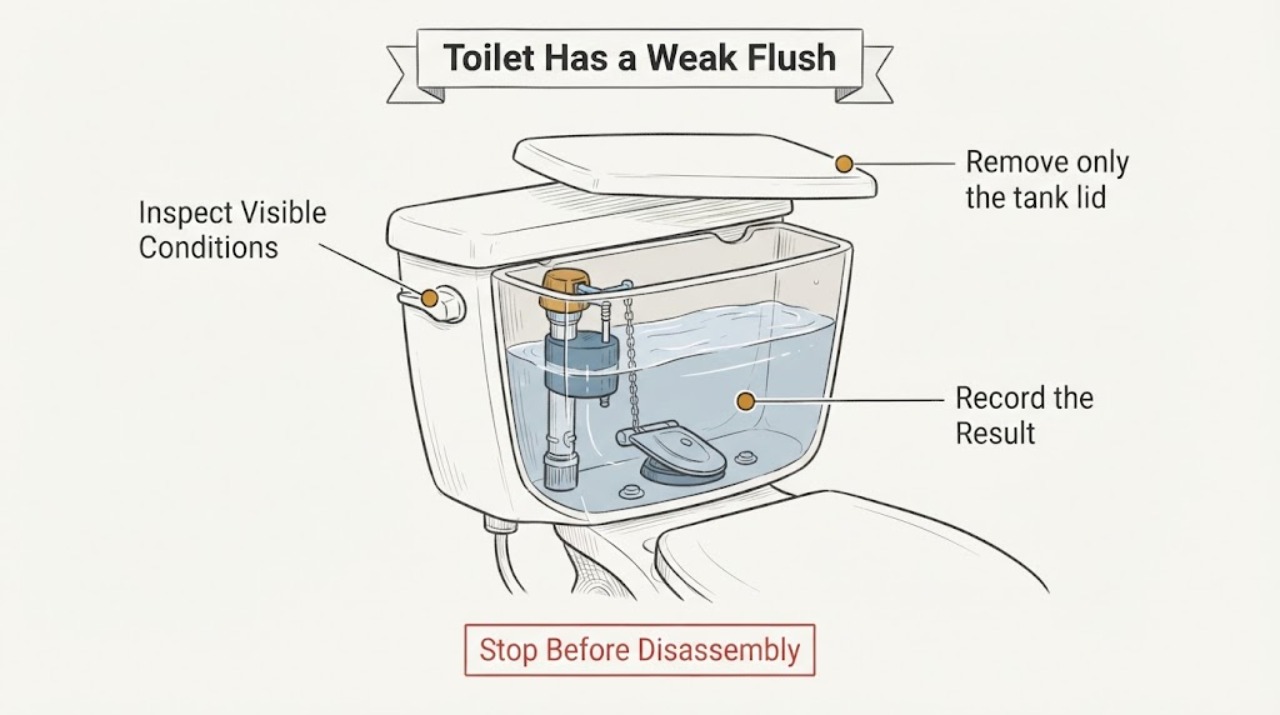
Remove only the tank lid if it lifts freely and the toilet is a standard tank design. Compare the water level with the manufacturer's waterline mark, and check that the toilet's supply shutoff is fully open without forcing it.
Expected result: The tank level is below the marked line, the supply valve is partly closed, or the level reaches the overflow; or the level is at the mark and the valve is open.
Next step: If the model allows a user adjustment, set the water only to its marked line and retest once. Do not raise it above the line. If the valve will not open normally, the tank overflows, or the level will not hold, stop and arrange plumbing service; otherwise continue.
Why this matters
Why: A low tank or restricted supply reduces the water available for the flush. Water at or above the overflow indicates a fill-level problem rather than proof that the flush valve is defective. A correct level and open supply move the diagnosis to actuation, flow openings, or the drain path.
-
Check 3
With the tank lid off, operate the handle or button gently and watch the linkage. For a flapper style, look for excessive chain slack; for a canister or dual-flush style, check that the rod or actuator moves the valve fully. If present, verify that the refill hose is routed into the overflow opening or the canister as the model guide shows.
Expected result: The flapper or canister opens only partway, the handle must be held down, the chain or rod has slack or binds, or the refill hose is detached or misrouted; or the valve opens fully and returns freely.
Next step: Use only the exact Kohler model instructions to correct an accessible chain, rod, or hose position. Do not bend a rod, force a canister, or replace a seal until the valve style and model are identified. Retest once after a permitted correction.
Why this matters
Why: Incomplete valve travel or incorrect linkage can shorten the flush even when the tank waterline is correct. A misrouted refill hose can affect bowl refill and may indicate an assembly issue. A full, free valve movement makes the actuator less likely and shifts attention to flow openings or the drain path.
-
Check 4
If the tank and linkage are correct, inspect the bowl rim holes and the jet opening with a mirror and light. Look for mineral deposits, debris, or a noticeably uneven wash around the bowl; shut off the supply and flush residual tank water before any model-approved cleaning.
Expected result: Several rim holes or the jet are visibly restricted, the wash is weak on one side, or the openings are clear and the wash is even.
Next step: Clean only with the Kohler procedure for the identified toilet and a suitable product; do not enlarge openings or use a sharp tool that could damage the fixture. Retest after cleaning. If deposits are hard, widespread, or the weak flush remains, call for service.
Why this matters
Why: Restricted rim holes or a jet can reduce the swirl and siphon-starting flow while the tank still operates normally. Clear, even openings make a localized rim restriction less likely and support checking the trapway, waste line, or vent if the bowl is slow.
-
Check 5
Separate a bowl-path problem from a tank problem without repeated flushing. Note whether the bowl returns to its normal level promptly, whether bubbles appear from the trapway, whether nearby drains make noise, and whether the toilet has developed frequent clogs.
Expected result: The bowl is slow to fall, bubbles, gurgles, or backs up, especially with nearby drain noise; or it clears normally with no such signs.
Next step: Keep the toilet out of service if water rises and request a plumber for a suspected waste-line or vent issue. A toilet plunger or auger is conditional on a clear obstruction diagnosis, a suitable tool, and no chemical residue; never force it against porcelain.
Why this matters
Why: This combined pattern is consistent with an obstruction in the trapway or waste line or restricted venting, and is not corrected by raising the tank level. A normal bowl response after the flush makes a severe downstream restriction less likely, though it does not rule out a partial obstruction.
-
Check 6
Photograph the toilet, tank markings, flush mechanism, waterline, and the safe observations, then locate the Kohler model information before considering a replacement part. Do not remove the tank, pressure vessel, or concealed components just to find a number.
Expected result: The model identifier and tank style are readable; only a partial identifier is available; or the identifier cannot be reached without disassembly.
Next step: Give the model information, flush pattern, waterline result, actuator behavior, rim-flow result, and bowl behavior to a plumber or Kohler support channel. Keep the toilet out of service when the source remains uncertain.
Why this matters
Why: Kohler flush valves, seals, fill valves, rods, and service procedures vary by model and tank layout. A partial or missing identifier prevents a reliable fit or adjustment decision.
Use your observations
Decision map
Find the observation that best matches what you see, then follow the next safe action.
-
PATH 01Next step
What you see
The bowl rises, falls slowly, bubbles, gurgles, or frequently clogs while the tank is at its waterline.
Do this next
Treat a trapway, waste-line, or vent restriction as more likely than a low tank. Stop flushing if the bowl is high and arrange plumbing service; do not install a fill valve to solve a drain restriction.
-
PATH 02Next step
What you see
The bowl drains normally, but the tank is below its marked line or the supply shutoff is not fully open.
Do this next
Correct only the model-approved water-level or supply setting, then perform one controlled retest. If the level cannot be set or the valve binds, stop and call a plumber.
-
PATH 03Next step
What you see
The waterline is correct, but the handle must be held, the canister or flapper opens partly, or the chain, rod, or refill hose is mispositioned.
Do this next
Use the exact Kohler layout instructions to correct the accessible linkage or hose position. If the mechanism binds, the pressure-assist assembly is involved, or the flush remains weak, stop and request model-qualified service.
-
PATH 04Next step
What you see
The tank and actuator work normally, but rim flow is uneven and several rim holes or the jet show deposits.
Do this next
Follow the Kohler rim-cleaning procedure for that fixture and retest once. Persistent or widespread restriction needs service rather than drilling, enlarging, or forcing the openings.
-
PATH 05Next step
What you see
All visible checks are normal, yet the flush remains weak, the problem began after installation or a part change, or the model and mechanism cannot be identified.
Do this next
Keep the toilet in limited use or out of service and have a plumber or Kohler support identify the model, concealed obstruction, vent condition, pressure-assist assembly, or incorrect component before any part is ordered.
Helpful context
Understand the symptom
The phrase weak flush can describe either a weak release of water or a bowl that cannot move water through the trapway. Those are different diagnoses. A normal water level with a bowl that rises quickly and falls slowly points downstream; a low tank level or a handle that must be held down points to the tank or actuator. Record which pattern occurs before changing a part.
Kohler toilets use different tank layouts, including flapper, canister, dual-flush, in-wall, and pressure-assist designs. A check that applies to one layout may not apply to another, so use the toilet's model instructions for any adjustment or cleaning step.
A weak flush that remains after the waterline, actuation, rim flow, and bowl path have been checked is a service boundary rather than a reason to keep flushing. Keep the toilet out of service if water rises, porcelain is cracked, or a suspected obstruction will not clear with a suitable, non-forceful method.
Safety boundary
Stop conditions
- Stop flushing and call a plumber if the bowl approaches the rim, wastewater is present, nearby drains gurgle with backup, or water is reaching the floor or a ceiling below.
- Do not use drain chemicals, mix cleaning products, drill rim holes, or force a plunger, auger, chain, rod, canister, or porcelain hardware.
- Stop if the supply valve, tank lid, pressure-assist vessel, or flush mechanism binds, cracks, leaks, or requires disassembly beyond the exact model instructions.
- A weak flush that remains after the waterline, actuation, rim flow, and bowl response are checked needs plumbing or model-qualified service; do not keep replacing parts by symptom alone.
Only after diagnosis
Potential parts
- Kohler flapper or flush-valve seal
Consider only when the identified flapper or flush-valve seal does not open or seal correctly after the waterline and linkage are confirmed, and the exact model supports that part.
Flapper shape, canister design, chain or rod arrangement, and seal material vary by Kohler model; confirm the model documentation before ordering. - Kohler fill valve
Consider only when the tank cannot reach or hold its marked waterline because the fill valve fails a model-specific adjustment or service check.
Inlet arrangement, height, float style, refill connection, and overflow setup must match the exact toilet model. - Kohler flush actuator, rod, or linkage
Consider only when the handle or button does not fully actuate the flush valve and the model-specific linkage is confirmed as the cause.
Flapper, canister, dual-flush, in-wall, and pressure-assist layouts use different mechanisms; do not substitute based on appearance alone. - Kohler rim or jet service component
Consider only when a qualified inspection confirms a damaged or irreversibly restricted flow opening after approved cleaning does not restore the flush.
The bowl casting and flow path are model-specific; do not enlarge openings or select a component without the model service information.
When checks do not resolve it
Need a professional?
Request a qualified plumber or Kohler-trained service provider when the bowl rises or backs up, the waste line or vent may be restricted, the pressure-assist assembly or concealed tank is involved, porcelain is cracked, the supply valve or flush mechanism binds, the model cannot be identified, or the weak flush remains after the safe model-specific checks.
Common questions
FAQ
Why is my Kohler toilet weak even though the tank looks full?
A full-looking tank may still be below its marked waterline, or the valve may not open fully. If the waterline and linkage are correct, inspect rim holes, the jet, and the bowl's drain response before choosing a part.
Should I hold the Kohler toilet handle down longer?
Holding the handle can mask incomplete chain, rod, or canister travel. Check whether the valve opens fully according to the model guide; do not keep holding it as a substitute for correcting a binding or misadjusted mechanism.
Can clogged rim holes cause a weak flush?
Yes. Kohler identifies restricted rim holes as a cause of poor flush or poor rim wash. Follow the fixture-specific cleaning procedure after shutting off the supply; do not drill or enlarge the openings.
Does a high bowl mean the fill valve is bad?
No. A bowl that rises and drains slowly points toward a trapway, waste-line, or vent issue, while a fill-valve problem is in the tank water path. Stop flushing if the bowl is near the rim and separate those symptoms before replacing a valve.
How do I find the correct Kohler replacement part?
Record the toilet and tank markings and identify the flush layout before selecting anything. Kohler's parts guidance directs users to identify the product and consult its parts diagram; a generic-looking valve, seal, or actuator may not fit.
Read the exact guide
Official sources
- Troubleshooting GuideKohler Co. · Supports model-specific waterline and supply checks and differentiating poor flush from fill-valve or flush-seal symptoms.
- Poor FlushKohler Assist · Supports distinguishing a weak flush caused by bowl, waste-stack, or vent symptoms from a tank-side issue.
- Toilet Water Not Leaving BowlKohler Assist · Supports the safety branch for a bowl that does not evacuate and the distinction between trapway obstruction and restricted venting.
- Poor toilet rim washKohler Assist · Supports the branch where weak or uneven bowl wash is caused by restricted rim holes or deposits.
- KOHLER Genuine Service PartsKOHLER · Supports identifying the toilet model and consulting the model-specific parts diagram before selecting a flush component.
- TroubleshootingKohler Co. · Supports checks for waterline, chain or rod, refill hose, rim holes, trapway, jet, waste line, and plunger or auger conditions.
Community feedback
Share a repair observation
Share a plain-text repair observation. Accepted observations are published automatically; this page may take a moment to update.