
On this page
Start here
Quick answer
Water at the base of an American Standard toilet can come from the wax ring and floor-flange seal, but first rule out water running down from the supply connection, tank bolts, or bowl condensation. Wipe the base dry, observe whether moisture appears only after flushing or refilling, and check whether the bowl rocks or the floor feels soft. American Standard describes the wax ring as the seal between the toilet and floor flange and its installation guidance seats the ring under the bowl before setting the bowl over the T-bolts. A leak that returns after flushing, a rocking bowl, damaged flooring, or a seal that has already been compressed generally requires shutting off the supply and having a plumber remove and reseat the toilet; do not keep tightening bolts against the porcelain or reuse a disturbed wax ring.
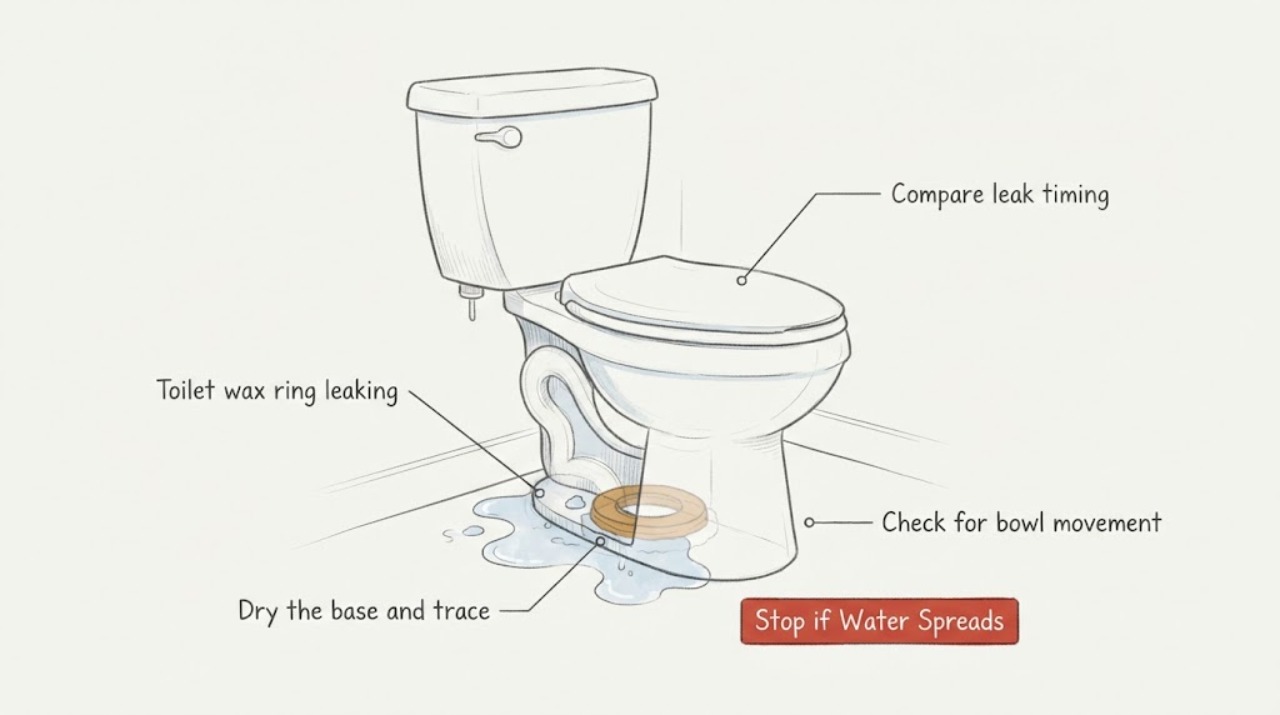
Work through in order
Diagnostic checks
Use only checks that match the exact appliance or system and its official guide.
-
Dry the base and trace the first drop
Close the water supply if the leak is active, wipe the floor and the visible underside of the bowl dry, and place dry tissue or a towel at separate points around the base. Do not pull or rock the toilet while tracing the water.
Expected result: The first moisture appears at the supply connection, tank joint, bowl rim, or only beneath the bowl; or the floor stays dry until flushing.
Next step: Use the source location and timing to select a branch. Keep the supply off if water is reaching flooring, the ceiling below, or an electrical fixture.
Stop if: Do not remove the tank, loosen the bowl, or use a caulk bead to hide an active leak before its source is identified.
Why this matters
Why: Water beginning above the base can travel downward and is not proof of a wax-ring failure. Moisture appearing from under the bowl after a flush makes the toilet-to-flange seal or drain connection more likely.
-
Compare leak timing with a flush and refill
After the area is dry and only if there is no risk of spreading water, observe one normal flush from a dry starting point. Watch the base, supply connection, and tank joints during the flush and again while the tank refills; do not repeat flushes if the leak is clearly worsening.
Expected result: Water appears only during flushing, during refill, continuously between flushes, or not at all after the bowl and floor dry.
Next step: Turn off the supply for a leak that reaches the floor and arrange a plumbing inspection when the base is the source or the timing remains unclear.
Stop if: Do not continue flushing a toilet that leaks onto the floor or into a room below.
Why this matters
Why: A flush-only leak beneath the bowl favors the wax ring, flange, or drain connection. A refill-only leak at the supply or tank favors an upper connection. Moisture that does not follow a flush may be condensation, a supply leak, or water from cleaning.
-
Check for bowl movement and floor support
From a standing position, look for a gap or uneven contact at the bowl base and note whether the toilet rocks during ordinary use. Do not deliberately push hard on the bowl or loosen the mounting hardware to investigate.
Expected result: The bowl rocks, the base is visibly uneven, the floor feels soft or stained, the flange area is hidden, or the bowl appears stable and supported.
Next step: If the bowl moves or the floor is soft, keep the supply off and have a plumber inspect the mounting and flange before any seal replacement.
Stop if: Do not wedge the bowl, shim it permanently, or tighten mounting nuts against the porcelain as a substitute for flange repair.
Why this matters
Why: Movement can disturb the wax-ring seal and can also indicate an uneven floor, loose mounting, or flange damage. A stable bowl does not rule out a seal leak, but it makes movement a less obvious contributor.
-
Rule out an upper connection that mimics a base leak
With the supply off, inspect the visible supply-line connection, shutoff valve, tank-to-bowl joint, and tank bolts for a wet trail. Follow the trail downward without removing fittings or disturbing the bowl seal.
Expected result: Moisture starts at a supply fitting, tank connection, or tank bolt; the trail starts below the bowl; or all upper connections remain dry.
Next step: Address only an accessible shutoff or connection according to its instructions. If the upper connection is dry or the leak continues after an external correction, arrange toilet-base service.
Stop if: Do not overtighten supply fittings or tank bolts, and do not use sealant to conceal a connection that needs repair.
Why this matters
Why: An upper leak can run along the china and collect at the base. A dry upper assembly with flush-triggered moisture below the bowl keeps the wax ring, floor flange, or drain path as the leading concern.
-
Check whether the leak follows cleaning or condensation instead
Note whether moisture appears after mopping, bathing, or a cold humid period rather than after a flush. Dry the bowl exterior and floor again, protect the area from splash, and observe without moving the toilet.
Expected result: The moisture follows cleaning or splash; forms broadly on a cold bowl; appears only after a flush; or returns with no clear event.
Next step: Correct the external moisture source if confirmed. For any unexplained or flush-related base leak, keep the floor dry and schedule a plumber.
Stop if: Do not seal around the base until the leak source and flange condition have been established.
Why this matters
Why: External water or condensation can imitate a wax-ring leak. A repeatable flush-only leak from beneath the bowl is more concerning for the seal or flange, while unexplained recurrence needs inspection rather than guesswork.
-
Use the exact model installation information
Record the full American Standard model and consult its installation guide for the bowl, floor bolts, seal, and mounting sequence. Confirm whether the model uses a wax ring or a different drain gasket; do not assume every American Standard toilet uses the same seal arrangement.
Expected result: The model guide confirms a wax ring; it specifies another gasket or socket; the toilet was recently installed or moved; or the installation history is unknown.
Next step: Give the model information to the plumber and use it to select only a conditional replacement seal. Do not lift the toilet without the proper preparation and help.
Stop if: Do not order by toilet appearance alone or reuse a wax ring after the bowl has been lifted.
Why this matters
Why: American Standard says toilet designs and installation parts differ, and its SpaLet guidance, for example, uses a drain socket and a gasket different from a traditional wax ring. The model guide determines which seal and mounting sequence are applicable.
-
Escalate a confirmed or persistent base leak
If the leak starts beneath the bowl after flushing, the bowl rocks, the floor is soft or stained, or the leak returns after an upper connection is ruled out, turn off the supply and stop using the toilet until a qualified plumber can inspect the bowl, seal, flange, and floor.
Expected result: The leak stops after an external source is corrected; the base leaks again after flushing; the bowl moves; or damage is visible below or around the flange.
Next step: Arrange plumbing service and provide the model, leak timing, source location, installation history, photos, and whether the bowl moves. Protect the floor and the room below from further water.
Stop if: Do not lift the bowl, scrape old wax, repair a flange, or reconnect the toilet without the exact model instructions and proper plumbing support.
Why this matters
Why: An external-source correction supports a supply or splash cause. Recurrence from beneath the bowl, movement, or floor damage is more consistent with a disturbed seal, flange problem, mounting issue, or drain connection that needs professional access.
Use your observations
Decision map
Find the observation that best matches what you see, then follow the next safe action.
-
PATH 01Next step
What you see
The first wet point is at the supply line, shutoff, tank-to-bowl joint, or tank bolt, and water tracks downward to the base.
Do this next
Keep the supply off if the connection continues to leak and arrange the matching plumbing repair; recheck the base only after the upper source is dry.
Why this path and its safety boundary
Why it matters: An upper connection is more likely than the wax ring, even though the floor is wet at the toilet base.
-
PATH 02Next step
What you see
The bowl exterior and upper connections are dry, but water appears from beneath the bowl or around the floor after a flush.
Do this next
Turn off the supply, stop using the toilet, and arrange a plumber to inspect the seal and flange. A disturbed wax ring should be replaced rather than reused.
Why this path and its safety boundary
Why it matters: The wax ring, floor flange, drain connection, or bowl seating is more likely than condensation or a tank leak.
-
PATH 03Next step
What you see
The toilet rocks, the base is uneven, the floor is soft or stained, or the leak returns after the toilet was recently installed or moved.
Do this next
Keep the supply off and have the toilet lifted and the flange and floor inspected by a plumber. Do not shim or force the mounting hardware as a final repair.
Why this path and its safety boundary
Why it matters: Movement, uneven support, a damaged flange, or an improperly seated seal can be contributing; tightening alone may damage the bowl.
-
PATH 04Next step
What you see
Moisture follows mopping, splash, bathing, or condensation and does not recur after the bowl and floor are dried and protected.
Do this next
Correct the splash or condensation source and monitor the dry base. Reclassify the problem as a plumbing leak if water returns after flushing.
Why this path and its safety boundary
Why it matters: An external moisture source is more likely than a failed wax ring.
-
PATH 05Next step
What you see
The model guide specifies a drain socket or gasket rather than a traditional wax ring, or the toilet is a specialized bidet or concealed design.
Do this next
Use the exact model installation documentation and arrange qualified service for removal and resealing; do not substitute a wax ring by appearance.
Why this path and its safety boundary
Why it matters: A generic wax ring diagnosis or part may be wrong for this installation.
Helpful context
Understand the symptom
A wet base is not automatically a failed wax ring
Dry the floor and underside of the bowl, then watch where the first drop appears. Water that starts at the supply connection, tank-to-bowl joint, or tank bolts can travel down and mimic a base leak. Water that appears from beneath the bowl only after a flush is more consistent with the toilet-to-flange seal or a drain connection. Condensation can wet the outside of a bowl without a drain leak, so the timing matters.
The wax ring seals the toilet to the floor flange
American Standard's glossary places the wax ring between the toilet and the floor flange to prevent leakage and fumes. Its installation guide shows the ring pressed firmly onto the bottom of the bowl, the bowl gently set over the T-bolts, and the nuts tightened by hand. A ring that was shifted, under-compressed, reused after removal, or paired with a flange or floor that cannot support the bowl may not seal.
Do not fix a seal leak by forcing the porcelain down
If the bowl rocks, the floor is soft, the flange is damaged, or the base remains wet after an external source is ruled out, the toilet usually needs to be lifted for inspection. Tightening mounting nuts unevenly or aggressively can crack the porcelain without correcting a failed seal. A plumber can inspect the flange, floor support, bolts, and the correct seal arrangement for the exact toilet.
Safety boundary
Stop conditions
- Turn off the toilet water supply and stop using the fixture when water is escaping from beneath the bowl or reaching the floor below.
- Do not keep tightening mounting nuts against the porcelain, force the bowl, shim it as a permanent repair, or apply caulk to hide a leak.
- Do not lift the toilet, scrape old wax, repair a floor flange, or reconnect the drain without model-specific instructions and appropriate plumbing support.
- Arrange prompt plumbing service for a soft or stained floor, a rocking bowl, a flush-only base leak, repeated leakage, or water reaching a ceiling or electrical fixture.
Only after diagnosis
Potential parts
- toilet wax ring or model-specific bowl-to-flange gasket
Consider this category only when a plumber confirms the leak is from beneath the bowl and the exact model uses that seal arrangement.
Confirm the complete American Standard model and drain design before ordering; specialized models may use a socket or gasket different from a traditional wax ring. - closet bolts and bowl mounting hardware
Consider this category only when inspection finds damaged, corroded, missing, or unusable mounting hardware after the bowl and flange are assessed.
Verify the exact toilet and flange configuration; hardware alone will not correct a damaged flange or floor. - closet flange or flange-repair component
Consider this category only when professional inspection confirms the floor flange is cracked, loose, low, or otherwise unable to support and seal the bowl.
Flange parts depend on the existing drain and floor construction; confirm the repair approach on site before selecting a component.
When checks do not resolve it
Need a professional?
Arrange qualified plumbing service when the first wet point is beneath the bowl, the leak returns after flushing, the bowl rocks, the floor or flange may be damaged, the toilet was recently moved, the seal has been disturbed, or the model uses a gasket or socket different from a traditional wax ring. Provide the complete American Standard model, leak timing, photos, upper-connection findings, and installation history.
Have this ready
- Provide the complete American Standard model, whether water appears only after flushing or refilling, the first wet point, bowl movement, floor condition, photographs, recent installation or movement, and whether the model guide specifies a wax ring or another gasket.
Common questions
FAQ
How can I tell whether an American Standard toilet wax ring is leaking?
Dry the base and trace the first moisture. A flush-only leak that begins beneath the bowl, especially with bowl movement or a recent installation, makes the wax ring, flange, or bowl seating more likely. Water starting at the supply or tank can simply run down to the base, so rule out upper connections first.
Can I tighten the toilet bolts to stop a base leak?
Do not force the bowl down by tightening bolts against the porcelain. If the bowl rocks or the base leaks after flushing, the floor support, flange, mounting, or compressed seal needs inspection. Keep the supply off and have a plumber evaluate the installation.
Does every American Standard toilet use a wax ring?
No. American Standard's standard toilet installation guidance uses a wax ring, but its SpaLet bidet guidance describes a drain socket and a gasket different from a traditional wax ring. Use the exact model documentation before selecting a replacement seal.
Should I keep using the toilet if water leaks at the base?
Stop using it and turn off the water supply when water is escaping from beneath the bowl, recurring after flushing, reaching flooring below, or accompanied by a soft or stained floor. A plumber may need to lift the bowl and inspect the seal, flange, and support.
Read the exact guide
Official sources
- What Type Of Wax Ring Should I UseAmerican Standard · American Standard guidance on wax rings and the sealed connection between a toilet and floor flange
- How To Install A Spalet Bidet ToiletAmerican Standard · American Standard SpaLet toilet drain-socket and gasket installation distinction from a traditional wax ring
- GlossaryAmerican Standard · American Standard definitions of wax ring, floor flange, toilet, and related sealing components
- Champion PRO Two-Piece 1.28 gpf/4.8 Lpf Chair Height Round Front Toilet With Seat and Wax RingAmerican Standard · American Standard toilet product documentation showing a model supplied with a wax ring and installation guide
- How To Install The Acticlean ToiletAmerican Standard · American Standard toilet installation sequence, wax-ring placement, floor-bolt seating, bowl mounting, supply connection, and water-supply restoration
Community feedback
Share a repair observation
Share a plain-text repair observation. Accepted observations are published automatically; this page may take a moment to update.