
On this page
Start here
Quick answer
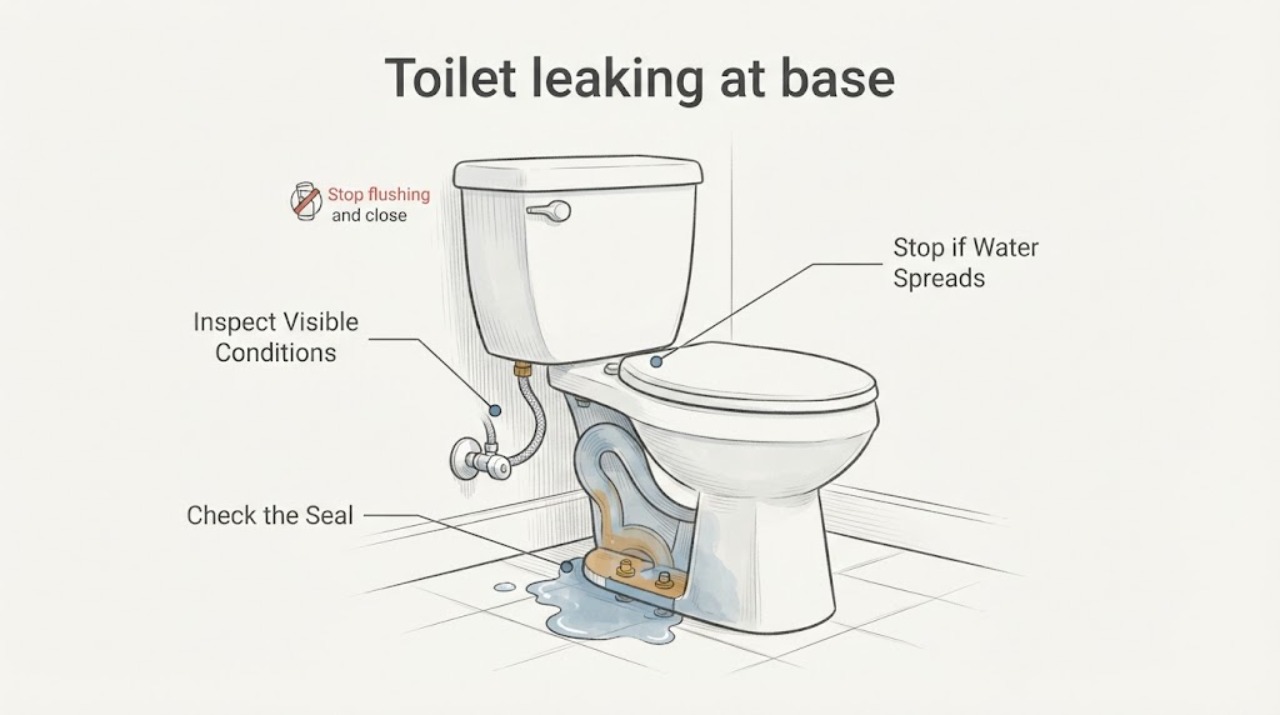
If a Kohler toilet is wet at the base, first stop flushing and trace the water to its highest dry-to-wet point. Close the toilet's accessible supply stop if water is actively pooling, protect the floor, and do not keep using the toilet until the source is identified. Water that starts at the supply hose or shutoff without a flush points toward the water connection; water that appears at the base only during or after a flush points more toward the bowl-to-floor seal, flange, movement, or a porcelain crack. Water from the tank-to-bowl joint or condensation can travel down and look like a base leak. Kohler's installation guidance uses a wax ring or rubber gasket at the floor flange, warns that rocking or lifting the toilet can break that seal, and says to check the supply connection for leaks. A dye test can identify a silent tank-to-bowl leak into the bowl, but it cannot prove the floor seal is sound. Do not caulk over an active leak, overtighten mounting hardware, lift the toilet, or disassemble the bowl unless you are prepared for water isolation, removal, flange inspection, a new seal, and safe reinstallation. Arrange a qualified plumber promptly for sewage-like water, a cracked or rocking toilet, a damaged flange, water reaching the subfloor or ceiling below, a leak that continues with the supply closed, or any source you cannot isolate safely.
Before you begin
Safety first
- Homeowner checks should remain limited to stopping use, closing an accessible supply stop, drying and tracing the first wet point, checking visible hose, tank, bowl, and floor conditions, and performing a contained tank dye test only when no active pooling is present. A qualified plumber should remove or reset the toilet, inspect the floor seal and flange, assess porcelain and drain connections, and repair damaged flooring or plumbing.
Work through in order
Diagnostic checks
Use only checks that match the exact appliance or system and its official guide.
-
Check 1
Stop flushing and close the toilet's local supply stop if it is accessible and turns normally; keep towels or a shallow container around the area, and do not touch water that may be sewage-contaminated without appropriate protection.
Expected result: Water stops when the supply is closed, continues with the stop closed, the stop will not close, or water is spreading into the floor, wall, ceiling below, or electrical area.
Next step: Keep the toilet isolated. For continued spreading, sewage-like water, an uncontrollable stop, structural damage, or water near electricity, leave the area as needed and arrange urgent qualified plumbing service.
Why this matters
Why: A stoppable clean-water leak is different from a drain-side or structural leak. Continued flow with the supply closed suggests stored bowl or tank water, a drain connection, or another plumbing source.
-
Check 2
Dry the outside of the tank, tank-to-bowl joint, bowl, supply hose, shutoff, and floor with separate paper towels; then watch from a safe position for the first place that becomes wet, without rocking or lifting the toilet.
Expected result: The first wet point is at the supply connection, tank-to-bowl seam, bowl surface, base seam, or floor behind the toilet; no new water appears after drying.
Next step: Photograph the source and keep the supply closed if water returns. Do not tighten mounting nuts or apply caulk over the wet area; arrange service if the source is the base, flange, porcelain, or an inaccessible joint.
Why this matters
Why: The highest first-wet point is more useful than the puddle's final location. Water at a supply or tank joint can run down to the base, while a base-only wet point keeps the floor seal, flange, or porcelain in consideration.
-
Check 3
With the area dry and the supply reopened only if it is safe, observe whether a new drip appears while the tank refills and whether the leak occurs without flushing; do not reopen the stop if the leak is rapid or uncontrolled.
Expected result: Water appears during refill at the supply hose or shutoff, appears at the tank-to-bowl seam, or remains dry until a flush is initiated.
Next step: Close the supply again after the observation. A visible hose or stop leak needs plumbing attention; a flush-related base leak should not be tested repeatedly and generally needs a plumber to inspect the seal, flange, and floor.
Why this matters
Why: Refill-only water favors a supply or tank connection. A leak that follows flushing more strongly implicates the bowl-to-floor seal, flange, drain path, or a bowl crack, but timing alone cannot prove which one.
-
Check 4
Inspect the toilet and floor from the side for a visible porcelain crack, a gap at the base, rocking, a broken or displaced mounting area, soft flooring, staining, or an unusual sewage odor; do not sit on or rock a suspect toilet.
Expected result: The toilet rocks, the porcelain or flange looks damaged, the floor is soft or stained, or no physical damage is visible and the toilet remains stable.
Next step: Keep a damaged or rocking toilet out of use, close the supply, and arrange qualified plumbing inspection. Do not overtighten bolts or lift the toilet as a diagnostic shortcut.
Why this matters
Why: Movement can break a wax or rubber floor seal, while a crack or damaged flange can leak independently of the seal. A stable exterior does not rule out a failed seal below the bowl.
-
Check 5
If the water is not actively pooling and the suspected path is inside the tank, add a few drops of food coloring to the tank without flushing, wait 10 minutes, and inspect the bowl; flush afterward to avoid staining.
Expected result: Colored water appears in the bowl, or the bowl remains uncolored during the test; the outside base is wet, or it stays dry.
Next step: Do not use the dye result to dismiss an active base leak. If the base is wet or water returns, close the supply and arrange service; only a confirmed internal tank seal issue should be matched to a model-specific tank repair.
Why this matters
Why: Color in the bowl shows a tank-to-bowl internal leak such as a worn flush-valve seal, not proof of a floor-seal failure. A negative dye test leaves supply, tank joint, bowl, flange, and other external paths in consideration.
-
Check 6
If there is no emergency symptom, make one controlled note of whether the leak follows a flush, refill, or no water use, then leave the toilet unused with the supply closed until the source is resolved; do not repeatedly flush to reproduce it.
Expected result: The leak is repeatable after a flush, repeatable during refill, appears intermittently without use, or cannot be reproduced after drying.
Next step: Arrange a plumber for any repeatable leak, base moisture, odor, movement, or floor damage. Provide photos, the first-wet point, timing, toilet type, and whether closing the supply stopped the water.
Why this matters
Why: Timing helps a plumber separate the floor seal or drain path from a supply or tank path, but an intermittent leak may still be caused by movement, a hidden crack, or water tracking from above.
-
Check 7
Gather the Kohler model or product information, one-piece or two-piece configuration, leak photos taken from a dry safe position, first-wet point, flush or refill timing, supply-stop behavior, floor condition, odor, and any recent installation or movement.
Expected result: The leak returns, the source is below the toilet, the fixture moved, the floor has damage, or the issue began after installation or a repair.
Next step: Give the record to a qualified plumber and request inspection of the supply stop and hose, tank and bowl joints, floor seal, flange, drain path, porcelain, and floor/subfloor as applicable.
Why this matters
Why: These details tell the technician whether to inspect a supply connection, tank-to-bowl joint, floor seal, flange, drain connection, porcelain, or subfloor without assuming that a generic wax ring or bolt will fit.
Use your observations
Decision map
Find the observation that best matches what you see, then follow the next safe action.
-
PATH 01Next step
What you see
The area is dry at first, then water appears at the supply hose or shutoff during refill and the base remains dry when the supply is closed.
Do this next
Close the supply stop and arrange plumbing service for the hose, stop, inlet, or connection. Do not keep cycling the valve or overtighten fittings on a wet connection.
Why this path and its safety boundary
Why it matters: A pressurized supply connection is more likely than a floor-seal leak, although water may still track downward and mislead the inspection.
-
PATH 02Next step
What you see
Water first appears at the tank-to-bowl seam or runs down from the bowl after refill, while the floor seal stays dry when separately traced.
Do this next
Keep the supply closed if the leak returns and use the Kohler model information for a qualified repair or model-specific part selection. Do not let water continue to pool at the floor.
Why this path and its safety boundary
Why it matters: A tank gasket, flush-valve gasket, canister seal, or another upper connection is more likely than the toilet base itself.
-
PATH 03Next step
What you see
The toilet is dry until a flush, then water appears at the base or from below, especially if the bowl rocks or the floor is stained.
Do this next
Stop flushing, close the supply, and arrange qualified plumbing inspection. Do not rock, lift, bolt-tighten, or caulk the toilet to hide the leak.
Why this path and its safety boundary
Why it matters: A failed bowl-to-floor seal, damaged flange, drain connection, movement, or porcelain problem is more likely than an internal flapper leak.
-
PATH 04Next step
What you see
The dye test colors the bowl but the outside base stays dry after careful tracing, or the toilet occasionally refills without a floor puddle.
Do this next
Use the toilet only if no exterior leak is present and arrange a model-correct tank-seal repair if the running persists. If the base becomes wet, stop use and reassess the external source.
Why this path and its safety boundary
Why it matters: An internal tank-to-bowl leak is more likely, such as a worn flapper or canister seal; this is distinct from a leak through the floor seal.
-
PATH 05Next step
What you see
Water is sewage-like, the supply cannot be stopped, the toilet or porcelain is cracked or unstable, water reaches the subfloor or ceiling below, or the leak continues after the supply is closed.
Do this next
Keep the toilet out of use, isolate water as safely as possible, protect people from contaminated water, and arrange urgent qualified plumbing service. Use emergency help for immediate danger near electricity or severe flooding.
Why this path and its safety boundary
Why it matters: Contamination, structural damage, uncontrolled water, or a drain-side failure requires prompt professional containment and inspection.
Helpful context
Understand the symptom
A wet base is a location, not a diagnosis
Water can run down the bowl, tank, supply hose, shutoff, wall, or floor and collect around the base. Dry the outside surfaces and trace a new bead or drip from the highest point you can see. A floor seal leak often changes after a flush, while a supply connection can leak during refill even when the toilet is not flushed. Do not assume the visible puddle identifies the failed part.
Contain water before testing
Stop flushing and close the toilet supply stop if it turns normally and is accessible. Use towels to protect flooring, but do not pull the toilet or remove a tank lid if water is actively spreading. If the shutoff will not close, the hose or valve is damaged, or water is reaching another room or ceiling, leave the fixture isolated as far as safely possible and call a plumber.
Kohler's floor seal and flange warnings matter
Kohler's installation material shows a wax ring or rubber gasket sealing the toilet to the floor flange. It cautions against rocking or lifting the toilet after placement because the seal can break, and against overtightening mounting hardware because the bowl can be damaged. A failed seal generally requires lifting the toilet, inspecting the flange and floor, installing the model-appropriate seal, and testing—work that is easy to turn into a larger leak if attempted without a plan.
Rule out a tank leak that runs down the bowl
On a two-piece toilet, water can escape at the tank-to-bowl joint; inside the tank, a flush-valve or canister seal can also let water leak into the bowl and cause occasional refilling. Kohler describes these as separate leak paths. A dry-paper trace and a dye test help distinguish a tank leak from water emerging at the floor, but neither replaces inspection of an actively wet base.
Do not hide the source with caulk
Caulk may be part of a particular installation, but applying it over a wet or moving toilet can conceal an ongoing leak and delay detection of floor or flange damage. Find and correct the source first. If the toilet rocks, the floor is soft or stained, the porcelain is cracked, or the water may be contaminated, use the supply stop and arrange qualified plumbing service.
Safety boundary
Stop conditions
- Stop using the toilet and arrange urgent qualified plumbing service for sewage-like water, an uncontrollable supply leak, a cracked or rocking bowl, a damaged flange, soft or stained flooring, water reaching a ceiling below, or water near electricity.
- Do not rock, lift, or remove the toilet as a casual test; do not overtighten mounting nuts, crack porcelain, disturb the flange, or install a wax ring or gasket without confirming the model, seal type, flange condition, and safe reinstallation plan.
- Do not caulk over an active leak, repeatedly flush to reproduce it, leave the supply stop open while water is pooling, or assume a positive or negative tank dye test proves the floor seal condition.
- Arrange service when water returns at the base after a flush, the first-wet point cannot be isolated, a leak continues with the supply closed, or safe external checks do not resolve the source.
Only after diagnosis
Potential parts
- toilet floor wax ring or rubber base gasket
Consider only when a qualified inspection confirms the leak is through the bowl-to-floor seal and the toilet will be removed for flange and floor inspection; water at the base alone is not proof.
Confirm the exact Kohler model, toilet configuration, flange condition, seal type, and installation instructions before selecting a replacement. - toilet supply hose or shutoff connection
Relevant only when tracing shows a pressurized leak at the supply hose, toilet inlet, or shutoff during refill; do not replace a floor seal for this pattern.
Confirm connection sizes, hose routing, shutoff condition, and the Kohler model requirements; plumbing isolation and replacement may require a qualified plumber. - Kohler tank-to-bowl or flush-valve gasket
Consider only when water begins at the tank-to-bowl joint or a model-specific flush-valve seal is confirmed as leaking; an external base leak needs a different diagnosis.
Match the exact Kohler model and one-piece or two-piece configuration; avoid overtightening porcelain hardware or substituting an unverified seal. - toilet flange or mounting hardware
Consider only after a qualified inspection finds a damaged flange, broken mounting point, or hardware problem contributing to a flush-related base leak.
Confirm the flange type, floor construction, toilet configuration, and approved mounting method; flange and subfloor work is not a casual bolt adjustment.
When checks do not resolve it
Need a professional?
Safety scope: Homeowner checks should remain limited to stopping use, closing an accessible supply stop, drying and tracing the first wet point, checking visible hose, tank, bowl, and floor conditions, and performing a contained tank dye test only when no active pooling is present. A qualified plumber should remove or reset the toilet, inspect the floor seal and flange, assess porcelain and drain connections, and repair damaged flooring or plumbing.
Common questions
FAQ
Why is my Kohler toilet leaking only after I flush?
A leak that begins after flushing keeps the bowl-to-floor seal, flange, drain connection, movement, and porcelain in consideration. Trace the first wet point, stop flushing, close the supply, and arrange service rather than rocking or lifting the toilet.
Can a supply-line leak look like a toilet leaking at the base?
Yes. Water from the supply hose, shutoff, or toilet inlet can run down the bowl and collect at the base. Dry the hose, connection, tank, and bowl, then watch for the first place that becomes wet. Close the supply if water returns.
Does a toilet dye test find a leaking wax ring?
No. Food coloring in the tank tests for water leaking into the bowl through the flush valve or flapper seal. It does not prove that the bowl-to-floor seal is intact. A wet base still needs external tracing and, when indicated, plumbing inspection.
Should I tighten the Kohler toilet bolts or add caulk around the base?
Do not use either as a blind fix. Kohler warns that overtightening can damage the toilet and that rocking or lifting can break the floor seal. Caulk can hide an active leak. Identify the source first and have a plumber inspect a wet, moving, cracked, or flush-related base.
Read the exact guide
Official sources
- Fix a Leak WeekU.S. Environmental Protection Agency WaterSense · EPA WaterSense gives general toilet leak-detection guidance; the dye test identifies tank-to-bowl leakage and does not diagnose a floor seal.
- No Job NameKohler Co. · This Kohler installation document is for a particular toilet installation family; its warnings about a broken wax seal, overtightening, and supply leak checks are used with model-specific caution.
- Toilet Occasionally Leaking or RunningKohler Assist · Kohler's troubleshooting page addresses one- and two-piece toilets that occasionally leak or run from tank water; it helps distinguish an internal tank leak from a wet floor base.
- How to Install a ToiletKOHLER · Kohler's general installation article covers floor-mounted toilet installation and notes that exact requirements vary by product manual; it supports tracing supply and base leaks without proving a specific model's failed part.
- Home MaintenanceU.S. Environmental Protection Agency WaterSense · EPA's general home-maintenance guidance supports addressing water leaks promptly and documenting the source; it does not identify the Kohler toilet component at fault.
Community feedback
Share a repair observation
Share a plain-text repair observation. Accepted observations are published automatically; this page may take a moment to update.