
On this page
Start here
Quick answer
A Glacier Bay toilet that leaks at the base may have a failed or disturbed wax seal, a loose or damaged floor flange, a rocking bowl, or water running down from the supply line, tank, or bowl rather than coming through the floor seal. Dry the area, observe the leak during a flush and while the tank refills, and trace the highest wet point before tightening anything. Glacier Bay's guide calls for a clean, level mounting surface, a wax ring, an aligned bowl, and a leak check at the connections; it also warns against overtightening. If water appears from the base after a flush, the bowl rocks, the flange or floor is damaged, sewage is present, or the leak continues after the supply is shut off, stop using the toilet and arrange qualified plumbing service. Do not smear caulk over an active leak or retighten floor bolts enough to risk cracking the porcelain.
Before you begin
Safety first
- This article supports drying, tracing the first wet point, closing the shutoff, and ordinary visual inspection. It does not authorize contaminated-water cleanup without protection, heavy-fixture lifting alone, drain alteration, forced hardware, or an improvised seal or flange repair.
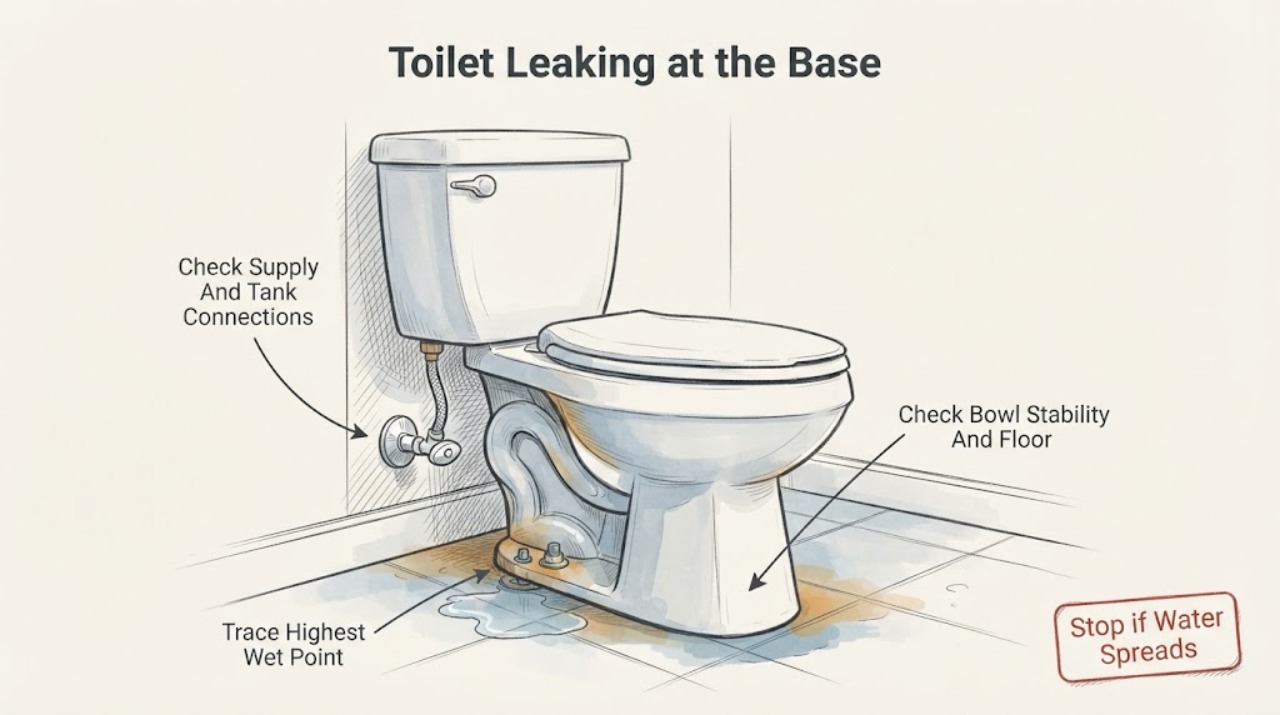
Work through in order
Diagnostic checks
Use only checks that match the exact appliance or system and its official guide.
-
Check 1
Turn off nearby bathroom water use, dry the toilet, supply connection, tank underside, bowl sides, and floor around the base, then place separate dry towels at the supply connection and around the base before observing a normal refill and, only if safe, one flush.
Expected result: Record which towel becomes wet first: the shutoff or supply connection, tank-to-bowl joint, bowl side or rim, front or rear base seam, or the floor with no visible path from above; note whether the leak occurs during refill, only during a flush, or continuously.
Next step: Keep the photos and timing, then follow the branch for the first wet point; stop flushing if the base or floor becomes wet or the source cannot be safely contained.
Stop if: Stop immediately for sewage, a rapidly spreading leak, soft or collapsing flooring, a cracked bowl or tank, water entering the ceiling below, or any need to handle contaminated water without suitable protection.
Why this matters
Why: A high wet point that runs down suggests a supply, tank, or bowl leak rather than a floor seal. Water that starts at the base during a flush makes the wax seal, flange, bowl outlet, or a crack more likely; continuous water after the supply is closed needs urgent isolation and further diagnosis.
-
Check 2
With the tank dry and the shutoff accessible, inspect the supply-line nut, shutoff valve, tank inlet, tank-to-bowl joint, and visible tank hardware from ordinary access; use a dry tissue or towel to locate the first drop without forcing a fitting.
Expected result: Classify the leak as starting at the supply connection, the tank inlet, the tank-to-bowl joint, the tank hardware, or nowhere above the base; record whether the first drop appears while the tank fills or only after flushing.
Next step: If a user-accessible connection is the clear source, close the shutoff and follow the Glacier Bay model guide for compatible sealing or service; if water still appears at the base or the source is uncertain, leave the toilet off and arrange plumbing diagnosis.
Stop if: Do not overtighten tank, supply, or floor hardware, remove ceramic parts under tension, or continue testing a cracked tank, bowl, valve, or supply line.
Why this matters
Why: A refill-time leak at an upper connection can travel to the floor and mimic a base leak. A dry upper assembly with water emerging from the base after a flush keeps the floor seal, flange, or bowl outlet in focus. A cracked ceramic part is a fixture-replacement or service issue, not a tightening problem.
-
Check 3
Without leaning hard on the bowl or trying to tighten bolts, observe whether the toilet rocks, sits unevenly, has a visible gap at the floor, or rests over a floor that looks swollen, stained, soft, or damaged.
Expected result: Record the bowl as stable and dry, stable with a visible base leak, rocking or uneven, or supported by a damaged or uncertain floor; note any broken bolt cap, exposed mounting hardware, or visible flange edge.
Next step: Do not use a rocking toilet. Close the shutoff, protect the floor, and have a plumber assess the bowl, flange, seal, and supporting floor before the toilet is reset.
Stop if: Do not rock, lift, pry, shim aggressively, or tighten floor nuts until the porcelain flexes; do not cover a moving or leaking base with caulk.
Why this matters
Why: A rocking or uneven bowl can disturb the wax seal and may indicate a flange, mounting, shim, or subfloor problem. A stable bowl with a flush-only base leak still needs the seal and flange checked; a soft floor or damaged flange expands the repair beyond replacing a seal.
-
Check 4
After the outside is dry, observe the toilet without flushing for a period of normal use and compare the pattern with a controlled refill; do not pour water around the base or use a chemical dye on the floor.
Expected result: Record whether moisture returns with no flush, only during refill, only during flushing, or only after bathing or cleaning; note whether the water is clear and surface-limited or has a sewage odor or discoloration.
Next step: Stop using the toilet for any flush-linked or contaminated leak; for moisture that is clearly from another source, correct that source and recheck the dry base before assuming a toilet-seal failure.
Stop if: Do not continue use when moisture reaches flooring, the ceiling below, electrical equipment, or a neighboring room, or when the water may be sewage.
Why this matters
Why: Moisture that returns without a flush may be condensation, a supply or tank leak, or water from another fixture. A flush-linked, odorous, or discolored leak at the base is more consistent with a waste-seal, flange, bowl, or drain-path problem and should not be treated as condensation.
-
Check 5
If the upper connections are dry and the leak is linked to flushing or the toilet has moved, close the shutoff, keep the toilet out of service, and have the bowl removed only under the exact Glacier Bay instructions or by a qualified plumber so the wax seal, bowl outlet, flange, bolts, and floor can be inspected.
Expected result: The inspection should establish whether the seal is compressed, displaced, or damaged; whether the flange is cracked, loose, low, or not secured; whether the bowl outlet or porcelain is damaged; and whether the floor is sound and level.
Next step: Replace or reset only the components confirmed by the model-specific instructions and inspection, then perform a controlled connection and flush leak check before returning the toilet to service.
Stop if: Do not lift a heavy fixture alone, leave an open flange unprotected, scrape or alter the drain connection, force mounting hardware, or reuse a seal that has been compressed or disturbed.
Why this matters
Why: A damaged or disturbed seal can explain a flush-only base leak, but a failed flange, unstable floor, or cracked ceramic must also be corrected or the leak may return. The symptom does not justify selecting a seal or flange part before the model and installation are known.
Use your observations
Decision map
Find the observation that best matches what you see, then follow the next safe action.
-
PATH 01Safety boundary
What you see
The first wet point is the supply connection, tank inlet, tank-to-bowl joint, or another point above the base, and no water starts at the base during a flush.
Do this next
Close the shutoff, follow the exact Glacier Bay guide for the identified connection, and recheck with the floor dry; call a plumber if the connection is damaged, inaccessible, or still leaks.
Why this path and its safety boundary
Why it matters: The apparent base leak is likely water tracking down from an upper connection rather than a failed floor seal.
Safety stop: Do not overtighten ceramic-tank hardware or keep operating with a cracked tank, bowl, valve, or supply line.
-
PATH 02Safety boundary
What you see
The upper connections remain dry, the bowl is stable, and water appears at the base only during or immediately after flushing.
Do this next
Stop using the toilet, close the shutoff, protect the floor, and arrange a seal, flange, bowl, and floor inspection; do not mask the leak with caulk.
Why this path and its safety boundary
Why it matters: A disturbed wax seal, bowl outlet, floor flange, or drain connection is more likely than condensation or a tank leak.
Safety stop: Do not continue flushing, lift or rock the bowl, or reuse a compressed seal.
-
PATH 03Safety boundary
What you see
The toilet rocks, the floor is soft or swollen, the flange or bolts are damaged, or the bowl or tank has a crack.
Do this next
Keep the toilet out of service and have a plumber assess the fixture, flange, fasteners, floor, and any area below before selecting replacement parts.
Why this path and its safety boundary
Why it matters: The problem is not limited to a seal. Movement or structural damage can break a new seal and can allow water damage to continue.
Safety stop: Do not tighten until porcelain cracks, wedge improvised shims under the bowl, or use the toilet while the support is unstable.
-
PATH 04Safety boundary
What you see
Moisture returns without flushing, follows bathing or cleaning, or has sewage odor/discoloration, and the actual source is not clear.
Do this next
Stop using the toilet if the water may be sewage or reaches the floor assembly, isolate the water source, dry and protect the area, and arrange plumbing and water-damage assessment.
Why this path and its safety boundary
Why it matters: The water may be condensation or another bathroom leak, but odor, discoloration, or an uncertain path makes contamination and concealed water damage possible.
Safety stop: Do not wipe contaminated water with bare hands, pour water around the base to test it, or keep using the fixture because the leak is intermittent.
Helpful context
Understand the symptom
Confirm that the water is really coming through the base
Water at the front edge of a toilet can start at the supply connection, tank-to-bowl joint, flush valve, bowl rim, or floor seal and then travel under the bowl. Dry the porcelain and floor completely, place a dry towel in separate sections around the supply connection and base, and watch during a flush and refill. A leak that starts high and runs downward is not proof of a failed wax ring. A leak that appears at the base only when the toilet is flushed makes the waste-seal or flange path more likely.
The base seal depends on a stable, correctly seated toilet
The Glacier Bay guide shows the wax ring seated at the bowl outlet, the bowl aligned over the floor flange and bolts, and the mounting surface clean and level. Kohler's installation guidance similarly warns not to rock or lift a toilet after placement because the wax seal can break. If the bowl moves, the floor feels soft, the flange is damaged, or the seal has already been disturbed, a surface bead of caulk cannot restore the drain connection. Keep the toilet out of service until the seal, flange, and supporting floor can be assessed.
Protect the floor while you decide whether service is needed
A base leak can carry contaminated water into flooring or the ceiling below. Close the toilet's shutoff valve if the leak is active or the source is uncertain, flush only if needed to empty the bowl safely, and keep towels or a container in place without reaching into contaminated water. EPA leak guidance recommends finding the source rather than letting a leak continue unnoticed. Do not remove the bowl unless you can safely isolate the water, handle the fixture, protect the flange opening from sewer gas, and follow the exact model and local plumbing requirements; otherwise call a plumber.
Safety boundary
Stop conditions
- Stop using the toilet for a flush-linked base leak, sewage odor or discoloration, a rapidly spreading leak, a rocking bowl, a cracked bowl or tank, soft or swollen flooring, or water reaching the ceiling below.
- Close the toilet shutoff when the leak is active or the source is uncertain, and do not keep flushing to see whether the leak gets worse.
- Do not overtighten floor or tank hardware, rock or lift the bowl, force a damaged fitting, scrape a drain connection, or cover an active leak with caulk.
- Do not remove the toilet alone or leave an open floor flange unprotected; use qualified plumbing service when the seal, flange, floor, drain, or ceramic fixture must be exposed.
Only after diagnosis
Potential parts
- toilet wax ring or approved waste seal
Consider this category only after a flush-linked base leak is confirmed and inspection shows the existing seal is displaced, compressed, or damaged.
Confirm the exact Glacier Bay model, floor-flange arrangement, seal style, and manufacturer's installation instructions before selecting a replacement. - toilet floor flange and mounting hardware
Consider this category only when inspection finds a cracked, loose, low, or poorly supported flange or damaged mounting hardware contributing to movement or leakage.
Confirm the drain material, flange configuration, finished-floor height, local plumbing requirements, and exact repair method; do not assume a universal part will fit. - toilet water-supply line or shutoff connection
Consider this category only if the first wet point is the supply line, shutoff, or tank inlet during refill rather than the waste seal at the base.
Confirm the connection type, length, shutoff condition, and Glacier Bay model requirements before replacing the line; do not overtighten a ceramic or compression connection. - toilet bowl or tank sealing gasket
Consider this category only when water is proven to start at the tank-to-bowl joint or another model-specific gasket rather than at the floor seal.
Confirm whether the toilet is one-piece or two-piece and verify the exact model and gasket arrangement before ordering or disassembling the fixture.
When checks do not resolve it
Need a professional?
Arrange qualified plumbing service when water starts at the base during flushing, the bowl rocks, the floor or flange is damaged, the leak source remains uncertain, a ceramic part is cracked, the seal has been disturbed, or moisture may have reached the floor assembly or ceiling below. Provide the Glacier Bay model number if available, leak photos, first wet point, flush/refill timing, and any prior installation or repair history.
Safety scope: This article supports drying, tracing the first wet point, closing the shutoff, and ordinary visual inspection. It does not authorize contaminated-water cleanup without protection, heavy-fixture lifting alone, drain alteration, forced hardware, or an improvised seal or flange repair.
Common questions
FAQ
Why is my Glacier Bay toilet leaking at the base only when flushed?
If the supply line, tank, and bowl sides stay dry and water starts at the base during a flush, a disturbed wax seal, bowl outlet, floor flange, or drain connection is more likely. Stop flushing, close the shutoff, and arrange an inspection rather than sealing over the seam.
Could a supply-line leak look like a toilet base leak?
Yes. Water can start at the shutoff, supply connection, tank inlet, or tank-to-bowl joint and run down the porcelain or floor. Dry the fixture and use separate towels to find the first wet point during refill before concluding that the floor seal failed.
Can I tighten the bolts to stop a Glacier Bay toilet leak?
Do not tighten by feel until the porcelain flexes. A rocking bowl may involve the seal, flange, floor, or mounting, and overtightening can damage the toilet. Close the shutoff and have the assembly assessed if the bowl moves or the base remains wet.
Does caulk around the toilet base fix the leak?
Caulk cannot repair a failed waste seal, damaged flange, cracked bowl, or wet floor below the toilet. Find and correct the source first; covering an active leak can hide water damage and delay diagnosis.
When should I stop using the toilet and call a plumber?
Stop for a flush-linked base leak, sewage odor or discoloration, a rocking bowl, cracked ceramic, soft or swollen flooring, a rapidly spreading leak, or water reaching the level below. Also call when the source is uncertain or the seal, flange, drain, or floor must be exposed.
Read the exact guide
Official sources
- Installation Guide: Toilet with Cleansing SeatKohler Co. · Kohler installation guide used for general floor-mounted toilet seal and stability mechanics; the installed Glacier Bay model guide and local requirements control.
- Glacier Bay N2441E Use and Care Guide: High Efficiency Elongated Dual Flush ToiletGlacier Bay · Opened Glacier Bay manufacturer guide for model N2441E; other Glacier Bay models and configurations can differ, so the exact model guide controls.
- How to Install a ToiletKohler · General Kohler installation guidance used for toilet-seal decision logic; exact Glacier Bay model instructions and local plumbing requirements control.
- Fix a Leak WeekU.S. Environmental Protection Agency WaterSense · U.S. EPA WaterSense household leak guidance; it helps identify water loss but does not replace toilet-specific installation instructions or plumbing diagnosis.
Community feedback
Share a repair observation
Share a plain-text repair observation. Accepted observations are published automatically; this page may take a moment to update.