
On this page
Start here
Quick answer
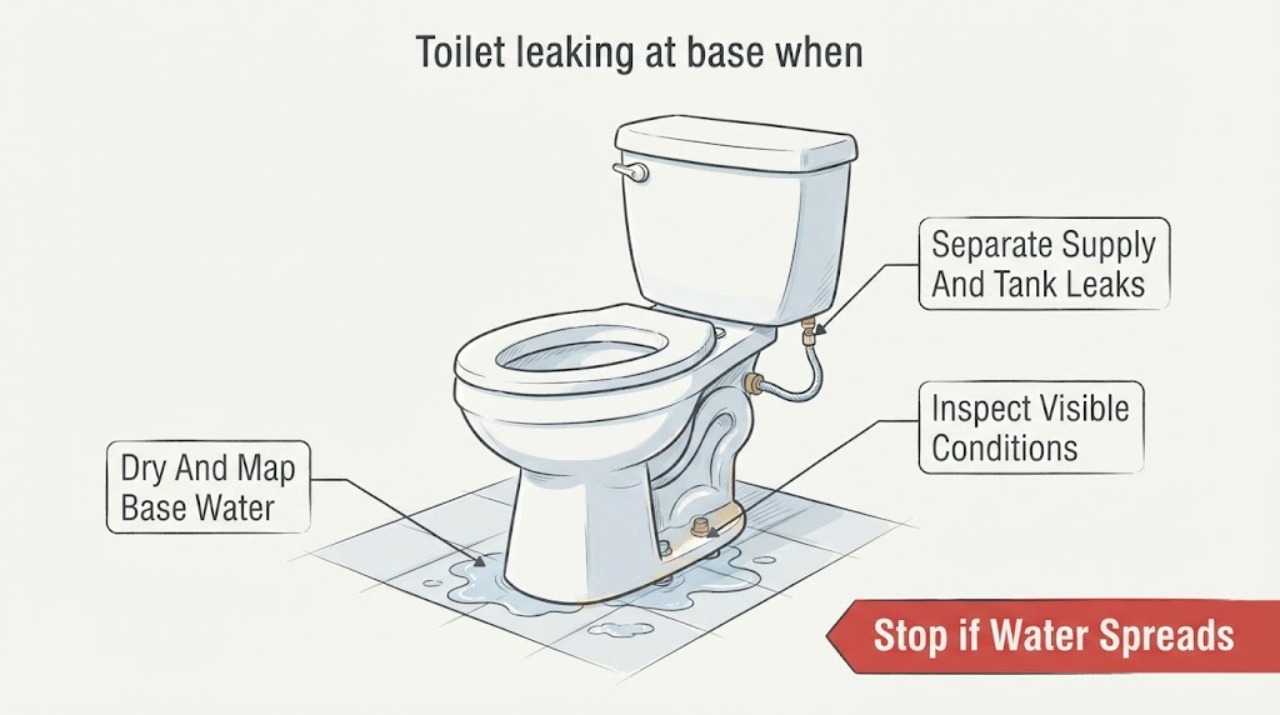
Water at the toilet base is not automatically a failed wax seal: it may be condensation, a supply connection, tank-to-bowl leakage that runs down the outside, or a bowl-to-floor seal/flange problem. First stop unnecessary flushing, dry the floor, and use paper towel strips to identify whether water returns at the supply connection, tank/bowl seam, bowl base, or only after a flush. Gently observe whether the bowl rocks; do not force it or tighten mounting nuts by guesswork, because porcelain and the flange can crack. A stable bowl with water appearing only after flushing makes the bowl-to-floor seal, flange, or drain connection more likely; a rocking bowl means the mounting/seal assembly may be moving and needs plumbing service even if the leak is small. Keep using the toilet only long enough to prevent an urgent sanitation problem if no water is escaping, but otherwise close the supply valve gently and stop flushing until a plumber assesses it. Any crack, sewage odor or waste-water leak, spreading floor damage, ceiling stain below, stuck shutoff, or water near electrical equipment is a stop-and-service condition.
Work through in order
Diagnostic checks
Use only checks that match the exact appliance or system and its official guide.
-
Check 1
Stop unnecessary flushing, dry the floor and the lower porcelain with paper towels, then place separate dry paper-towel strips at the supply connection, tank/bowl seam, around the bowl base, and beside the shutoff; do not caulk or move the toilet.
Expected result: Record which strip becomes wet first, whether water appears only after a flush, whether the water is clear or has a sewage odor, and whether the floor remains wet with no use.
Next step: Use the water-path result to choose the matching branch and keep the area dry. Close the toilet supply gently if water is spreading or the source cannot be controlled.
Stop if: Do not continue if the bowl or tank is cracked, waste water is present, water reaches electrical equipment, the floor is soft, or the supply stop or connection is spraying.
Why this matters
Why: Water first appearing at the supply or tank seam points above the base. Water returning at the bowl foot during/after a flush makes the bowl-to-floor seal, flange, or drain connection more likely. Persistent clear moisture with no flush may be condensation or a supply leak; foul or waste-water contamination raises the sanitation urgency.
-
Check 2
From a standing position, observe whether the bowl shifts relative to the floor during ordinary use; if it must be checked, apply only light hand pressure to the porcelain without rocking it hard, lifting it, or leaning your body weight against it.
Expected result: Record a stable bowl, slight movement at the base, obvious rocking, a bowl that shifts with a wet seal, or cracking/creaking from the porcelain or floor.
Next step: Do not tighten nuts or add shims as a blind repair. Photograph the movement and arrange plumbing service, especially when rocking and base leakage occur together.
Stop if: Stop touching the bowl if it shifts suddenly, the porcelain cracks, the floor flexes, or water appears underneath; keep people off the toilet until assessed.
Why this matters
Why: A stable bowl narrows attention to the water path and seal/flange condition. Any movement means the mounting, floor, flange, or seal relationship may be compromised; movement can worsen the leak even when the bowl looks intact. Cracking or creaking is an immediate stop condition.
-
Check 3
With the water off only if the supply stop operates normally, inspect externally for droplets at the shutoff, supply line, tank bolts, tank-to-bowl seam, and flush-handle side; do not loosen fittings or remove the tank.
Expected result: Record a wet supply connection, water at the tank/bowl seam, a dry upper assembly with water only at the base, or no visible source.
Next step: If an upper connection is clearly leaking and the stop can be closed without force, isolate it and request plumbing service. If the upper path is dry, keep the toilet out of service until the base is assessed.
Stop if: Do not use pliers on a stuck shutoff, tighten porcelain-mounted hardware, remove tank bolts, or continue if the tank/bowl is cracked or water is uncontrolled.
Why this matters
Why: An upper leak can run down and imitate a base leak. A dry tank and supply path with base water that follows flushing shifts suspicion toward the bowl-to-floor seal, flange, or drain connection. No visible source requires controlled service diagnosis rather than tightening every accessible nut.
-
Check 4
After the area is dry and only when there is no overflow or active hazard, note whether moisture returns after a single normal flush versus during a period with no use; do not repeat flushes to force a leak.
Expected result: Record water that appears immediately after flushing, water that appears with someone sitting or shifting the bowl, slow moisture with no use, or no return of water.
Next step: Keep the toilet out of service when base water returns or the bowl moves, and give the timing to the plumber. If moisture returns without use, close the supply if safe and investigate no further beyond visible checks.
Stop if: Do not perform repeated flush tests, stand on the bowl, lift the toilet, or continue where sewage odor, floor damage, cracking, or water near electrical equipment is present.
Why this matters
Why: Flush-linked water makes the outlet seal, flange, drain connection, tank-to-bowl path, or bowl crack more likely. Movement-linked water makes a rocking bowl or compromised seal more concerning. No-use moisture points toward a supply leak, condensation, or concealed water source rather than a flush-only seal.
-
Check 5
If water continues at the base, close the toilet's supply stop gently only if it turns normally, place absorbent material around—not under or inside—the bowl, and inspect the nearby floor and ceiling below for swelling, staining, or softness without moving the fixture.
Expected result: Record a shutoff that stops tank refilling, a stop that leaks or will not turn, water spreading beyond the base, a damaged floor/ceiling below, or no accessible way to isolate the toilet.
Next step: Keep the fixture out of service and request prompt plumbing service. Use the home's main shutoff only if it is safely identified and can be operated without force; seek building or electrical help if water reaches those systems.
Stop if: Do not force the shutoff, disconnect the supply line, pull the toilet, pry up flooring, or touch electrical equipment in wet areas.
Why this matters
Why: A normal shutoff can limit additional water while service is arranged. A stuck or leaking stop, spreading water, soft floor, or ceiling stain indicates that the leak may be causing building damage and should not be managed by continued toilet use.
-
Check 6
Prepare a service handoff with toilet make/model if visible, bowl stability, first wet location, flush/no-use timing, water appearance or odor, supply-stop condition, photographs, and any floor, ceiling, crack, or sanitation symptoms.
Expected result: Confirm that the record contains external observations only and that the bowl, mounting hardware, flange, seal, tank, and supply fittings were not forced or removed.
Next step: Keep the supply closed when needed and arrange qualified plumbing inspection. Do not order a seal or attempt to stabilize a rocking bowl until the installation and model are verified.
Stop if: Stop all homeowner work when the next step requires lifting the toilet, removing mounting nuts, exposing the flange, replacing a seal, repairing flooring, or working on concealed drain piping.
Why this matters
Why: The pattern helps a plumber distinguish an upper supply or tank leak from a bowl-to-floor seal, flange, drain, bowl, floor, or mounting problem and choose a model-appropriate repair path.
Use your observations
Decision map
Find the observation that best matches what you see, then follow the next safe action.
-
PATH 01Next step
What you see
The first wet paper strip is at the supply connection, shutoff, tank/bowl seam, or upper porcelain rather than at the bowl foot.
Do this next
Close the supply gently if it operates normally, do not tighten porcelain-mounted hardware, and arrange plumbing service for the leaking connection or tank assembly.
-
PATH 02Next step
What you see
The bowl remains stable, upper connections stay dry, and water returns at the base during or shortly after one flush.
Do this next
Keep the toilet out of service and arrange plumbing inspection. Do not add caulk, remove the bowl, or buy a seal based only on the visible water.
-
PATH 03Next step
What you see
The bowl rocks or shifts and the base becomes wet, especially when someone sits down or after flushing.
Do this next
Stop using the toilet, keep people off it, and arrange prompt plumbing service. Do not overtighten nuts or wedge an improvised shim under the bowl.
-
PATH 04Next step
What you see
The bowl is stable and dry at the base after a controlled check, but moisture returns during no-use periods or near a cold porcelain surface.
Do this next
Observe only from safe, dry positions, close the supply if water continues and the stop works normally, and arrange plumbing diagnosis if moisture persists or the floor is affected.
-
PATH 05Next step
What you see
The tank or bowl is cracked, the floor is soft/swollen, water stains the ceiling below, the leak spreads, or waste water/odor is present.
Do this next
Close the supply if safe, stop using the toilet, keep people away from contaminated or damaged areas, and obtain prompt plumbing/building service.
-
PATH 06Next step
What you see
The shutoff will not turn, leaks when operated, water reaches electrical equipment, or the fixture cannot be isolated while the base leak continues.
Do this next
Keep clear, use the safest known main shutoff only if it can be operated without force, and obtain urgent plumbing help; use qualified electrical or emergency assistance when electrical equipment is wet.
Helpful context
Understand the symptom
Find the water path before blaming the base seal
Water that appears around the foot of a toilet can travel from above. A loose supply connection, condensation, a tank-to-bowl leak, or a flush-valve leak can run down the porcelain and collect at the base. A true bowl-to-floor seal or flange problem is more likely when the base becomes wet during or immediately after a flush, especially if the bowl moves. Dry the area and observe one controlled event only; do not keep flushing a leak to make the pattern clearer.
Rocking and stable bowls lead to different service clues
A stable bowl with a wet base still needs attention, but the seal, flange, or drain connection may be leaking without visible movement. A rocking bowl can flex the seal and mounting relationship each time someone sits down or flushes. Delta notes that floor irregularities can make a bowl rock and that leveling is part of installation; it also cautions that sealing the bowl to the floor can make leaks harder to detect. Do not hide the leak with caulk or try to stabilize the bowl by overtightening hardware.
A base leak may expose a floor or sanitation problem
The seal between the toilet outlet and floor flange is a serviceable installation component, not a surface patch. American Standard describes wax-ring products as the sealed connection to the floor flange, but the appropriate seal depends on the toilet and installation. If the bowl has to be lifted, the flange inspected, the floor dried and repaired, or the bowl remounted, that is plumber work. Keep the area dry and protect the floor while you arrange service rather than adding a new seal around a toilet that has not been diagnosed.
Safety boundary
Stop conditions
- Do not keep using or repeatedly flushing a toilet with water returning at its base, a rocking bowl, a crack, sewage odor, waste-water leak, soft floor, or spreading damage.
- Do not overtighten bowl hardware, add caulk as a seal repair, lift or move the toilet, expose the flange, disconnect the supply line, or force a stuck shutoff as a homeowner.
- Stop immediately for uncontrolled water, a cracked or shifting fixture, water near electrical equipment, ceiling/floor damage, or contaminated water; close the supply only if it operates normally and arrange prompt qualified service.
Only after diagnosis
Potential parts
- toilet-to-floor seal
Consider this only after a qualified plumber confirms that the bowl-to-floor seal is leaking and the flange, bowl outlet, floor, and installation conditions are suitable for resealing.
Confirm the exact toilet outlet, floor flange condition, seal type, and installation requirements before selecting a replacement. - closet flange or flange repair component
Consider this only if service finds a damaged, loose, low, or otherwise unsuitable floor flange contributing to movement or leakage.
The plumber must verify flange material, floor construction, outlet size, bowl alignment, and local installation requirements. - toilet supply stop or supply connector
Consider this only when the visible supply stop or connector is confirmed to be the source, damaged, leaking, or unable to isolate the toilet.
Confirm the existing connection, pipe type, shutoff configuration, and local plumbing requirements before replacement.
When checks do not resolve it
Need a professional?
Call a qualified plumber for any water returning at the toilet base, a bowl that rocks, a flush-linked base leak, an uncertain water path, a leaking or stuck shutoff, or any repair requiring the toilet to be lifted, the flange inspected, the seal replaced, or flooring/drain piping assessed. Seek prompt or urgent help for a cracked tank or bowl, waste-water or sewage odor, spreading floor damage, ceiling staining below, uncontrolled water, or water near electrical equipment.
Have this ready
- Provide the toilet make/model if visible, first wet location, flush/no-use timing, bowl stability, water appearance or odor, supply-stop status, photographs, and any crack, floor, ceiling, sanitation, or electrical-water symptoms.
Common questions
FAQ
Does water around the toilet base always mean the wax seal failed?
No. Water can travel from the supply connection, tank-to-bowl seam, or condensation. Dry the area and use paper towels to identify the first wet location and whether it returns after one flush. A true base leak still needs plumbing assessment.
Can I use a toilet that leaks at the base if the bowl is stable?
Avoid continued use when water returns at the base, especially after flushing. A stable bowl does not rule out a failed seal, flange, drain connection, or hidden floor damage. Keep the supply closed when needed and arrange a plumber.
What does a rocking toilet bowl mean?
Movement can involve the bowl mounting, floor, flange, or bowl-to-floor seal. It can worsen a leak even when the porcelain looks intact. Do not overtighten hardware or wedge an improvised shim; have a plumber inspect it.
Should I caulk around a leaking toilet base?
No. Caulk can hide where water is escaping and does not repair a seal, flange, bowl, or floor problem. Find the water path, keep the area dry, and arrange qualified plumbing service.
When should I shut off the toilet supply?
Close the supply gently if it turns normally and water is spreading, the base leak continues, the fixture is cracked, or the floor is being damaged. Do not force a stuck or leaking shutoff; request urgent plumbing help instead.
Read the exact guide
Official sources
- Toilets - Service & Parts FAQDelta Faucet · Delta installation FAQ used for general bowl-stability reasoning; it does not authorize a homeowner to lift or remount a leaking toilet.
- Home MaintenanceU.S. Environmental Protection Agency WaterSense · EPA WaterSense household maintenance guidance used for general leak-identification context; base leaks and fixture repairs require plumbing assessment.
- 3 Quick Fixes for Common Toilet ProblemsDelta Faucet · Delta consumer toilet guidance used for general symptom triage and stop boundaries; exact toilet model and local plumbing practice govern repair.
- What Type Of Wax Ring Should I Use?American Standard · American Standard consumer guidance used to explain the bowl-to-flange sealing boundary; it is not a diagnosis of this toilet's leak.
Community feedback
Share a repair observation
Share a plain-text repair observation. Accepted observations are published automatically; this page may take a moment to update.