
On this page
Start here
Quick answer
When an A. O. Smith gas water heater has no hot water, first confirm the symptom at more than one faucet, then use the exact model manual to check the gas-control status, pilot, and burner through the designed viewing area. A pilot that is out, a status light that does not behave as the manual describes, a burner that never ignites, a burner that drops out, or a tripped air or thermal safety points to different service paths. Do not open the combustion chamber, test gas pressure, bypass a safety, or relight after a gas smell. If the pilot will not stay lit, the burner is dirty or damaged, venting is abnormal, carbon monoxide is suspected, or the problem returns after a manual-approved reset, stop and arrange qualified water-heater service.
Before you begin
Safety first
- Do not open the combustion chamber, test gas pressure, bypass a safety, alter venting, work on energized wiring, relight after gas odor, or restore gas operation before the tank and burner system are confirmed safe.
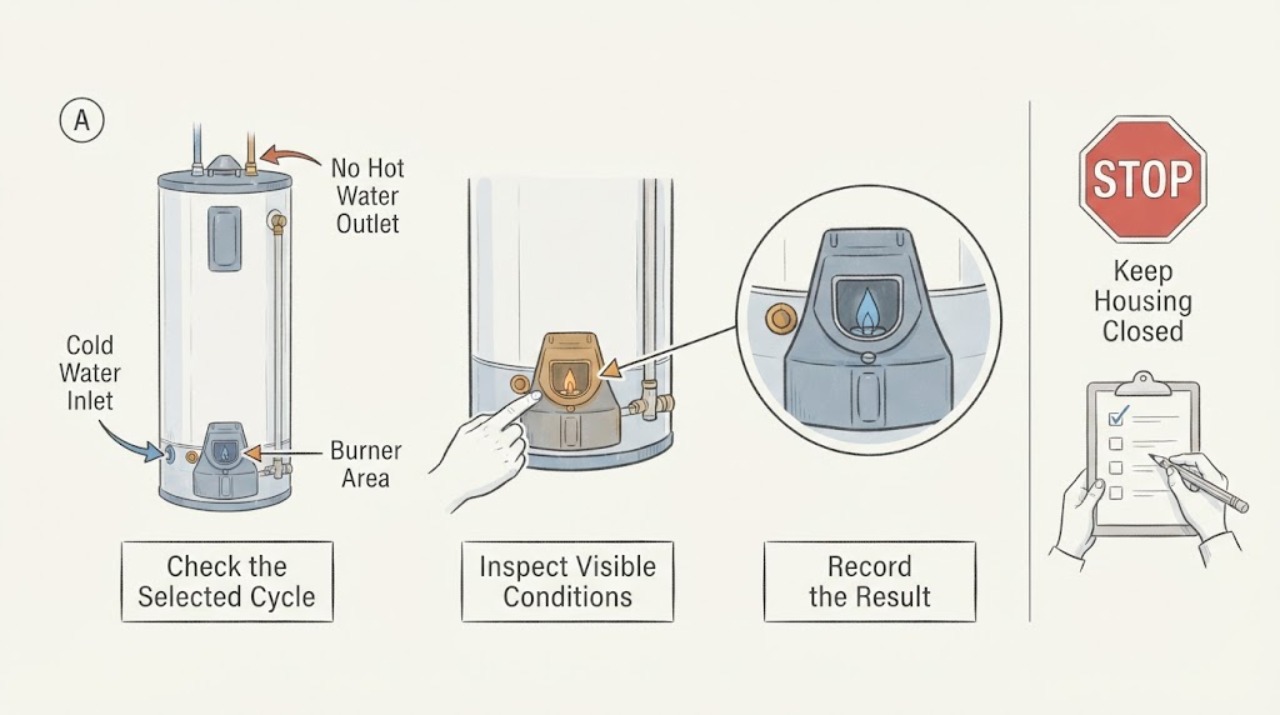
Work through in order
Diagnostic checks
Use only checks that match the exact appliance or system and its official guide.
-
Check 1
Confirm the symptom without opening the heater. Check hot-water availability at more than one faucet after allowing the system's normal recovery period, and identify whether the water is cold everywhere or only at one fixture. Avoid touching water that may be unexpectedly hot and do not remove any burner or control cover.
Expected result: All fixtures are cold, one fixture is cold while others have hot water, hot water returns after recovery, or the water is dangerously hot rather than cold.
Next step: If the symptom is not system-wide, arrange plumbing diagnosis for the affected fixture. If all fixtures are cold, continue only with external, model-approved indicators and keep the heater's safety boundary in view.
Why this matters
Why: Cold water at every fixture keeps the heater's ignition, fuel, safety, or control path in scope; a single cold fixture points to local plumbing or mixing hardware. A dangerously hot result is a scalding-control problem, not a reason to increase the heater setting.
-
Check 2
Identify the exact model, fuel configuration, gas-control type, and status-light or display behavior from the rating label and manual. Observe the pilot and burner only through the designed viewing window or indicator, without removing an inner door, reaching into the combustion area, or disturbing wiring or tubing.
Expected result: The pilot is lit and the status indicator is normal, the pilot is out, the indicator is dark or flashing an abnormal pattern, or the burner never starts when heat is called for.
Next step: Record the indicator pattern and model number. Follow only the exact manual's low-risk observation or pilot-lighting instructions; do not guess a fault code or open the burner assembly.
Why this matters
Why: The pilot and indicator state select different manual troubleshooting paths. An abnormal status can indicate an electrical, gas-control, thermopile or safety condition; a pilot that is lit but a main burner that never starts needs more than a temperature-dial change.
-
Check 3
If the pilot is out and there is no gas smell, review the lighting label and exact model manual before attempting any relight. Stop immediately if the pilot will not light as directed, goes out when the control is released, or the heater shows an unexpected status pattern; do not make repeated attempts beyond the manual's procedure.
Expected result: The pilot lights and remains lit, the pilot will not light, the pilot lights but goes out, or gas odor appears during or after the attempt.
Next step: For a successful manual-approved relight, observe whether the main burner starts as the manual describes. For a failed relight, recurring dropout, or any gas odor, turn the control to the safe position if the manual allows, leave the area as appropriate, and arrange qualified service.
Why this matters
Why: A pilot that remains lit allows the manual's next burner check; a pilot that will not light or will not hold can involve gas supply, ignition, flame-sensing, or a safety control. Gas odor changes the situation to an immediate gas-safety response.
-
Check 4
With the heater off and cool enough for a visual check, inspect only the accessible air-inlet screen, draft hood, and vent connection for obvious blockage, separation, damage, or objects stored around the heater. Do not remove the draft hood, use smoke or flame to test draft, clean a hidden burner, or modify venting.
Expected result: An air opening is blocked, the draft hood or vent is loose or damaged, the area is unobstructed, or the thermal or air-supply safety has tripped again.
Next step: Remove only an obvious object that is safely outside the heater and never block the opening. For a recurring safety trip, damaged or altered vent, soot, abnormal exhaust, or uncertain airflow, stop and arrange qualified gas-appliance service.
Why this matters
Why: A. O. Smith links thermal-switch trips with an air-supply problem and requires adequate combustion air and proper venting. A blocked, altered, or damaged vent can create combustion and carbon-monoxide risk; a clear exterior does not prove internal airflow is safe.
-
Check 5
Check the manual gas shutoff and the gas-control setting only from a safe standing position and only if you are confident identifying them. Do not loosen a gas connection, test pressure, remove a burner, or adjust a regulator. If the home has other gas appliances, note whether they also fail without manipulating their controls.
Expected result: The heater's shutoff is not in the manual's open position, other gas appliances also fail, the heater alone has no burner, or a gas smell is present.
Next step: If there is a suspected utility interruption, contact the gas utility or qualified service provider. For heater-only failure, abnormal flame, or any odor, leave gas-component diagnosis and repair to a qualified professional.
Why this matters
Why: A closed supply or broader gas interruption may explain a cold tank; a heater-only failure keeps the pilot, thermopile, thermal safety, gas control, or burner path in scope. Gas odor or uncertainty is not a troubleshooting result to work around.
-
Check 6
After a manual-approved pilot relight or external correction, observe one normal heating call through the viewing area without opening the burner compartment. Note whether the main burner ignites, burns steadily, drops out, or never starts, and stop if flame leaves the intended area or the venting sounds or looks abnormal.
Expected result: The burner ignites and remains stable, ignites then drops out, never ignites with a lit pilot, or shows soot, unusual flame, noise, or exhaust.
Next step: Do not relight repeatedly or adjust gas controls. Turn the heater to the safe state described by the manual and arrange qualified service for any unstable, abnormal, or absent burner operation.
Why this matters
Why: A stable burner supports a restored ignition sequence, but a burner that drops out or never starts can involve flame sensing, air supply, gas control, or burner condition. Soot, abnormal flame, or exhaust is a combustion-safety concern rather than a homeowner adjustment.
-
Check 7
Before any restart, verify from the exact manual that the water heater's tank is full, the drain valve and water connections are secure, and no wiring or covers are exposed. Restore operation only through the model's stated sequence, then monitor hot-water recovery without changing the setting to an unsafe level.
Expected result: The tank cannot be confirmed full, water connections leak, the pilot or burner remains abnormal, the heater recovers normally, or no hot water returns.
Next step: Do not restore gas operation when the tank is not full, a leak is present, or any gas, flame, vent, or safety abnormality remains. Arrange qualified plumbing or gas-appliance service and provide the recorded indicator pattern.
Why this matters
Why: A. O. Smith warns that a heater must be full before operation and that startup safety checks matter. Normal recovery after a manual-approved correction supports an ignition interruption; no recovery or a recurring fault needs diagnosis of the burner, control, gas supply, or another system component.
Use your observations
Decision map
Find the observation that best matches what you see, then follow the next safe action.
-
PATH 01Next step
What you see
The pilot is out, there is no gas odor, and it remains lit after the exact model's approved lighting procedure.
Do this next
Observe one normal heating call through the viewing area. If the burner does not start, drops out, or the pilot goes out again, stop and arrange qualified service.
Why this path and its safety boundary
Why it matters: A temporary pilot interruption or control-state issue is plausible, but the main burner still must ignite and remain stable before the heater is considered restored.
-
PATH 02Next step
What you see
The pilot will not light, will not stay lit, or the status indicator is abnormal after a manual-approved attempt.
Do this next
Do not bypass the safety or open the burner compartment. Keep the heater in the safe state described by the manual and arrange qualified gas-water-heater service.
Why this path and its safety boundary
Why it matters: Gas supply, ignition, flame sensing, thermopile, thermal safety, or gas-control trouble is more likely than a simple temperature-setting issue.
-
PATH 03Next step
What you see
The pilot is lit but the main burner never ignites when heat is called for.
Do this next
Record the model and status behavior and arrange qualified diagnosis. Do not adjust gas pressure, remove the burner, or substitute a control or burner from another model.
Why this path and its safety boundary
Why it matters: A gas-control, thermopile or flame-sensing, thermostat, fuel-supply, or burner-path fault is possible; visual symptoms cannot select the failed part.
-
PATH 04Next step
What you see
A thermal or air-supply safety trips again, the air screen is blocked, or the draft hood or vent is damaged or altered.
Do this next
Stop operation and arrange qualified gas-appliance service. Do not use smoke, flame, a fan, or an improvised vent repair to test or correct draft.
Why this path and its safety boundary
Why it matters: Combustion-air or venting trouble is more likely and can create carbon-monoxide or flame-spillage risk.
-
PATH 05Next step
What you see
The burner lights but drops out, burns irregularly, produces soot, or has abnormal flame, noise, or exhaust.
Do this next
Turn the heater to the safe state in the manual, leave the combustion area closed, and arrange qualified service. Leave immediately and follow local emergency guidance for gas odor or a carbon-monoxide alarm.
Why this path and its safety boundary
Why it matters: A flame-sensing, fuel, burner, combustion-air, or venting fault is more likely than a normal ignition cycle.
-
PATH 06Next step
What you see
Other gas appliances also fail, or the heater's gas shutoff is not in its normal open position, without any gas odor.
Do this next
Contact the gas utility or qualified service provider and do not dismantle any heater gas connection. Follow the provider's instructions before attempting a restart.
Why this path and its safety boundary
Why it matters: A broader fuel-supply interruption or closed shutoff is possible, but the utility or a qualified provider should confirm the cause.
-
PATH 07Next step
What you see
The tank is not confirmed full, water is leaking, gas odor is present, a carbon-monoxide alarm sounds, wiring or controls are exposed, or no hot water returns after a permitted correction.
Do this next
Leave the area as appropriate, keep the heater in its safe state, and arrange qualified plumbing or gas-appliance service. Do not restart, bypass a safety, open the burner chamber, or continue relighting attempts.
Why this path and its safety boundary
Why it matters: The condition exceeds a safe homeowner check and may involve scalding, gas, carbon-monoxide, electrical, pressure, or equipment-damage risk.
Helpful context
Understand the symptom
The pilot and burner are different observations
A gas water heater can have no hot water because the pilot is out, because the pilot does not hold, because a safety has interrupted operation, or because the main burner does not ignite or remain lit. Look only through the model's provided viewing area and use the status indicators described in its manual. A dark or irregular indicator is a clue for the manual's fault path, not permission to open the burner compartment or replace a gas component.
Gas and carbon-monoxide boundaries are immediate
If there is a gas smell, soot, flame outside the intended burner area, unusual exhaust, a blocked-looking vent, a carbon-monoxide alarm, or illness symptoms, leave the area and contact the appropriate emergency or qualified service provider. Do not operate switches that could ignite gas, perform a draft or pressure test, or keep trying to light the heater. Keep the draft hood and vent openings unobstructed and use the exact installation and owner instructions.
Safety boundary
Stop conditions
- Do not open the combustion chamber, remove the burner or gas valve, test gas pressure, bypass a thermal or flame safety, use a flame or smoke to test draft, or adjust gas controls as a routine homeowner check.
- Stop immediately for a gas smell, carbon-monoxide alarm, headache or other possible exposure symptoms, soot, flame outside the intended burner area, abnormal exhaust, damaged venting, exposed wiring, or a thermal or air-supply safety that trips again. Leave the area and use the appropriate emergency or qualified service provider.
- Do not restore gas operation until the exact manual's startup conditions are met, the tank is confirmed full, and the pilot, burner, venting, and connections are safe. A pilot or burner problem that returns after a manual-approved check needs qualified service.
Only after diagnosis
Potential parts
- A. O. Smith gas burner assembly
Consider only after qualified diagnosis identifies a damaged, obstructed, or failed burner assembly and rules out pilot, fuel, control, airflow, and venting causes.
Burner design and fuel configuration vary by A. O. Smith model. Confirm the exact model and professional diagnosis before selecting a replacement. - A. O. Smith gas control valve or thermostat
Consider only when qualified testing identifies a control fault after pilot, flame-sensing, fuel, air-supply, and venting checks.
Gas controls are safety-critical and model- and fuel-specific. Use the exact serial-based parts identification and qualified installation. - A. O. Smith thermocouple or thermopile
Consider only when qualified diagnosis links a pilot-dropout or flame-sensing symptom to that component and rules out gas, burner, and thermal-safety causes.
Sensing components and connections vary by gas-control system. Confirm the exact model and service diagnosis before ordering. - A. O. Smith air-screen or venting component
Consider only when qualified service identifies a damaged or model-specific air or venting component after confirming the installation and combustion-air path.
Draft hoods, screens, and vent parts are configuration- and code-sensitive. Do not modify or substitute them based on appearance alone.
When checks do not resolve it
Need a professional?
Arrange qualified plumbing or gas-appliance service when the pilot will not light or stay lit, the status indicator is abnormal, the main burner will not ignite or drops out, the thermal or air-supply safety trips, the air screen or vent is blocked or damaged, the flame is abnormal, gas or carbon monoxide is suspected, the tank is not full, or no hot water returns after the exact manual's permitted checks. Provide the model and serial information, fuel type, indicator pattern, pilot and burner observations, vent or air-opening findings, and any odor or alarm details.
Safety scope: Do not open the combustion chamber, test gas pressure, bypass a safety, alter venting, work on energized wiring, relight after gas odor, or restore gas operation before the tank and burner system are confirmed safe.
Common questions
FAQ
Why does my A. O. Smith gas water heater have no hot water?
Start by checking the pilot and status indicator through the designed viewing area and following the exact model manual. A pilot that will not hold, a burner that never ignites, a thermal or air-supply safety trip, a fuel interruption, or an abnormal gas-control signal leads to different diagnosis. Do not open the burner chamber or bypass a safety; arrange qualified service for recurring or abnormal behavior.
Can I relight the pilot on an A. O. Smith gas water heater?
Only if there is no gas odor and the exact model label or manual provides a relighting procedure you can follow safely. Stop for a failed or recurring pilot, abnormal status pattern, flame outside the viewing area, or any odor. Never bypass a thermal or flame safety or keep repeating attempts beyond the manual.
What if the pilot is lit but the gas burner does not ignite?
A lit pilot with no main burner can involve the gas control, flame sensing, fuel supply, thermostat, air supply, or burner path. Observe only through the intended viewing area, record the status behavior, and arrange qualified diagnosis. Do not adjust gas pressure or remove the burner assembly.
How can venting cause no hot water on an A. O. Smith gas heater?
A blocked or altered combustion-air or vent path can trip a safety and stop heating. Keep the draft hood and openings unobstructed and inspect only for obvious exterior blockage or damage. Do not perform an improvised draft test or modify the vent; a recurring safety trip, soot, abnormal exhaust, or carbon-monoxide concern needs qualified service.
Read the exact guide
Official sources
- How to Adjust Temperature on Gas Water Heater SafelyA. O. Smith · Official A. O. Smith information-center guidance for gas water-heater controls and common no-hot-water symptoms; exact model manual controls the lighting procedure.
- MECHANICAL RESIDENTIAL GAS VALVE TROUBLESHOOTINGA. O. Smith University · Official A. O. Smith University training guide for mechanical and electronic residential gas-valve troubleshooting; exact model manual and qualified service control repair work.
- When to Repair or Replace Your Water Heater | A.O. SmithA. O. Smith · Official A. O. Smith information-center troubleshooting guidance; model manuals and qualified professionals control repair and testing.
- How to Turn a Water Heater On & Off | A. O. SmithA. O. Smith · Official A. O. Smith startup and shutdown guidance; printed instructions for the exact model take priority.
- Technical Bulletins - Bulletin #187 Field Installation of Draft Hoods - Standard Gas Water HeatersA. O. Smith · Official A. O. Smith technical bulletin for standard gas-water-heater draft hoods; exact installation manual and applicable codes control any vent work.
Community feedback
Share a repair observation
Share a plain-text repair observation. Accepted observations are published automatically; this page may take a moment to update.