
On this page
Start here
Quick answer
If a Bradford White gas water heater has no hot water, first confirm whether the problem affects every hot-water outlet and whether the heater shows any normal operating indication through its intended viewing window or control display. A pilot that will not light or stay lit, a main burner that does not ignite, a burner that shuts off, a blocked combustion or vent path, a closed or interrupted gas supply, or a safety control fault can all stop heating. Bradford White directs homeowners with no hot water, pilot problems, or a leaking water heater to a plumbing professional, and its gas-water-heater instructions say not to repair the combination gas control, burner, or gas piping yourself. Do not repeatedly try to light the appliance, remove the burner door, bypass a safety control, adjust gas pressure, or test combustion. If you smell gas, hear hissing, see soot or abnormal flame, a CO alarm sounds, or anyone has headache, dizziness, weakness, nausea, chest pain, or confusion, leave the area and follow emergency and gas-supplier guidance. Otherwise record the model and visible status from a safe position and arrange qualified Bradford White service.
Before you begin
Safety first
- This article supports ordinary outlet comparison and dry exterior observation only. Do not operate gas controls, hand-light or reset an unverified model, remove burner doors or panels, test combustion, clear internal venting, bypass safety devices, or repair gas piping.
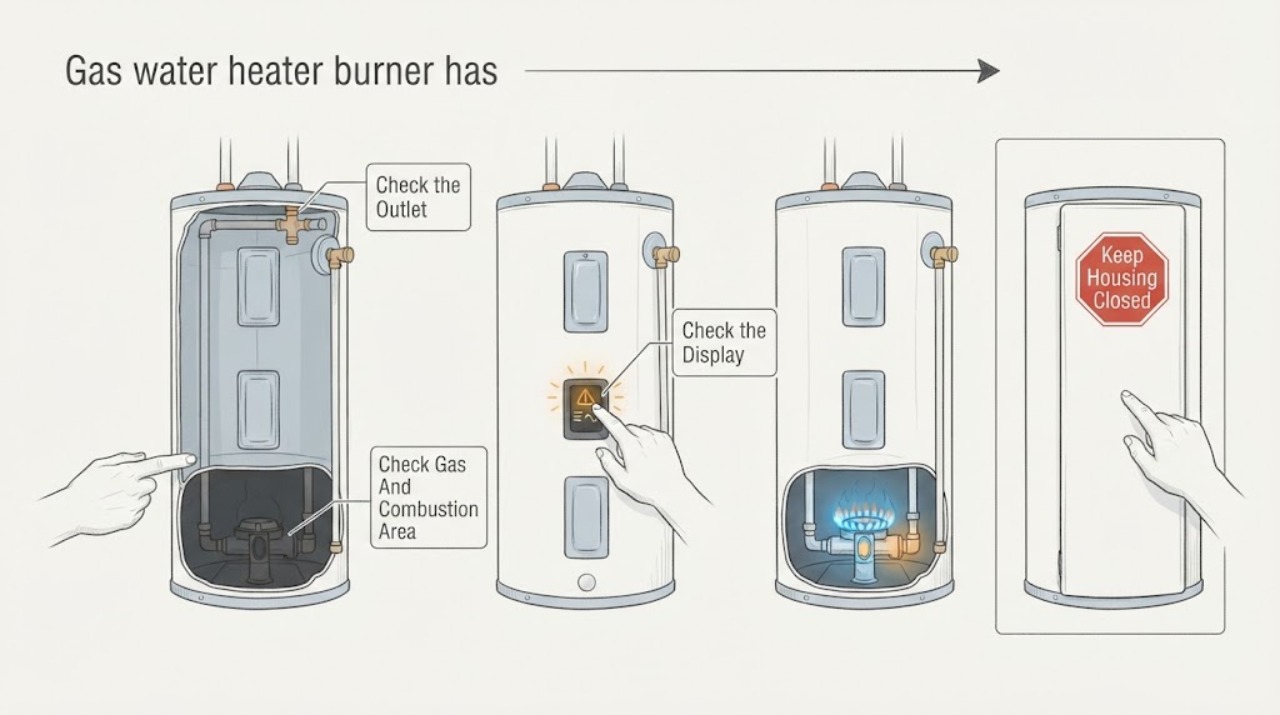
Work through in order
Diagnostic checks
Use only checks that match the exact appliance or system and its official guide.
-
Check 1
At two or more fixtures, use the hot side normally for a brief observation and compare the result with cold water; do not run the heater's controls or open any plumbing.
Expected result: Record whether every hot-water outlet is cold, only one outlet is cold, hot water is intermittent, or water is warm but not at the usual temperature. Note whether the heater has recently been used or installed.
Next step: If all outlets are cold, continue with safe exterior observations and arrange qualified service; if only one outlet is affected, have the fixture or building plumbing assessed separately.
Stop if: Stop if hot water is scalding, water is leaking, the area smells of gas, or the comparison requires entering a wet, confined, or unsafe equipment area.
Why this matters
Why: Cold water at only one fixture makes a faucet or mixing-valve issue more likely than a gas burner fault. Cold water everywhere makes the water heater, gas supply, ignition, burner, or safety controls more relevant. Intermittent warmth can indicate a control, ignition, or supply problem but does not identify a part.
-
Check 2
From a dry position, read the Bradford White rating plate and observe only the model's intended pilot sight window, indicator light, or display; do not remove a cover, burner door, or control.
Expected result: Record the model and serial information if legible, fuel marking, whether a pilot or indicator is visibly present, whether an indicator shows a fault pattern, and whether the heater is completely inactive or has a normal-looking status indication.
Next step: Give the model, serial number, visible status, and all-outlet temperature result to a Bradford White plumbing professional; do not use another model's lighting or diagnostic sequence.
Stop if: Stop for a damaged control, water on or under the unit, a missing or altered cover, a gas odor, soot, abnormal flame, or any need to open the combustion or control compartment.
Why this matters
Why: Model identity determines whether pilot observations and reset instructions apply. A fault indication, absent pilot where a pilot is expected, or no heating indication can narrow the service diagnosis, but a homeowner should not decode or bypass a safety control without the exact manual and professional guidance.
-
Check 3
Without touching gas controls or entering the burner compartment, observe from a safe distance whether the surrounding area has combustible materials, unusual soot, blocked visible air openings, damaged vent components, or signs that water has reached the controls.
Expected result: Record a clear area and intact visible venting, restricted or obstructed air path, soot or discoloration, water exposure, or any gas odor or hissing.
Next step: For any abnormal observation, leave the burner and controls untouched and arrange qualified service; if gas odor or combustion danger is suspected, leave the area and follow emergency gas guidance.
Stop if: Do not clear internal passages, remove the burner door, clean the burner, relight the pilot, adjust gas pressure, or operate the heater after flooding or suspected flammable vapor exposure.
Why this matters
Why: Restricted combustion air or venting, water exposure, soot, or abnormal sound can prevent safe burner operation or create a combustion hazard. A clear exterior does not prove that gas pressure, ignition, flame sensing, or internal combustion is correct.
-
Check 4
Use only ordinary household observations away from the heater to note whether other gas appliances operate normally; do not test a gas line, remove a connector, or change the water heater's gas-valve setting.
Expected result: Record whether other gas appliances are also unavailable, whether the home has a broader gas interruption, or whether only the Bradford White water heater has no heating indication.
Next step: Follow the gas supplier's instructions for a broader interruption and arrange qualified water-heater service for an isolated heater problem.
Stop if: Stop for any gas odor, hissing, suspected leak, abnormal flame, or need to manipulate a gas valve or pipe.
Why this matters
Why: A broader gas interruption makes a utility or supply issue more likely than an isolated burner part. If other appliances operate while the heater does not, the heater's ignition, control, burner, venting, or model-specific safety system remains the service focus; this observation cannot authorize gas-valve work.
-
Check 5
From a dry position, inspect the floor and exterior of the heater for flooding, leaks, corrosion, soot, or damage and note whether the unit may have been exposed to water; do not drain, remove panels, or operate the burner to test recovery.
Expected result: Record a dry and intact exterior, a leak or puddle, water at or above the control area, visible corrosion or damage, or evidence that the heater has been flooded.
Next step: Keep the heater out of service and arrange qualified inspection for any leak, flooding, or damage; provide photographs and the rating-plate information.
Stop if: Stop for water at the burner or controls, an active leak, flooding, hot spray, damaged venting, or any need to open the tank or control cabinet.
Why this matters
Why: A leak or water exposure can disable controls and create electrical, gas, or scalding hazards even when the original complaint is no hot water. Bradford White instructions say not to operate a unit after external parts or controls have been submerged; an intact dry exterior still does not prove burner operation.
Use your observations
Decision map
Find the observation that best matches what you see, then follow the next safe action.
-
PATH 01Safety boundary
What you see
Only one faucet or shower is cold while other hot-water outlets work normally.
Do this next
Arrange fixture or plumbing diagnosis and leave the Bradford White heater controls unchanged unless a separate heater symptom appears.
Why this path and its safety boundary
Why it matters: The symptom is less consistent with a gas burner failure and more consistent with a fixture, mixing valve, or local plumbing issue.
Safety stop: Stop if the local fixture leaks, produces scalding water, or requires opening a wall or valve.
-
PATH 02Safety boundary
What you see
Every hot-water outlet is cold and the heater has no normal pilot, ignition, burner, or status indication visible through its intended observation point.
Do this next
Arrange Bradford White-qualified plumbing service with the model, serial number, visible status, and timing of the loss of hot water.
Why this path and its safety boundary
Why it matters: An ignition, gas-supply, burner, control, venting, or safety-system problem is plausible, but no single part can be identified safely from the exterior.
Safety stop: Do not relight, open the burner door, bypass a safety control, adjust gas pressure, or repair gas piping.
-
PATH 03Safety boundary
What you see
Other gas appliances also fail to operate normally, or a gas-supply interruption is suspected, while the Bradford White heater has no heat.
Do this next
Follow the gas supplier's instructions and do not attempt heater ignition or gas-valve troubleshooting until the supply condition is cleared by the appropriate professional.
Why this path and its safety boundary
Why it matters: A broader gas supply or utility condition is more likely than an isolated heater burner component.
Safety stop: If gas is smelled or heard escaping, leave the area, avoid switches and ignition sources, and follow emergency gas guidance.
-
PATH 04Safety boundary
What you see
The unit has water at or above controls, a leak, soot, abnormal flame or sound, blocked visible venting, or a CO alarm or combustion concern.
Do this next
Leave the equipment untouched, leave the area for gas or CO danger, and arrange qualified service or emergency assistance as appropriate.
Why this path and its safety boundary
Why it matters: The heater may be damaged or operating unsafely; no-hot-water troubleshooting is secondary to fuel, combustion, electrical, and flood safety.
Safety stop: Do not operate, relight, reset, open panels, clear internal venting, or return to the unit to gather more evidence.
-
PATH 05Safety boundary
What you see
All outlets are cold and the pilot will not light or stay lit, an indicator reports a burner or ignition fault, or the burner starts and then shuts off.
Do this next
Contact a plumbing professional familiar with Bradford White products and provide the model, indicator pattern, pilot or burner timing, and any recent installation, outage, flooding, or maintenance history.
Why this path and its safety boundary
Why it matters: The ignition, flame-sensing, gas-control, burner, combustion-air, venting, or safety system needs model-specific professional diagnosis; a burner part cannot be selected from the symptom alone.
Safety stop: Do not repeatedly light the pilot, hand-light a direct-ignition model, remove burner components, jumper controls, or adjust gas piping.
Helpful context
Understand the symptom
No hot water does not prove the burner is the failed part
A gas burner may fail to heat because the pilot or ignition sequence is not operating, a safety control has stopped the cycle, gas is unavailable, combustion air or venting is restricted, or the unit is not being called to heat. A problem at one faucet can instead be a fixture or mixing-valve issue. Compare more than one hot-water outlet without opening the heater. If every outlet is cold and the heater has no normal heating indication, the burner and controls need qualified diagnosis.
Use only the appliance's intended observation points
Some Bradford White models use a pilot and others use electronic or direct ignition. Do not assume that a model has a user-relightable pilot or use instructions from another model. Read the rating plate and the manual for the exact unit, and observe only a designed sight window, indicator, or display from a dry position. Never remove the burner door or reach into the combustion chamber to see whether the burner is working.
Gas and carbon-monoxide boundaries come before troubleshooting
A gas odor, hissing, abnormal flame or soot, venting concern, CO alarm, or symptoms of CO exposure is not an ordinary no-hot-water check. Leave the area and follow the gas supplier, fire department, emergency, and medical guidance appropriate to the situation. Bradford White and CDC materials support qualified service for fuel-burning appliance operation; do not return to the heater to collect more evidence.
Safety boundary
Stop conditions
- If you smell gas, hear hissing, see an abnormal flame or soot, or suspect flammable vapor, leave the area and follow gas-supplier, fire-department, or emergency guidance; do not use switches or attempt ignition.
- If a CO alarm sounds or anyone has headache, dizziness, weakness, nausea, chest pain, confusion, or other possible CO symptoms, leave for fresh air and seek emergency or medical help; do not return to operate the heater.
- Do not repair or adjust the combination gas control, burner, gas piping, venting, flame-sensing system, or safety controls yourself.
- Do not hand-light a direct-ignition model, bypass or jumper a control, remove the burner door, or operate a heater after flooding, water exposure, or damaged or missing safety components.
- Stop ordinary troubleshooting for leaks, hot spray, scalding risk, electrical-area moisture, blocked venting, soot, abnormal combustion, or any need to enter the combustion compartment.
Only after diagnosis
Potential parts
- Bradford White model-specific gas control or ignition assembly
Consider this category only after a qualified diagnosis identifies a failed gas control or ignition assembly as the cause of no hot water and confirms that the model-specific repair is permitted.
Confirm the exact Bradford White model, serial number, gas type, control design, safety approvals, and manufacturer's part guidance; do not substitute or bypass controls. - Bradford White pilot or flame-sensing assembly
Consider this category only when a qualified diagnosis shows that the pilot, igniter, thermopile, flame sensor, or related assembly fails the model-specific test and the burner and gas control are otherwise suitable.
Confirm exact model fit and the manufacturer's service procedure; installation requires safe gas and combustion work. - Bradford White burner assembly
Consider this category only when a qualified technician confirms burner damage or an approved replacement need after gas supply, ignition, venting, and safety causes are excluded.
Confirm the exact model, fuel type, burner design, gasket requirements, and approved installation procedure; do not clean, modify, or hand-install the burner. - Bradford White venting or combustion-air component
Consider this category only when qualified diagnosis finds a damaged or incorrect vent or combustion-air component that is preventing safe burner operation.
Confirm exact model, vent configuration, local code, and manufacturer instructions; venting and combustion work require qualified service.
When checks do not resolve it
Need a professional?
Arrange qualified Bradford White water-heater service for no hot water at all outlets, a pilot that will not light or stay lit, a burner or ignition indicator fault, burner shutdown, suspected gas-supply or venting trouble, any leak or water exposure, or any repair involving the gas control, burner, wiring, vent, combustion air, or safety system. Treat gas odor, hissing, CO alarm, suspected flammable vapor, or possible CO symptoms as an emergency rather than a routine service call.
Safety scope: This article supports ordinary outlet comparison and dry exterior observation only. Do not operate gas controls, hand-light or reset an unverified model, remove burner doors or panels, test combustion, clear internal venting, bypass safety devices, or repair gas piping.
Common questions
FAQ
Why does my Bradford White gas water heater have no hot water?
The cause may be a pilot or ignition failure, burner or flame-sensing fault, gas interruption, venting or combustion-air restriction, safety-control shutdown, or a problem outside the heater. Compare more than one hot-water outlet and observe only the intended exterior status point before arranging qualified service.
Can I relight the Bradford White pilot myself?
Do not assume your model has a user-relightable pilot. Bradford White directs homeowners with pilot problems to a plumbing professional, and some models use direct ignition rather than a pilot. Never hand-light a direct-ignition model or continue if gas odor is present.
What if the burner starts and then shuts off?
That pattern can involve flame sensing, gas control, combustion air, venting, or a safety system. Do not bypass the control, repeatedly relight, remove the burner door, or adjust gas pressure; provide the timing and visible status to a qualified technician.
Could a blocked vent cause no hot water or a CO risk?
Restricted or damaged venting can prevent safe gas-water-heater operation, and CDC warns that improperly vented fuel-burning appliances can allow CO to build up indoors. Stop for a CO alarm, symptoms, soot, abnormal flame, or vent concern and leave the area for appropriate emergency or professional guidance.
What information should I give a Bradford White service professional?
Provide the model and serial number, fuel marking, whether one or all hot-water outlets are cold, the visible pilot or indicator behavior, whether other gas appliances work, recent outage or maintenance history, and any leak, flooding, gas odor, hissing, soot, venting, or CO concern.
Read the exact guide
Official sources
- Carbon Monoxide Poisoning BasicsCenters for Disease Control and Prevention · Official CDC public-health guidance for CO exposure and fuel-burning household appliances, including water heaters.
- 238-51370-00_CurrentBradford White Water Heaters · Official Bradford White installation and operating manual for a gas water-heater model family; the installed model's rating plate and manual control when details differ.
- USA & International Contact InformationBradford White Water Heaters · Official Bradford White contact and support page that directs homeowners with no hot water or pilot and burner symptoms to a plumbing professional.
- How often do I have to light the pilot?Bradford White Water Heaters · Official Bradford White FAQ; model-specific lighting instructions and professional service requirements control.
- The Defender Safety System and Eco-Defender Safety SystemBradford White Corporation · Official Bradford White safety-system overview; it does not replace model-specific service instructions or authorize user repair.
Community feedback
Share a repair observation
Share a plain-text repair observation. Accepted observations are published automatically; this page may take a moment to update.