
On this page
Start here
Quick answer
If an A. O. Smith electric tank water heater has no hot water, first establish whether every hot faucet is affected and whether the heater has a visible power or control problem. A tripped breaker, a thermostat or safety-control problem, or a failed heating element can all produce the same symptom, so the element should not be assumed. Do not remove covers, touch terminals, use a meter on the heater, drain the tank, or replace an element yourself. If the tank was recently installed, serviced, or emptied, do not restore power until a qualified person has confirmed that it is completely full; a dry element can burn out. Use the exact model manual or arrange qualified service for electrical diagnosis and element replacement.
Before you begin
Safety first
- The user should not perform energized testing, remove covers, drain the tank, or replace an element. A qualified technician must isolate power, verify safe conditions, and follow the exact model literature before internal work.
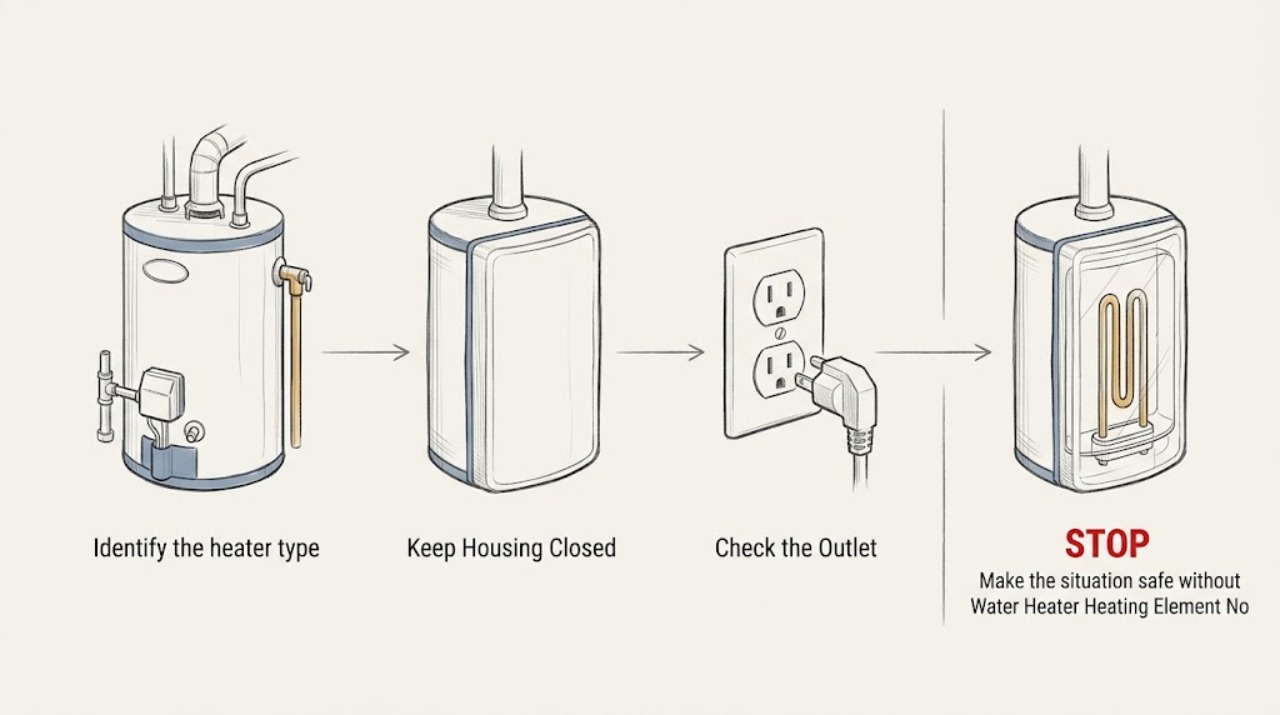
Work through in order
Diagnostic checks
Use only checks that match the exact appliance or system and its official guide.
-
Check 1
Make the situation safe without opening the water heater: look only for a leak, exposed wiring, smoke, a burning odor, unusual discharge, or signs that the cabinet is damaged.
Expected result: The area is dry and intact, or one of those hazards is present.
Next step: If any hazard is present, keep clear, do not touch the heater or its wiring, and arrange qualified service. If none is present, continue with the external symptom checks.
Why this matters
Why: A hazard changes this from a routine no-hot-water diagnosis to an immediate stop; the hot-water tank and electrical compartment may both be unsafe.
-
Check 2
Run a hot-water check at two or more fixtures, without dismantling a faucet or heater, and note whether the water is cold everywhere or only at one outlet.
Expected result: All checked fixtures are cold, or one fixture is cold while another produces hot water.
Next step: For a one-fixture result, arrange plumbing service for that fixture. For cold water at every checked fixture, continue with the heater-type and external-status checks.
Why this matters
Why: Cold water everywhere points toward the heater, its supply, or its controls; a single cold fixture makes a local cartridge or mixing-valve issue more likely than a failed heating element.
-
Check 3
Identify the heater type and copy the exterior model information without removing a cover: confirm whether it is an electric storage tank, a hybrid with an electric mode, gas, tankless, or another configuration.
Expected result: The label identifies an electric tank or electric-capable hybrid, or it identifies a different type.
Next step: Use the exact model manual. If the unit is not an electric tank or electric-capable hybrid, stop the element-focused checks and request service familiar with that system type.
Why this matters
Why: An electric tank can have an element-related no-hot-water fault; a gas, tankless, or different system needs its own ignition, flow, or control diagnosis, so an element assumption may be wrong.
-
Check 4
For an identified electric tank, inspect the accessible electrical panel or disconnect from the outside only; note whether its breaker appears tripped, the disconnect looks damaged, or the heater has a visible status indication.
Expected result: The breaker is tripped, trips again, looks damaged, or the heater has no expected external indication; alternatively, power appears normal.
Next step: Do not remove the panel, probe terminals, or repeatedly reset a breaker. If it trips again or looks damaged, leave it off and call a qualified electrician or water-heater technician; if it stays normal, continue only with non-invasive history and control checks.
Why this matters
Why: A tripped or recurring breaker can reflect an electrical fault rather than a simple element replacement, while normal external power does not prove that an element or thermostat is good.
-
Check 5
Ask whether the tank was recently installed, serviced, drained, or allowed to run empty, and whether power was restored before the tank was refilled.
Expected result: The tank may have been empty when power returned, or there is no such event.
Next step: If an empty-tank power-up is possible, do not energize the heater again and have a qualified technician inspect it. If not, continue by documenting the model, symptom timing, and breaker or status observations for service.
Why this matters
Why: Restoring power to an unfilled electric tank can damage a heating element; without that history, a control, supply, or element fault remains unresolved and needs model-specific diagnosis.
-
Check 6
Check the user-accessible temperature or operating mode display against the model manual, looking for a vacation or low-demand mode, a blank display, or a diagnostic indication; do not remove covers or alter hidden controls.
Expected result: A special mode or diagnostic indication is visible, or the control appears normal while all fixtures remain cold.
Next step: Follow only the model manual's external user reset or mode instructions. If the indication returns, the display is blank, or no user control explains the symptom, arrange qualified service rather than opening the heater.
Why this matters
Why: A mode or displayed fault may explain the symptom without proving an element failure; a normal display with cold water leaves the internal element, thermostat, safety control, and wiring as professional diagnoses.
-
Check 7
Record the symptom pattern for the service call: no hot water versus a short supply, whether recovery ever occurs, recent work, breaker behavior, model information, and any visible leak or odor.
Expected result: The heater never recovers, recovers briefly, or the issue is limited to one fixture; the history is now documented.
Next step: Give the record and model manual to a qualified technician. Do not perform live electrical tests, remove access covers, drain the tank, or replace an element or gasket as a DIY step.
Why this matters
Why: No recovery at every fixture is consistent with a supply, control, or heating-element fault; brief or limited hot water can point to a different element, thermostat, sediment, or fixture-side problem and cannot identify a part by symptom alone.
Use your observations
Decision map
Find the observation that best matches what you see, then follow the next safe action.
-
PATH 01Next step
What you see
Do this next
Keep the cabinet closed and arrange qualified water-heater service for an electrical diagnosis and model-specific repair.
-
PATH 02Next step
What you see
Do this next
Leave the equipment untouched and use qualified electrical or water-heater service; do not reset repeatedly or test terminals.
-
PATH 03Next step
What you see
Do this next
Leave the water heater alone and have the affected fixture or its mixing valve evaluated by a plumber.
-
PATH 04Next step
What you see
Do this next
Do not energize the heater or open it; tell the installer or qualified technician exactly what happened and have the element and controls inspected.
-
PATH 05Next step
What you see
Do this next
Document how long the supply lasts and have a technician compare the symptom with the exact model's design and parts information.
-
PATH 06Next step
What you see
Do this next
Follow the exact model manual's user-facing guidance and arrange qualified service for the identified system type; never open the cabinet or attempt gas or electrical repair.
Helpful context
Understand the symptom
What this symptom usually means
A. O. Smith electric tank heaters use one or more heating elements and controls to warm stored water. No hot water can therefore reflect a lost power supply, a control or safety interruption, or an element that no longer heats. The same symptom can also come from a fixture-side mixing problem or a different heater type, so identify the pattern before anyone opens the cabinet.
The important safety gate
Water in the tank can remain scalding even when the heater is not currently making hot water, and the element circuit can remain hazardous. Keep the cabinet closed. If there is a leak, exposed wiring, a burning odor, smoke, repeated breaker operation, or water discharging from a safety outlet, stop and use qualified service. Never restore power to a tank that may be empty.
Why the exact model matters
A. O. Smith sells electric, gas, hybrid, and other water-heating configurations. A heating-element diagnosis applies to an electric tank or a compatible hybrid operating in electric mode, not automatically to a gas, tankless, or unrelated system. Record the model from the exterior rating plate and use the matching manual before ordering any part.
Safety boundary
Stop conditions
- Stop immediately for a leak, exposed wiring, smoke, burning odor, damaged electrical equipment, or unexpected hot-water discharge.
- Do not remove access covers, touch terminals, probe wiring, or perform a live electrical test.
- Do not drain the tank or replace an element, thermostat, gasket, or wiring as an ordinary-user step.
- Do not restore power if the tank may be empty or if recent service left its fill state uncertain.
- Do not repeatedly reset a breaker that trips again; leave the equipment alone and arrange qualified service.
- Stop the element-focused path when the model is gas, tankless, or another configuration for which the element diagnosis does not apply.
Only after diagnosis
Potential parts
- Heating element
Consider only after a qualified diagnosis identifies an element that is not heating and confirms the tank model and element specification.
Element style and electrical rating vary by model; confirm the exact model literature and fit information before any purchase or repair. - Thermostat or safety control
Consider only if qualified diagnosis finds that the control is not switching or a safety limit has interrupted heating rather than the element itself being the failed part.
Use the exact model documentation and have a qualified technician confirm the correct control and safe replacement procedure. - Element gasket
Relevant only when a qualified technician has confirmed an element replacement and the model requires a matching sealing gasket.
Seal dimensions and material are model-dependent; do not assume a generic gasket fits or open the tank to check.
When checks do not resolve it
Need a professional?
Call qualified water-heater service when all fixtures are cold, the external power check is inconclusive, or the heater's controls, element, wiring, or safety control may need diagnosis., Use qualified electrical help when a breaker trips again, a disconnect is damaged, or wiring shows heat or burning damage., Use plumbing service when only one fixture is affected or there is a leak around the tank or connections.
Safety scope: The user should not perform energized testing, remove covers, drain the tank, or replace an element. A qualified technician must isolate power, verify safe conditions, and follow the exact model literature before internal work.
Have this ready
- Provide the exact model, whether every fixture is cold, breaker or status observations, recent installation or draining history, and any leak, odor, or repeated-trip details.
Common questions
FAQ
Does no hot water prove the A. O. Smith heating element failed?
No. A tripped supply, thermostat or safety control, wiring problem, empty-tank dry operation, fixture mixing issue, or a different heater type can produce the same symptom. A qualified technician must distinguish them.
Can I reset the breaker to see whether the element starts working?
You can observe whether the accessible breaker is tripped, but do not repeatedly reset it or open the heater. If it trips again, looks damaged, or the cause is unclear, leave it alone and arrange qualified electrical or water-heater service.
Why must the tank be full before power is restored?
An electric element can be exposed when the tank is empty and may burn out when energized. After installation, draining, or service, have the fill state confirmed before power is restored.
Should I use a multimeter on the heating element?
No. Do not perform energized electrical testing or remove covers as an ordinary-user step. The element circuit and stored hot water can be hazardous; arrange qualified diagnosis instead.
What if only one shower or faucet has no hot water?
If another fixture produces hot water, a local cartridge, mixing valve, or fixture restriction is more likely than a heater element failure. Have that fixture evaluated before servicing the heater.
Do the same checks apply to an A. O. Smith gas or tankless unit?
No. The heating-element path is for an electric tank or an electric-capable hybrid in electric operation. Gas, tankless, and other configurations need the exact model manual and a system-appropriate qualified technician.
Read the exact guide
Official sources
- Support - Water Heater Support Manuals & Videos | A.O. SmithA. O. Smith · ao smith water heater heating element no hot water; exact model manuals and support
- How to Turn a Water Heater On & Off | A. O. SmithA. O. Smith · ao smith water heater heating element no hot water; electric tank fill and power safety
- HPWH Service Handbook (321547-000 Smith).inddA. O. Smith · ao smith water heater heating element no hot water; service isolation, element matching, and refill safety
- Water Heater Maintenance Guide | A. O. SmithA. O. Smith · ao smith water heater heating element no hot water; electric tank maintenance and safety
- When to Repair or Replace Your Water Heater | A. O. SmithA. O. Smith · ao smith water heater heating element no hot water; failed electric element and model identification
- Water Heater Repair: Things to Consider | A.O. SmithA. O. Smith · ao smith water heater heating element no hot water; repair causes and professional diagnosis
Community feedback
Share a repair observation
Share a plain-text repair observation. Accepted observations are published automatically; this page may take a moment to update.