
On this page
Start here
Quick answer
A failed heating element can leave an electric tank water heater with no hot water, but the same symptom can also come from no power, a tripped high-limit safety cutoff, a thermostat or wiring fault, a recently refilled tank that was energized while empty, reversed connections after installation, or a hot-water-side leak. Start with safe, external observations: identify the heater type, check the electrical panel for an abnormal breaker position without repeatedly resetting it, review any visible status message, and note whether the problem affects every hot-water fixture. Do not remove covers, disconnect wires, press an internal reset, drain the tank, or test an element with a meter unless a qualified professional performs the electrical and plumbing work. A breaker that trips again, an overheating indication, a leak, or no hot water after a recent refill is a service boundary.
Before you begin
Safety first
- Do not open electrical covers, disconnect conductors, perform live or resistance testing, press hidden reset controls, drain the tank as a test, or energize an unfilled tank.
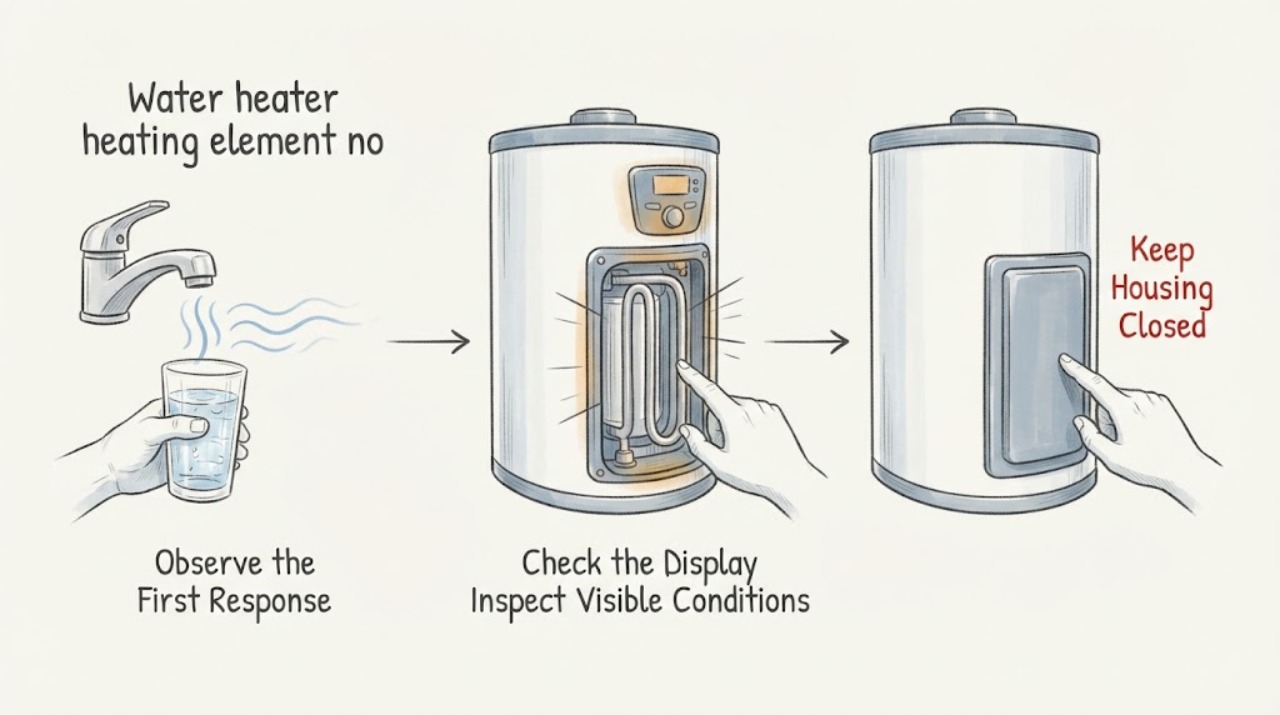
Work through in order
Diagnostic checks
Use only checks that match the exact appliance or system and its official guide.
-
Check 1
Identify the heater as an electric storage tank from its visible rating label, breaker labeling, owner manual, or external controls, and test more than one hot-water fixture without opening the heater.
Expected result: Record whether the tank is electric or another type, whether all fixtures are cold or only one is affected, and whether the complaint is no hot water or only slow recovery.
Next step: Continue with external electrical and status checks only for an electric storage heater. For another heater type or a single-fixture symptom, use the matching manual or arrange qualified plumbing service instead of opening the tank.
Why this matters
Why: A heating-element diagnosis applies to an electric storage heater. Whole-house loss points toward the heater or supply, while one cold fixture points more toward a local mixing or flow problem; a gas or tankless unit needs a different troubleshooting path.
-
Check 2
Visually check the water-heater circuit breaker or disconnect and any normal user-facing controller display without removing an electrical cover or touching wiring.
Expected result: Note whether the breaker is in an abnormal or tripped position, whether it trips again after a normal reset attempt, and whether the display shows an overheating, energy-cutoff, or heating fault message.
Next step: Do not repeatedly reset a tripping breaker or an overheating condition. Keep the heater off and have a qualified electrician or plumber diagnose the circuit, element, thermostat, and safety control.
Why this matters
Why: No supply can explain no hot water. A breaker that trips again can indicate a short or grounded element, while an energy-cutoff or overheating indication means the safety control has detected an abnormal condition; neither proves which component failed.
-
Check 3
Review the installation or service history and observe the tank and nearby floor from a safe position for a recent drain, refill, replacement, leak, or plumbing work; do not remove panels or energize a tank whose fill state is uncertain.
Expected result: Record whether the no-hot-water symptom began after the tank was drained, an element or thermostat was changed, the power was restored, the water connections were altered, or a leak appeared.
Next step: Leave uncertain or recently serviced equipment unmodified and provide the timeline to a qualified provider. If water is leaking near electrical parts or the tank is not known to be full, turn off the appropriate supply only if it is safely accessible and arrange service.
Why this matters
Why: A heater energized before its element was submerged can dry-fire the element. A recent connection change can also reverse inlet and outlet plumbing, and a hot-side leak can make a heater appear unable to keep up. These clues require product-specific confirmation rather than a generic part swap.
-
Check 4
From outside the heater, observe the hot-water behavior and any sound or leak without touching the temperature-and-pressure relief valve, drain valve, access covers, thermostats, or element terminals.
Expected result: Note whether hot water briefly appears and then turns cold, whether the tank never produces hot water, whether there is a continuous hot-side flow or visible leak, and whether crackling, popping, or hissing comes from the tank.
Next step: Document the pattern and stop if there is a leak, scalding risk, unusual heating, or pressure-relief discharge. Have a qualified provider inspect the plumbing, elements, thermostats, and safety controls.
Why this matters
Why: Brief or rapidly depleted hot water can indicate recovery, plumbing, or lower-element issues rather than a completely dead upper element. A persistent hot-side leak can consume heat, while crackling or hissing can be associated with scale around an element; sound alone cannot identify a failed part.
-
Check 5
Prepare a service handoff with the heater's visible brand and model, electric or hybrid type, breaker or display observation, fixture comparison, recent refill or repair history, leak or sound observations, and photographs taken without removing covers.
Expected result: The provider can determine whether the evidence points first to supply, high-limit protection, thermostat, upper or lower heating element, plumbing, or a local fixture issue.
Next step: Use the manufacturer, licensed plumber, or qualified electrician route for resistance or voltage testing, cover removal, element replacement, and verification. Do not perform those procedures from this observation-only checklist.
Why this matters
Why: Element replacement is conditional: the exact heater model, element rating and fit, tank fill state, wiring, and the reason for failure must be confirmed before a part is selected. A generic element or repeated reset can create a second failure or safety risk.
Use your observations
Decision map
Find the observation that best matches what you see, then follow the next safe action.
-
PATH 01Next step
What you see
All hot-water fixtures are cold, the electric-heater breaker is tripped or will not remain on, or the display reports an electrical or heating fault.
Do this next
Leave the circuit or heater off after a repeat trip and arrange qualified electrical and plumbing diagnosis. Do not keep resetting it or remove covers.
Why this path and its safety boundary
Why it matters: A supply fault, grounded or failed element, thermostat problem, or high-limit event is more likely than a single faucet problem, but the external symptom cannot identify the exact component.
-
PATH 02Next step
What you see
No hot water began immediately after a drain, refill, element replacement, or installation, and the tank's fill state or water connections are uncertain.
Do this next
Do not energize or re-energize the heater to test it. Provide the service timeline and model information to a qualified provider for a full, water-filled, model-specific inspection.
Why this path and its safety boundary
Why it matters: Dry firing or a changed inlet/outlet arrangement becomes more plausible, especially on a new or recently serviced heater; the timing is not proof of the failed part.
-
PATH 03Next step
What you see
Only one shower or faucet is cold while another hot-water fixture works, and the heater has no external fault indication.
Do this next
Keep the heater closed and have the affected fixture or branch checked before authorizing element work.
Why this path and its safety boundary
Why it matters: A fixture cartridge, mixing valve, local restriction, or branch-plumbing issue is more likely than a whole-tank heating-element failure.
-
PATH 04Next step
What you see
Hot water is present briefly or recovers slowly, with crackling or hissing, scale history, or a continuous hot-side flow.
Do this next
Document timing, sound, flow, and recent demand, then arrange qualified service to assess the tank and element system. Do not drain, flush, or open the heater as an improvised test.
Why this path and its safety boundary
Why it matters: The pattern may involve a lower element, scale, thermostat behavior, tank recovery, or a hot-water leak rather than the upper element alone.
-
PATH 05Next step
What you see
Water is leaking near electrical components, the pressure-relief outlet is discharging, there is smoke or a burning smell, or the tank or wiring appears damaged.
Do this next
Keep clear, avoid contact with the heater, and use qualified or urgent local help as appropriate. Do not touch the relief valve, electrical parts, or hot water.
Why this path and its safety boundary
Why it matters: The issue has crossed from routine no-hot-water diagnosis into an immediate scald, pressure, fire, or shock hazard.
Helpful context
Understand the symptom
The heating element is only one part of the heating path
An electric storage heater needs a live supply, functioning controls and high-limit protection, an intact element, and a tank full of water. A failed upper element can produce no hot water on a two-element tank, while a lower-element or thermostat problem may present as slow recovery or insufficient hot water. A recent drain, replacement, or installation is important context because energizing an element before it is submerged can destroy it.
Keep the diagnosis outside the electrical covers
A water heater combines electricity, very hot water, and a pressurized tank. The manufacturer safety guidance says to turn power off before touching components, and its service procedures use a non-contact tester or meter around wiring and element terminals. Those are not ordinary faucet checks. If the next step would expose wiring, remove insulation or an access panel, reset a hidden cutoff, or measure voltage or resistance, stop and arrange qualified service.
One cold fixture is a different clue from a whole-house outage
If every hot-water fixture is cold, the heater, its supply, or a whole-system control fault is more likely. If only one tap or shower is cold while another hot tap works, a fixture cartridge, mixing valve, or local flow problem is more likely than a failed tank element. This comparison helps avoid opening an energized heater for a problem that is downstream of the tank.
Safety boundary
Stop conditions
- Do not remove electrical junction-box or access covers, expose insulation, disconnect wires, press an internal reset, or test voltage, continuity, or resistance unless a qualified professional performs the work.
- Do not repeatedly reset a breaker or high-limit cutoff, energize a tank whose fill state is uncertain, drain or refill a heater as a test, or install a generic heating element.
- Stop for water near electrical parts, a leaking tank, pressure-relief discharge, smoke, burning smell, exposed wiring, damaged covers, or scalding-hot discharge.
- Use qualified plumbing or electrical service when no hot water affects the whole home, a fault returns, the heater was recently drained or serviced, or the cause remains uncertain.
Only after diagnosis
Potential parts
- electric water-heater heating element
Consider an element only after a qualified provider confirms that the element is open, grounded, dry-fired, scaled beyond service, or otherwise failed and identifies the correct heater-specific replacement.
Confirm the exact heater model, element type, electrical rating, thread or flange arrangement, gasket requirements, and manufacturer fit information before ordering.
When checks do not resolve it
Need a professional?
Contact the manufacturer, licensed plumber, or qualified electrician when safe external checks cannot distinguish supply, thermostat, safety cutoff, heating element, or plumbing causes.
Safety scope: Do not open electrical covers, disconnect conductors, perform live or resistance testing, press hidden reset controls, drain the tank as a test, or energize an unfilled tank.
Have this ready
- Provide the visible brand and model, heater type, fixture comparison, breaker or display observation, exact timing, recent drain or repair history, leak or sound observations, and photos taken without removing covers.
Common questions
FAQ
Does no hot water prove the heating element is bad?
No. No power, a tripped high-limit cutoff, a thermostat or wiring fault, reversed connections after installation, a hot-side leak, or a local fixture problem can look similar. The exact element should be confirmed by qualified testing.
Can I reset the water-heater breaker to see if the element starts?
A single normal external observation of the breaker is reasonable, but do not repeatedly reset a breaker that trips again or a heater showing overheating. A repeat trip can indicate a grounded element or another electrical fault that needs qualified diagnosis.
Why would a recently refilled water heater have no hot water?
If power was restored before the tank was full, an element can dry-fire and fail. A recent refill or repair can also leave a connection or control problem. Keep the heater unmodified and have the provider verify the fill state and installation.
Can scale cause an electric heating element problem?
Scale can form around an element and may cause crackling or hissing; manufacturer service guidance also describes sediment or lime creating an air pocket that can dry-fire an element. These observations do not identify a replacement part by themselves.
When should I stop troubleshooting and call a professional?
Stop for water near electrical parts, a leaking tank, pressure-relief discharge, smoke, burning smell, exposed wiring, a repeat-tripping breaker, an overheating indication, or any need to remove covers or test an element. Use a qualified plumber or electrician.
Read the exact guide
Official sources
- How to Turn a Water Heater On & OffA. O. Smith · Manufacturer guidance used for the relationship between tank fill state, element dry firing, power restoration, and model-specific startup; the installed heater manual controls.
- Residential Electric Water Heater Use and Care GuideA. O. Smith · Manufacturer manual used for the documented no-hot-water cause list and the warning that element, thermostat, wiring, and energy-cutoff tests require electrical access; the exact installed model may differ.
- Is Your Hot Water Not Getting Hot? Common Causes & What To Do About ThemA. O. Smith · Manufacturer troubleshooting article used for electric no-hot-water causes, breaker and element relationship, hot-side leak context, scale sounds, and safety boundaries; model-specific manuals control.
- Commercial Electric Energy Saver E32 Series Models Service ManualBradford White Corporation · Manufacturer service manual for Bradford White E32 commercial electric models; used for the general mechanisms of dry firing, sediment or lime air pockets, and qualified-only element diagnosis, not as a universal residential procedure.
Community feedback
Share a repair observation
Share a plain-text repair observation. Accepted observations are published automatically; this page may take a moment to update.