
On this page
Start here
Quick answer
If an A. O. Smith water heater has no hot water and the thermostat is suspected, first identify whether the heater is electric or gas and whether every hot-water fixture is affected. For an electric model, check the breaker and external controls without removing covers; the thermostat, high-limit safety, heating element, wiring, or power supply may be involved, but the heater can contain lethal voltage even after a control is changed. For a gas model, observe the pilot or gas-control status only through the intended indicator or sight glass and stop for gas odor, soot, flame rollout, a carbon-monoxide alarm, or illness. A single cold fixture points more toward a local mixing valve or plumbing issue; no hot water at every fixture after the safe external checks needs qualified diagnosis. Do not open energized panels, press a reset blindly, adjust a gas control, or raise the temperature to compensate for a fault.
Before you begin
Safety first
- This article supports fixture comparison, model and fuel identification, external breaker or indicator observation, and a model-authorized gas status or lighting check only when no hazard is present. Do not open electric or gas covers, test live circuits, adjust gas controls, bypass safety devices, or handle very hot water.
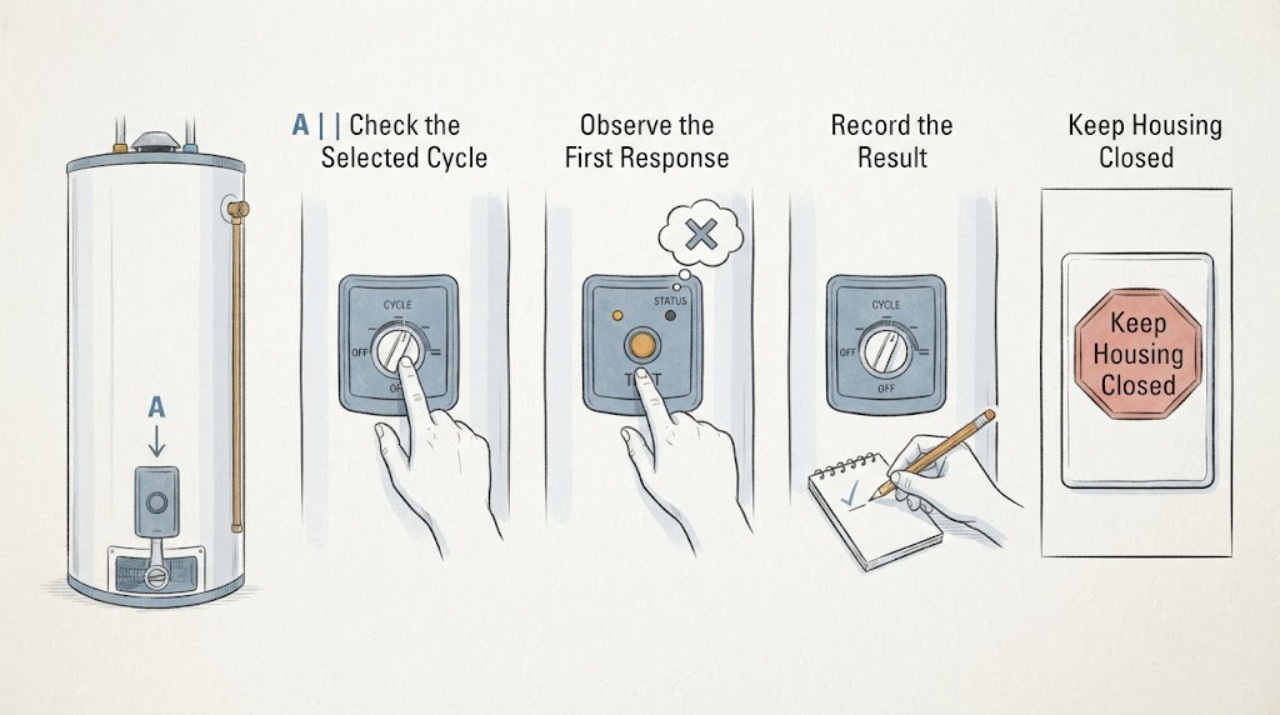
Work through in order
Diagnostic checks
Use only checks that match the exact appliance or system and its official guide.
-
Check 1
Briefly test hot water at two separate fixtures using care to avoid scalding, and before inspecting the heater look for gas odor, hissing, soot, flame outside its viewing area, a carbon-monoxide alarm, smoke, or illness.
Expected result: Every fixture is cold, only one fixture is cold, the water is dangerously hot, or a gas or combustion warning is present.
Next step: For gas odor, a CO alarm, symptoms, soot, smoke, or flame rollout, leave immediately and call emergency services or the gas utility from a safe location. For a single cold fixture, arrange plumbing diagnosis; for whole-house loss, continue only with the safe heater-type check.
Stop if: Stop for gas odor, hissing, a CO alarm, headache, dizziness, nausea, confusion, visible flame outside the intended view, smoke, sparking, or water hot enough to threaten a scald.
Why this matters
Why: Cold water at every fixture supports a heater, power, gas, or whole-house plumbing problem; one cold fixture points more toward a local mixing valve or faucet. Dangerously hot water can indicate a thermostat or high-limit fault. Any gas or CO warning overrides troubleshooting.
-
Check 2
Read the A. O. Smith data plate and model manual from outside the unit, identify electric versus gas fuel, and record the external thermostat, gas-control knob, pilot or ignition indicator, display, or status light without removing a cover.
Expected result: The unit is electric with a breaker and thermostat covers, gas with a pilot or gas-control status, newly installed or recently serviced, or the fuel and control type cannot be identified.
Next step: Use the exact manual for the identified model. If the unit type, fuel, or control cannot be confirmed, stop and arrange qualified service rather than opening the heater or changing a setting.
Stop if: Do not remove access covers, open a gas-control compartment, turn an unlabeled valve, or rely on a generic reset sequence.
Why this matters
Why: A. O. Smith troubleshooting paths differ by fuel and model. A new electric installation can have no power or a dry-fired element; a gas model can have a pilot, ignition, gas-control, or combustion issue. An unidentified unit makes a generic thermostat or reset step unsafe.
-
Check 3
For an electric model only, inspect the dedicated breaker or external disconnect for an obvious trip and confirm the heater's outside display or indicator state; do not remove panels or take voltage readings unless you are a qualified person equipped for the model.
Expected result: The breaker is tripped, the heater has no external indication, the breaker immediately trips again, or external power appears normal while all fixtures remain cold.
Next step: If the model instructions permit one ordinary breaker reset and it stays on, allow the heater to recover without opening it. For repeat trips, no power, or persistent cold water, turn the circuit off if safe and arrange qualified electrical or water-heater service.
Stop if: Do not reset a repeatedly tripping breaker, open an energized junction or thermostat cover, touch terminals, use a meter as an untrained user, or work around wet electrical parts.
Why this matters
Why: A. O. Smith identifies absent power as a common no-hot-water cause, but a breaker that trips again can indicate a fault rather than a reset opportunity. Normal external power shifts suspicion to the upper thermostat or high-limit, element, wiring, dry-fire damage, or a plumbing leak.
-
Check 4
For a gas model only and only when no hazard sign is present, observe the pilot or status indication through the intended sight glass or external display and compare it with the exact A. O. Smith lighting and operating instructions; do not adjust the gas-control valve beyond the labeled position.
Expected result: The pilot or status light is normal, the pilot is out, the status light is abnormal, the main burner does not respond, or the flame is weak, unstable, yellow, lifting, or outside the intended view.
Next step: Use the exact model label for no more than the authorized lighting attempt; if the pilot will not stay lit, status remains abnormal, the burner does not respond, or the flame is abnormal, turn the control to the safe OFF state and arrange qualified gas-appliance service.
Stop if: Do not relight if gas is smelled, do not open the burner door, adjust gas pressure, bypass a flame sensor, clean an orifice, or continue after a recurring outage or abnormal flame.
Why this matters
Why: A. O. Smith says a pilot or gas-control status problem can stop heating, and its pilot guidance links the flame-safety path to the gas valve. A stable pilot with no heat can still leave a gas-control, thermostat, burner, or venting issue. An abnormal flame is a combustion-safety concern, not a thermostat adjustment.
-
Check 5
Compare hot-water temperature and flow at more than one fixture, note whether the problem began after installation or a repair, and look only for an obvious accessible hot-water leak or reversed hot/cold indication without opening walls or tank covers.
Expected result: Water is hot at the heater but cold at one fixture, hot water is available briefly then runs out, all fixtures remain cold, a visible hot-water leak is present, or the issue started after installation or plumbing work.
Next step: Arrange a plumber or qualified water-heater technician for a local mixing valve, visible leak, reversed connection, or persistent whole-house loss; provide the fixture comparison and installation history rather than raising the thermostat.
Stop if: Do not touch very hot water, cap a relief outlet, open walls, change plumbing connections, or continue using a visible hot-water leak near electrical equipment.
Why this matters
Why: A. O. Smith identifies a faulty mixing valve, excessive demand, a plumbing leak, reversed connections, and a tank or thermostat problem as different explanations for insufficient or absent hot water. A leak or reversed connection can make a working heater appear not to heat.
Use your observations
Decision map
Find the observation that best matches what you see, then follow the next safe action.
-
PATH 01Safety boundary
What you see
Gas odor, hissing, soot, flame rollout, a CO alarm, or possible CO symptoms are present.
Do this next
Leave immediately for fresh air, call emergency services or the gas utility from outside or another safe location, and do not reenter or operate the heater until trained responders clear it.
Why this path and its safety boundary
Why it matters: This is an immediate gas or combustion-safety event, not a thermostat diagnosis.
Safety stop: Do not search for the source, relight the pilot, switch electrical devices, or silence and ignore the alarm inside the home.
-
PATH 02Safety boundary
What you see
One faucet or shower is cold while another hot-water fixture has normal hot water.
Do this next
Keep the heater settings unchanged and arrange fixture or plumbing diagnosis; do not replace the water-heater thermostat based on one outlet.
Why this path and its safety boundary
Why it matters: A local mixing valve, faucet cartridge, shower control, or fixture-side plumbing issue is more likely than the heater thermostat.
Safety stop: Do not open the water heater or change gas or electrical controls to correct a local fixture problem.
-
PATH 03Safety boundary
What you see
An electric A. O. Smith heater has a tripped breaker, no external indication, or a breaker that trips again.
Do this next
Do not reset repeatedly. Leave the circuit in the safe state and arrange qualified electrical or water-heater service to check supply, wiring, thermostat, high-limit, and element.
Why this path and its safety boundary
Why it matters: No power or an electrical fault is more likely than an isolated thermostat setting; repeated trips need electrical diagnosis.
Safety stop: Do not remove covers, touch terminals, test energized circuits, or work around wet electrical parts.
-
PATH 04Safety boundary
What you see
An electric heater has stable external power but no hot water at every fixture.
Do this next
Arrange qualified service and provide the model, breaker behavior, installation history, fixture results, and any visible leak. Do not open the thermostat covers or measure resistance as a casual check.
Why this path and its safety boundary
Why it matters: The upper thermostat or high-limit, heating element, wiring, dry-fire damage, reversed connection, or hot-water leak becomes more likely; external checks cannot identify the component safely.
Safety stop: Do not work on the heater while energized, press a reset repeatedly, remove insulation or access covers, or change wiring.
-
PATH 05Safety boundary
What you see
A gas model has an extinguished or recurring pilot, an abnormal status light, no main-burner response, or a stable pilot but no heat.
Do this next
Use only the model-label relight procedure if the area is safe and the manual allows it; for recurrence or no heat, leave the control safe and arrange qualified gas-appliance service.
Why this path and its safety boundary
Why it matters: A gas-control thermostat, pilot or flame-safety component, ignition, gas supply, burner, combustion-air, or venting issue is possible and cannot be selected from the symptom alone.
Safety stop: Do not adjust gas pressure, bypass flame safety, open the burner compartment, clean an orifice, or continue relighting after failure.
-
PATH 06Safety boundary
What you see
Hot water is absent or short-lived after installation or plumbing work, or an accessible hot-water leak is visible while the heater's external controls appear normal.
Do this next
Stop a visible leak if the accessible shutoff operates normally, protect electrical equipment and flooring, and arrange qualified plumbing or water-heater service to verify connections and the leak path.
Why this path and its safety boundary
Why it matters: A. O. Smith identifies reversed inlet and outlet connections and a hot-water plumbing leak as conditions that can make a working heater appear to produce little or no hot water.
Safety stop: Do not open walls, alter tank connections, cap a relief valve, or continue using a leak near electrical or gas components.
Helpful context
Understand the symptom
Classify the symptom before blaming the thermostat
Run a brief, cautious check at more than one hot-water fixture without touching hot water long enough to scald yourself. If only one faucet or shower is cold, a local mixing valve or faucet control can be mixing in cold water even when the tank is hot. If every fixture is cold, compare the heater's type, control or status indication, and recent installation or power history. A thermostat is only one possible cause, and a symptom alone cannot identify which thermostat, element, gas control, or plumbing part is at fault.
Electric and gas thermostat checks are not interchangeable
An electric A. O. Smith tank uses one or more thermostats and heating elements behind access covers; the manufacturer's troubleshooting material warns that work near an energized circuit can cause severe injury or death. A gas tank commonly uses a gas-control valve with thermostat functions and a pilot or ignition status. Do not apply an electric breaker, reset, or meter procedure to a gas heater, and do not open an electric access panel because a thermostat is suspected.
Use the data plate and manual, not a generic temperature setting
A. O. Smith states that the printed instructions and model data control startup, power, gas, and temperature procedures. Keep the setting at the label's safe range while diagnosing; higher settings increase scald risk, and even a normal setting can deliver scalding water. Do not raise the thermostat to overcome no heat, and do not reset a high-limit repeatedly without finding why it opened.
A service boundary protects both the tank and the person
A no-hot-water symptom can come from an electrical supply, upper thermostat or high-limit, heating element, gas pilot or flame-safety path, gas control, plumbing crossover, reversed connections, or an open hot-water leak. Some checks require energized measurements, burner access, gas testing, or cover removal. Record external observations and leave component diagnosis to a qualified technician.
Safety boundary
Stop conditions
- Leave immediately for gas odor, hissing, a carbon-monoxide alarm, headache, dizziness, nausea, confusion, soot, smoke, or flame outside the intended viewing area; call emergency services or the gas utility from a safe location.
- Do not open energized electric panels, thermostat covers, junction boxes, or gas-burner doors; do not touch terminals, take live measurements, or work around wet electrical parts.
- Do not bypass a high-limit, thermostat, thermocouple, thermopile, flame sensor, or gas-control safety; do not adjust gas pressure, clean an orifice, or change wiring as a user test.
- Do not raise the temperature to compensate for a no-heat fault, touch very hot water, cap a temperature-and-pressure relief outlet, or repeatedly reset a tripping breaker or high-limit.
- Arrange qualified electrical, plumbing, or gas-appliance service for persistent whole-house no hot water, a recurring gas-control or pilot fault, a suspected thermostat or element failure, a visible plumbing leak, or any unresolved safety indication.
Only after diagnosis
Potential parts
- A. O. Smith electric thermostat or high-limit assembly
Consider this category only when qualified diagnosis confirms that the electric thermostat or high-limit is open, inaccurate, or failed after power, wiring, element, and installation checks.
Confirm the exact A. O. Smith model, voltage, thermostat arrangement, and safety device; thermostat-cover work requires power isolation and qualified electrical skill. - A. O. Smith electric heating element
Consider this category only when service confirms a failed or dry-fired element after verifying the tank was full and the electrical supply and thermostat path are correct.
Confirm exact model and element specifications; do not energize a heater with an unfilled tank or access the element under live power. - A. O. Smith gas-control valve or thermostat
Consider this category only when a qualified gas-appliance technician diagnoses the gas-control thermostat or valve after pilot, flame-safety, gas supply, burner, combustion-air, and venting checks.
Confirm exact model and fuel type; never open, adjust, bypass, or replace a gas control as an ordinary user repair.
When checks do not resolve it
Need a professional?
Arrange qualified A. O. Smith water-heater service when no hot water affects every fixture after the safe external checks; when an electric breaker trips, power is present but heat is absent, the high-limit or thermostat may be involved, or an element may have dry-fired; when a gas pilot will not stay lit, the status light is abnormal, the main burner does not respond, or the flame or venting is abnormal; or when installation, reversed connections, or a hot-water leak may be involved. Leave immediately for gas odor, hissing, soot, flame rollout, a CO alarm, or possible CO symptoms and call emergency services or the gas utility from a safe location. Provide the model, fuel type, fixture comparison, breaker or status result, installation history, water temperature pattern, leak observations, and any label-authorized test result.
Safety scope: This article supports fixture comparison, model and fuel identification, external breaker or indicator observation, and a model-authorized gas status or lighting check only when no hazard is present. Do not open electric or gas covers, test live circuits, adjust gas controls, bypass safety devices, or handle very hot water.
Common questions
FAQ
Can a bad thermostat cause an A. O. Smith water heater to have no hot water?
Yes, but it is only one possibility. A. O. Smith also identifies power, a failed or dry-fired element, a high-limit or wiring issue, gas pilot or control problems, reversed connections, and hot-water plumbing leaks. External observations can narrow the path; thermostat diagnosis requires the exact fuel, model, and safe test procedure.
Can I reset the thermostat on an A. O. Smith electric water heater?
Do not press a reset blindly or repeatedly. The heater may contain lethal voltage, and a tripped high-limit can have an underlying electrical or heating fault. Arrange qualified service if power is present but the tank remains cold, a breaker trips, or the high-limit repeatedly opens.
Why is one faucet cold while other hot-water fixtures work?
A local mixing valve, faucet cartridge, shower control, or fixture-side plumbing issue is more likely than the water-heater thermostat. Compare more than one fixture before changing heater settings or parts.
What should I do if a gas A. O. Smith water heater has no hot water?
If there is no gas or combustion warning, identify the pilot or gas-control status through the intended indicator and follow only the exact model label. A pilot that is out, will not stay lit, or has an abnormal status needs qualified gas-appliance service; never adjust the gas control or bypass its safety path.
What if the carbon-monoxide alarm sounds near my water heater?
Leave immediately for fresh air, call emergency services from outside, and do not reenter or operate the heater until responders and trained personnel clear it. Carbon monoxide cannot be seen or smelled, so do not try to find the source inside.
Read the exact guide
Official sources
- Adjusting the TemperatureA. O. Smith · Use for general electric thermostat safety context; exact temperature controls and procedures vary by model.
- Electric Mini Tank Water HeaterA. O. Smith · Use for the electric mini-tank model family represented by the manual; do not generalize its element values, wiring, or covers to another model.
- How To Relight A Water Heater's Pilot LightA. O. Smith · Use only for the gas models and pilot or control styles covered by the page; the installed label and owner manual supersede this general guide.
- What to Do If You Have NO Hot WaterA. O. Smith (AO Smith) · Use for the A. O. Smith supported no-hot-water workflow; the exact model manual and fuel type determine which checks apply.
- Carbon Monoxide Fact SheetU.S. Consumer Product Safety Commission · Use for the emergency safety boundary around a gas water heater; it is not a model-specific thermostat or repair guide.
Community feedback
Share a repair observation
Share a plain-text repair observation. Accepted observations are published automatically; this page may take a moment to update.