
On this page
Start here
Quick answer
If an A. O. Smith water heater is slow to recover after hot-water use, first establish whether the delay is new, whether all fixtures are affected, and whether the heater is actually calling for heat. Check the model-specific thermostat or gas-control setting from the outside, then use only safe visual indicators for a gas pilot or burner and an electric unit's breaker or display. Sediment, a slow plumbing leak, a failing thermostat or sensor, a weak gas burner, a failed electric element, a restricted air path, or an undersized heater can look similar. Do not open electric access panels, test live voltage, open a gas control, or change internal settings. If the thermostat does not respond, the pilot or burner is abnormal, a safety trips, the unit leaks, water is dangerously hot, or recovery remains slow after manual-approved checks, arrange qualified plumbing service.
Before you begin
Safety first
- Do not open electrical access panels, test energized wiring, dismantle gas components, measure gas pressure, bypass a safety, or restore operation when the tank is not full or gas, venting, electrical, scalding, or leak conditions are abnormal.
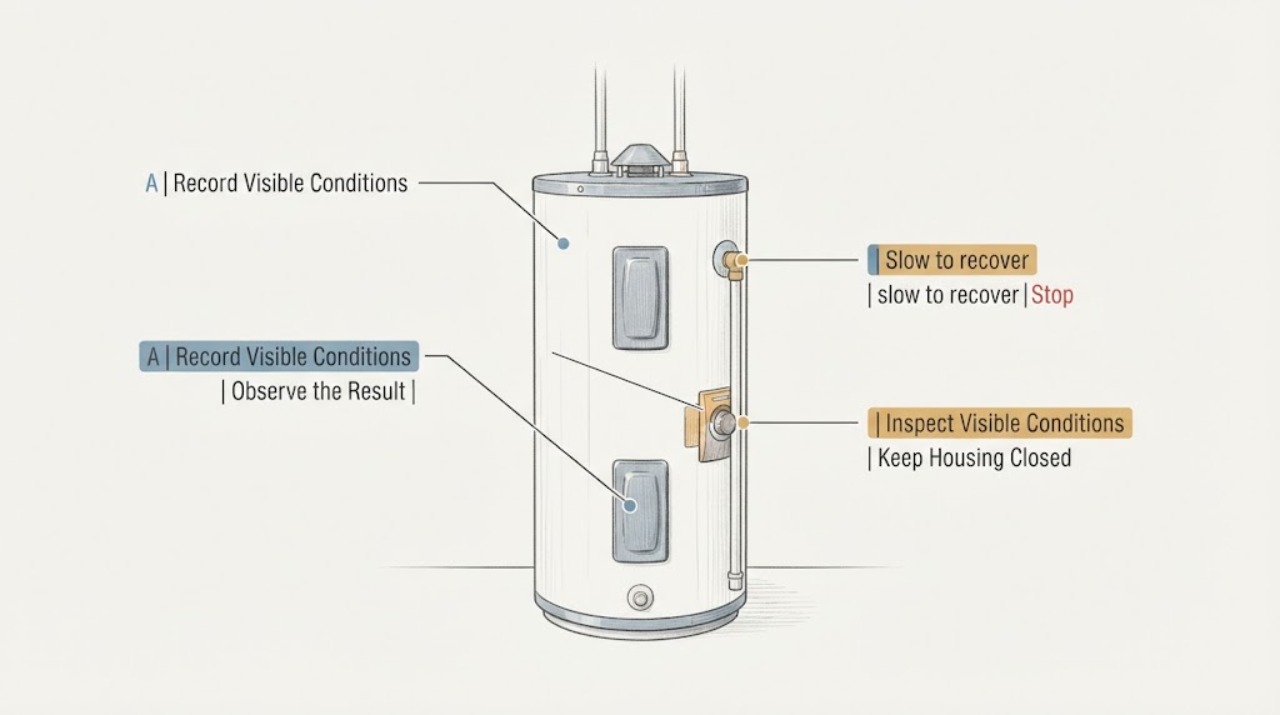
Work through in order
Diagnostic checks
Use only checks that match the exact appliance or system and its official guide.
-
Check 1
Measure the symptom without opening the heater. Check hot water at more than one fixture after the model's normal recovery window, note how much hot water was used, and record whether the delay is new, affects every fixture, or occurs only at one shower or faucet. Avoid scalding water when checking temperature.
Expected result: All fixtures recover slowly, only one fixture is affected, the delay follows unusually heavy use, or the water is dangerously hot rather than merely slow to recover.
Next step: If only one fixture is affected, arrange plumbing diagnosis there. If recovery is slow everywhere, record the use pattern and continue only with external, fuel-appropriate checks.
Why this matters
Why: A system-wide new delay keeps the heater's thermostat, heating source, leak, or sediment path in scope; a single fixture points to local mixing or plumbing hardware. Heavy use or a changed household load can exceed a correctly working system, while dangerously hot water is a scalding-control concern.
-
Check 2
Identify the exact A. O. Smith model, fuel type, tank or tankless configuration, thermostat or gas-control style, and current setting from the rating label and manual. Compare the setting with the manual's recommended household guidance without opening panels or changing a setting to an unsafe level.
Expected result: The setting is lower than expected, the setting appears normal, the model is not yet identified, or the water temperature is unusually hot or inconsistent.
Next step: Use only the model manual for a small external adjustment and allow the documented stabilization period. Do not remove an electric access cover or open a gas-control assembly; arrange service for hot or unstable temperatures.
Why this matters
Why: A low or changed setting can lengthen perceived recovery, but a normal setting with a new delay makes a heating-source, sensor, leak, sediment, or demand issue more relevant. An unusually hot or inconsistent result raises a thermostat or control safety concern.
-
Check 3
For a gas model, observe the pilot, status indicator, and main burner only through the designed viewing area after a normal call for heat. Follow the exact manual only for a permitted pilot-status check; do not relight after a gas smell, remove the burner, or change gas settings.
Expected result: The pilot and status indicator are normal and the burner remains lit, the pilot is out, the burner never starts, the burner drops out, or the indicator shows a fault pattern.
Next step: Record the indicator and burner pattern. Follow no more than the manual's safe observation or relight path; stop and arrange qualified gas-water-heater service for any repeated or abnormal behavior.
Why this matters
Why: A normal burner makes thermostat, sensor, demand, sediment, leak, and sizing causes more relevant. Pilot dropout, absent burner ignition, repeated burner shutdown, or an abnormal status points to gas supply, flame sensing, air supply, venting, or gas-control diagnosis.
-
Check 4
For an electric model, check the breaker or exterior display for an obvious trip, fault, or disabled state without opening an access panel or testing wiring. Reset a breaker only once and only if the exact manual permits it and there is no smell, water, heat damage, or repeated trip.
Expected result: The breaker or display is normal, a breaker is tripped and stays reset, it trips again, the display shows a fault, or no safe external indicator is available.
Next step: Do not open the electric compartment or perform live testing. Arrange qualified service for a repeated trip, fault display, exposed wiring, or continued slow recovery after a permitted reset.
Why this matters
Why: A one-time external interruption can explain slow or absent heating, while a recurring trip or fault can indicate a thermostat, element, wiring, or high-limit problem. A normal exterior state does not prove the internal thermostat or element is working.
-
Check 5
Inspect only accessible plumbing and the area around the tank for a slow hot-water leak, damp connection, relief discharge, drain-pan water, corrosion, or unusual sediment-related noise. Do not remove insulation, drain the tank, open a relief valve, or touch a hot burner or electrical part.
Expected result: Water is present, a relief or drain path drips, connections are damp, the tank base is wet, the area is dry but the heater rumbles or pops, or no leak or unusual noise is present.
Next step: Close the cold-water supply and shut down gas or power as safely directed for an active leak. Arrange qualified service for water, corrosion, relief discharge, or persistent sediment noise rather than flushing or opening the tank as a first response.
Why this matters
Why: A slow leak can consume newly heated water and prolong recovery; a wet base can indicate a serious tank condition. Sediment can reduce heating efficiency, while a dry quiet unit makes thermostat, heating-source, demand, or sizing causes more relevant.
-
Check 6
Compare the current demand with the heater's rated configuration using the model documentation: simultaneous showers, longer draws, added occupants, seasonal incoming-water changes, or a new appliance may have changed the recovery load. Do not increase the thermostat beyond the manual's safe guidance to compensate for an undersized or failing system.
Expected result: The household demand recently increased, the complaint occurs only after unusually heavy use, demand is unchanged, or recovery slowed under the same use pattern.
Next step: Record demand and recovery pattern for a plumber. If the demand is unchanged and recovery remains slow, arrange diagnosis rather than changing to a hotter setting or buying a larger unit without evaluation.
Why this matters
Why: An undersized or newly over-demanded system can recover slowly while operating normally. A new delay under unchanged demand makes a thermostat, burner, element, sediment, leak, fuel, or airflow problem more likely.
-
Check 7
After any model-approved external correction, allow the heater to complete one normal recovery and observe the result without opening the unit. Before restoring gas or electric operation after any shutdown, verify the exact manual's startup conditions, including a completely full tank where applicable and secure water connections.
Expected result: Recovery returns to its prior behavior, remains slow, improves briefly then slows again, the tank cannot be confirmed full, or a gas, electrical, temperature, leak, or safety abnormality appears.
Next step: Do not restore operation when the tank is not full, water is leaking, a safety has tripped, or any gas, electrical, venting, or temperature abnormality remains. Arrange qualified plumbing service and provide the model and observations.
Why this matters
Why: A repeatable improvement supports a setting or temporary interruption, but recurring slow recovery indicates an unresolved thermostat, heating-source, leak, sediment, demand, or sizing issue. Restoring power or gas to an incompletely filled tank can damage the heater and create a safety risk.
Use your observations
Decision map
Find the observation that best matches what you see, then follow the next safe action.
-
PATH 01Next step
What you see
Recovery became slow only after heavier household use or longer simultaneous draws, while the heater's pilot or electric external indicators are normal.
Do this next
Document the use pattern and have a qualified plumber compare demand and rated recovery before changing temperature settings or replacing the thermostat.
Why this path and its safety boundary
Why it matters: Demand or an undersized system is more likely than a thermostat failure.
-
PATH 02Next step
What you see
The delay occurs with unchanged demand, the current setting is correct, and the gas burner or electric external indicators do not show a normal heating response.
Do this next
Do not open panels or test live circuits. Arrange qualified diagnosis and provide the fuel type, setting, indicator behavior, and recovery observations.
Why this path and its safety boundary
Why it matters: A thermostat or sensor, gas-control, burner, electric-element, high-limit, or wiring fault is more plausible than a capacity issue.
-
PATH 03Next step
What you see
A gas pilot will not stay lit, the main burner never starts or drops out, or the gas status indicator shows an abnormal pattern.
Do this next
Keep the burner compartment closed and arrange qualified gas-water-heater service. Do not bypass a safety, measure gas pressure, or continue relighting attempts.
Why this path and its safety boundary
Why it matters: Gas supply, flame sensing, thermopile, air supply, venting, or gas-control trouble is more likely than a simple thermostat setting.
-
PATH 04Next step
What you see
An electric breaker trips again, a display shows a fault, or there is no normal external response from an electric heater.
Do this next
Leave the breaker off if it trips again and arrange qualified electrical or plumbing service. Do not remove the access panels or test voltage yourself.
Why this path and its safety boundary
Why it matters: A thermostat, element, high-limit, wiring, or control problem is possible and requires de-energized internal diagnosis.
-
PATH 05Next step
What you see
The area around the heater is damp, a relief or drain path drips, the tank base is wet, or sediment-related rumbling or popping accompanies slow recovery.
Do this next
Isolate water and energy as safely directed and arrange qualified service. Do not drain, flush, open the relief device, or remove panels as a first homeowner check.
Why this path and its safety boundary
Why it matters: A slow leak, relief or plumbing issue, tank condition, or sediment buildup may be reducing effective recovery and can cause further damage.
-
PATH 06Next step
What you see
Recovery improves after a manual-approved setting correction and remains normal under the same demand, with no leak, gas, electrical, or temperature abnormality.
Do this next
Leave the control at the model's safe recommended guidance and monitor. Arrange service if the delay returns, temperature becomes unstable, or hot water becomes dangerously hot.
Why this path and its safety boundary
Why it matters: A prior setting or temporary operating state may have contributed, but continued monitoring is needed because a thermostat can misread intermittently.
-
PATH 07Next step
What you see
Gas odor, a carbon-monoxide alarm, abnormal flame or venting, exposed wiring, scalding water, a tripped safety, or an incompletely filled tank is present.
Do this next
Leave the area and follow emergency guidance for gas or carbon monoxide. Otherwise keep the heater in its safe state and arrange qualified plumbing or electrical service; do not restart or bypass a safety.
Why this path and its safety boundary
Why it matters: The condition exceeds routine troubleshooting and may involve gas, carbon monoxide, electrical, scalding, combustion, or equipment-damage risk.
Helpful context
Understand the symptom
Slow recovery is a symptom, not a thermostat diagnosis
Recovery time depends on the amount of hot water used, incoming-water temperature, household demand, tank size, and the heating system's actual output. A thermostat that reads the tank incorrectly can stop heating too early, but a weak burner, a failed element, sediment, a slow plumbing leak, or an undersized system can create the same complaint. Record the pattern before buying a thermostat.
Gas and electric models require different boundaries
For a gas model, the useful homeowner observations are the pilot, status indicator, burner behavior through the intended viewing area, and obvious external air or vent conditions. For an electric model, the useful checks are the exact model setting, an accessible breaker or display, and safe hot-water behavior; the thermostats and elements are inside an electrical compartment. Never open that compartment or test live wiring as a first check.
Safety boundary
Stop conditions
- Do not open electric thermostat or element panels, test live voltage, remove gas-control or burner parts, measure gas pressure, bypass a high-limit or flame safety, or alter internal thermostat settings as a routine homeowner check.
- Stop immediately for gas odor, carbon-monoxide alarm, abnormal flame or venting, exposed wiring, a recurring breaker or safety trip, scalding water, an active leak, or a tank that cannot be confirmed full. Leave the area or isolate the heater only as safely directed.
- Do not restore gas or electrical operation after a shutdown until the exact manual's fill and startup conditions are met. A thermostat or heating-source problem that persists or returns after external checks needs qualified plumbing or electrical service.
Only after diagnosis
Potential parts
- A. O. Smith water-heater thermostat or gas-control thermostat
Consider only after qualified diagnosis confirms incorrect sensing or control behavior and rules out demand, setting, leak, sediment, fuel, burner, element, and airflow causes.
Thermostats and gas controls are fuel- and model-specific safety components. Confirm the exact model and professional diagnosis before selecting a replacement. - A. O. Smith gas burner or thermopile assembly
Consider only for a gas unit when qualified service identifies weak burner output or flame-sensing failure associated with slow recovery.
Burner and sensing parts vary by gas-control and model configuration. Do not select a part from recovery time or flame appearance alone. - A. O. Smith electric heating element
Consider only for an electric unit when qualified de-energized diagnosis identifies an element fault after thermostat, wiring, demand, and water-level causes are excluded.
Element ratings and access vary by model. A qualified technician should confirm the exact model and safe installation requirements. - A. O. Smith water-heater expansion or mixing component
Consider only when qualified plumbing assessment finds demand, pressure, thermal-expansion, or fixture-mixing behavior contributing to the recovery complaint.
Sizing and installation depend on the home's plumbing and usage. Do not substitute a hotter thermostat setting for system diagnosis.
When checks do not resolve it
Need a professional?
Arrange qualified plumbing or water-heater service when recovery is slow under unchanged demand, the thermostat setting is correct but heating response is abnormal, a gas pilot or burner is unstable, an electric breaker trips or display faults, water leaks, sediment noise persists, a safety trips, temperatures are dangerously hot or inconsistent, the tank is not full, or gas, carbon monoxide, venting, or wiring is involved. Provide the exact A. O. Smith model and serial information, fuel type, setting, demand pattern, recovery observations, indicator or burner behavior, leak findings, and any alarm details.
Safety scope: Do not open electrical access panels, test energized wiring, dismantle gas components, measure gas pressure, bypass a safety, or restore operation when the tank is not full or gas, venting, electrical, scalding, or leak conditions are abnormal.
Common questions
FAQ
Why is my A. O. Smith water heater thermostat slow to recover?
A thermostat that reads the tank early can stop heating prematurely, but sediment, weak gas or electric heating output, a slow leak, household demand, or an undersized system can look the same. Check the setting and fuel-appropriate external indicators, then arrange qualified diagnosis before buying a thermostat.
Should I turn up the thermostat to make recovery faster?
Use only the exact model's safe recommended setting. Raising temperature can increase scald risk and will not repair a thermostat, burner, element, sediment, leak, or sizing problem. If recovery remains slow at the correct setting, have a qualified plumber diagnose the system.
What should I check on an A. O. Smith gas water heater with slow recovery?
Observe the pilot, status indicator, and main burner only through the intended viewing area and follow the model manual for any permitted pilot check. A pilot that will not hold, a burner that drops out, a thermal or air-supply safety trip, abnormal flame, or vent concern needs qualified gas-appliance service. Do not open the burner compartment or test gas pressure.
What should I check on an A. O. Smith electric water heater with slow recovery?
Check the model setting and any exterior display or breaker indication without opening the electrical access panels. A repeated breaker trip, fault display, leak, or continued delay requires qualified diagnosis of the thermostats, elements, high-limit, wiring, or plumbing. Never test live voltage yourself.
Read the exact guide
Official sources
- How Long for Water Heater to Reheat After Use? | A. O. SmithA. O. Smith · Official A. O. Smith information-center guide to water-heater recovery; exact model specifications and qualified diagnosis control repair decisions.
- MAINTENANCE & TROUBLESHOOTING GUIDEA. O. Smith University · Official A. O. Smith University maintenance and troubleshooting guide; exact model manual and qualified service control internal gas and electrical diagnosis.
- Water Heater Repair: Things to Consider | A.O. SmithA. O. Smith · Official A. O. Smith repair guidance for residential water heaters; internal testing and parts replacement require qualified service.
- How to Turn a Water Heater On & Off | A. O. SmithA. O. Smith · Official A. O. Smith startup and shutdown guidance; printed instructions for the exact model take priority.
- How to Adjust Temperature on Gas Water Heater SafelyA. O. Smith · Official A. O. Smith temperature and common-problem guidance; model manual controls exact settings and safe procedures.
Community feedback
Share a repair observation
Share a plain-text repair observation. Accepted observations are published automatically; this page may take a moment to update.