
On this page
Start here
Quick answer
A slow-recovering A. O. Smith water heater is not automatically a bad heating element. First compare the symptom with the household's recent hot-water use, confirm the unit type and operating mode, and look for an accessible power or control indication without opening the cabinet. On an electric tank, a worn or scaled element—especially the element responsible for most recovery—can reduce output, but a low setting, closed valve, hot-water leak, sediment, heat-pump mode, or an undersized tank can look similar. Do not remove covers, touch terminals, use a meter, drain the tank, or replace an element yourself. If the tank was emptied or serviced, never restore power until a qualified person confirms that it is full. Have a qualified technician diagnose internal electrical parts against the exact model manual.
Before you begin
Safety first
- The user should not perform energized testing, remove covers, drain the tank, or replace an element. A qualified technician must isolate power, verify safe conditions, and follow the exact model literature before internal work.
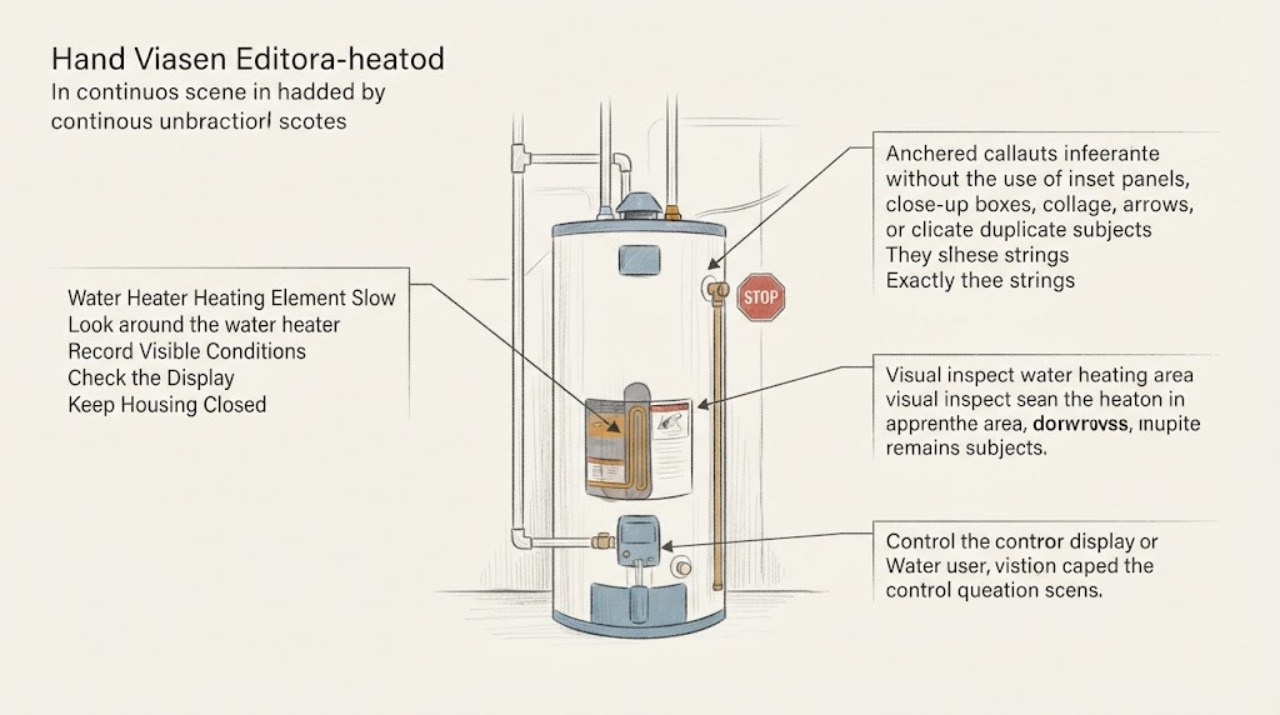
Work through in order
Diagnostic checks
Use only checks that match the exact appliance or system and its official guide.
-
Check 1
Look around the water heater without opening it: check for water at the pan or connections, a hot-water faucet that never fully shuts off, exposed wiring, smoke, a burning odor, or damaged electrical equipment.
Expected result: The area is dry and intact, or a leak, odor, exposed wire, smoke, or other hazard is present.
Next step: If any hazard is present, keep clear, do not touch the heater, and arrange qualified service. If a hot-water leak is visible and safe to identify externally, report its location to the plumber; otherwise continue with the non-invasive checks.
Why this matters
Why: A leak can consume the heater's recovery capacity, while electrical or hot-water hazards make further troubleshooting unsafe.
-
Check 2
Record when recovery feels slow and what preceded it: back-to-back showers, laundry or dishwasher use, a new household demand, colder incoming water, a setting change, or a sudden change with no obvious usage change.
Expected result: Recovery is slow only after unusually heavy use, or it has become noticeably slower during ordinary use.
Next step: If demand is the only trigger, stagger large hot-water draws and compare the result. If the slowdown is new, persistent, or worsening, continue documenting the unit for qualified diagnosis.
Why this matters
Why: A heavy-use-only pattern can be normal capacity or recovery behavior; a sudden change during ordinary use makes a failing element, thermostat, supply, leak, or other component more likely.
-
Check 3
Identify the heater type and operating mode from the exterior label or user display, without removing a cover: electric storage tank, hybrid heat-pump mode, gas, tankless, or another configuration.
Expected result: The unit is an electric tank, an electric-capable hybrid in a slower efficiency mode, or a different type.
Next step: Use the exact model manual for the mode and expected behavior. If it is not an electric tank or electric-capable hybrid, stop assuming an element is the cause and arrange system-appropriate service.
Why this matters
Why: Element-focused recovery applies to an electric tank and may apply to a hybrid when its electric heating system is active; a heat-pump-only mode can recover more slowly by design, while gas and tankless systems need different checks.
-
Check 4
Check only user-accessible temperature or mode controls against the exact model manual; look for a low set point, vacation or efficiency mode, a blank display, or a visible diagnostic indication.
Expected result: A lower setting or slower mode is selected, a diagnostic indication is visible, or the controls look normal while recovery remains slow.
Next step: Follow only the manual's external user adjustment or reset guidance. If the indication returns, the display is blank, or no mode explains the slowdown, arrange qualified service without opening the heater.
Why this matters
Why: A setting or hybrid mode can intentionally reduce recovery speed, while a returning indication or normal controls with a changed recovery pattern leaves an internal control or element fault possible.
-
Check 5
From outside the equipment, note whether the electric heater's accessible breaker or disconnect appears tripped, damaged, or repeatedly interrupted; do not remove the electrical cover or probe anything.
Expected result: The breaker appears normal, is tripped, trips again, or the disconnect shows damage.
Next step: Do not repeatedly reset a breaker and do not perform live electrical testing. If it trips again or looks damaged, leave the heater alone and arrange qualified electrical or water-heater service.
Why this matters
Why: A recurring interruption or damaged disconnect points to an electrical fault or protection event, not a confirmed element-only problem; normal external status does not prove that the element is healthy.
-
Check 6
With the heater cabinet closed, look for an externally accessible hot-water leak at a fixture or pipe and note whether one fixture is affected while another supplies hot water.
Expected result: A faucet or pipe leaks, or only one fixture has poor hot water while another has normal hot water.
Next step: Arrange plumbing service for the leak or affected fixture and tell the technician that another fixture has normal hot water; do not open the heater to investigate a local symptom.
Why this matters
Why: A continuous hot-water leak can use the heater's recovery capacity, while a one-fixture pattern makes a cartridge, mixing valve, or local restriction more likely than a tank element problem.
-
Check 7
Ask whether the tank was recently installed, drained, flushed, or serviced, and whether anyone may have restored power before the tank was completely refilled.
Expected result: The tank may have been empty when power returned, or there is no recent service or draining history.
Next step: If the tank may have been empty when energized, do not energize it again and have a qualified technician inspect it. Otherwise, provide the history and model information to service rather than attempting internal checks.
Why this matters
Why: An electric element can be damaged by dry operation; with no such event, the remaining possibilities include demand, mode, sediment, thermostat, supply, wiring, or element performance.
-
Check 8
Document the model, tank capacity shown on the exterior label, recovery pattern, mode, recent usage, breaker behavior, leak observations, and whether the slowdown is gradual or sudden for the service call.
Expected result: The unit is consistently slow, briefly recovers and then runs out, or the issue follows a recent change; the relevant history is recorded.
Next step: Give the record and exact model manual to a qualified technician. Do not use a meter, remove access covers, drain the tank, or replace an element, thermostat, gasket, or wiring yourself.
Why this matters
Why: A persistent or newly worsening pattern can justify professional diagnosis of the lower or other heating element, thermostat, safety control, sediment, valves, leak, or system sizing; the record helps separate those paths.
Use your observations
Decision map
Find the observation that best matches what you see, then follow the next safe action.
-
PATH 01Next step
What you see
Do this next
Stagger large hot-water uses and compare the pattern. If ordinary-use recovery later becomes slow, arrange qualified service rather than assuming the usage explanation still applies.
-
PATH 02Next step
What you see
Do this next
Keep the cabinet closed and arrange qualified water-heater service for internal diagnosis against the exact model.
-
PATH 03Next step
What you see
Do this next
Use only the exact model manual's user-facing mode guidance. If recovery remains abnormal in the documented mode or a fault indication appears, arrange qualified service.
-
PATH 04Next step
What you see
Do this next
Arrange plumbing service for the leak or fixture and do not open the heater to chase a local symptom.
-
PATH 05Next step
What you see
Do this next
Do not energize, reset repeatedly, remove covers, or test terminals. Keep clear and arrange qualified electrical or water-heater service.
-
PATH 06Next step
What you see
Do this next
Document peak demand and the exterior model information, then ask qualified service to compare the unit's intended recovery with actual use.
Helpful context
Understand the symptom
Why recovery gets slower
Recovery is the time needed to make usable hot water after a large draw. A. O. Smith notes that electric tanks, hybrid heat-pump modes, gas systems, and tankless systems have different recovery behavior. In an electric tank, a heating element that is worn or covered with scale may heat less effectively; a thermostat that stops heating early, sediment that insulates the heat source, or a household demand greater than the tank's capacity can create the same complaint.
Start with the pattern, not the part
A gradual slowdown after years of normal operation points differently from slow recovery that began after a setting change, a service visit, a tank drain, or a change in family usage. A leak or a single fixture that mixes cold water can also make the tank appear slow. Record the pattern before considering any component.
Keep the cabinet closed
The water can be hot enough to scald even when recovery is poor, and an electric element compartment can contain hazardous wiring. Look only at external controls, labels, valves, and the surrounding area. Stop for a leak, exposed wiring, smoke, a burning smell, repeated breaker operation, or unexpected discharge, and arrange qualified service.
Safety boundary
Stop conditions
- Stop immediately for a leak, exposed wiring, smoke, burning odor, damaged electrical equipment, repeated breaker operation, or unexpected hot-water discharge.
- Do not remove access covers, touch terminals, probe wiring, use a meter, or perform energized electrical testing.
- Do not drain the tank or replace an element, thermostat, gasket, or wiring as an ordinary-user step.
- Do not restore power if the tank may be empty or if recent service left its fill state uncertain.
- Do not repeatedly reset a breaker that trips again; leave the equipment alone and arrange qualified service.
- Stop the element-focused path when the label identifies gas, tankless, or another configuration for which an electric heating element is not the applicable heat source.
Only after diagnosis
Potential parts
- Heating element
Consider only after qualified diagnosis finds an electric element is not heating effectively and confirms that it explains the slow recovery pattern.
Element style and electrical rating vary by model; confirm the exact model literature and fit information before any purchase or repair. - Thermostat or safety control
Consider only if qualified diagnosis finds that a control is stopping heat early or a safety limit has interrupted an otherwise suitable heating cycle.
Use the exact model documentation and have a qualified technician confirm the correct control and safe replacement procedure. - Heating element gasket
Relevant only when a qualified technician has confirmed an element replacement and the model requires a matching seal.
Seal dimensions and material are model-dependent; do not assume a generic gasket fits or open the tank to check.
When checks do not resolve it
Need a professional?
Call qualified water-heater service when recovery has suddenly slowed during ordinary use, the external checks do not explain it, or an element, thermostat, safety control, wiring, or sediment issue may need diagnosis., Use qualified electrical help when a breaker trips again, a disconnect is damaged, or wiring shows heat or burning damage., Use plumbing service when a fixture or pipe leaks, or when only one fixture has poor hot water while others are normal.
Safety scope: The user should not perform energized testing, remove covers, drain the tank, or replace an element. A qualified technician must isolate power, verify safe conditions, and follow the exact model literature before internal work.
Have this ready
- Provide the exact model and capacity information, heater type and mode, recovery pattern, recent usage or service history, breaker behavior, and any leak, odor, or display observations.
Common questions
FAQ
Does slow recovery prove the A. O. Smith heating element is failing?
No. Heavy use, an undersized unit, a slower hybrid mode, low settings, sediment, a hot-water leak, a thermostat or safety control, and supply or wiring faults can all produce slow recovery. A qualified technician must identify the cause.
Why can a lower element matter when recovery is slow?
A. O. Smith's recovery guidance notes that the lower element does much of the reheating work in an electric tank, so its failure or reduced performance can affect recovery. That observation still does not identify a part without model-specific diagnosis.
Can I check the element with a meter?
Do not perform energized electrical testing or remove covers as an ordinary-user step. The element circuit and stored hot water can be hazardous; arrange qualified diagnosis instead.
What should I do after the tank was drained or serviced?
Do not restore power until a qualified person confirms that the tank is completely full. An electric element can burn out if it is energized without enough water around it.
Could a hot-water leak make the heater seem slow?
Yes. A continuously running hot-water faucet or pipe can consume recovery capacity. If only one fixture is affected while another has hot water, a local cartridge or mixing valve is more likely than a tank element problem.
Do these checks apply to a gas or tankless A. O. Smith unit?
Not as an element-focused diagnosis. Gas, tankless, and hybrid configurations have different heat sources and recovery behavior. Use the exact model manual and arrange system-appropriate qualified service.
Read the exact guide
Official sources
- HPWH Service Handbook (321547-000 Smith).inddA. O. Smith · ao smith water heater heating element slow to recover; service isolation, slow-recovery causes, and refill safety
- Water Heater Repair: Things to Consider | A.O. SmithA. O. Smith · ao smith water heater heating element slow to recover; power, thermostat, element, leak, and repair guidance
- How Long for Water Heater to Reheat After Use? | A. O. SmithA. O. Smith · ao smith water heater heating element slow to recover; recovery behavior and causes
- When to Repair or Replace Your Water Heater | A. O. SmithA. O. Smith · ao smith water heater heating element slow to recover; insufficient hot water and model identification
- Support - Water Heater Support Manuals & Videos | A.O. SmithA. O. Smith · ao smith water heater heating element slow to recover; exact model manuals and support
- Water Heater Maintenance Guide | A. O. SmithA. O. Smith · ao smith water heater heating element slow to recover; refill and electrical safety
- Technical Bulletins - Bulletin #36 Not Enough Hot Water - Electric | A. O. SmithA. O. Smith · ao smith water heater heating element slow to recover; electric not-enough-hot-water diagnosis
Community feedback
Share a repair observation
Share a plain-text repair observation. Accepted observations are published automatically; this page may take a moment to update.