
On this page
Start here
Quick answer
A Bradford White water heater that takes too long to recover may have a cracked or blocked dip tube, but recovery also depends on demand, tank size, burner or element input, thermostat operation, sediment, and the fuel type. The dip tube should send incoming cold water to the bottom of the tank; if it cracks or breaks, cold water can mix with the hot water outlet and make showers turn cool quickly. First record whether the problem is low total hot-water capacity, slow reheating after a heavy draw, or an immediate lack of hot water, and check the model and serial number for the correct service documentation. Do not remove the inlet nipple/dip tube from a hot or pressurized tank. Gas heaters require gas-control and venting precautions; electric heaters require power isolation before any cover or element work. A qualified plumbing professional should drain the tank, inspect the dip tube and hydro-jet slots, and distinguish it from sediment or a failed burner, element, thermostat, or gas/electrical supply.
Before you begin
Safety first
- A qualified professional should isolate gas or electricity, drain and depressurize the tank, remove the inlet nipple/dip tube, inspect heating and venting systems, service sediment, and restart the heater without scald, fire, explosion, flooding, or shock hazards.
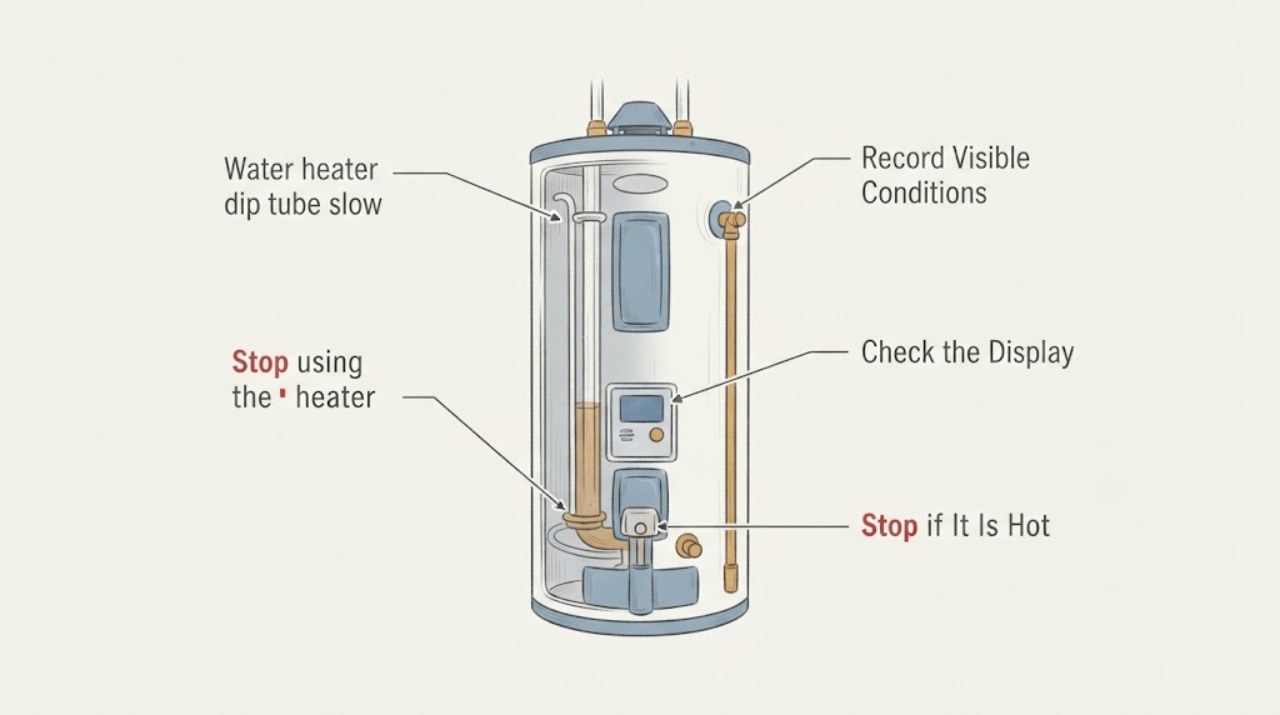
Work through in order
Diagnostic checks
Use only checks that match the exact appliance or system and its official guide.
-
Check 1
Stop using the heater for diagnosis if water is scalding, the tank or fittings leak, the gas smell or venting is abnormal, the area is flooded, or electrical parts are wet; keep people away and isolate gas, electricity, and water only as safely directed by the model manual or a qualified professional.
Expected result: The heater is stable and dry with ordinary warm water, or there is an active leak, flooding, gas/vent concern, scalding discharge, or wet electrical area.
Next step: For any hazard, leave the heater off or isolated if safe and arrange qualified water-heater service. Otherwise record the model, serial, gas/electric type, and hot-water symptom before further checks.
Why this matters
Why: A recovery complaint can be measured only when the heater is safe. Flooding, combustion hazards, scalding, and electricity are not dip-tube DIY conditions.
-
Check 2
Record the sequence of use: how much hot water is available after the heater has completed a cycle, how quickly it turns cool during a normal draw, and how long it takes to become hot again without changing the thermostat.
Expected result: Hot water runs out only after several users, becomes cool almost immediately, recovers normally after a rest, or remains slow to recover after a modest draw.
Next step: Give this pattern to a plumber and continue with fuel/control and demand checks. Do not raise the thermostat to compensate for an unknown fault or scald risk.
Why this matters
Why: Several users may exceed rated delivery; immediate cooling supports a dip-tube mixing or supply issue; slow recovery after a modest draw supports heating input, sediment, thermostat, or dip-tube investigation.
-
Check 3
Confirm the heater's fuel type and note whether the burner or heating elements complete a normal heating cycle according to the owner's manual; do not remove gas-control, burner, or electrical covers.
Expected result: A gas burner does not fire or stays on unusually briefly, electric elements do not energize, the thermostat or control shows an issue, or the heater completes its cycle normally.
Next step: Arrange qualified gas or electrical appliance service for a failed burner, element, thermostat, control, vent, or supply. If the cycle is normal, proceed to demand and dip-tube-specific evaluation.
Why this matters
Why: A missing or weak heat input can explain slow recovery without a dip-tube failure. Normal cycle behavior keeps sediment, capacity, and dip-tube flow in the differential.
-
Check 4
Check only the accessible rating plate and owner documentation for tank capacity, fuel type, input, recovery information, and maintenance history; compare the complaint with the exact model rather than a generic recovery expectation.
Expected result: The demand is near or above the heater's rated delivery, the model has a different expected recovery, sediment service is overdue, or the complaint is new despite an adequate history.
Next step: Reduce simultaneous demand while awaiting a professional diagnosis, and provide the model and history. Do not change burner or thermostat settings from an internet estimate.
Why this matters
Why: Bradford White says recovery depends on capacity, heat source, burner or element size, and temperature rise. Demand or maintenance can explain performance without proving a bad dip tube.
-
Check 5
Have a qualified professional perform a model-appropriate draw or recovery assessment and, if indicated, shut down, depressurize, drain below the inlet nipple, and remove the inlet nipple/dip tube for inspection; never attempt this on a hot or pressurized heater.
Expected result: The dip tube is cracked, deformed, blocked, has unintentional holes, or obstructed hydro-jet slots, or the tube is intact and unrestricted.
Next step: Use the exact model service procedure to replace a damaged tube and refill or restart the heater. If the tube is intact, do not replace it speculatively; continue diagnosis of the heating and delivery system.
Why this matters
Why: Bradford White identifies those dip-tube conditions as not field-repairable and requiring replacement; an intact tube shifts attention to heating input, sediment, controls, demand, or another plumbing restriction.
-
Check 6
After any professional repair, refill the heater fully, purge air through a hot-water fixture as the manual directs, restore gas or electrical operation using the model procedure, and observe a complete heating cycle for leaks and recovery.
Expected result: Hot-water delivery and recovery return to the model's expected behavior, recovery remains slow, a leak appears at the inlet connection, or the burner/elements do not restart correctly.
Next step: Shut down for leaks, failed restart, gas/vent concerns, or electrical faults and have the installer or qualified technician correct the work. Provide the before-and-after draw pattern and exact part used.
Why this matters
Why: A stable refill and normal cycle support a successful repair. Persistent slow recovery or a post-service leak indicates an unresolved dip-tube, connection, sediment, heating, or restart problem.
Use your observations
Decision map
Find the observation that best matches what you see, then follow the next safe action.
-
PATH 01Next step
What you see
Hot water lasts through a normal draw but runs out only during simultaneous or unusually heavy use, and the heater completes its normal cycle.
Do this next
Have a plumbing professional compare the demand and model recovery rating before selecting a part or changing settings.
Why this path and its safety boundary
Why it matters: Demand may exceed the rated delivery capacity rather than indicating a dip-tube fault.
-
PATH 02Next step
What you see
The water becomes cool almost immediately after the heater has been hot, while the burner or elements appear to cycle normally.
Do this next
Arrange model-specific dip-tube and plumbing diagnosis. Do not drain or remove the inlet nipple without the full shutdown and safety procedure.
Why this path and its safety boundary
Why it matters: A cracked, broken, or otherwise misdirecting dip tube is more plausible because cold inlet water may mix near the hot outlet, though a plumbing cross-connection or control issue remains possible.
-
PATH 03Next step
What you see
Recovery is slow after a modest draw and the burner or elements do not complete a normal heating cycle.
Do this next
Use qualified gas or electrical water-heater service to diagnose the heating system before changing the dip tube.
Why this path and its safety boundary
Why it matters: Heating input, thermostat, control, gas supply, venting, or electrical supply is more likely than an isolated dip-tube problem.
-
PATH 04Next step
What you see
The qualified inspection finds dip-tube cracks, deformation, blockage, or blocked hydro-jet slots.
Do this next
Install only the exact model-approved inlet nipple/dip tube, reconnect and refill safely, and verify the heating cycle and connections.
Why this path and its safety boundary
Why it matters: The dip tube can alter inlet mixing and is a supported cause of insufficient hot water; the service manual treats these conditions as replacement rather than field repair.
-
PATH 05Next step
What you see
The dip tube is intact but the tank has heavy sediment, the tank or inlet connection leaks, the heater was flooded, or gas, vent, or electrical concerns remain.
Do this next
Stop speculative part replacement and arrange qualified water-heater service; a flooded Bradford White heater may require replacement rather than repair.
Why this path and its safety boundary
Why it matters: A different maintenance, tank, connection, combustion, or electrical fault can limit recovery and may be unsafe to keep operating.
Helpful context
Understand the symptom
Decide whether this is capacity, recovery, or mixing
If the first shower is hot but later showers turn cool, demand may exceed the heater's delivery capacity or a dip tube may be mixing cold water at the top. If the tank needs unusually long to reheat after a normal draw, sediment, burner or element input, thermostat control, or the dip tube may be involved. If hot water is absent immediately, check the fuel or electrical supply and controls before blaming the dip tube.
What the dip tube actually changes
The inlet dip tube carries incoming cold water toward the bottom so the burner or heating elements can heat it. A crack, hole, deformation, or blockage can change the water path. Bradford White service manuals inspect the inlet nipple/dip tube and hydro-jet slots for those conditions, but access requires shutting down, isolating, draining, and reconnecting the heater. That is not a safe live-tank visual check.
Gas and electric heaters need separate safety handling
A gas model may require the gas control in OFF and attention to the vent and pilot or ignition procedure; an electric model must have all electrical power isolated before covers or elements are touched. Both contain scalding water under pressure. Do not drain or remove an inlet nipple just to see whether the dip tube is damaged unless a qualified person is following the exact manual.
Sediment and heating input can mimic a dip-tube fault
Bradford White notes that sediment can insulate the tank and slow heating, while a bad heating element or thermostat can keep the heater from recovering normally. A dip-tube diagnosis should therefore include model-specific observations of burner or element operation and sediment history rather than replacing the tube from a single cool-shower symptom.
Use the exact manual and model identity
Bradford White publishes different service procedures for different product families, fuel types, and model generations. Record the rating-plate model and serial number before service. Do not infer dip-tube length, nipple arrangement, hydro-jet design, or restart steps from another Bradford White heater.
Safety boundary
Stop conditions
- Stop for scalding water, a gas smell, abnormal flame or venting, a flooded heater, a leaking tank, or water near electric controls; isolate the heater only as safely directed and arrange qualified service.
- Do not remove the inlet nipple or dip tube from a hot, full, or pressurized tank, and do not drain a gas or electric heater without the exact model procedure and safe discharge route.
- Do not remove gas-control, burner, thermostat, element, or electrical covers, bypass safety controls, or restart the heater after service until the tank is fully refilled and the manual's restart procedure is followed.
- Do not assume a universal dip-tube length, nipple, hydro-jet pattern, or replacement part; Bradford White service procedures differ by model family and generation.
- Arrange service when a normal draw still recovers slowly, the dip tube is intact but performance remains poor, the inlet connection leaks after work, or the heater cannot safely complete a heating cycle.
Only after diagnosis
Potential parts
- Bradford White inlet nipple and dip tube
Consider this only when the exact model procedure or professional inspection finds a cracked, deformed, blocked, or holed dip tube or obstructed hydro-jet slots.
Match the exact Bradford White model family, inlet nipple dimensions, dip-tube length and design, threads, hydro-jet features, and service manual; do not infer fit from a generic tube. - water heater heating element or burner control
Consider this only when a professional diagnosis shows the heater is not receiving or applying its specified electric or gas heat input and the dip tube is intact.
Match the exact fuel type, model, input, element or control specification, gas/vent requirements, and qualified service procedure. - water heater thermostat or temperature control
Consider this only when a qualified test identifies incorrect control operation after demand, sediment, supply, and dip-tube causes are considered.
Match the exact Bradford White model, control generation, fuel type, wiring or gas-control arrangement, and safety instructions; do not raise temperature as a substitute for diagnosis.
When checks do not resolve it
Need a professional?
Use a qualified plumbing or water-heater professional for dip-tube inspection or replacement, tank draining, recovery testing, sediment service, gas or vent diagnosis, electrical element or thermostat work, leaks, flooding, or any restart after component work.
Safety scope: A qualified professional should isolate gas or electricity, drain and depressurize the tank, remove the inlet nipple/dip tube, inspect heating and venting systems, service sediment, and restart the heater without scald, fire, explosion, flooding, or shock hazards.
Common questions
FAQ
Can a Bradford White dip tube make recovery seem slow?
Yes. Bradford White says the dip tube sends incoming cold water to the tank bottom, while a cracked or broken tube can mix cold water near the hot outlet so water becomes cool sooner. Sediment, heating input, thermostat operation, capacity, and demand can create similar symptoms.
How can I tell whether the dip tube or heater is the problem?
Record whether water becomes cool immediately or only after a heavy draw, and whether the gas burner or electric elements complete a normal cycle. A professional draw and recovery assessment plus dip-tube inspection can separate mixing from demand, sediment, heating, or control faults.
Can I remove the Bradford White dip tube myself?
The service procedure requires shutdown, gas or electrical isolation, cold-water isolation, draining below the inlet nipple, and precautions for hot stored water. Because the tank remains a scald and pressure hazard and procedures differ by model, dip-tube removal should be done by a qualified water-heater professional.
Does gas versus electric change the recovery diagnosis?
Yes. Bradford White says recovery varies with heat source, burner or element input, tank capacity, and temperature rise. A gas ignition, burner, or vent issue and an electric element or control issue require different qualified service procedures, even when the symptom is similar.
When should I stop troubleshooting a slow Bradford White water heater?
Stop for scalding water, gas or vent concerns, flooding, a leaking tank or inlet connection, wet electrical parts, or any attempt to drain or open a hot or pressurized heater. Arrange qualified service and provide the model, fuel type, symptom sequence, and any professional draw or dip-tube findings.
Read the exact guide
Official sources
- Bradford White Service Manual: Dip Tube Inspection and ReplacementBradford White · The specific Bradford White service-manual family covered by 238-50629-00_A; other models require their own manual
- FAQs - Bradford White Water HeatersBradford White · Bradford White water heaters; recovery varies by model, capacity, input, fuel type, and temperature rise
- Insufficient Hot Water / Draw Test ProcedureBradford White For The Pro · Storage-type Bradford White water heaters and professional diagnostic testing; exact expected recovery varies by model
- The Cold-Water Conundrum: What to Do When You Run Out of Hot WaterBradford White · Bradford White storage water heaters; exact causes and service procedures vary by model and fuel type
Community feedback
Share a repair observation
Share a plain-text repair observation. Accepted observations are published automatically; this page may take a moment to update.