
On this page
Start here
Quick answer
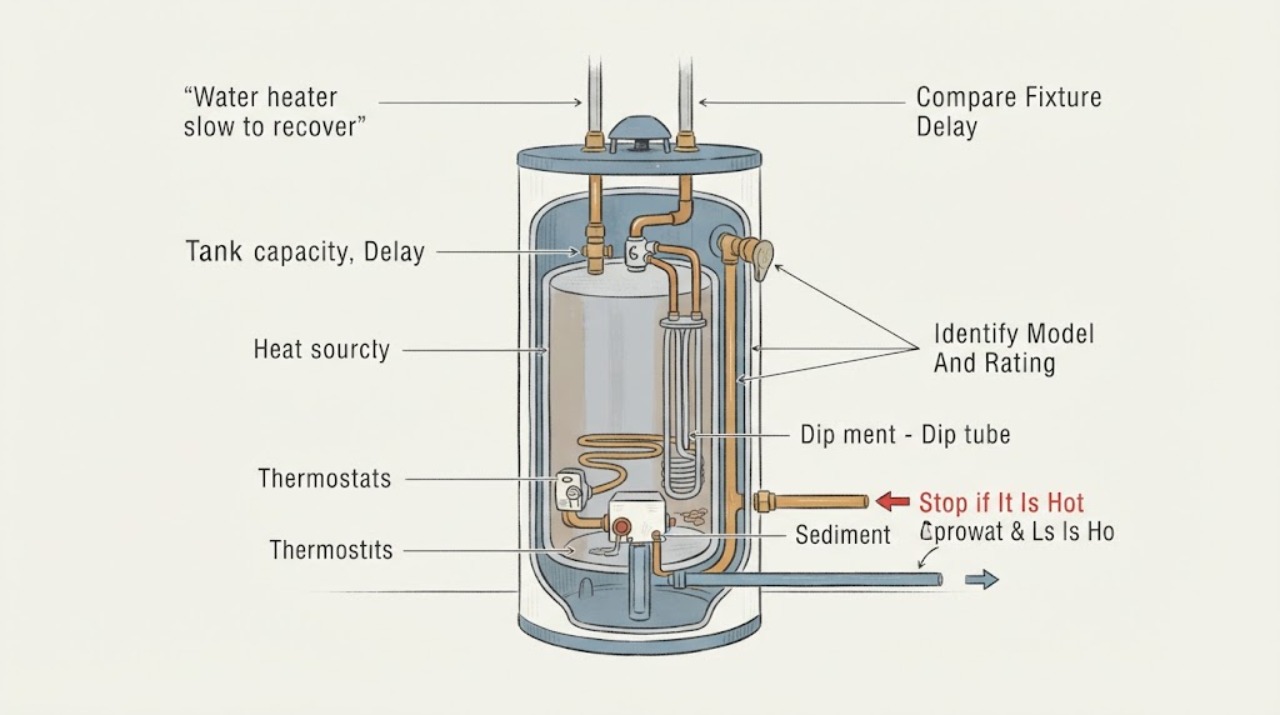
First separate slow hot water reaching one distant faucet from a Bradford White tank that actually takes too long to reheat after a known hot-water draw. Recovery depends on the heater's tank capacity, heat source, and burner or element input, so compare the timing with the model's rating and household demand rather than guessing from one shower. If the delay is new, check the external temperature setting, power or fuel status, recent plumbing changes, and whether multiple fixtures are affected. A Bradford White service manual lists sediment or lime on elements, loose connections, a failed thermostat, a derated element, and a poorly coupled power switch as possible slow-recovery causes on the covered electric models; gas models require their own manual and qualified combustion checks. Do not open energized panels, test live voltage, adjust gas controls, or remove elements as a first step. Persistent slow recovery, a fault that returns after a safe external check, leaks, unusual temperature, or gas/electrical symptoms needs qualified plumbing service.
Before you begin
Safety first
- This article supports ordinary-access observation, model identification, fixture comparison, and one safe external control check only. Qualified service handles energized electrical tests, gas and combustion work, tank draining, element/burner/thermostat/dip-tube inspection, sediment removal, and capacity changes.
Work through in order
Diagnostic checks
Use only checks that match the exact appliance or system and its official guide.
-
Check 1
Compare hot-water behavior at a nearby fixture and the farthest affected fixture, one at a time and only when the water can be handled safely; do not change the heater setting during the comparison.
Expected result: Record whether hot water is delayed only at a distant outlet, whether nearby outlets also run out, whether the affected water becomes hot after the pipe clears, and whether flow or temperature changes when another fixture runs.
Next step: Use the distribution path for a distant-only delay and the heater-recovery path when multiple fixtures share the symptom; record the fixture locations and timing for service.
Stop if: Stop for scalding water, unstable temperature, a leak, unsafe access, or any need to open a wall or remove a fixture valve.
Why this matters
Why: A distant-only delay with normal nearby recovery points toward cold water in a long pipe, insulation, or distribution/recirculation rather than slow tank recovery. A whole-home loss of stored hot water or a new delay at every outlet points toward capacity, heat input, controls, or tank condition.
-
Check 2
Use a repeatable, ordinary hot-water draw that matches the household complaint, then note how long the heater takes to provide normal hot water again without draining the tank or performing a bucket test yourself.
Expected result: Record the starting condition, approximate fixtures used, whether the unit appears to heat during recovery, the time until normal hot water returns, and whether the delay is repeatable or varies with demand.
Next step: Compare the observation with the model manual or rating information and provide the usage pattern to a plumber; do not infer a failed part from time alone.
Stop if: Do not deliberately empty a tank, collect scalding water, bypass controls, or keep running water to reproduce a no-hot-water event.
Why this matters
Why: A repeatable delay after a comparable draw supports a recovery or capacity issue. A delay that varies with simultaneous use or very large draws may be demand exceeding the heater's delivery ability. A delay only at one outlet still favors piping or a local mixing problem.
-
Check 3
Read the Bradford White rating plate and manual from a safe position and identify fuel type, tank capacity, model, heat-input or element information, and any first-hour or recovery information supplied for that model.
Expected result: Record gas or electric operation, storage capacity, rated input, model-specific recovery information, age, and whether the installed unit is smaller than the household's current demand.
Next step: Give the rating-plate data and household demand pattern to a plumbing professional for a capacity and recovery assessment before ordering parts or a larger heater.
Stop if: Do not remove covers, inspect a burner, disconnect wires, or treat a rating-plate value as permission to change an element, thermostat, or gas setting.
Why this matters
Why: Recovery is model-dependent: tank capacity, heat source, and burner or element input determine how fast stored water is replenished. A unit that recovers normally for its rating but cannot meet current demand is a sizing issue, not proof of a defective component.
-
Check 4
From a dry, safe position, check the external temperature setting, control/status indication, known service disconnect or breaker, and clearly identified fuel or water supply controls according to the exact manual; do not force a valve or open a panel.
Expected result: Record a lower-than-usual setting, a blank or fault display, a tripped breaker, a control in vacation or standby, a closed supply, normal external status, or a condition that is unclear.
Next step: Restore only a clearly identified user control once if the manual permits and it is safe; leave it alone and arrange service if the fault returns or recovery does not improve.
Stop if: Do not reset repeatedly, test live voltage, adjust gas pressure, bypass a safety limit, or operate a wet or damaged control.
Why this matters
Why: A changed setting, interrupted power or fuel, or an operating mode can lengthen recovery without a failed heater component. A repeated breaker trip, recurring fault, normal supplies with poor recovery, or an unclear control state points toward qualified diagnosis.
-
Check 5
Visually inspect accessible external piping, the drain pan, and the heater area for leaks, corrosion, unusual condensation, scorching, blocked venting on a gas installation, or signs that the unit was recently drained or serviced.
Expected result: Record a dry installation, a leak at a connection or pan, heavy corrosion, sediment-related noise, a gas/venting concern, water intrusion, or a recent refill or plumbing change.
Next step: Stop for gas odor, exhaust concern, water near electrical parts, or active leakage; otherwise document the findings and have a professional inspect sediment, venting, tank condition, and recent work.
Stop if: Do not remove insulation, open a combustion chamber, flush a tank with hot water, or energize a heater that may be empty or wet.
Why this matters
Why: A leak or water intrusion can make the heater run continuously or reduce usable supply. Sediment can reduce heat transfer and lengthen recovery. A gas or venting concern is a combustion safety issue, while recent draining may mean the unit has not completed normal refill and recovery.
-
Check 6
Create a service record with model, fuel, capacity, fixture comparison, demand pattern, recovery timing, external control status, recent maintenance, and any noise or fault indication; do not remove an element, thermostat, burner, dip tube, or contactor to inspect it.
Expected result: Record whether the slowdown is new or gradual, whether it occurs after every comparable draw, whether hot water returns briefly then falls away, and whether a single reset or supply restoration changes the result.
Next step: Give the complete record to a qualified plumber or Bradford White service professional so they can perform model-appropriate electrical, gas, draw, sediment, and component checks.
Stop if: Do not keep resetting, increasing temperature, draining, or opening the heater to reproduce the symptom.
Why this matters
Why: A new repeatable slowdown points more toward sediment, heat-source, thermostat, element, connection, or dip-tube diagnosis. A gradual problem with unchanged demand can indicate aging or scale. A stable but insufficient result for the model's rating points toward sizing or usage rather than a repairable fault.
Use your observations
Decision map
Find the observation that best matches what you see, then follow the next safe action.
-
PATH 01Safety boundary
What you see
A far faucet or shower waits for hot water, but a nearby outlet becomes hot normally and the tank recovers normally after a comparable draw.
Do this next
Have a plumber assess exposed-pipe insulation, the distribution layout, and any recirculation arrangement; do not replace heating components based on this symptom alone.
Why this path and its safety boundary
Why it matters: Cold water held in a long run, pipe heat loss, or distribution/recirculation is more likely than a slow Bradford White heater.
Safety stop: Stop for a leak inside a wall, unstable temperature, or any need to open the wall or alter a mixing valve.
-
PATH 02Safety boundary
What you see
The heater recovers normally for its rating after a controlled draw, but the household frequently empties the tank with long or simultaneous uses.
Do this next
Stagger large draws and ask a qualified plumber to assess capacity, first-hour delivery, and a properly sized replacement or supplemental design if the usage pattern is permanent.
Why this path and its safety boundary
Why it matters: Demand or sizing is more likely than a failed component; recovery time is being exceeded by the volume being used.
Safety stop: Do not raise the temperature beyond the manual's safe setting or change fuel/element input as a shortcut.
-
PATH 03Safety boundary
What you see
An electric Bradford White tank has a new repeatable slow-recovery symptom, while demand and external settings are unchanged.
Do this next
Leave internal electrical diagnosis to a qualified person using the exact service manual; provide the model, rating, timing, noise, and breaker history.
Why this path and its safety boundary
Why it matters: Sediment or lime on an element, a failed element, loose wiring, an inoperative thermostat or contactor, a derated element, or a power-switch issue becomes more likely on the applicable models.
Safety stop: Do not open energized covers, measure live voltage, disconnect wires, remove an element, or reset the high limit repeatedly.
-
PATH 04Safety boundary
What you see
A gas Bradford White tank recovers slowly, the burner cycle is abnormal, the pilot or control status is not normal, or venting/combustion conditions are uncertain.
Do this next
Stop using the heater for gas odor, soot, exhaust concern, or unsafe combustion signs and obtain qualified gas-appliance service with the exact model manual.
Why this path and its safety boundary
Why it matters: Fuel supply, burner, gas control, thermostat, venting, or another combustion-related issue may reduce heat input; the electric service-manual path does not establish a gas repair.
Safety stop: Do not adjust gas pressure, dismantle a burner, relight in the presence of gas odor, or bypass a combustion safety control.
-
PATH 05Safety boundary
What you see
Recovery has gradually worsened, the unit serves hard water, there is rumbling or hissing, or inspection/service history suggests sediment or lime buildup.
Do this next
Arrange model-appropriate flushing or element/tank inspection by a qualified person, especially if the drain is blocked, the tank is old, or hot water is unsafe.
Why this path and its safety boundary
Why it matters: Mineral buildup can insulate the tank or element and reduce heat transfer, making recovery slower and potentially damaging a heating component.
Safety stop: Do not open a hot drain, remove elements, or flush an unfamiliar heater without following the exact manual and safe cooling procedure.
-
PATH 06Safety boundary
What you see
Hot water becomes insufficient soon after use, plumbing was recently changed, the cold inlet is unusually cold, connections may be reversed, or a dip-tube/mixing symptom is present.
Do this next
Have a plumber verify inlet/outlet orientation, dip-tube and mixing behavior, and the distribution system using the model documentation.
Why this path and its safety boundary
Why it matters: Cold inlet conditions, reversed connections, a damaged dip tube, or a local mixing issue can make usable hot water disappear without a primary heat-input failure.
Safety stop: Do not disconnect water connections, remove a dip tube, or open a mixing valve as a homeowner test.
-
PATH 07Safety boundary
What you see
Slow recovery is accompanied by a tank or connection leak, water near electrical parts, gas odor, smoke, unusual temperature, repeated breaker/high-limit trip, or a heater that may be empty.
Do this next
Stop using the heater, isolate water, gas, or power only from a known-safe external control when appropriate, keep people away, and obtain urgent qualified service or emergency help for gas or fire conditions.
Why this path and its safety boundary
Why it matters: The symptom has crossed into a water, electrical, gas, scald, or equipment-damage hazard and is no longer a routine recovery check.
Safety stop: Do not touch wet wiring, reset a safety device repeatedly, relight, drain hot water, or energize an unfilled tank.
Helpful context
Understand the symptom
Define recovery before changing a part
Recovery is how quickly the heater replenishes usable hot water after a draw. That is not the same as waiting for cold water to leave a long run of pipe before a remote shower becomes hot. If only one far fixture is slow while the tank and nearby fixtures recover normally, investigate distribution or recirculation rather than replacing a heating component. If every fixture runs out and the heater takes longer than it used to after a comparable draw, the heater or its capacity becomes the focus.
Use the installed model, fuel, and demand as the baseline
A Bradford White model's expected recovery depends on its tank size and heat input. A busy household, long showers, a soaking tub, or simultaneous fixtures can exceed the delivery ability of an otherwise working unit. Compare the complaint with the rating plate, manual, and a repeatable usage pattern. Do not raise the thermostat beyond the manual's safe setting to compensate for an undersized heater.
A new slowdown deserves component diagnosis
When demand has not changed but recovery has, sediment or lime, a failing element or burner, a thermostat or contactor problem, loose electrical connections, a derated element, a dip-tube issue, or a fuel/power interruption may be involved. The checks that distinguish those causes involve energized electrical measurements, gas combustion, internal controls, or tank draining, so document the symptom and leave those steps to a qualified person using the exact Bradford White manual.
Safety boundary
Stop conditions
- Do not open electrical access panels, test live voltage, disconnect wires, remove heating elements, or bypass the ECO/high-limit control as a homeowner check.
- Do not adjust gas pressure, dismantle a burner, relight with gas odor, or continue operating a heater with a combustion or venting concern.
- Do not raise the temperature beyond the exact manual's safe setting to compensate for undersizing or slow recovery.
- Do not drain or flush a hot or unfamiliar tank, or energize an electric tank that may not be completely full.
- Stop for gas odor, smoke, water near electrical parts, active leakage, scalding or unstable temperature, repeated safety trips, or unsafe access; obtain qualified service.
Only after diagnosis
Potential parts
- Bradford White heating element
Consider this category only when a qualified technician confirms a covered electric model has a failed, scaled, grounded, or incorrectly rated element after safe power, control, and full-tank checks.
Confirm the exact model, element voltage, wattage, style, thread, gasket, and service procedure; do not substitute a derated or higher-input element by appearance. - Bradford White thermostat or high-limit control
Consider this category only after qualified diagnosis confirms inaccurate temperature control, recurring high-limit operation, or a thermostat fault that explains slow recovery.
Match the exact model, fuel/electrical configuration, control position, and safety specification; do not bypass or repeatedly reset a high-limit control. - Bradford White gas burner or gas-control assembly
Consider this category only when qualified gas-appliance service confirms reduced or abnormal heat input after fuel supply, venting, and safety conditions are verified.
Confirm the exact model, fuel type, control generation, certified replacement information, and combustion setup; gas work requires qualified service. - water-heater dip tube
Consider this category only when a plumber confirms reversed or poorly mixed inlet flow or a damaged dip tube is causing usable hot water to fall away sooner than expected.
Confirm the exact tank model, inlet arrangement, tube length/material, and installation procedure; do not remove a nipple or tube without draining and safe professional preparation. - properly sized replacement water heater
Consider replacement or resizing only when recovery is normal for the existing unit but current household demand exceeds its rated delivery, or when the tank is aged or structurally compromised.
A qualified installer must match capacity, fuel or power, venting, dimensions, recovery, first-hour delivery, local requirements, and the home's demand pattern.
When checks do not resolve it
Need a professional?
Arrange qualified plumbing service when a Bradford White heater remains slow after a safe external setting and supply check, recovery is newly or repeatedly worse, the unit cannot meet its rated delivery, sediment or scale is suspected, an element/burner/thermostat/contactor/dip-tube issue is possible, plumbing was reversed or changed, or a distant-faucet delay needs distribution diagnosis. Seek urgent help for gas odor, smoke, combustion or venting concerns, water near electrical parts, a tank or connection leak, unusually hot or unstable water, repeated breaker/high-limit trips, or an unfilled tank. Provide the model and rating plate, fuel type, capacity, fixture comparison, demand pattern, timing, controls, recent work, and safety symptoms.
Safety scope: This article supports ordinary-access observation, model identification, fixture comparison, and one safe external control check only. Qualified service handles energized electrical tests, gas and combustion work, tank draining, element/burner/thermostat/dip-tube inspection, sediment removal, and capacity changes.
Common questions
FAQ
What does slow recovery mean on a Bradford White water heater?
It means the heater takes longer than expected to replenish usable hot water after a draw. First rule out a long pipe run or a household demand that exceeds the tank's rated delivery; a new slowdown can point to sediment, a heat-source component, thermostat, wiring, element rating, dip tube, or another model-specific issue.
Why does hot water take a long time to reach one shower?
Distance can leave cold water in the pipe between the heater and that shower. If a nearby faucet gets hot normally and the tank recovers normally, investigate distribution, insulation, or recirculation rather than replacing the Bradford White heating component.
Can a Bradford White water heater be too small for my household?
Yes. Long showers, soaking tubs, simultaneous fixtures, or a changed household can deplete stored hot water faster than the heater can recover. Compare demand with the model's capacity and recovery information and ask a plumber about sizing before changing a part.
Can sediment make recovery slower?
Yes. Bradford White explains that mineral buildup can reduce heat transfer and lengthen recovery, and its service material lists sediment or lime around electric elements as a slow-recovery cause. Have the exact model's maintenance procedure followed by a qualified person when draining or opening the heater is required.
Should I replace the heating element when recovery is slow?
Not without diagnosis. A failed or incorrectly rated element is one possible cause on applicable electric models, but demand, sediment, thermostat, wiring, and other faults can look similar. Element testing and replacement require de-energizing, model-matched parts, and qualified service.
When does slow recovery become an emergency?
Seek urgent help for gas odor, smoke, combustion or venting concern, water near electrical parts, an active leak, scalding or unstable water temperature, repeated breaker or high-limit trips, or a heater that may be empty. Stop operating the unit and isolate it only from a known-safe external control when appropriate.
Read the exact guide
Official sources
- 238-47157-00_Current Service ManualBradford White Water Heaters · Official Bradford White service manual for the covered electric water-heater family; exact model manuals and qualified service procedures control other models and fuel types.
- Hot Water Problem Solver: What To Do When It Takes a Long Time for Your Water to Get HotBradford White Water Heaters · Official Bradford White consumer guidance; product-specific manuals and local plumbing assessment control an installed system.
- Insufficient Hot Water / Draw Test ProcedureBradford White For The Pro · Official Bradford White professional guidance; a qualified technician should conduct a draw test involving hot-water volumes and temperature measurements.
- What does “recovery” mean for my water heater?Bradford White Water Heaters · Official Bradford White FAQ; it defines recovery generally and does not establish a particular model's rating or fault.
- The Cold-Water Conundrum: What to Do When You Run Out of Hot WaterBradford White Water Heaters · Official Bradford White consumer guidance for insufficient stored hot water; it is not a model-specific repair manual.
Community feedback
Share a repair observation
Share a plain-text repair observation. Accepted observations are published automatically; this page may take a moment to update.