
On this page
Start here
Quick answer
A. O. Smith describes the dip tube as the inlet tube that carries cold water toward the bottom of a tank so the stored hot water remains usable at the top. A cracked, missing, short, melted, or incorrectly connected dip tube can let cold water reach the hot outlet early, making recovery feel slow and sometimes producing cold water from a hot faucet or plastic fragments at faucets. Do not assume the dip tube is the cause until you compare more than one outlet and rule out a small tank, excessive demand, a hot-water leak or crossover, sediment, thermostat or burner/element trouble, and wrong piping. From a safe position, record the model and serial number, observe the symptom and visible operating status, and arrange qualified water-heater service for any dip-tube inspection or replacement. Do not open the tank, disconnect hot or cold piping, drain hot water, change gas pressure or combustion parts, or expose electrical terminals.
Before you begin
Safety first
- This article supports outlet comparison, debris observation, and dry exterior inspection only. Do not open the tank or controls, drain hot water, remove piping, relight an unverified gas unit, test combustion or live wiring, or bypass a safety device.
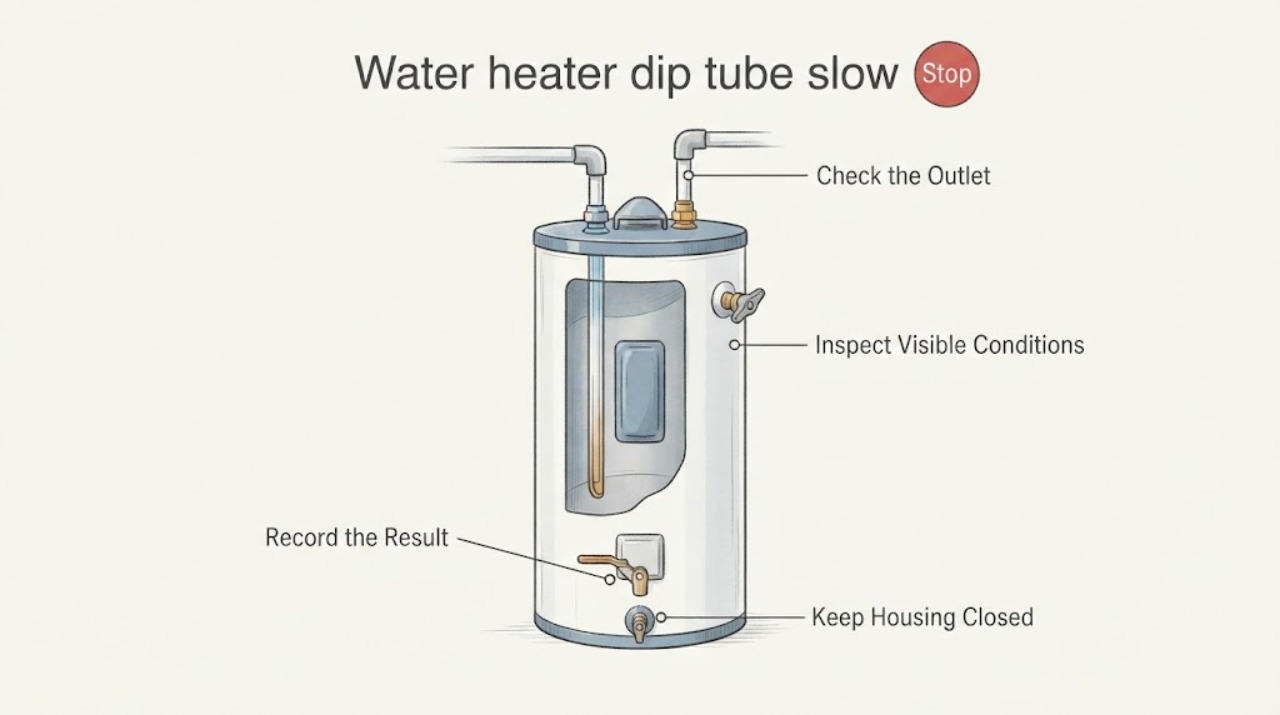
Work through in order
Diagnostic checks
Use only checks that match the exact appliance or system and its official guide.
-
Check 1
Use two or more hot-water outlets normally and compare the first water, the change during continued use, and the result after the heater has had ordinary time to recover; do not alter the thermostat or open the heater.
Expected result: Record whether hot water is initially hot then turns cold quickly at several outlets, is never hot, is slow only at one fixture, or is intermittent. Note whether the symptom began after installation, plumbing work, or a component change.
Next step: Continue to the visible fragment and operating-status checks only when the heater area is dry and safe; provide the outlet pattern to a qualified technician.
Stop if: Stop if water is scalding, leaking, discolored with debris, or the comparison exposes gas odor, abnormal combustion, electrical damage, or water near controls.
Why this matters
Why: Several outlets that start hot and turn cold quickly support a tank mixing, dip-tube, piping, leak, or demand issue. One affected outlet points toward its fixture or mixing valve. No hot water with no burner or heating indication shifts attention to gas, ignition, thermostat, element, power, or controls rather than the dip tube alone.
-
Check 2
At an affected faucet or shower, collect any visible particles in a clean container or observe the aerator or shower screen only from ordinary safe access; do not open the water-heater inlet or probe the tank.
Expected result: Record whether small plastic-like fragments, repeated clogs, or unusual debris appear at more than one hot-water outlet, or whether no fragments are present.
Next step: Keep a sample or photograph, avoid pushing debris farther into a fixture, and arrange model-specific service for dip-tube inspection when the outlet pattern and recovery symptom agree.
Stop if: Do not disassemble the tank, remove the cold-water nipple, flush hot debris through the system, or use a chemical cleaner to clear suspected fragments.
Why this matters
Why: A. O. Smith identifies broken dip-tube pieces and more frequent clogs as possible signs of a broken dip tube. Their absence does not rule it out, because a dip tube can fail without sending visible pieces to every outlet; debris from a different plumbing source remains possible.
-
Check 3
From a dry position, observe only the heater's designed exterior indicator, sight window, display, burner-area exterior, vent termination, or electrical status light as applicable; do not remove covers or reach into the combustion or wiring compartments.
Expected result: Record whether the unit shows a normal call-for-heat indication, a pilot or burner indication where the model provides one, an error or lockout indication, no power or status, blocked or damaged visible venting, soot, or abnormal sound.
Next step: Photograph the model and status without opening the unit and provide the observation to an A. O. Smith service professional; do not reset or relight an unknown model.
Stop if: Stop for gas odor, hissing, abnormal flame, soot, CO alarm, hot surfaces, exposed wiring, water near electrical parts, or any need to open the burner or access compartment.
Why this matters
Why: A failed or absent heating indication, lockout, blocked vent, soot, or abnormal sound can independently slow recovery and requires model-specific service. A normal exterior heating indication makes a dip-tube, piping, demand, sediment, or leak investigation more useful but does not prove the dip tube is faulty.
-
Check 4
From safe access, inspect visible hot-water piping, nearby fixtures, floor area, and any drain pan for signs of a continuous leak or unintended hot-water flow; do not open walls, move the heater, or manipulate relief or drain valves.
Expected result: Note a dry system, a dripping fixture, moisture at visible piping or the tank, water in the pan, or hot-water use that continues when fixtures are closed.
Next step: Arrange plumbing diagnosis for any leak or unexplained hot-water flow and give the technician the recovery timing and outlet comparison before replacing a dip tube.
Stop if: Stop for hot water, a relief-valve discharge, an active leak, water near controls, or any need to open a wall or drain the tank.
Why this matters
Why: A slow plumbing leak or crossover can make recovery appear poor by continuously consuming heated water. A dry visible system makes demand, capacity, heating performance, piping, sediment, and dip-tube causes more relevant, but a concealed leak is still possible.
-
Check 5
Read the rating plate from a dry, safe position and record the model, serial number, fuel type, tank size marking, installation history, and any prior plumbing or water-heater work; do not select a tube by tank appearance.
Expected result: Note whether the unit is gas or electric, whether the serial and model are legible, whether piping was recently changed, and whether the symptom followed installation or a replacement part.
Next step: Give the model, serial, fuel type, outlet pattern, fragment evidence, and service history to an A. O. Smith professional; request confirmation of the inlet tube and piping before ordering parts.
Stop if: Stop if the rating plate area is hot or wet, the unit has been flooded or damaged, or obtaining the information would require removing covers or entering an unsafe equipment space.
Why this matters
Why: A. O. Smith uses model and serial information to identify appropriate parts and documentation. A dip-tube symptom after installation can also reflect reversed or incorrect piping, while a long-standing gradual loss can fit sediment, an undersized unit, leaks, heating controls, or tube deterioration.
Use your observations
Decision map
Find the observation that best matches what you see, then follow the next safe action.
-
PATH 01Safety boundary
What you see
Several hot-water outlets start hot and then turn cold quickly, and plastic-like fragments or repeated hot-side clogs are also observed.
Do this next
Arrange model-specific professional inspection of the cold inlet, dip tube, and piping; preserve the debris sample and do not open the tank.
Why this path and its safety boundary
Why it matters: A cracked, missing, short, melted, or incorrectly connected dip tube becomes more likely, but a piping crossover or leak can create a similar recovery complaint.
Safety stop: Do not pull the cold-water nipple, drain hot water, or install a tube without confirming the exact model and inlet arrangement.
-
PATH 02Safety boundary
What you see
Water is never hot or recovery is poor while the heater shows no normal burner or heating indication, a lockout, a gas or venting symptom, or abnormal combustion evidence.
Do this next
Stop using the heater and arrange qualified service for ignition, gas, combustion, venting, or control diagnosis; do not attempt burner or gas repairs.
Why this path and its safety boundary
Why it matters: The burner, gas control, thermostat, combustion air, venting, supply, or another heating component is more likely than an isolated dip-tube fault.
Safety stop: For gas odor, hissing, soot, abnormal flame, or CO concern, leave the area and follow emergency and gas-supplier guidance.
-
PATH 03Safety boundary
What you see
The heater or visible hot-water piping is wet, a fixture continues to flow when closed, or water usage appears to continue while fixtures are not being used.
Do this next
Arrange plumbing diagnosis and provide the timing and location of the loss; leave the heater and relief device untouched.
Why this path and its safety boundary
Why it matters: A slow plumbing leak, crossover, or relief-path issue can consume hot water and mimic slow recovery; the dip tube is not established as the cause.
Safety stop: Stop for hot discharge, an active leak, water near controls, or any work requiring wall access or tank draining.
-
PATH 04Safety boundary
What you see
The heater heats normally, no dip-tube fragments are observed, the plumbing appears dry, and the complaint follows heavy use, seasonal demand, tank noise, or gradual performance loss.
Do this next
Have a qualified professional compare the heater's capacity, heating operation, sediment condition, and piping before choosing a dip tube or changing the temperature setting.
Why this path and its safety boundary
Why it matters: Capacity, usage, sediment, thermostat or gas-control calibration, or heat-transfer limitations remain plausible; a dip tube should not be ordered on this pattern alone.
Safety stop: Do not raise the temperature blindly, drain a hot tank, open gas or electrical covers, or perform combustion or element tests as an ordinary user check.
-
PATH 05Safety boundary
What you see
The symptom began after installation or plumbing work, the model and serial information are missing, the fuel type or piping is uncertain, or a prior repair changed the inlet arrangement.
Do this next
Photograph the rating plate and accessible piping, keep the unit out of disassembly, and ask an A. O. Smith professional to verify the model-specific inlet, tube, and installation.
Why this path and its safety boundary
Why it matters: Incorrect piping, an incompatible or short tube, a changed control, or a different tank design may be involved; a generic dip tube cannot be assumed to fit.
Safety stop: Do not disconnect piping, remove the inlet nipple, alter the gas or electrical system, or operate an unsafe or damaged heater.
Helpful context
Understand the symptom
What a dip tube changes in a tank water heater
The dip tube is inside the cold-water inlet and directs incoming cold water downward. If that tube is damaged, shortened, melted, missing, or connected to the wrong inlet, incoming cold water can enter near the top and mix with the hot outlet sooner than intended. That can feel like slow recovery even though the burner or heating elements are operating. A dip tube is not visible from outside the tank, so the outside symptom can establish a service lead but cannot confirm the part by itself.
Separate a dip-tube pattern from demand or heating trouble
If hot water starts normally and then turns cold quickly at several fixtures, a dip-tube or piping problem becomes more plausible, especially if small plastic pieces appear at an aerator or shower screen. If the water is never hot, the burner or heating system does not operate, or recovery is slow after every use, gas, venting, thermostat, element, sediment, capacity, or supply issues remain possible. Compare outlets and record the timing rather than raising a thermostat or opening the heater.
Gas and electrical work are outside this check
A gas tank adds pilot, burner, gas-control, and venting hazards; an electric tank adds energized terminals and heating elements. Do not relight an unverified gas model, remove burner or access covers, test gas pressure, use a meter on live wiring, drain hot water, or pull the inlet connection to inspect the dip tube. A qualified technician can isolate the heater, inspect the inlet and piping, and verify safe operation after any repair.
Safety boundary
Stop conditions
- Do not open the tank, remove the cold-water inlet or dip tube, disconnect hot or cold piping, drain hot water, or work on a pressurized heater as an ordinary user check.
- Do not open gas-control, burner, vent, combustion, thermostat, or electrical compartments, change gas pressure, test live wiring, or bypass a safety control.
- Stop for gas odor, hissing, soot, abnormal flame, a CO alarm, suspected combustion or venting trouble, scalding water, flooding, water near controls, or any damaged equipment.
- Do not raise the thermostat blindly or assume that fragments prove a dip-tube failure; capacity, demand, leaks, piping, sediment, and heating operation can produce similar recovery symptoms.
- Arrange qualified service when the symptom persists, the model or fuel type is uncertain, the tank has been modified or flooded, or selecting a replacement requires access inside the heater.
Only after diagnosis
Potential parts
- A. O. Smith model-specific dip tube
Consider this category only when the exact model and professional diagnosis confirm a cracked, missing, short, melted, or incorrectly connected dip tube as the cause of the recovery symptom.
Confirm the exact model, serial number, inlet location, tube length and material, heat-trap arrangement, and manufacturer's fit information before ordering. - cold-water inlet or heat-trap assembly
Consider this category only if a qualified inspection finds damage, incorrect installation, or a restriction at the cold-water inlet or heat-trap assembly rather than in the dip tube alone.
Confirm exact model, connection, flow direction, tube and heat-trap design, and installation requirements; do not substitute a generic inlet assembly. - gas control or thermostat assembly
Consider this category only when a qualified heating-system diagnosis identifies a gas-control or thermostat fault after the dip-tube, capacity, demand, leak, and piping causes are excluded.
Confirm exact model, fuel type, control design, safety approvals, and manufacturer's service guidance; gas-control work is professional service. - water heater replacement assembly
Consider a complete replacement only when the tank, installation, capacity, or internal condition is beyond practical repair or a qualified professional determines that replacement is appropriate.
Confirm exact fuel type, capacity, venting, connections, location, code requirements, and model documentation before selection or installation.
When checks do not resolve it
Need a professional?
Arrange qualified water-heater service when several outlets turn cold quickly, fragments or recurring hot-side clogs suggest a dip tube, recovery is slow despite normal heating indication, piping or installation history is uncertain, the heater shows a burner or control fault, a leak or crossover is possible, or any inspection would involve gas, combustion, electrical, hot-water, pressurized, or internal tank work. Treat gas odor, hissing, soot, abnormal flame, CO alarm, or possible CO symptoms as an emergency.
Safety scope: This article supports outlet comparison, debris observation, and dry exterior inspection only. Do not open the tank or controls, drain hot water, remove piping, relight an unverified gas unit, test combustion or live wiring, or bypass a safety device.
Common questions
FAQ
What does a dip tube do in an A. O. Smith water heater?
The dip tube carries incoming cold water toward the bottom of a tank so the hotter water remains available near the outlet. If it is cracked, missing, short, melted, or incorrectly connected, cold water can reach the hot outlet early and make recovery feel slow.
What are signs of a broken water-heater dip tube?
Several hot-water outlets may start hot and turn cold quickly, and small plastic-like fragments or repeated hot-side clogs may appear. Those signs are not conclusive; wrong piping, a leak, demand, sediment, capacity, or heating trouble can look similar.
Can I remove the cold-water inlet to inspect the dip tube?
Do not remove the inlet or open the tank as an ordinary user check. The connection is part of a hot, pressurized water system, and the exact tube and heat-trap arrangement must match the model. Arrange qualified service and provide the model and serial number.
Why is recovery slow if the burner appears to be working?
A normal-looking burner indication does not rule out a dip-tube or piping problem. Capacity, heavy demand, a leak or crossover, sediment, gas pressure, venting, thermostat or gas-control behavior, and the tube itself can all affect recovery. A technician should separate those causes before replacing a part.
When should I call a professional for slow recovery?
Arrange service when multiple outlets turn cold quickly, fragments appear, the heater has a gas, venting, combustion, or electrical symptom, a leak is present, piping or model identity is uncertain, or diagnosis would require opening the tank, changing gas controls, draining hot water, or exposing electrical parts.
Read the exact guide
Official sources
- Water Heater Maintenance GuideA. O. Smith · Official A. O. Smith maintenance guidance; hazardous gas, electrical, hot-water, relief-valve, and draining work is kept outside this article's user checks.
- How Long Does It Take to Heat Up a Water HeaterA. O. Smith · Official A. O. Smith consumer guidance for tank water-heater heat-up behavior and broken dip tubes.
- Order OEM Parts for Water HeatersA. O. Smith · Official A. O. Smith parts-support page; it does not establish fit without exact model and serial information.
- STD_DV_EN_RES-GAS.inddA. O. Smith · Official A. O. Smith residential gas water-heater instruction manual; the installed model's rating plate and manual control.
- Technical BulletinsA. O. Smith · Official A. O. Smith technical-bulletin index; linked bulletins and the installed model's documentation control a particular repair.
Community feedback
Share a repair observation
Share a plain-text repair observation. Accepted observations are published automatically; this page may take a moment to update.