
On this page
Start here
Quick answer
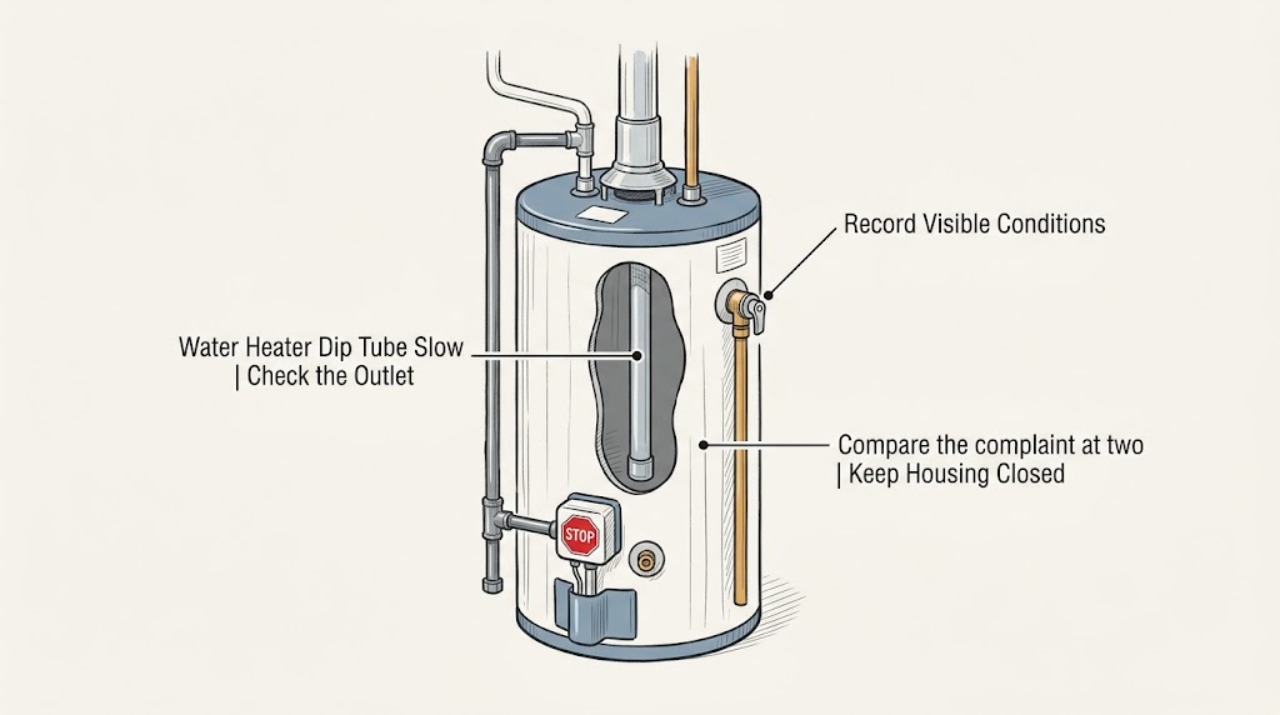
A storage water heater's dip tube sends incoming cold water to the bottom of the tank so the heated water remains available at the top. If the tube cracks, breaks, or becomes restricted, cold water can mix near the hot outlet and the supply may turn lukewarm unusually quickly; however, slow recovery is also commonly associated with heavy demand, sediment at the heating source, a heating element or thermostat problem, or an undersized or very cold-water-fed system. First separate a heater that is slow to reheat after a large draw from one that produces a sudden cold change during a normal draw. Check the usage pattern, temperature behavior, visible leaks, model information, and any control or vent warning without opening the tank or touching gas, electrical, or hot-water components. Dip-tube inspection or replacement requires model-specific service work, water isolation and draining, and hot-water and electrical or combustion safety controls, so arrange qualified plumbing service rather than pulling the inlet fitting yourself.
Before you begin
Safety first
- Do not remove the cold-water inlet or dip tube, drain a hot tank, open electrical covers, test live circuits, adjust gas controls, bypass a thermostat or high-limit control, or operate a tank that may not be full. For gas odor, a carbon-monoxide alarm, smoke, exposed wiring, an active leak, or hot discharge, stop using the heater and follow the appropriate emergency or qualified-service response.
Work through in order
Diagnostic checks
Use only checks that match the exact appliance or system and its official guide.
-
Check 1
Describe one normal hot-water event from a cold start: note how much hot water was used, whether the first outlet water was hot, how quickly it turned lukewarm, and how long the heater needed before the next normal use was hot again. Use ordinary household use only; do not deliberately empty the tank.
Expected result: The water starts hot and turns cool abruptly during a modest draw; the supply declines gradually after a large demand; or the heater is still slow after a long low-demand interval.
Next step: Record the fixture, draw pattern, approximate sequence, and recovery observation for the technician. Do not identify the dip tube as failed until model-specific service diagnosis separates it from demand and heating causes.
Why this matters
Why: A sudden cool change after initially hot water is more consistent with disturbed tank stratification, a dip-tube problem, or mixing than with ordinary recovery time. A gradual decline after heavy use can be capacity or demand related. Persistent slow recovery after light use keeps heating, sediment, thermostat, inlet-temperature, and dip-tube causes in the differential.
-
Check 2
Check the heater's exterior label and controls without opening any cover: record whether it is tank-type or tankless, gas or electric, its model information if readable, any setpoint or mode shown, and any active error, reset, or vent warning. Look only for visible pipe or tank leaks and corrosion.
Expected result: The unit is a storage heater with no warning; an electric control or breaker indication is abnormal; a gas unit shows a combustion or vent warning; or water is leaking from the tank, inlet, outlet, or relief discharge.
Next step: Photograph the label and visible condition, then arrange qualified plumbing or appliance service for warnings, leaks, corrosion, abnormal controls, or any need to open a panel. Do not reset a recurring safety control or disturb gas, wiring, or relief-valve components.
Stop if: Stop using the heater for a gas odor, combustion or vent warning, carbon-monoxide alarm, active tank leak, steam, scalding discharge, exposed wiring, or a repeated breaker or safety-control trip.
Why this matters
Why: The dip-tube mechanism applies to a storage tank, not every water-heating design. An electrical, gas, vent, leak, or relief symptom can independently cause poor hot-water performance or create an immediate safety issue, so it should not be folded into a dip-tube diagnosis.
-
Check 3
Compare the complaint at two nearby fixtures, one close to the heater and one farther away, while using the same ordinary draw pattern. Note whether the hot temperature changes at the heater-side fixture at the same point, whether only one branch is affected, and whether a single-handle faucet or shower is involved.
Expected result: Both fixtures become cool together; only the distant fixture is delayed; only one fixture becomes lukewarm; or a fixture changes temperature when another tap is used.
Next step: Record which fixtures were compared and ask the technician to check the building's mixing and distribution paths along with the water heater. Do not disassemble a faucet or alter a mixing valve solely to prove a tank diagnosis.
Why this matters
Why: A simultaneous change at multiple fixtures supports a tank, inlet, heating, or mixing issue. A distant-only delay points more toward the hot-water run or recirculation behavior. A single-fixture or cross-use change can be a local mixing-valve or faucet crossover problem rather than a dip tube.
-
Check 4
Review the conditions before the symptom: several simultaneous showers or appliances, a recent increase in household demand, unusually cold inlet water, rumbling or popping during heating, a long maintenance interval, or a recent plumbing change. Compare the complaint with a quieter, lower-demand period without raising the temperature setting.
Expected result: The issue appears only after unusually high demand; it occurs after light use as well; heating is noisy; or plumbing was recently changed and the hot and cold behavior changed immediately afterward.
Next step: Provide the usage and timing history to a qualified plumber. Do not raise the setpoint as a diagnostic shortcut, flush a hot tank, or open service panels without the exact manual and appropriate training.
Why this matters
Why: Demand or an undersized system is more likely when recovery is normal after a small draw but inadequate after a large one. Persistent slow recovery with light use raises sediment, element, thermostat, or dip-tube concerns. Noisy heating supports a sediment or lime possibility, while a sudden post-plumbing change raises reversed or cross-connected piping as another possibility.
-
Check 5
Prepare a service handoff with the model and serial information if readable, fuel type, fixture comparison, draw pattern, first-hot-to-lukewarm behavior, recovery history, visible leaks, noises, warnings, and any recent plumbing work. Ask the professional to distinguish dip-tube damage from sediment, heating, thermostat, capacity, mixing, and piping causes.
Expected result: The pattern is a sudden cold change during a modest draw; a slow recovery only after heavy use; a persistent slow recovery with light use; or a safety, leak, or combustion symptom.
Next step: Arrange qualified plumbing service for internal dip-tube inspection or replacement and any associated heating or piping diagnosis. Leave the tank and its safety controls intact; do not remove the inlet fitting or energize a tank that may not be full.
Stop if: Stop all troubleshooting and keep clear of the unit for a tank leak, hot discharge, gas odor, carbon-monoxide alarm, smoke, exposed wiring, or any internal inspection or draining requirement.
Why this matters
Why: The first pattern can justify a dip-tube and mixing-path inspection, but the other patterns require different checks. A service provider needs the whole symptom pattern because a dip tube is only one possible cause and cannot be confirmed by external timing alone.
Use your observations
Decision map
Find the observation that best matches what you see, then follow the next safe action.
-
PATH 01Next step
What you see
Several fixtures start hot, then become lukewarm unusually soon during a modest draw, and the problem is not limited to one faucet.
Do this next
Arrange qualified service for a model-specific dip-tube and mixing-path diagnosis. Do not remove the cold inlet fitting or attempt to inspect inside the tank as a homeowner.
Why this path and its safety boundary
Why it matters: A cracked, shortened, displaced, or otherwise damaged dip tube or a tank-level mixing problem becomes more plausible because cold water may be entering the hot region too early. It is still not proof; a cross-connection or control issue can imitate it.
-
PATH 02Next step
What you see
The heater supplies normal hot water after a small draw but is slow to recover after several showers or appliances use hot water together.
Do this next
Document the simultaneous use and ask a plumber to evaluate demand, capacity, heating input, and recovery. Do not raise the temperature setting as a substitute for a safety review.
Why this path and its safety boundary
Why it matters: Demand, tank capacity, incoming-water temperature, or recovery capacity is more likely than a dip tube. A dip-tube replacement would not increase a system that is simply being depleted faster than it can heat.
-
PATH 03Next step
What you see
Hot water declines gradually and recovery remains slow even after light use, with rumbling or popping, an electric heating symptom, or no abrupt temperature drop.
Do this next
Arrange qualified service for heating and sediment diagnosis before selecting a dip tube. Do not open electrical covers, test live circuits, or drain a hot tank yourself.
Why this path and its safety boundary
Why it matters: Sediment or lime at the heating source, a heating element or thermostat issue, a loose connection, or a derated heating element becomes more likely. The dip tube remains possible but is not the leading conclusion from recovery time alone.
-
PATH 04Next step
What you see
Only one fixture is affected, the distant fixture has a long wait while a heater-side fixture is normal, or temperature changes when another fixture is used.
Do this next
Have the plumbing distribution and mixing paths checked before opening the heater. Keep the comparison notes and fixture locations for the technician.
Why this path and its safety boundary
Why it matters: A local faucet or shower mixing issue, hot-and-cold cross-connection, distribution run, or recirculation issue is more likely than a tank dip tube.
-
PATH 05Next step
What you see
There is a tank or connection leak, hot discharge, gas odor, combustion or vent warning, carbon-monoxide alarm, exposed wiring, or repeated electrical or safety-control trip.
Do this next
Stop using the heater, leave the area for gas or carbon-monoxide danger, and contact the appropriate emergency or qualified service response. Do not reset a recurring safety control or attempt internal inspection.
Why this path and its safety boundary
Why it matters: The complaint is now a safety or equipment-failure issue, not a dip-tube troubleshooting exercise. Continuing to operate or opening the heater can increase burn, shock, fire, gas, or water-damage risk.
Helpful context
Understand the symptom
What the dip tube changes
In a conventional storage tank, incoming cold water is routed down the cold-water inlet so it can be heated while hot water remains at the top. A damaged tube can disturb that separation and make the outlet supply turn cool sooner than expected. That pattern is different from a heater that simply needs more time after a large demand. Sediment, a failed heating element or thermostat, a high-demand period, low incoming temperature, or a system that is too small can produce a similar complaint.
Keep dip-tube work inside the service boundary
The dip tube is inside the cold-water inlet connection and is not a safe visual or light-maintenance part for a homeowner to pull. Inspection can require isolating water, draining hot contents below the inlet, disconnecting piping, and restoring a completely full tank before energizing it. Do not remove the inlet nipple, drain the tank, open electrical covers, adjust gas controls, or test a temperature-and-pressure relief device to chase this symptom.
Only after diagnosis
Potential parts
- cold-water inlet dip tube
Consider this part only when a qualified, model-specific diagnosis finds a cracked, deformed, blocked, shortened, or otherwise damaged dip tube and the tank and inlet assembly are suitable for repair.
Confirm the exact water-heater model, inlet connection, tube length and material, anti-siphon or outlet features, and manufacturer fit information. A visually similar tube is not proof of compatibility. - heating element or thermostat
Consider this category only if the recovery pattern and qualified testing identify a heating or thermostat fault rather than demand, sediment, mixing, or dip-tube damage.
Match the exact fuel type, model, electrical or control specification, and manufacturer documentation. Do not substitute a component by appearance or bypass a safety control. - sediment service or compatible tank maintenance component
Consider this service or component category only when the technician finds sediment or lime affecting recovery and confirms that the tank and drain path can be serviced safely.
Maintenance method depends on the heater design, condition, water quality, and manufacturer instructions. Do not order a part or drain a tank solely from slow recovery.
When checks do not resolve it
Need a professional?
Stop troubleshooting and arrange qualified plumbing or appliance service for a suspected dip-tube failure, persistent slow recovery after light use, abrupt cooling at multiple fixtures, a tank or connection leak, hot discharge, rumbling with poor recovery, abnormal electric controls, gas or vent warnings, a carbon-monoxide alarm, exposed wiring, or any internal inspection, draining, or inlet-fitting work. Leave a fuel-burning appliance off and leave the area for a gas odor or carbon-monoxide alarm according to local emergency guidance.
Safety scope: Do not remove the cold-water inlet or dip tube, drain a hot tank, open electrical covers, test live circuits, adjust gas controls, bypass a thermostat or high-limit control, or operate a tank that may not be full. For gas odor, a carbon-monoxide alarm, smoke, exposed wiring, an active leak, or hot discharge, stop using the heater and follow the appropriate emergency or qualified-service response.
Common questions
FAQ
Can a bad dip tube cause slow water-heater recovery?
It can reduce usable hot-water delivery by allowing incoming cold water to mix near the top of a storage tank, especially when water turns lukewarm soon after initially being hot. But slow recovery can also come from demand, sediment, a heating element, a thermostat, or capacity, so recovery time alone does not identify the dip tube.
How can I check a water-heater dip tube myself?
Do not pull the cold-water inlet fitting as a casual check. Manufacturer service procedures require water isolation and draining below the inlet, warn that stored water and components may be hot, and reserve the work for qualified service providers. Give the technician the temperature pattern and model information instead.
Why is recovery slow only after several showers?
A large or simultaneous demand can deplete a storage tank faster than it can heat the incoming water. If the heater recovers normally after a small draw, demand, capacity, incoming-water temperature, and heating input are more likely than a dip-tube failure.
What if only one faucet has lukewarm water?
Compare a nearby fixture and a distant one. A single-fixture problem or a temperature change when another tap runs points toward a faucet, shower mixing valve, cross-connection, or distribution issue rather than the tank dip tube. Have the plumbing path checked before opening the heater.
When is slow recovery an emergency?
Slow recovery itself is usually a service diagnosis, but stop using the heater for an active leak, hot or steam discharge, gas odor, combustion or vent warning, carbon-monoxide alarm, smoke, exposed wiring, or repeated electrical or safety-control trips. Leave a carbon-monoxide danger area and use emergency guidance rather than investigating the heater.
Read the exact guide
Official sources
- The Cold-Water Conundrum: What to Do When You Run Out of Hot WaterBradford White Water Heaters · Manufacturer homeowner guidance for running out of hot water and a faulty dip tube
- Product EducationRheem Manufacturing Company · Manufacturer glossary definition of the cold-water dip tube in a storage water heater
- How Often To Flush Your Water Heater (And How To Do It)Rheem Manufacturing Company · Manufacturer guidance connecting sediment buildup with longer recovery and maintenance decisions
- Carbon Monoxide Fact SheetUnited States Consumer Product Safety Commission · Safety boundary for gas water-heater troubleshooting
- Commercial Electric Energy Saver E32 Series Models Service Manual: Troubleshooting Guide and Instructions for ServiceBradford White Corporation · Manufacturer service manual for E32 commercial electric models; used for differential causes, qualified-service warnings, and dip-tube inspection limitations
Community feedback
Share a repair observation
Share a plain-text repair observation. Accepted observations are published automatically; this page may take a moment to update.