
On this page
Start here
Quick answer
A. O. Smith water heater recovery can feel slow after a large draw because the tank, fuel type, heat input, incoming-water temperature, thermostat setting, and household demand all matter. First establish whether recovery is newly slower or has always been inadequate: note the heater type, tank nameplate, draw pattern, thermostat indication, and whether hot water is merely depleted or never becomes hot. Check for a lit pilot or normal electric supply only as the exact model manual allows, and look for leaks, unusual noise, or a fault indication. Sediment, a failing element or burner, thermostat trouble, a slow hot-water leak, a dip-tube issue, or an undersized system requires qualified diagnosis; do not open gas controls, test live electrical parts, or flush a hot tank without the model procedure.
Before you begin
Safety first
- This article covers ordinary-access identification, fixture comparison, visible observations, and only model-approved user checks. It does not authorize live electrical or gas testing, combustion or vent disassembly, tank draining without the exact procedure, safety bypass, or component replacement.
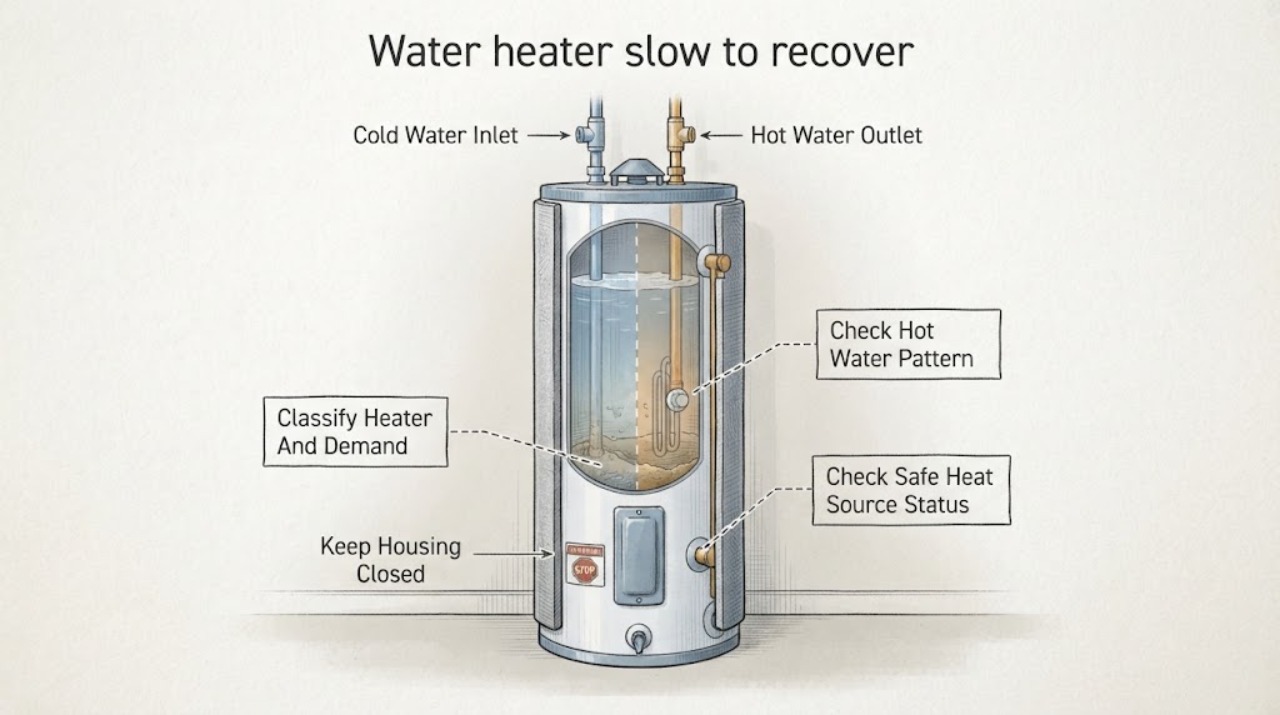
Work through in order
Diagnostic checks
Use only checks that match the exact appliance or system and its official guide.
-
Check 1
Read the nameplate and control area from ordinary safe access and record whether the A. O. Smith unit is a gas tank, electric tank, hybrid heat-pump, tankless, or another design, along with tank capacity and the recent hot-water draw pattern; do not remove panels.
Expected result: Recovery has always been inadequate for the household demand, recovery recently changed, or the heater type or capacity is unclear.
Next step: Compare the draw pattern with the nameplate and model documentation. If the unit type or capacity cannot be identified, give the label information to a qualified plumber rather than guessing at a procedure.
Stop if: Do not remove access covers, alter thermostat wiring, open gas controls, or use a tankless or heat-pump procedure on a different design.
Why this matters
Why: Longstanding shortage with heavy or simultaneous use makes sizing or demand more likely. A new slowdown makes a heat-source, thermostat, sediment, leak, or component issue more likely. An unclear type prevents a safe generic test.
-
Check 2
At several normal fixtures, compare whether water becomes hot and then runs out, stays lukewarm from the start, recovers between draws, or is weak at only one outlet; note whether a hot-water faucet drips when all other fixtures are closed.
Expected result: The whole home runs out after a large draw, one outlet is affected, hot water never reaches the expected condition, or the supply slowly loses heat without use.
Next step: Record the fixtures and timing. Check visible hot-water connections for moisture without tightening anything, and arrange service for a persistent leak, whole-home lukewarm water, or a sudden change in recovery.
Stop if: Stop if water is leaking near the heater, a tank or fitting is wet, the temperature is scalding or unstable, or a fixture cannot be isolated safely.
Why this matters
Why: Whole-home depletion points toward demand, capacity, recovery, or a heating problem. One-outlet trouble suggests that fixture or mixing path. Lukewarm water from the start makes heat-source or thermostat behavior more likely; an unexplained loss without use raises a hot-water leak or dip-tube concern.
-
Check 3
Using only the exact model manual, observe the external pilot or status indication on a gas unit, or the external breaker/disconnect position and display on an electric or heat-pump unit; do not expose wiring, relight an unknown control, or repeatedly reset a trip.
Expected result: The gas pilot or status indication is absent or abnormal, the electric supply is tripped or the display shows a fault, or the external indication appears normal while recovery remains slow.
Next step: Follow only the model's documented user reset or relight boundary. If the indication is abnormal, the fault returns, or recovery remains slow, leave the unit in the manual's safe state and arrange qualified plumbing service.
Stop if: Do not test live voltage, remove electrical covers, bypass a safety control, open a gas valve body, or repeatedly reset a fault.
Why this matters
Why: An abnormal pilot, status, supply, or fault indication can stop or reduce heat input. A normal external indication does not rule out a weak burner, heating element, thermostat, airflow, or control problem.
-
Check 4
With the heater operating normally and from a safe position, listen for new popping, rumbling, hissing, or sizzling; inspect visible pipes, the drain area, and the gas unit's external air and vent area for moisture, corrosion, obstruction, or unusual exhaust signs without touching hot surfaces or removing covers.
Expected result: There is new tank noise, visible water, corrosion, a slow drip, blocked external air or venting, or no visible abnormality.
Next step: Keep the heater in a safe operating state only when no hazard is present. Arrange prompt service for a leak, corrosion, unusual gas-unit exhaust, blocked air or venting, or noise that persists after model-approved maintenance.
Stop if: Do not touch a hot pipe, open the combustion chamber, remove a vent, clear an internal passage, or continue operation with a leak, soot, exhaust concern, or damaged tank.
Why this matters
Why: Popping or rumbling can accompany sediment; a leak can reduce available hot water and damage the unit; blocked air or venting can affect gas operation. No visible finding does not clear internal heating components.
-
Check 5
Look up the exact A. O. Smith maintenance instructions and note the last documented flush, inspection, anode check, filter or air-intake cleaning, and service visit; do not begin draining or descaling until the heat source, water temperature, drain route, refill, and restart steps are understood for this model.
Expected result: Maintenance is overdue or unknown, sediment or scale is suspected, the drain valve is obstructed, or the model procedure is available and safe to follow.
Next step: Follow the model handbook or have a qualified plumber perform the maintenance. If flushing or descaling does not restore recovery, or the drain will not flow, arrange component diagnosis instead of repeating the procedure.
Stop if: Do not drain a hot tank, open a pressure-relief path as a test, force a blocked drain valve, or restore heat before an electric tank is correctly refilled.
Why this matters
Why: Sediment and scale can slow heat transfer, but a maintenance history does not prove they are the only cause. A blocked drain or uncertain restart sequence creates a service boundary.
-
Check 6
After only a model-approved correction such as clearing an accessible obstruction, completing an approved maintenance procedure, or reducing simultaneous demand, compare the next equivalent recovery cycle and record whether the result is normal, partially improved, or unchanged.
Expected result: Recovery returns to the prior baseline, improves only with reduced demand, remains slow despite normal demand, or becomes worse with lukewarm water, noise, or a leak.
Next step: Keep the record with the model and nameplate information. Arrange qualified service for unchanged or worsening recovery, and do not compensate by raising the setting beyond the model guidance.
Stop if: Stop use for a leak, unstable or scalding water, gas odor, exhaust concern, repeated fault, or any repair that requires live electrical or gas access.
Why this matters
Why: Improvement after demand changes supports a capacity or usage explanation. Improvement after maintenance supports sediment or airflow as a contributor. No improvement or worsening points toward a heat-source, thermostat, element, burner, leak, dip-tube, or control fault.
Use your observations
Decision map
Find the observation that best matches what you see, then follow the next safe action.
-
PATH 01Safety boundary
What you see
The heater has always recovered slowly, hot water returns between draws, the tank type and nameplate are consistent with normal operation, and the problem appears after long or simultaneous use.
Do this next
Stagger large draws, record the first-hour or recovery information from the model documents, and ask a qualified plumber to assess sizing if the household demand has changed.
Why this path and its safety boundary
Why it matters: Household demand, storage capacity, recovery rating, and draw timing are more likely than a new component failure.
Safety stop: Do not increase the temperature beyond model guidance or treat a capacity limit as proof that a larger component will fit.
-
PATH 02Safety boundary
What you see
Recovery was previously adequate but is now slow, water is lukewarm from the start, or the external pilot, display, breaker, or status indication is abnormal.
Do this next
Follow only the exact model's safe external check or one documented reset, then leave the unit in its safe state and arrange qualified service for diagnosis.
Why this path and its safety boundary
Why it matters: A failing burner, heating element, thermostat, ignition or electrical supply, control, or safety condition is more likely than normal demand.
Safety stop: Do not test live wiring, open gas controls, bypass protection, or continue resetting a returned fault.
-
PATH 03Safety boundary
What you see
Recovery has gradually worsened and is accompanied by popping or rumbling, hard-water history, overdue maintenance, or visible sediment during a model-approved service procedure.
Do this next
Use the exact maintenance instructions or request qualified flushing and inspection. If the drain is blocked, the tank leaks, or recovery remains slow afterward, stop maintenance attempts and arrange repair diagnosis.
Why this path and its safety boundary
Why it matters: Sediment or scale may be reducing heat transfer, but a burner, element, thermostat, drain, or tank issue can coexist.
Safety stop: Do not drain hot water, force a drain valve, or use an unapproved descaling method.
-
PATH 04Safety boundary
What you see
Hot water is lost without a corresponding draw, a hot faucet or visible fitting drips, the tank or drain area is wet, or one outlet is lukewarm while others are normal.
Do this next
Stop the leak source only if its accessible shutoff is clear and safe, protect the area, and arrange plumbing diagnosis. Do not tighten or replace hidden fittings as a generic test.
Why this path and its safety boundary
Why it matters: A hot-water leak, dip-tube issue, mixing path, fixture valve, or localized delivery problem is more likely than simply slow tank recovery.
Safety stop: Stop use for a tank leak, water near electrical parts, scalding or unstable temperature, or a fitting that cannot be isolated safely.
Helpful context
Understand the symptom
First decide whether the heater is slow or the demand is larger
A tank that has always run short during back-to-back showers may be correctly operating near its storage or recovery limit. A unit that formerly recovered normally but now takes much longer points toward a change in heat input, thermostat behavior, sediment, a leak, or another fault. Compare the same type of draw on a typical day and record whether the problem affects every fixture or only one hot-water outlet.
The fuel type changes the useful checks
Gas and electric tank heaters do not recover through the same components. A gas model needs a functioning pilot or ignition path, burner, combustion-air supply, and venting; an electric model depends on its supply, thermostats, and heating elements. A hybrid, tankless, or other design needs its own manual. Do not apply an electric test to a gas unit or a gas relight sequence to a model without a standing pilot.
Sediment and maintenance are clues, not permission for risky work
A. O. Smith links sediment with reduced heat transfer, efficiency changes, unusual tank noise, and longer recovery, and recommends model-specific maintenance. Flushing a tank involves a heat source, hot water, drain hardware, and refill sequence; a clogged drain valve, leak, or uncertainty about the procedure is a service boundary. A sudden performance change should not be managed by repeatedly raising the thermostat.
Safety boundary
Stop conditions
- Do not open gas controls, combustion chambers, electrical access covers, or live wiring, and do not test gas pressure or live voltage as a homeowner check.
- Do not drain or flush a hot tank, force a drain or pressure-relief valve, or restore an electric heater before the exact model refill and restart procedure is satisfied.
- Stop for a tank or fitting leak, gas odor, unusual exhaust, soot, unstable or scalding water, repeated fault, damaged vent or air path, or water near electrical parts.
- Do not repeatedly reset a tripped breaker or fault, relight an unknown gas control, raise the thermostat as a substitute for diagnosis, or bypass a safety device.
- Do not order a burner, element, thermostat, dip tube, or control by appearance alone; confirm the model and qualified diagnosis first.
Only after diagnosis
Potential parts
- heating element or burner assembly
Consider this category only when a qualified diagnosis confirms reduced heat input on the correct fuel type after demand, thermostat, sediment, airflow, and supply checks.
Confirm the exact model, fuel type, input or element design, and manufacturer fit information before ordering; do not substitute across heater types. - thermostat or temperature-control component
Consider this category only when the heater's external indications and qualified testing show that temperature control is ending the heat cycle incorrectly or failing to call for heat.
Confirm the exact model, fuel type, control arrangement, and manufacturer fit information; gas controls and electric thermostats are not interchangeable. - dip tube or hot-water delivery component
Consider this category only when hot water is inadequate despite normal heat input and a qualified diagnosis finds a damaged, missing, or incorrect inlet or delivery component.
Confirm the exact model, tank configuration, connection, and manufacturer repair procedure before ordering; do not infer fit from tank capacity alone.
When checks do not resolve it
Need a professional?
Arrange qualified plumbing service when recovery is newly slower, water is lukewarm from the start, a pilot or status indication is abnormal, an electric supply or fault returns, sediment noise persists, a drain is blocked, a hot-water leak is visible, or the unit does not improve after model-approved maintenance. Request sizing assessment when the heater has always been inadequate for current demand. Seek urgent help for gas odor, exhaust concern, a tank leak, unstable or scalding water, or water near electrical parts.
Safety scope: This article covers ordinary-access identification, fixture comparison, visible observations, and only model-approved user checks. It does not authorize live electrical or gas testing, combustion or vent disassembly, tank draining without the exact procedure, safety bypass, or component replacement.
Common questions
FAQ
Why is my A. O. Smith water heater suddenly slow to recover?
A sudden change makes a burner, heating element, thermostat, pilot or ignition, sediment, hot-water leak, dip-tube, airflow, vent, or control issue more likely than normal household demand. Record the model, fuel type, timing, status indication, noise, and leak observations, then arrange qualified service if the exact model checks do not resolve it.
Could a water heater that has always been slow simply be undersized?
Yes. If hot water returns between draws and the shortage appears only after long or simultaneous use, demand, storage capacity, and recovery rating may be the limiting factors. Ask a qualified plumber to compare the nameplate and documented recovery information with current household use before replacing parts.
Does sediment make an A. O. Smith water heater recover slowly?
Sediment or scale can reduce heat transfer and may accompany popping or rumbling. Follow only the exact maintenance procedure for the model, or request qualified flushing and inspection. A blocked drain, leak, or unchanged recovery needs service rather than repeated flushing.
Should I raise the thermostat to make recovery faster?
Do not use a higher setting as a substitute for diagnosis. Incorrect temperature changes can create scalding risk and will not repair a failed burner, element, thermostat, leak, sediment problem, or undersized system. Use the model guidance and qualified service for persistent slow recovery.
When is slow recovery an emergency?
Seek urgent help for gas odor, unusual exhaust, a tank or fitting leak, unstable or scalding water, smoke or soot, a repeated fault, or water near electrical parts. Keep the heater in the safe state described by its manual and do not open gas or electrical components.
Read the exact guide
Official sources
- Technical BulletinsA. O. Smith (AO Smith) · Official manufacturer bulletin index used to identify diagnostic branches; individual model and bulletin instructions control any repair or test.
- When to Repair or Replace Your Water HeaterA. O. Smith (AO Smith) · Official manufacturer troubleshooting overview used to distinguish capacity, heat-source, leak, and component branches without making a model-specific compatibility claim.
- How to Adjust Temperature on Gas Water Heater SafelyA. O. Smith (AO Smith) · Official manufacturer guidance used for safe external checks, temperature and noise context, leak escalation, and the prohibition on dismantling gas components.
- How Long for Water Heater to Reheat After Use?A. O. Smith (AO Smith) · Official manufacturer overview used to distinguish demand or sizing from a new recovery slowdown and to identify broad recovery factors; the exact model documentation controls.
- Water Heater Maintenance GuideA. O. Smith (AO Smith) · Official maintenance guide used for model-manual priority, sediment and flushing context, and safe boundaries; exact model instructions take precedence.
Community feedback
Share a repair observation
Share a plain-text repair observation. Accepted observations are published automatically; this page may take a moment to update.