
On this page
Start here
Quick answer
A thermostat can make a storage electric water heater recover slowly if it reads the tank incorrectly, is set lower than expected, or stops the elements prematurely, but the same symptom can come from a failed lower heating element, low power, heavy demand, sediment, a plumbing leak, or a mixing-valve problem. Record whether the shortage follows one heavy use or ordinary use, compare hot water at several outlets, and note the heater's visible control and breaker status without opening it. Do not remove access covers, expose wiring, adjust internal thermostats, measure live voltage, reset a safety control repeatedly, or drain the tank. If recovery stays slow, water is dangerously hot or unavailable, a breaker trips, or the tank or relief valve leaks, stop using the heater as appropriate and arrange qualified water-heater service.
Before you begin
Safety first
- The professional should distinguish thermostat sensing or switching from element, power, safety-control, sediment, leak, mixing-valve, capacity, and installation causes before selecting parts or changing settings.
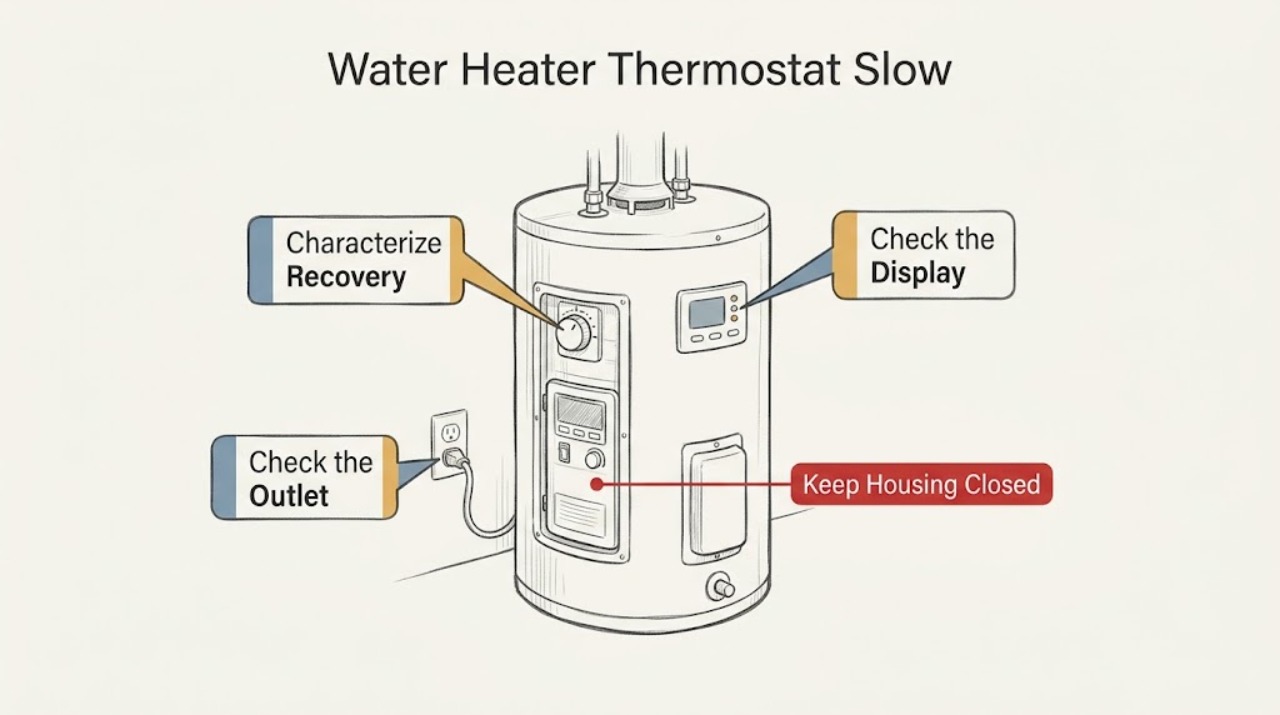
Work through in order
Diagnostic checks
Use only checks that match the exact appliance or system and its official guide.
-
Check 1
Record when hot water becomes insufficient, how much was used beforehand, how long recovery normally takes, and whether the new delay follows ordinary use or only an unusually large draw.
Expected result: The heater recovers normally after a heavy one-time demand, recovers slowly after ordinary use, is progressively worsening, or has no reliable history.
Next step: Keep a short recovery log and compare it with the exact model manual; arrange service when the delay persists or worsens instead of repeatedly changing the set point.
Stop if: Do not create repeated high-demand cycles or alter internal controls to reproduce the symptom.
Why this matters
Why: A heavy-demand-only pattern can be a capacity or usage issue in an otherwise working heater. Persistent or worsening slow recovery after ordinary use makes a thermostat, lower element, power, sediment, leak, or control problem more plausible.
-
Check 2
Use several normal hot-water outlets without disassembling a faucet or shower control and compare whether each provides the same temperature pattern after the same recovery period.
Expected result: Every outlet is short of hot water, only one outlet is cooler, temperature changes at one mixing control, or the result changes when another fixture operates.
Next step: Record the outlet pattern and give it to a qualified plumber or water-heater technician; do not remove a mixing valve or alter hot and cold connections.
Stop if: Stop for scalding temperature, unstable temperature, a leak, or any need to open a wall or disassemble a valve.
Why this matters
Why: A whole-home shortage supports a heater, thermostat, element, power, capacity, or hot-water-loss check. A single cool outlet points more toward a local mixing valve or fixture, while an interaction with another fixture suggests a plumbing or demand issue.
-
Check 3
From ordinary safe access, read the rating plate and observe any user-facing display, indicator, vacation or low-demand mode, alert, breaker, or disconnect status; do not remove covers or insulation.
Expected result: The display or indicator is blank, a documented mode or alert is visible, the breaker or disconnect appears abnormal, or the visible controls appear normal while recovery remains slow.
Next step: Follow only the exact model's user-level instructions for a documented mode; request qualified service for a blank display, recurring trip, alert, uncertain disconnect, or persistent slow recovery.
Stop if: Do not open the junction box or access panel, reset a safety control repeatedly, or work on energized wiring.
Why this matters
Why: A mode, alert, blank display, or abnormal breaker can limit heating or indicate a power or control problem. Normal visible controls do not rule out a thermostat or element fault because the sensing and switching parts are behind the covers.
-
Check 4
From a dry, stable position, inspect around the tank, hot-water piping, relief-valve discharge route, and nearby fixtures for visible water or a dripping hot tap, and note any recent household demand or installation change.
Expected result: Water is visible at the tank or piping, a relief-valve route discharges, a hot fixture drips, demand increased, the unit was recently installed or altered, or no external explanation is visible.
Next step: Arrange prompt plumbing service for water, relief-valve discharge, or an inaccessible leak and include the demand or installation history in the service request.
Stop if: Do not plug a relief-valve outlet, touch hot water or piping, drain the tank, or disconnect plumbing to investigate.
Why this matters
Why: A leak or open hot-water path can consume the heater's output and mimic a thermostat fault. Increased demand or recent installation can change recovery without a failed thermostat, while no visible explanation leaves thermostat, element, power, and sediment causes unresolved.
-
Check 5
Use normal caution at a faucet to note whether water is lukewarm, unexpectedly hot, absent, or changing abruptly; do not use bare hands to handle tank parts or open the water-heater controls.
Expected result: Water is consistently lukewarm, briefly hot then unavailable, unexpectedly hot, absent at all outlets, or unstable from one use to the next.
Next step: Stop using the heater for unexpectedly hot or unstable water and request qualified service; provide the outlet pattern and timing for other temperature complaints.
Stop if: Do not raise the thermostat to compensate, bypass a limit, or keep using water that may scald.
Why this matters
Why: Lukewarm or absent hot water can fit thermostat, lower-element, power, or demand problems. Unexpectedly hot or unstable water can indicate a thermostat or mixing-control fault and creates a scalding concern rather than a reason to raise or reset the thermostat.
-
Check 6
Prepare a service record with the model and serial information, recovery log, outlet comparison, visible control and breaker status, leak observations, and any recent work or demand change.
Expected result: The record points toward a thermostat or element possibility, a power or safety-control symptom, a leak or mixing issue, a capacity problem, or an unresolved whole-heater pattern.
Next step: Give the record to a qualified water-heater professional and request diagnosis of the thermostat, elements, supply, safety controls, leaks, and recovery capacity before ordering parts.
Stop if: Do not remove the thermostat cover, disconnect a wire, drain the tank, or replace the thermostat based only on the symptom.
Why this matters
Why: These observations help a technician choose model-specific thermostat, element, wiring, plumbing, and capacity checks. They cannot identify a failed thermostat without internal diagnosis and do not make access-panel work safe for a homeowner.
Use your observations
Decision map
Find the observation that best matches what you see, then follow the next safe action.
-
PATH 01Next step
What you see
The delay follows an unusually large draw, the heater later recovers, ordinary-use recovery is stable, and no leak or control warning is visible.
Do this next
Compare use with the exact model information and monitor; request service if slow recovery begins after ordinary use or continues to worsen.
Why this path and its safety boundary
Why it matters: Household demand or tank capacity is more likely than a thermostat failure, although the model's recovery specification is needed to judge it.
-
PATH 02Next step
What you see
Hot water is available but recovery is consistently slow after ordinary demand, no fixture or visible leak explains it, and the heater's visible controls appear normal.
Do this next
Arrange qualified water-heater diagnosis of the thermostat, lower element, wiring, and supply instead of changing settings or ordering a part by appearance.
Why this path and its safety boundary
Why it matters: A thermostat that reads incorrectly or stops heating early and a lower heating element that is not functioning are both plausible for a storage electric heater; the symptom does not distinguish them.
-
PATH 03Next step
What you see
The display is blank, a breaker or disconnect trips or appears abnormal, a safety alert is shown, or a recent electrical change preceded the recovery problem.
Do this next
Leave the heater's covers closed and request qualified electrical or water-heater service; report the alert, trip, and timing exactly.
Why this path and its safety boundary
Why it matters: Power, wiring, or safety-control involvement is more likely than an isolated thermostat aging issue, and repeated resets can leave an underlying fault unresolved.
-
PATH 04Next step
What you see
A hot faucet drips, the relief-valve discharge route releases water, water is visible around the tank or piping, or one outlet is cooler or more unstable than others.
Do this next
Request prompt plumbing assessment and do not plug, bypass, or disassemble the relief valve or mixing control.
Why this path and its safety boundary
Why it matters: A plumbing leak, relief-valve condition, or local mixing valve is more likely than a thermostat alone and can consume or misrepresent available hot water.
-
PATH 05Next step
What you see
Water is unexpectedly hot or unstable, there is no hot water at all, a safety limit has activated, or the tank has physical or water damage.
Do this next
Stop using the heater as appropriate, keep people away from hot water or leaking equipment, and arrange urgent qualified water-heater service.
Why this path and its safety boundary
Why it matters: This is no longer a routine slow-recovery complaint. Thermostat or safety-control failure can create a scalding risk, while no hot water can indicate loss of power or an upper control problem.
-
PATH 06Next step
What you see
The recovery delay is persistent but the cause cannot be localized safely, model information is missing, or several symptoms overlap.
Do this next
Keep the heater's electrical compartments closed and arrange qualified service with the recovery log and model information.
Why this path and its safety boundary
Why it matters: A thermostat diagnosis is not supportable from the tap alone; element, power, sediment, leak, capacity, and control causes remain possible.
Helpful context
Understand the symptom
A thermostat symptom is not a thermostat diagnosis
The thermostat controls when the tank calls for heat, so a wrong reading or unexpectedly low setting can end heating before the water is recovered. A failed lower element, interrupted power, sediment, an open hot-water path, or a tank that is too small for current demand can look the same at the tap. The pattern across time and outlets is more useful than guessing at a component from lukewarm water.
Use the model manual for any user-level setting
Record the model and visible control state, then use the exact manufacturer's manual for any permitted operating-mode or temperature-setting change. Do not remove an access cover to reach a thermostat or reset button. Manufacturer manuals place electrical, thermostat, element, and safety-device repairs beyond the ordinary homeowner troubleshooting boundary.
Slow recovery can also be hot-water loss or excess demand
If hot water is escaping through a dripping fixture or hidden leak, the heater may never catch up even when the thermostat is working. A one-time heavy draw can also exceed a tank's recovery capability. Compare multiple outlets, look for visible water from a dry position, and document use before concluding that the thermostat is at fault.
Safety boundary
Stop conditions
- Do not remove water-heater access covers, insulation, junction-box covers, thermostats, heating elements, or safety controls.
- Do not measure live voltage, disconnect wiring, drain the tank, replace a thermostat, or reset an ECO or other safety control repeatedly.
- Stop and request service for a tripping breaker, blank display, safety alert, tank or relief-valve leak, unexpectedly hot or absent hot water, exposed wiring, or water damage.
- Keep children away from hot water and the heater area and use qualified plumbing or water-heater service for thermostat, element, wiring, supply, and safety-device work.
Only after diagnosis
Potential parts
- electric water-heater thermostat
Consider this only after qualified diagnosis confirms a thermostat fault and identifies the exact water-heater model, thermostat position, control design, and compatible replacement requirements.
Do not choose by appearance or a generic setting. Confirm the manufacturer's model documentation and required electrical and fitment details with the service provider before ordering.
When checks do not resolve it
Need a professional?
Use prompt service for persistent slow recovery after ordinary demand. Treat a leak, relief-valve discharge, no hot water, dangerously hot or unstable water, tripping breaker, safety alert, or exposed wiring as urgent.
Safety scope: The professional should distinguish thermostat sensing or switching from element, power, safety-control, sediment, leak, mixing-valve, capacity, and installation causes before selecting parts or changing settings.
Have this ready
- Water-heater model and serial information from the rating plate without opening the unit
- Recovery log showing hot-water use, timing, and whether the problem follows ordinary or heavy demand
- Hot-water comparison at multiple outlets and any local mixing-valve behavior
- Photos from safe access of visible leaks, controls, rating plate, and breaker status
- Recent installation, electrical, plumbing, household-demand, or maintenance changes
Common questions
FAQ
Can a thermostat make a water heater recover slowly?
Yes. A thermostat can read incorrectly, be set lower than expected, or stop heating prematurely. A lower heating element, power problem, demand, sediment, leak, or capacity issue can look the same, so diagnose the pattern before selecting a thermostat.
How can I tell a thermostat issue from heavy hot-water use?
Record whether the delay follows one unusually large draw or occurs after ordinary use, then compare the pattern with the exact model's recovery information. Persistent slow recovery after ordinary use needs qualified service assessment.
Should I open the access panel to adjust or test the thermostat?
No. The access panel covers electrical parts, and manufacturer guidance warns against homeowner repair of thermostats, heating elements, wiring, and safety devices. Provide the model and symptom record to qualified water-heater service.
Can a plumbing leak look like a thermostat problem?
Yes. A dripping hot fixture, relief-valve discharge, or concealed hot-water leak can consume the heater's output and make recovery seem slow. Look only for visible water from a safe, dry position and request plumbing service for a suspected leak.
When is slow recovery urgent?
Request urgent service for unexpectedly hot or unstable water, no hot water, a tripping breaker, blank display, safety alert, tank or relief-valve leak, exposed wiring, or any need to open the heater's electrical compartments.
Read the exact guide
Official sources
- What does “recovery” mean for my water heater?Bradford White Water Heaters · Supports explaining recovery as heated gallons over time and recognizing that capacity and element or heat-source size affect it.
- How Long for Water Heater to Reheat After Use?A. O. Smith · Supports distinguishing thermostat settings or sensing, lower-element problems, demand, capacity, sediment, and other causes of slow recovery.
- Residential Electric Water Heater Installation Instructions and Use & Care GuideA. O. Smith · Supports slow-recovery causes involving thermostats, lower elements, power, demand, leaks, and connections, and establishes the boundary against homeowner work inside access panels.
- Before You Call For Service…Rheem Manufacturing Company · Supports checking visible use, supply, leaks, controls, and demand context while leaving thermostat, heating-element, wiring, and safety-device repairs to qualified personnel.
Community feedback
Share a repair observation
Share a plain-text repair observation. Accepted observations are published automatically; this page may take a moment to update.