
On this page
Start here
Quick answer
A thermostat can cause an electric storage water heater to produce no hot water, but the same symptom can come from a tripped breaker, a high-limit safety cutoff, a failed heating element, a wiring fault, a recently refilled tank that was energized before it was full, or a hot-water-side leak. Start with safe observations: identify the heater type, compare more than one hot-water fixture, check the visible electrical panel and user-facing display, and note the thermostat setting or operating mode only if it is accessible without opening covers. Do not remove panels, touch wiring, press a hidden reset, measure live voltage or resistance, drain the tank, or keep resetting a fault. A repeated breaker or cutoff trip, abnormal temperature, leak, or no hot water after recent service requires qualified plumbing or electrical diagnosis.
Before you begin
Safety first
- Do not open electrical or thermostat covers, touch wiring, perform live or resistance testing, press hidden reset controls, drain the tank as a test, or energize an unfilled tank.
Work through in order
Diagnostic checks
Use only checks that match the exact appliance or system and its official guide.
-
Check 1
Identify whether the appliance is an electric storage water heater from its visible label, breaker marking, owner manual, or user-facing control, then test more than one hot-water fixture without opening the heater.
Expected result: Record whether the heater is electric, gas, tankless, or a hybrid; whether all fixtures are cold or only one is affected; and whether the issue is no hot water or slow recovery.
Next step: Continue with the electric-heater control checks only when the unit is an electric storage model. For another heater type or a single-fixture symptom, use the matching manual or arrange qualified plumbing service.
Why this matters
Why: A thermostat component diagnosis applies differently by heater type. Whole-house loss points toward the heater or its supply, while one cold fixture makes a local mixing or flow problem more likely.
-
Check 2
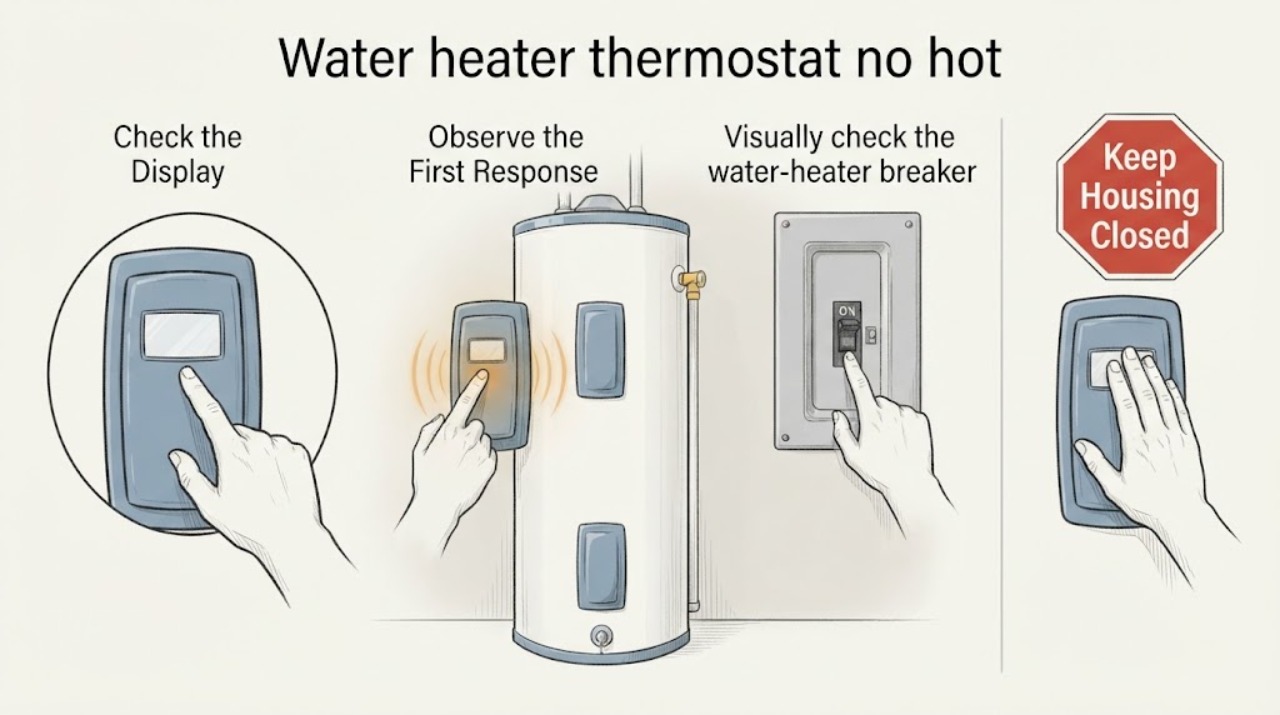
Read the thermostat setpoint, operating mode, lock indicator, status light, or control-panel alert from the normal user-facing interface, if present, without removing an access panel or touching wiring.
Expected result: Note whether the control is in a vacation, standby, locked, or otherwise non-heating mode; whether the displayed setpoint is unexpectedly low; and whether a thermostat, sensor, element, or high-limit alert is shown.
Next step: Use only the installed manual's normal interface instructions for a safe user-level setting correction. If the control is inaccessible, locked by an installer setting, repeatedly faults, or requires panel removal, stop and arrange qualified service.
Why this matters
Why: An incorrect user-facing mode or setting can explain low heat without proving that the thermostat hardware failed. A recurring alert or a control that will not accept a normal setting needs model-specific diagnosis.
-
Check 3
Visually check the water-heater breaker or disconnect for an abnormal or tripped position and compare it with the heater's visible status, without repeatedly resetting the circuit or opening the electrical enclosure.
Expected result: Record whether the breaker is off or tripped, whether it trips again after one normal reset attempt, and whether the heater display remains dark or reports a fault while the breaker appears on.
Next step: Do not keep resetting a breaker that trips again. Leave the circuit in a safe state and have a qualified electrician or plumber diagnose the supply, thermostat, high-limit control, wiring, and elements.
Why this matters
Why: A tripped or unavailable supply can prevent a thermostat from calling for heat. A repeat trip can indicate a grounded element, wiring fault, or another electrical problem; a normal breaker does not rule out a failed thermostat or element.
-
Check 4
Review the installation and service history and observe the tank and nearby floor from a safe position for a recent drain, refill, thermostat change, wiring work, or leak; do not energize a tank whose fill state is uncertain.
Expected result: Record whether no hot water began after the tank was emptied or refilled, power was restored, a thermostat or element was changed, plumbing connections were altered, or water appeared around the heater.
Next step: Leave recently serviced or uncertain equipment unmodified and provide the timeline to a qualified provider. If water is near electrical components or the tank is not known to be full, stop and arrange service.
Why this matters
Why: A control problem may be secondary to dry firing after an unfilled tank was energized, an installation wiring issue, or a hot-side leak that consumes heated water. Timing narrows the diagnosis but does not identify a replacement part.
-
Check 5
From outside the heater, observe the hot-water temperature pattern and any unusual sound or discharge without touching the temperature-and-pressure relief valve, drain valve, access covers, thermostat, or element terminals.
Expected result: Note whether water never warms, warms briefly and then turns cold, is unexpectedly hot, or is accompanied by crackling, hissing, a continuous hot-side flow, relief discharge, or a visible leak.
Next step: Stop for abnormal heat, scalding risk, relief discharge, a leak, or unusual electrical behavior. Preserve the observations and have a qualified provider test the thermostat, safety controls, elements, and plumbing.
Why this matters
Why: A thermostat or high-limit issue can produce inconsistent or unsafe temperature, while a lower element, scale, plumbing leak, or fixture mixing problem can mimic a thermostat failure. A sound or temperature pattern alone cannot confirm the component.
-
Check 6
Prepare a service handoff with the heater's visible brand and model, heater type, control setting or mode, breaker and display observations, fixture comparison, recent work, and photographs taken without removing covers.
Expected result: The provider can distinguish a user-setting issue from a thermostat, high-limit, element, wiring, supply, leak, or local-fixture problem and can identify the approved repair scope.
Next step: Use the manufacturer, licensed plumber, or qualified electrician for cover removal, electrical testing, thermostat or element replacement, reset diagnosis, and final safety verification.
Why this matters
Why: A thermostat replacement is conditional on the exact model and a confirmed control failure. A generic thermostat or element may be incompatible, and replacing it without addressing a repeat trip, dry firing, or leak can cause another failure.
Use your observations
Decision map
Find the observation that best matches what you see, then follow the next safe action.
-
PATH 01Next step
What you see
All hot-water fixtures are cold, the control shows a low or non-heating mode or refuses a normal setting, and the breaker remains on.
Do this next
Apply only a normal manual-directed setting correction if the interface allows it without opening the heater; otherwise arrange qualified service and keep the covers closed.
Why this path and its safety boundary
Why it matters: A user-facing setting, control lock, thermostat, or related control fault is more likely than a single fixture problem, but the interface clue cannot prove an internal thermostat failure.
-
PATH 02Next step
What you see
The breaker is normal but a thermostat, sensor, element, or high-limit alert recurs, or the heater provides inconsistent temperature.
Do this next
Stop repeated resets and have a qualified provider diagnose the control and heating circuit before restoring normal operation.
Why this path and its safety boundary
Why it matters: The control circuit, safety cutoff, element, or wiring needs model-specific testing; a thermostat may be involved but should not be replaced from the symptom alone.
-
PATH 03Next step
What you see
The breaker trips again, the heater was recently drained or serviced, or the tank's fill state was uncertain when power was restored.
Do this next
Leave the heater unmodified and arrange qualified plumbing or electrical service; do not energize an unfilled tank or open the electrical covers.
Why this path and its safety boundary
Why it matters: A grounded element, wiring fault, dry-fired element, or installation error becomes more plausible than a simple user setting.
-
PATH 04Next step
What you see
Only one shower or faucet is cold while another hot-water outlet works and the heater has no external fault indication.
Do this next
Have the affected fixture or branch checked before authorizing thermostat or element work on the tank.
Why this path and its safety boundary
Why it matters: A local mixing valve, cartridge, restriction, or branch-plumbing issue is more likely than a whole-tank thermostat failure.
-
PATH 05Next step
What you see
Water is too hot, the relief outlet discharges, a leak is near the heater, or smoke, burning smell, or exposed wiring is present.
Do this next
Keep clear, avoid the heater and relief valve, and use qualified or urgent local help as appropriate. Do not approach energized equipment to troubleshoot it.
Why this path and its safety boundary
Why it matters: The symptom has crossed into a scald, pressure, water, fire, or shock hazard and is not an ordinary thermostat adjustment.
Helpful context
Understand the symptom
What the thermostat controls
In an electric storage heater, the thermostat calls for heat and coordinates with the heating elements and high-limit protection. A control that is set too low, stuck, misreading temperature, or opening the safety circuit can leave the tank cold, but a similar symptom can also be caused by no supply or a failed element. That is why the visible setting and system pattern are useful clues, not proof of a failed thermostat.
Separate a control clue from an electrical repair
A visible thermostat setting, operating mode, alert, or status light can be recorded without opening the heater. The control, cutoff, wires, and element terminals behind the covers may remain energized and can also expose you to scalding water or tank pressure. Use the installed heater's manual for any user-facing adjustment; leave cover removal, reset diagnosis, meter testing, and replacement to qualified service.
Check the whole-house pattern before blaming the tank
When every hot-water fixture is cold, a tank, supply, control, or heating problem is more likely. When one shower or faucet is cold but another hot tap works, a thermostatic mixing valve or local fixture issue is more likely than a tank thermostat fault. This comparison can prevent unnecessary work on an energized heater.
Safety boundary
Stop conditions
- Do not remove electrical or thermostat access covers, expose insulation, disconnect conductors, press a hidden reset, or measure voltage, continuity, or resistance as a homeowner check.
- Do not repeatedly reset a breaker or cutoff, energize a tank whose fill state is uncertain, drain the tank as a test, or install a generic thermostat or heating element.
- Stop for water near electrical parts, a leak, relief-valve discharge, scalding-hot water, smoke, burning smell, exposed wiring, damaged covers, or an active electrical fault.
- Use qualified plumbing or electrical service when the control is inaccessible, a fault returns, the heater was recently serviced, or the cause remains uncertain.
Only after diagnosis
Potential parts
- water-heater thermostat
Consider a thermostat only after a qualified provider confirms that the thermostat or its sensor and control circuit has failed and rules out supply, high-limit, element, wiring, fill-state, and plumbing causes.
Confirm the exact heater model, thermostat type, operating range, electrical rating, mounting arrangement, and manufacturer fit information before ordering.
When checks do not resolve it
Need a professional?
Contact the manufacturer, licensed plumber, or qualified electrician when safe external observations cannot distinguish a setting issue from thermostat, high-limit, element, wiring, supply, leak, or fixture causes.
Safety scope: Do not open electrical or thermostat covers, touch wiring, perform live or resistance testing, press hidden reset controls, drain the tank as a test, or energize an unfilled tank.
Have this ready
- Provide the visible brand and model, heater type, control mode or setting, breaker and display observations, fixture comparison, exact timing, recent drain or repair history, temperature pattern, and photos taken without removing covers.
Common questions
FAQ
Does no hot water prove the thermostat has failed?
No. A tripped breaker, high-limit cutoff, failed heating element, wiring fault, dry firing after a refill, hot-side leak, or local fixture problem can look similar. The thermostat should be confirmed by qualified model-specific testing.
Can I adjust the thermostat myself?
Use only a normal user-facing control or mode adjustment described in the installed manual, without opening panels. Do not expose wiring or access a thermostat behind a cover; ask a qualified provider if the setting is inaccessible, locked, or unclear.
Why is one faucet cold while another has hot water?
A single cold shower or faucet points more toward a local mixing valve, cartridge, restriction, or branch-plumbing issue than a whole-tank thermostat fault. Check the pattern across fixtures before authorizing work on the heater.
What does a repeated reset or breaker trip mean?
It may indicate an overheating condition, grounded element, thermostat, wiring, or another electrical fault. Do not keep resetting it; leave the equipment unmodified and arrange qualified plumbing or electrical diagnosis.
When should I stop troubleshooting?
Stop for water near electrical parts, a leak, relief discharge, scalding-hot water, smoke, burning smell, exposed wiring, damaged covers, a repeat-tripping breaker, or any need to remove covers or test components. Use qualified service.
Read the exact guide
Official sources
- Use & Care Manual With Installation Instructions for the InstallerRheem Manufacturing Company · Rheem electric residential water heater with electronic control manual; used for examples of visible control state, thermostat safety, and no-hot-water troubleshooting, not a universal model procedure.
- Is Your Hot Water Not Getting Hot? Common Causes & What To Do About ThemA. O. Smith · Manufacturer troubleshooting article used for breaker, thermostat, element, high-limit, electrical, hot-surface, and pressure safety context; model-specific manuals control.
- Burned Out Or Dry Fired ElementsBradford White Corporation · Manufacturer professional guidance used to explain why thermostat settings and element condition must be considered together and why testing requires power-off service; it is not a homeowner repair procedure.
- Water Heater Repair: Things to ConsiderA. O. Smith · Manufacturer guidance used for thermostat settings, no-hot-water patterns, single-fixture mixing issues, leaks, and professional repair boundaries; the installed model's manual controls.
Community feedback
Share a repair observation
Share a plain-text repair observation. Accepted observations are published automatically; this page may take a moment to update.