
On this page
Start here
Quick answer
First determine whether the no-hot-water symptom affects every fixture or only one faucet, and whether the A. O. Smith unit is gas, standard electric, hybrid, or tankless. Check the model label and manual before using any restart procedure. For a gas tank with a standard control, the status light or pilot instruction is model-specific; for an electric tank, a tripped breaker or high-temperature limit may stop heating; a hybrid or tankless unit can have a display, mode, flow, or code-related cause. Confirm that the unit has power, the fuel or water supply is not intentionally shut off, and there is no leak, gas odor, smoke, or exposed wiring. Do not open electrical covers, adjust a gas valve, or relight a pilot when gas is present. If one faucet is cold but others are hot, suspect a local mixing or faucet issue rather than the heater. Persistent no hot water, a recurring fault code, a leaking tank, failed reset, or any gas/electrical hazard needs qualified plumbing or appliance service.
Before you begin
Safety first
- This article supports fixture comparison, model identification, external supply observations, one manual-approved reset or pilot step when safe, and full-tank verification. A qualified professional handles gas controls, combustion, electrical panels, heating elements, thermostats, tankless internals, pressure, leaks, and safety devices.
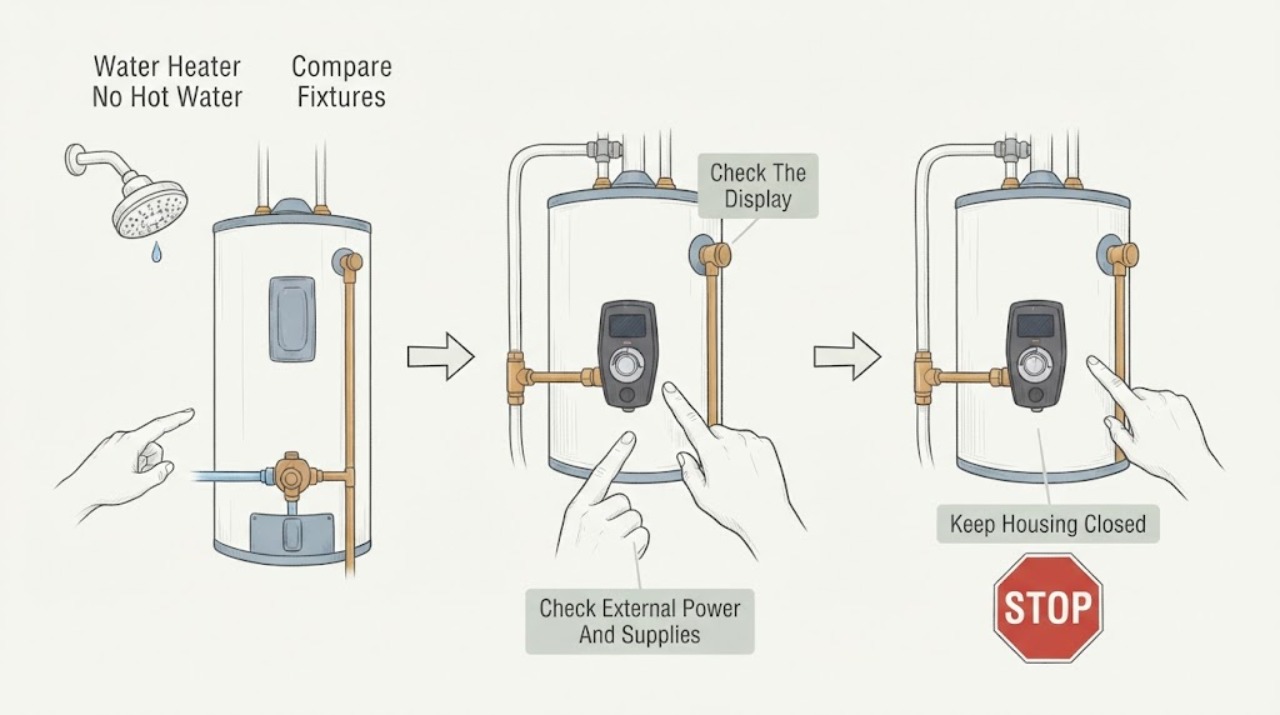
Work through in order
Diagnostic checks
Use only checks that match the exact appliance or system and its official guide.
-
Check 1
From a fixture where the water can be handled safely, compare the hot side at two or more faucets or showers without changing the heater setting or leaving water running unattended.
Expected result: Record whether no hot water affects every fixture, only one fixture, only one bathroom, or only hot water at a single valve; note whether the cold side has normal flow.
Next step: Use the heater-wide path only when the symptom is present at multiple fixtures; arrange plumbing service for an isolated fixture if its local valve or mixing device is suspect.
Stop if: Stop for scalding water, a leak, sewage or contaminated water, unsafe access, or any need to remove a faucet cartridge or open a wall.
Why this matters
Why: No hot water everywhere points toward the A. O. Smith heater, its power/fuel/water supply, control, or stored capacity. One cold fixture with hot water elsewhere points toward a local mixing valve, cartridge, supply, or faucet problem rather than a heater-wide failure.
-
Check 2
Read the A. O. Smith model and serial label and identify whether the unit is a gas tank, electric tank, hybrid, or tankless model; inspect only the external controller, status light, display, and labels.
Expected result: Record a gas control status light or pilot instruction, an electric breaker or control display, hybrid operating mode, tankless display and flow behavior, and any error or maintenance code.
Next step: Use the exact owner's manual for the identified model and preserve the code or status-light pattern for service; do not apply a gas-tank restart to another type.
Stop if: Do not remove covers, look into a burner compartment, probe wiring, or adjust any control not explicitly designated for owner use.
Why this matters
Why: The correct no-heat check depends on the heater type. A gas pilot/status-light symptom, electric power or element symptom, hybrid mode, and tankless flow or ignition symptom require different manuals and parts; a code is a diagnostic clue, not a part number.
-
Check 3
From a dry, safe position, verify the known water heater breaker or power switch, the external cold-water valve, and the external gas valve or fuel status only when their locations and normal positions are clear; do not force a valve.
Expected result: Record a tripped breaker, blank display, closed water or gas supply, normal power and supplies, a breaker that trips again, or a valve that is seized, leaking, or unclear.
Next step: Restore only a clearly identified supply or breaker once, if safe and permitted by the manual; leave it off and arrange service if it trips again, does not restore heat, or the supply cannot be safely verified.
Stop if: Do not reset a breaker repeatedly, open electrical covers, adjust gas pressure, remove a gas-valve cap, or operate around water and exposed wiring.
Why this matters
Why: A tripped breaker or absent power can stop electric, hybrid, or control-powered heating; a closed fuel or water supply can stop gas or tankless operation. A repeated trip, damaged valve, or normal supplies with no heat points toward a component or service fault.
-
Check 4
For a gas model with a user-facing status light, read the light and follow only the model label or manual; for an electric or hybrid model, read the display or external controls without opening element panels; for a tankless model, note whether a hot tap creates an ignition attempt.
Expected result: Record a normal status indication, an unlit or abnormal gas status, a failed pilot relight under the exact manual, a heating mode such as vacation or standby, a code, or no response to a hot-water demand.
Next step: Document the status pattern and stop after the manual-approved owner step; call qualified service for a failed relight, recurring code, absent heating response, or unknown control behavior.
Stop if: Do not relight when gas is smelled, bypass a safety control, remove the burner or element cover, or run the heater with a fault indication.
Why this matters
Why: A. O. Smith uses model-specific status-light, pilot, controller, operating-mode, and code paths. No response after a known-good supply check may indicate a control, thermostat, element, ignition, flow, or sensor fault; it does not authorize opening the unit.
-
Check 5
If the identified appliance is a tank model that has been drained, installed, or had its water supply interrupted, verify from the manual that the tank is full before restoring power or heat; run a hot faucet only as the manual directs and avoid touching the discharge water.
Expected result: Record whether water flows steadily from the open hot faucet after the cold supply is restored, whether air sputters, the tank remains empty, the drain valve or connections leak, or the heater has had enough model-appropriate recovery time.
Next step: Keep power or heat off until the manual's full-tank condition is met, check for leaks from a safe position, and request service if the tank will not fill, leaks, or does not recover.
Stop if: Do not energize an unfilled electric tank, open a pressure-relief valve as a test, drain hot water onto people or property, or operate a leaking tank.
Why this matters
Why: A. O. Smith warns that an electric tank must be full before power is restored or an element can burn out. A gas tank also requires water and gas controls to be handled in the correct order. No hot water immediately after a refill can be recovery time, while no heat after safe recovery points toward a fault.
-
Check 6
Create a service record with model, heater type, fixture comparison, supply and breaker status, pilot or display pattern, code, leak location, recent outage or maintenance, and the result of one manual-approved reset or restart only.
Expected result: Record whether hot water returns, returns briefly then goes cold, never returns, the fault recurs, the breaker or pilot fails again, water temperature is unsafe, or a leak or odor appears.
Next step: Leave the unit in the safest off state and arrange qualified plumbing or appliance service for recurrence, failed restart, leakage, code, no response, or unsafe temperature.
Stop if: Do not keep resetting, relighting, draining, or opening the heater to reproduce the no-hot-water symptom.
Why this matters
Why: A brief recovery followed by another failure points to a recurring control, fuel, element, thermostat, flow, or capacity issue. A leak, overheating, gas odor, or electrical symptom changes the problem from no-heat troubleshooting to an urgent safety/service event.
Use your observations
Decision map
Find the observation that best matches what you see, then follow the next safe action.
-
PATH 01Safety boundary
What you see
One faucet or shower is cold while another fixture still provides hot water with normal flow.
Do this next
Keep the heater setting unchanged and arrange plumbing diagnosis at the affected fixture; do not replace heater parts first.
Why this path and its safety boundary
Why it matters: The water heater is producing at least some hot water, so a local cartridge, thermostatic mixing valve, supply, or fixture restriction is more likely than a heater-wide failure.
Safety stop: Do not open a wall, remove a valve cartridge, or use a fixture with a leak, unstable temperature, or scald risk as a test.
-
PATH 02Safety boundary
What you see
Every fixture is cold, the A. O. Smith unit is an electric or hybrid model, and the breaker is tripped, the display is blank, or the power mode is off.
Do this next
Restore a clearly identified breaker or operating mode once as the manual permits; leave it off and call service if it trips again or heat does not return.
Why this path and its safety boundary
Why it matters: Power interruption or an operating mode can explain the loss of heat, but a repeated trip or blank display may indicate an electrical or control fault.
Safety stop: Do not remove element covers, test live voltage, bypass the high-temperature limit, or reset repeatedly.
-
PATH 03Safety boundary
What you see
Every fixture is cold on a standard gas tank model, the status light is off or abnormal, the pilot will not stay lit, or the unit reports a gas-control fault.
Do this next
Follow only the exact model's relight instructions when there is no gas odor and it is safe; arrange qualified gas-appliance service for a failed or recurring pilot/status symptom.
Why this path and its safety boundary
Why it matters: The unit cannot maintain its heat source; fuel supply, pilot, thermopile, gas control, ventilation, or another safety component may be involved.
Safety stop: Do not relight with gas odor, adjust the gas control, dismantle the burner, or keep attempting ignition after the manual's limit.
-
PATH 04Safety boundary
What you see
The tank was recently drained, installed, refilled, or had its cold-water supply interrupted, and the unit has not completed its normal recovery.
Do this next
Verify a full tank using the exact manual, purge air as directed, check for leaks, and allow the model-appropriate recovery period before testing temperature.
Why this path and its safety boundary
Why it matters: An unfilled tank or normal recovery delay can explain no hot water; energizing an empty electric tank can damage an element.
Safety stop: Do not power an unfilled electric tank, operate a leaking tank, or use hot water until it can be handled safely.
-
PATH 05Safety boundary
What you see
The appliance is tankless or hybrid, a hot tap does not create the expected heating response, flow is weak or intermittent, or a controller code appears.
Do this next
Record the model and code, compare a fully open hot tap when safe, check only accessible fixture restrictions, and arrange trained service for a persistent failure or code.
Why this path and its safety boundary
Why it matters: Demand flow, operating mode, inlet restriction, ignition, sensor, control, or another model-specific condition may prevent heating; a tank-pilot procedure does not apply.
Safety stop: Do not open a tankless cabinet, adjust gas pressure, bypass flow or safety controls, or substitute tank troubleshooting steps.
-
PATH 06Safety boundary
What you see
No hot water is accompanied by a tank or connection leak, water near electrical components, gas odor, smoke, burning odor, unusually hot water, or repeated safety trips.
Do this next
Stop using the heater, isolate water, gas, or power only from a known safe control if appropriate, keep people away, and obtain urgent qualified service or emergency help for gas or fire conditions.
Why this path and its safety boundary
Why it matters: The symptom has crossed into a water, gas, electrical, or scald hazard and cannot be safely resolved by a reset or temperature adjustment.
Safety stop: Do not touch wet wiring, relight, reset a safety device repeatedly, tighten pressurized fittings, or continue testing.
Helpful context
Understand the symptom
Start by separating a heater problem from a single-fixture problem
Run a brief hot-water comparison at more than one fixture only when the water can be handled safely. If every faucet is cold, inspect the A. O. Smith unit's power, fuel, mode, status light, display, or diagnostic code. If one shower or faucet is cold while another produces hot water, the heater may be working and a local cartridge, thermostatic mixing valve, aerator, or supply issue becomes more likely. Do not raise the heater temperature to compensate for a local mixing problem.
Match the check to the heater type
A. O. Smith's restart guidance differs for gas and electric tanks: gas units may use a pilot or electronic controller, while electric units require a full tank before power is restored and need time to heat. Hybrid units can have a mode or diagnostic routine, and tankless units respond to flow and controls rather than stored hot water. Read the model manual and rating label first; a gas pilot procedure is not interchangeable with an electric or tankless procedure.
Treat repeated no-heat symptoms as a service boundary
A single reset can distinguish an interrupted supply or control state from a recurring fault, but it does not prove the repair. A gas unit that will not keep its status light or pilot, an electric unit that trips again, a hybrid that reports a code, a tankless unit with no ignition, or a heater with a leak or overheating symptom needs model-specific diagnosis. A. O. Smith identifies heating elements, thermostats, fuel supply, dirty air screens, and other components as possible causes, but internal gas and electrical work should be performed by qualified service.
Safety boundary
Stop conditions
- If gas is smelled, do not light or relight the heater, operate electrical switches, or use a phone near the appliance; leave and contact the gas supplier or emergency services from a safe location.
- Do not open electrical access panels, test live wiring, bypass a high-temperature limit or other safety control, adjust a gas valve, or dismantle a burner or tankless cabinet.
- Do not energize an electric tank until the exact manual's full-tank condition is met, and do not operate any heater with exposed wiring, water intrusion, smoke, or a damaged tank.
- Do not repeatedly reset breakers, relight pilots, clear recurring codes, drain hot water, or change temperature settings to chase a no-heat symptom.
- Stop for a leak, unstable or scalding water temperature, repeated safety trip, gas odor, smoke, burning odor, or no safe way to isolate the unit; obtain qualified service.
Only after diagnosis
Potential parts
- A. O. Smith heating element
Consider this category only when a qualified technician confirms an electric model has a failed element after power, full-tank, thermostat, and high-limit checks.
Confirm the exact model, element wattage, voltage, thread, gasket, and safe tank-drain procedure; never energize an unfilled tank or open an electrical panel as a first check. - A. O. Smith thermostat or high-temperature limit
Consider this category only after service confirms a thermostat or reset limit fault or a recurring temperature-control symptom that is not caused by power, wiring, or an unfilled tank.
Confirm the exact heater type, model, thermostat position, voltage, and safety specification; do not bypass or reset a safety device repeatedly. - A. O. Smith gas control, pilot, or thermopile assembly
Consider this category only when qualified gas-appliance diagnosis confirms a failed pilot, thermopile, gas control, or related assembly after gas supply and venting are safe.
Confirm the exact model, fuel type, control generation, and certified replacement information; gas-control and combustion work require qualified service and no gas-valve adjustment by the owner.
When checks do not resolve it
Need a professional?
Arrange qualified plumbing or appliance service when no hot water affects multiple fixtures after the external power, fuel, water, mode, and model-specific checks, a pilot or status light will not stay normal, a breaker or high-temperature limit trips again, a tank does not fill or recover, a tankless or hybrid code recurs, a fixture has normal hot water elsewhere but its local valve is cold, or any leak, gas, electrical, smoke, or scald hazard appears. Provide the model, heater type, code or status pattern, fixture comparison, supply checks, recent maintenance, and one approved restart result.
Safety scope: This article supports fixture comparison, model identification, external supply observations, one manual-approved reset or pilot step when safe, and full-tank verification. A qualified professional handles gas controls, combustion, electrical panels, heating elements, thermostats, tankless internals, pressure, leaks, and safety devices.
Common questions
FAQ
Why does my A. O. Smith water heater have no hot water?
First determine whether every fixture is cold or only one. Heater-wide causes include power, gas, pilot or control, heating element, thermostat, mode, tank fill or recovery, tankless flow, or a code; a single cold fixture often points to its local mixing valve or faucet.
What should I check first on an A. O. Smith electric water heater?
Check the fixture comparison, model, external power and breaker, display or mode, and whether a recently drained tank is full. A. O. Smith warns that an electric tank must be full before power is restored; do not open element covers or test live wiring without proper expertise.
How do I know if the A. O. Smith gas pilot is the problem?
Use the exact model label or manual to interpret the pilot or status light. If the pilot will not light or stay lit, or the status pattern is abnormal, keep the unit off and arrange qualified gas-appliance service. Never relight when gas is smelled.
Can a faulty mixing valve cause no hot water?
Yes, when only one faucet or shower is cold while another fixture still has hot water. That pattern points toward a local cartridge, thermostatic mixing valve, supply, or faucet issue, not necessarily the A. O. Smith heater.
Why does my water heater provide hot water briefly and then go cold?
The cause can be recovery or capacity, a failed heating element or thermostat, gas or pilot dropout, tankless flow or ignition, a mixing valve, or another fault. Record which fixtures are affected, timing, mode, status, and codes, then request model-specific diagnosis if it recurs.
When is no hot water an emergency?
Treat it as urgent for gas odor, smoke, burning odor, water near electrical parts, a leaking or cracked tank, repeated breaker or safety trips, scalding or unstable temperature, or a heater that cannot be safely isolated. Stop use and obtain emergency or qualified service as appropriate.
Read the exact guide
Official sources
- How to Turn Your Water Heater On and OffA. O. Smith · Official A. O. Smith general guidance; the printed manual and model controls take precedence for a particular heater.
- Water Heater Repair: Things to ConsiderA. O. Smith · Official A. O. Smith repair guidance; it is general and does not establish the cause or compatibility for an unspecified model.
- How to Adjust Temperature on Gas Water Heater SafelyA. O. Smith · Official A. O. Smith general temperature and troubleshooting guidance; controls, parts, and safe procedures vary by model.
- Water Heater Maintenance GuideA. O. Smith · Official A. O. Smith maintenance guidance; draining, refilling, and power procedures remain model-specific and may require service.
Community feedback
Share a repair observation
Share a plain-text repair observation. Accepted observations are published automatically; this page may take a moment to update.