
On this page
Start here
Quick answer
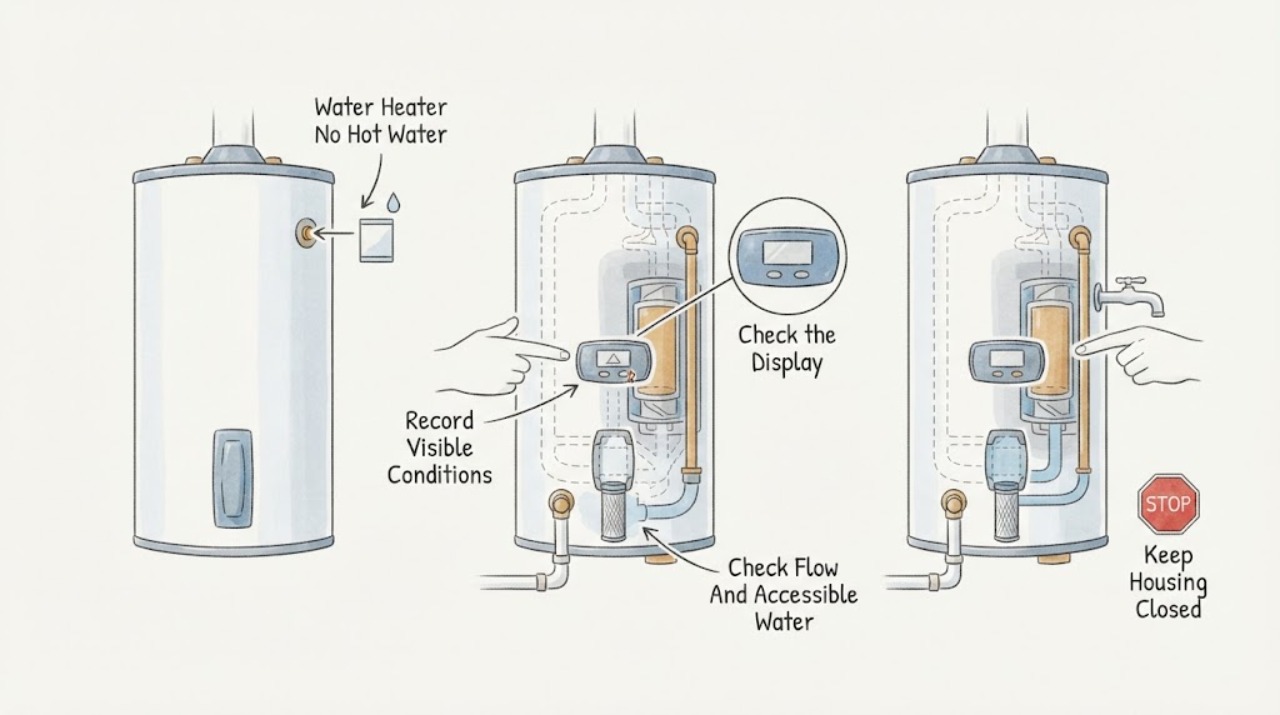
When a Rinnai water heater produces no hot water, first determine whether the problem is at every hot-water fixture or only one tap, and record any controller code or blank display. From a safe position, confirm the unit has its normal power, the user control is on, the visible water supply is open, and any external vent termination is unobstructed; do not remove the front cover or test gas or electrical parts. Rinnai diagnostic guidance points to water-flow problems, a dirty inlet filter, insufficient activation flow, reversed or crossed hot and cold lines, vent or condensate restrictions, scale, and component or wiring faults as different paths. A cold tap at one fixture can be a faucet or mixing-valve problem, while cold water everywhere after a valid demand points toward the heater or shared supply. Do not adjust gas pressure, open the combustion chamber, bypass a safety switch, measure live voltage, or repeatedly reset a code. If the unit does not ignite, a code returns, water leaks, exhaust is abnormal, or safe external checks do not restore hot water, turn the unit off as appropriate and arrange qualified Rinnai or plumbing service.
Work through in order
Diagnostic checks
Use only checks that match the exact appliance or system and its official guide.
-
Check 1
At a fixture close to the Rinnai heater, open only the hot side at a steady, useful flow and allow the normal delivery delay described in the manual. Repeat at a second fixture without mixing in cold water. Record whether water is cold, briefly warm then cold, or hot at one fixture but not another, and whether the controller responds to the demand.
Expected result: All fixtures are cold, only one fixture is cold, hot water arrives after a delay, water becomes warm then turns cold, or the controller remains blank or shows a code.
Next step: Keep the flow steady and write down the fixture, timing, display status, and code. If only one fixture is affected, arrange plumbing diagnosis for that fixture; if every fixture is affected or the display is abnormal, continue with the safe external heater checks and prepare for qualified service.
Stop if: Do not remove faucet cartridges, bypass a mixing valve, open the water heater, or keep running a fixture when water is scalding, leaking, or discolored.
Why this matters
Why: Cold water at one point can be a fixture, mixing, or local plumbing issue. A delay can be water remaining in the pipe rather than a heater failure. Warm-then-cold behavior can indicate flow dropping below activation, cycling, demand or crossover, or a heater fault. Cold water everywhere with no normal controller response points toward power, control, flow, or supply; a displayed code narrows the service path.
-
Check 2
From a dry, safe position, confirm the Rinnai controller or display is on, the appliance's dedicated electrical supply has not been switched off, and the visible cold-water isolation or supply valve is open. For a gas model, observe only that the external gas shutoff has not been intentionally closed; do not adjust gas fittings. Check the owner's manual for any user-level on/off state or display lock.
Expected result: The display is blank, the electrical supply or user control is off, the water valve is closed, an external gas valve is clearly off, or all visible supplies and controls appear normal.
Next step: Restore only a clearly identified user switch or water valve when the model instructions allow it and there is no leak or unsafe condition. Do not open covers or adjust gas components. If the display stays blank, the supply trips, or hot water remains absent, arrange qualified service.
Stop if: Do not reset a tripped electrical protection device repeatedly, relight or bypass gas safety controls, change gas-valve settings, or touch wet electrical connections.
Why this matters
Why: A missing electrical supply can disable controls and ignition even when water is available; a closed water valve prevents flow and a closed gas supply prevents a gas model from heating. A normal display and visible supply do not prove internal power, gas pressure, flow sensing, ignition, or safety operation.
-
Check 3
With the unit not being opened, compare the hot-side flow at the affected fixture with a normal cold-side flow and note whether a low-flow aerator, showerhead, or partially closed fixture valve is limiting demand. Inspect only visible water tubing for a kink, recent plumbing change, or crossover clue. If the Rinnai manual identifies an external or user-serviceable inlet filter, clean it only by that manual's procedure and only after shutting supplies as instructed; otherwise leave it for service.
Expected result: Hot flow is only a trickle, the issue occurs at a low-flow fixture, a recent filter or plumbing change preceded the failure, a visible line is kinked, or flow appears normal at multiple fixtures.
Next step: Remove only an obvious user-level aerator restriction or follow the exact manual's inlet-filter procedure if it requires no unsafe access. If flow remains low, the filter is internal, hot and cold lines may be crossed, or the problem affects all fixtures, arrange qualified plumbing/Rinnai service.
Stop if: Do not disconnect pressurized tubing, remove a filter housing without the manual's isolation procedure, pour chemicals into the water heater, or alter plumbing crossover or gas connections yourself.
Why this matters
Why: Tankless units need a minimum sensed flow to start or remain operating; low flow can make a functioning heater appear to produce no hot water. A dirty inlet filter, kinked supply, cross connection, or recent plumbing work can restrict or dilute the hot-water demand. Normal flow shifts attention toward ignition, gas, electrical, sensor, scale, or control diagnosis.
-
Check 4
From outside the appliance and without removing panels, look at the visible intake and exhaust termination and any accessible condensate outlet for snow, debris, ice, a blocked opening, unusual water, or a disconnected drain. Note whether the unit is indoors or outdoors and whether the no-hot-water event followed freezing weather, a storm, installation work, or a condensate alarm. Do not enter the vent, reach into the cabinet, or disconnect venting.
Expected result: A vent or condensate termination is blocked or frozen, water is pooling, a pipe is disconnected, the display shows a vent/condensate-related code, or the external paths look clear.
Next step: Remove only loose external debris when it can be done without climbing, disassembly, or contact with hot exhaust. Leave the unit off and arrange qualified service for a frozen or hidden drain, vent fault, water leak, or returning code.
Stop if: Do not operate with venting disconnected, enter a flue, chip ice from a pipe, bypass a condensate switch, or open the combustion cabinet.
Why this matters
Why: Rinnai diagnostic material treats blocked or frozen condensate drainage and vent restrictions as operating and safety conditions. A clear exterior does not prove the internal vent, fan, drain trap, heat exchanger, or combustion path is safe; a clear path makes the earlier flow, control, and supply clues more important.
-
Check 5
Record every displayed diagnostic or maintenance code exactly as shown, along with the model number, whether the burner or fan starts, the water-flow pattern, and the last known maintenance or heat-exchanger flush. Compare the code only with the Rinnai manual for that model; do not perform the manual's internal voltage, resistance, gas-pressure, flame, or board tests.
Expected result: A code returns after a permitted user reset, a scale or service indicator is present, there is no code but no ignition, the unit ignites then shuts down, or the code/display is absent.
Next step: Turn the unit off as directed by the model manual and arrange qualified Rinnai/plumbing service for recurring codes, scale, no ignition, shutdown, or absent hot water after the safe checks. Give the technician the code history and fixture pattern.
Stop if: Do not enter technician mode, reset a scale lockout repeatedly, adjust gas pressure, disconnect components, measure live circuits, or defeat a safety interlock.
Why this matters
Why: A returning code or service indicator means the cause remains and should not be hidden by repeated resets. Scale can restrict heat-exchanger flow and trigger maintenance lockout; no-code failures can still involve minimum flow, the inlet filter, crossed lines, sensors, or wiring. Ignition that starts and stops requires combustion, vent, flame-sensing, flow, or control diagnosis.
Use your observations
Decision map
Find the observation that best matches what you see, then follow the next safe action.
-
PATH 01Next step
What you see
Hot water is normal at one fixture but absent or weak at another, while the Rinnai controller responds normally and the heater serves other points of use.
Do this next
Stop treating the heater as the only suspect and arrange plumbing diagnosis at the affected fixture. Do not open or modify the Rinnai unit to correct a local flow problem.
Why this path and its safety boundary
Why it matters: A local aerator, cartridge, mixing valve, crossover, or branch-piping problem is more likely than a complete water-heater failure.
-
PATH 02Next step
What you see
Hot-side flow is a trickle, water warms then turns cold, a filter or line change preceded the issue, or the user test does not meet the model's activation demand.
Do this next
Correct only a clearly accessible fixture restriction or manual-approved filter issue. Have qualified service check flow, inlet filtration, crossover, valve, pressure, and sensor operation when the problem persists.
Why this path and its safety boundary
Why it matters: The flow sensor may not be receiving enough sustained demand, or a filter, kink, crossed line, inlet valve, pressure, or internal water path may be restricting flow.
-
PATH 03Next step
What you see
All fixtures are cold, the display is blank or shows a returning code, water flow is normal, or the unit never completes its normal ignition or heating response.
Do this next
Leave the unit off as appropriate and arrange qualified Rinnai service. Provide the code, model, display state, and whether the fan or ignition sequence began; do not test live circuits or gas components.
Why this path and its safety boundary
Why it matters: A power, control, sensor, ignition, gas, flame-sensing, wiring, or other internal fault is more likely than fixture flow or delivery delay.
-
PATH 04Next step
What you see
A vent or condensate path is blocked, water is pooling, a scale/service indicator appears, or the unit starts and shuts down after a short heating attempt.
Do this next
Stop operating the heater for an unresolved vent, condensate, leak, or scale lockout and arrange qualified service for inspection, flushing, drain/vent correction, and safety testing.
Why this path and its safety boundary
Why it matters: A safety shutdown, blocked drain or vent, heat-exchanger scale, combustion, or sensor condition is more likely and requires model-specific service.
-
PATH 05Next step
What you see
There is gas odor, abnormal exhaust, smoke, a combustion odor, a water leak into the cabinet, damaged wiring, a shock, or a safety code that returns immediately.
Do this next
Leave the area for a strong gas or combustion odor and follow local emergency or utility guidance. Keep people away from hot, wet, or damaged equipment and arrange emergency or qualified service; do not restart the heater.
Why this path and its safety boundary
Why it matters: The symptom exceeds routine troubleshooting and may present gas, combustion, scalding, water, or electrical danger.
Helpful context
Understand the symptom
Start at the fixture, then work toward the heater
Run a hot tap long enough to distinguish a short delivery delay from a true no-heat condition, and compare a second fixture. One cold faucet can have a clogged aerator, cartridge, tempering valve, or local crossover; every fixture being cold is more consistent with a water-heater, shared water, gas, or electrical issue. A Rinnai tankless unit heats water on demand: a flow sensor must detect a sufficient hot-water demand before the burner or heating sequence starts. The exact activation requirement varies by model, so use the owner's manual rather than assuming a universal flow value.
A display or fan does not prove the heater is making hot water
A lit controller, a fan sound, or water flowing at the tap only shows that part of the system is active. The unit still has to detect flow, open the correct valve, ignite or energize the heater, transfer heat through a clean exchanger, and safely exhaust combustion products where applicable. Rinnai's diagnostic material includes internal measurements and component checks for trained personnel; those are useful service clues, not homeowner repairs.
Only after diagnosis
Potential parts
- Rinnai inlet water filter
Only consider this category when the exact manual and diagnosis identify a restricted inlet filter after fixture flow, supply, and control checks; no hot water alone does not prove the filter is the cause.
Filter location, access, isolation steps, and fit vary by Rinnai model. Confirm the model and use the manual or qualified service before opening a pressurized connection. - Rinnai water flow sensor or flow-control component
Only consider this category after qualified testing confirms adequate water supply but no reliable flow detection or sustained activation.
Flow components, wiring, calibration, and control behavior are model-specific; do not measure, disconnect, or replace one from a symptom or visual match. - Rinnai heat exchanger or maintenance component
Only consider this category when a service diagnosis confirms scale damage or a heat-exchanger fault after the flow, ignition, vent, and maintenance-code checks.
Heat-exchanger and maintenance parts are model-specific and involve water, gas, venting, and safety procedures; qualified service should select and install them.
When checks do not resolve it
Need a professional?
Arrange qualified Rinnai or plumbing service when all fixtures remain cold after the safe control, supply, flow, and external vent checks; a code returns; the unit is silent or starts then shuts down; the inlet filter or water path is hidden or pressurized; scale or a maintenance lockout appears; or gas, ignition, flame, sensor, wiring, board, heat-exchanger, condensate, or vent work is required. Stop immediately for gas or combustion odor, smoke, abnormal exhaust, water entering the cabinet, damaged wiring, shock, scalding water, or a rapidly returning safety code. Do not open the front panel, adjust gas pressure, test live voltage, bypass safety devices, disconnect components, enter technician mode, or repeatedly reset the heater.
Common questions
FAQ
Why does my Rinnai water heater have no hot water when water is flowing?
Flow alone does not prove that the heater detected enough hot-side demand or completed its heating sequence. Check the controller, compare more than one fixture, and note whether the unit moves from flow detection to ignition or heating. Low flow, a dirty inlet filter, a water crossover, a code, or an internal fault can leave water cold.
Can low water flow make a Rinnai tankless heater produce no hot water?
Yes. Tankless heaters need a minimum sensed flow to activate or stay operating. A low-flow fixture, clogged aerator, restricted filter, kinked line, or crossover can prevent reliable activation. Correct only a clear user-level restriction and have a professional test hidden filters, valves, pressure, or sensors.
What should I do if my Rinnai display shows an error code?
Record the exact code and model, then compare it with the model-specific owner documentation. A single manual-approved reset may be appropriate, but a code that returns, a code involving gas, venting, condensate, scale, or safety, or a heater that remains cold needs qualified service. Do not enter technician mode or perform internal tests.
Can a dirty Rinnai inlet filter cause no hot water?
It can restrict flow enough to prevent activation or stable operation. Check the exact manual to see whether the filter is user-serviceable and follow its isolation instructions; otherwise leave it for service. Do not remove a pressurized filter, disconnect tubing, or use chemicals in the heater.
When should I stop using a Rinnai water heater?
Stop for gas or combustion odor, smoke, abnormal exhaust, water entering the cabinet, damaged wiring, shock, scalding water, a blocked or frozen vent or condensate path, or a safety code that immediately returns. Leave gas, electrical, combustion, vent, heat-exchanger, and internal control work to qualified service.
Read the exact guide
Official sources
- Measure Guideline: Transitioning to a Tankless Water HeaterU.S. Department of Energy · Tankless water-heater flow activation, delivery delay, water distribution, scaling, low-flow behavior, and gas/electric installation considerations
- How It Works — Whole-Home Gas Tankless Water HeatersENERGY STAR · Gas tankless water-heater flow sensing, burner activation, heat exchanger, and sealed venting mechanism
- Troubleshooting Tankless Water Heater Diagnostic CodesRinnai · Rinnai tankless water-heater no-code and diagnostic-code troubleshooting, water flow, inlet filter, line routing, venting, condensate, scale, wiring, gas, and qualified-service boundaries
Community feedback
Share a repair observation
Share a plain-text repair observation. Accepted observations are published automatically; this page may take a moment to update.