
On this page
Start here
Quick answer
When a Bradford White water heater produces no hot water, first identify whether the unit is electric, gas, tankless, or a heat-pump model and whether the problem affects every hot tap. Check the rating plate and model-specific manual, then verify from a safe position that the water-heater disconnect or breaker is on for an electric model, the gas supply and pilot/status indicator are normal for a gas model, and the hot-water faucet is not being mixed with a cold-water or plumbing problem. Bradford White's electric service manual lists no power, loose wiring, an inoperative heating element, thermostat, or open high-limit ECO among no-hot-water causes, but it also warns about high-voltage exposure. Bradford White directs owners to use the model or serial number to obtain the correct documentation and strongly recommends qualified plumbing professionals for service. Do not remove covers, test live voltage, reset a high limit repeatedly, relight a pilot outside the model instructions, change gas controls, or turn an electric heater back on after a drain unless the tank is completely full. If there is gas odor, a tripped breaker, a failed pilot or error indicator, scalding water, water leakage, flooding, or no hot water after safe external checks, leave the unit off and arrange qualified service.
Before you begin
Safety first
- Homeowner checks should remain limited to comparing hot fixtures, reading the rating plate, retrieving the exact manual, checking an accessible breaker or external gas status once, and documenting demand and recovery. A qualified professional should inspect power, wiring, elements, thermostat or ECO, burner and gas control, venting, tankless or heat-pump controls, and plumbing cross-connections.
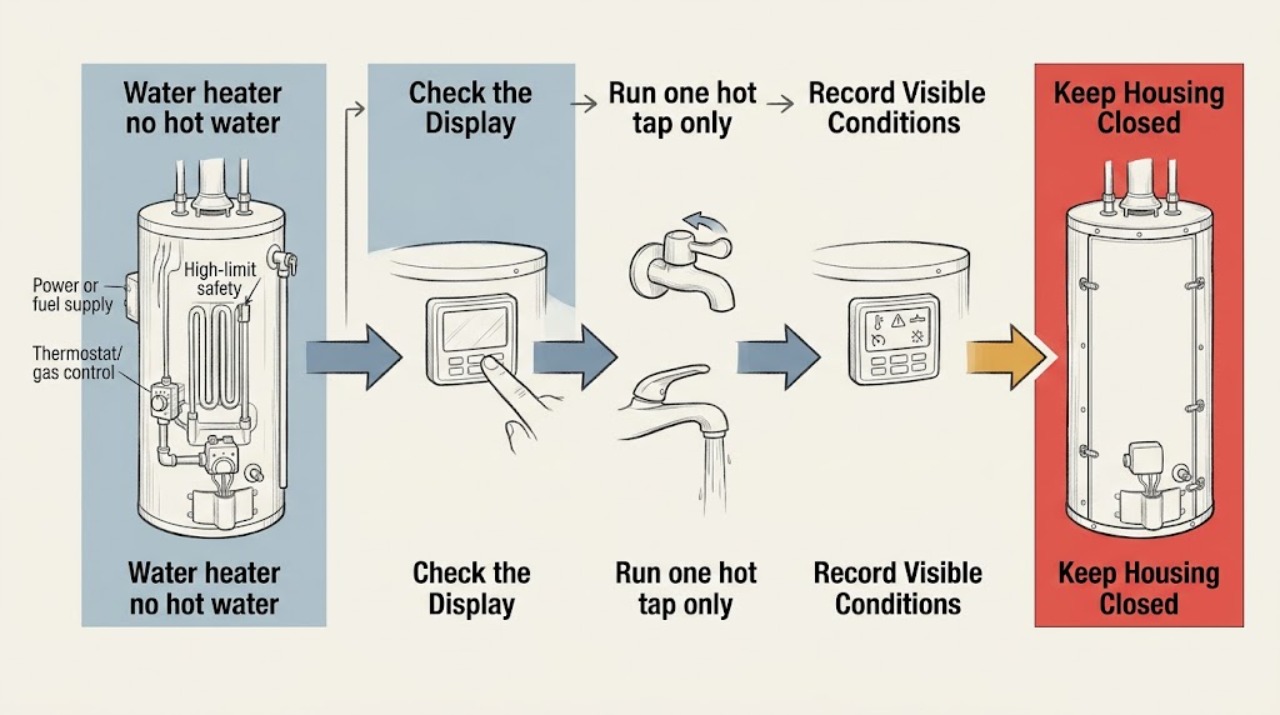
Work through in order
Diagnostic checks
Use only checks that match the exact appliance or system and its official guide.
-
Check 1
Stop testing and leave the area if there is gas odor, smoke, flame outside the burner area, sparking, exposed wiring, a hot or discolored disconnect, scalding water, active leakage, or flooding; do not touch the heater or operate a gas control in a hazardous condition.
Expected result: No hazard is present and the complaint is only cold water, or a gas, electrical, heat, water, or combustion hazard is present.
Next step: For gas odor, fire, smoke, or immediate electrical danger, leave and follow emergency guidance. Otherwise keep the heater off and arrange qualified plumbing or appliance service.
Why this matters
Why: No-hot-water troubleshooting is secondary to preventing fire, explosion, electric shock, burns, and water damage.
-
Check 2
Run one hot tap only until the water temperature can be checked safely, then compare a second hot fixture without waiting for scalding water; note whether the problem affects every fixture or only one.
Expected result: Every hot tap is cold, all taps are lukewarm, or only one fixture is cold while other hot fixtures work.
Next step: Stop using the affected tap if water is unsafe. Continue only with safe external heater checks for a whole-house issue; arrange plumbing diagnosis for a single-fixture problem or persistent lukewarm water.
Why this matters
Why: A whole-house cold condition keeps the heater, its power or fuel, controls, and heating components in consideration. One cold fixture points more toward local plumbing or a mixing valve; lukewarm water can reflect demand or partial heating rather than a complete heater shutdown.
-
Check 3
Read the Bradford White rating plate from a safe position and record the model, serial number, fuel type, and any visible status light or display; retrieve the exact owner or installation manual before changing any setting.
Expected result: The heater is electric, gas, tankless, or heat-pump; the model is identifiable, or the plate and manual are unavailable.
Next step: Use the model-specific documentation. If the identity or status indication is unclear, leave the heater alone and provide the rating-plate information to a qualified professional.
Why this matters
Why: The safe diagnostic path and parts differ by product family. A generic electric-element check is not valid for a gas or tankless control, and a gas-pilot instruction is not valid for an electric unit.
-
Check 4
For an electric model, check the dedicated breaker or disconnect once from a dry, safe position; for a gas model, observe only whether the external status or pilot view appears normal according to the exact manual. Do not open access panels or gas controls.
Expected result: The electric breaker is tripped, the breaker is on but water is cold, the gas pilot or status indicator is out or abnormal, or the external supply indications appear normal.
Next step: Do not repeatedly reset a breaker or gas safety. Keep the unit off for a repeat trip or abnormal status and arrange qualified service; follow only a clearly documented one-time user reset in the exact manual if no hazard exists.
Why this matters
Why: A tripped breaker or abnormal gas status can explain no hot water, but a repeated trip, failed pilot, lockout, or normal external indication with no heat points toward a service-level electrical, thermostat, element, burner, ECO, or control issue.
-
Check 5
Check whether the complaint follows a high-demand period or affects only recovery: note recent showers, appliances, very cold incoming water, and whether the water is lukewarm versus completely cold without changing the thermostat beyond the manual's user setting.
Expected result: Hot water returns after recovery time, the tank is only lukewarm, demand was unusually high, or the supply is completely cold regardless of demand.
Next step: Reduce simultaneous demand and allow a normal recovery only if the unit has no hazard or error. If hot water does not return or the condition is complete and persistent, arrange qualified diagnosis rather than raising temperature by guesswork.
Why this matters
Why: High demand, cold inlet water, undersizing, sediment, a lower element, or a thermostat issue can cause limited hot water. Complete cold water at every tap more strongly supports no power, fuel, control, heating-element, burner, or high-limit trouble.
-
Check 6
Check for a whole-house plumbing symptom without opening the heater: compare cold-water flow, look for a mixing valve or recent plumbing work, and note whether hot water is being diluted at one faucet; do not remove a panel or disconnect a pipe.
Expected result: Only one fixture is cold, hot and cold flow are cross-connected, plumbing was recently changed, or every fixture remains cold with normal flow.
Next step: Arrange local plumbing service for a single-fixture or cross-connection issue. For a whole-house condition, keep the heater settings unchanged and arrange qualified water-heater service.
Why this matters
Why: A local mixing or cross-connection problem can make one outlet cold while the heater works. A whole-house cold condition with normal flow keeps the heater's heat source, controls, elements, burner, or ECO in consideration.
-
Check 7
Prepare the model-specific service record: model and serial, fuel type, fixture comparison, breaker or gas-status observation, error or status code, water temperature pattern, demand and recovery, recent installation or maintenance, leaks, sounds, odor, and any reset attempt.
Expected result: The heater remains cold, a breaker trips again, a pilot or status indication is abnormal, an ECO or error is suspected, or the problem persists after safe external checks.
Next step: Give the record and rating-plate photo to a qualified plumbing professional and request inspection of power or fuel, thermostat/control, ECO or safety, heating elements or burner, plumbing connections, and demand or recovery as applicable.
Why this matters
Why: This record lets a professional distinguish power or fuel loss, thermostat or high-limit action, element or burner failure, wiring, demand, plumbing cross-connection, or model-specific control faults without a dangerous live test.
Use your observations
Decision map
Find the observation that best matches what you see, then follow the next safe action.
-
PATH 01Next step
What you see
Only one faucet or shower is cold while another hot fixture works, and the heater's external status appears normal.
Do this next
Use the working fixture only if its temperature is safe and arrange qualified plumbing diagnosis for the affected branch; do not adjust the heater to compensate.
Why this path and its safety boundary
Why it matters: A local mixing valve, faucet cartridge, cross-connection, or branch plumbing issue is more likely than a Bradford White heater failure.
-
PATH 02Next step
What you see
Every fixture is lukewarm after unusually high demand or very cold inlet water, then recovers normally without a status or safety warning.
Do this next
Reduce simultaneous demand and follow the model's normal recovery guidance. Arrange service if recovery is abnormal, the condition repeats, or water never becomes hot.
Why this path and its safety boundary
Why it matters: Demand, recovery, inlet-water conditions, sizing, sediment, or partial heating is more likely than a complete no-power failure.
-
PATH 03Next step
What you see
An electric breaker is off or trips again, or a gas status indicator or pilot is abnormal or repeatedly goes out.
Do this next
Keep the heater off and arrange qualified service. Do not repeatedly reset the breaker, bypass the ECO, adjust gas controls, or relight outside the exact manual procedure.
Why this path and its safety boundary
Why it matters: Power supply, wiring, element, high-limit, gas control, ignition, venting, or safety-lockout trouble is more likely than a simple temperature setting.
-
PATH 04Next step
What you see
All fixtures are cold with normal water flow, the power or fuel indication appears normal, and no safe user setting explains the condition.
Do this next
Leave the heater settings unchanged and arrange qualified diagnosis. Do not open covers or test energized components.
Why this path and its safety boundary
Why it matters: A failed heating element, thermostat, ECO, burner, gas control, wiring, or model-specific controller is more likely and requires measurements or service access.
-
PATH 05Next step
What you see
There is gas odor, smoke, sparking, exposed wiring, scalding water, an active leak, flooding, a repeated breaker trip, or a failed safety indicator.
Do this next
Leave the area for gas odor, smoke, or fire and follow emergency guidance. Otherwise isolate the heater only from a safe position and arrange urgent qualified plumbing or electrical service.
Why this path and its safety boundary
Why it matters: A gas, electrical, burn, water, or combustion hazard outweighs ordinary no-hot-water troubleshooting.
Helpful context
Understand the symptom
Start by separating no hot water from low hot water
Run one hot tap briefly and compare it with another fixture only if the water is safe to touch. No hot water at every tap points toward the heater or a whole-house supply issue; one fixture that is cold can have a local mixing valve or plumbing problem. Do not wait for a cold faucet to become scalding while testing.
The model and fuel type change the safe check
Bradford White sells electric, gas, tankless, and heat-pump water heaters with different controls and service procedures. Find the rating plate and use the model or serial number to retrieve the matching manual. A breaker check from the outside is different from opening an electric access panel, and a pilot/status observation is different from removing a gas control.
Electric models have a strict high-voltage boundary
Bradford White's electric service material puts power, wiring, heating elements, thermostats, and the high-limit ECO on the no-hot-water path, but its service procedure is for trained work and warns about high voltage. A homeowner can verify an accessible breaker has not tripped once, but should not remove covers, probe terminals, or reset an ECO repeatedly.
Gas models need a professional boundary too
For a gas heater, observe only the normal external status indicator or pilot view described by the exact manual. A failed pilot, repeated lockout, unusual flame, gas odor, or an error code is not a reason to adjust the gas valve or bypass safety controls. Bradford White's owner FAQ recommends a plumbing professional for nuisance pilot outages and service.
A plumbing or demand issue can imitate heater failure
If one fixture is cold but others are hot, a local mixing valve or faucet cartridge is more likely than the Bradford White heater. If all fixtures are merely lukewarm, high demand, cold inlet water, sediment, a lower element, thermostat setting, reversed connections, or a dip-tube issue may be involved. Those possibilities need model-specific diagnosis rather than a guessed replacement.
Safety boundary
Stop conditions
- Stop and arrange urgent qualified service for gas odor, smoke, sparks, exposed wiring, repeated breaker trips, scalding or uncontrolled water, an abnormal pilot or gas status, a failed safety indicator, or active leakage or flooding.
- Do not remove electric access covers, test live voltage, bypass or repeatedly reset the ECO, adjust gas controls, relight a pilot outside the exact model manual, or work on burner, vent, thermostat, element, or wiring components.
- Do not turn an electric heater back on after draining unless the tank is completely full, do not change fuel type or plumbing connections by guesswork, and do not raise the temperature to mask a control or safety fault.
- Arrange service when all fixtures remain cold after safe power or fuel observations, the issue persists beyond normal recovery, the model or status code is unclear, or a single-fixture plumbing check does not explain the lack of hot water.
Only after diagnosis
Potential parts
- Bradford White electric heating element
Consider only when a qualified technician confirms an element is inoperative or damaged after verifying power, thermostat, high-limit, wiring, and the exact model.
Match the exact Bradford White model, element position, voltage, wattage, terminal arrangement, and installation procedure; access involves electrical and hot-water hazards. - Bradford White thermostat or high-limit ECO
Consider only when model-specific testing confirms thermostat or high-limit operation is preventing heating; do not treat a tripped safety as the root cause without diagnosis.
Match the exact model, fuel or electrical system, control sequence, and approved safety component; never bypass the ECO or substitute an unverified control. - Bradford White gas pilot, ignition, or gas control component
Relevant only when a qualified professional confirms a pilot, ignition, thermocouple, gas valve, or control fault from the model's status and service tests.
Match the exact Bradford White model, fuel type, gas control, ignition system, venting, and safety requirements; gas and combustion work is professional-only. - Bradford White dip tube or plumbing connection component
Consider only for insufficient or mixed-temperature water when a qualified diagnosis rules out demand, heating components, thermostat, and a fixture-level mixing problem.
Confirm the exact model, tank configuration, inlet/outlet arrangement, and plumbing code requirements before selecting a component.
When checks do not resolve it
Need a professional?
Safety scope: Homeowner checks should remain limited to comparing hot fixtures, reading the rating plate, retrieving the exact manual, checking an accessible breaker or external gas status once, and documenting demand and recovery. A qualified professional should inspect power, wiring, elements, thermostat or ECO, burner and gas control, venting, tankless or heat-pump controls, and plumbing cross-connections.
Common questions
FAQ
What should I check first when my Bradford White water heater has no hot water?
Determine whether every hot fixture is cold, identify the fuel type and model, and verify an accessible electric breaker or normal external gas status only from a safe position. Do not open covers or adjust gas controls; persistent whole-house cold water needs qualified service.
Can a tripped breaker cause a Bradford White electric water heater to produce no hot water?
Yes. Bradford White's electric service manual lists no power among probable causes, along with elements, thermostats, wiring, and an open ECO. Check the breaker once if safe, but do not repeatedly reset it or test live terminals; a repeat trip needs service.
Why is one faucet cold while the Bradford White water heater still works?
A local mixing valve, faucet cartridge, cross-connection, or branch plumbing problem is more likely when another hot fixture works. Avoid raising the heater setting to compensate and arrange plumbing diagnosis for the affected fixture.
Can I relight a Bradford White pilot or reset the high limit myself?
Only follow a clearly documented user procedure in the exact model manual and only when there is no gas, heat, or electrical hazard. Bradford White directs owners to model-specific documentation and qualified professionals; repeated pilot outages, a high-limit trip, or an error indicator require service rather than bypassing safety controls.
Read the exact guide
Official sources
- 238-51544-00_BBradford White Water Heaters · This service manual covers a specific Bradford White electric product family and is used for cause categories and safety boundaries, not as a universal procedure for every fuel type or model.
- FAQs CanadaBradford White Water Heaters · This Bradford White FAQ is a general owner resource and is used for power, pilot, documentation, and qualified-service boundaries; exact operation varies by model and region.
- Where can I find the manual to my water heater?Bradford White Water Heaters · Bradford White directs owners to obtain documentation using the water heater's model or serial number; the exact manual controls operation and service steps.
- My Water HeaterBradford White Water Heaters · Bradford White's owner resource supports identifying the unit and obtaining service context; it does not diagnose the assigned no-hot-water condition.
Community feedback
Share a repair observation
Share a plain-text repair observation. Accepted observations are published automatically; this page may take a moment to update.