
On this page
Start here
Quick answer
If a gas water heater produces no hot water, first rule out a gas odor, hissing, carbon-monoxide alarm, or illness and leave the area for emergency help when any is present. If the area is safe, use the heater's label or manual to identify whether the pilot or ignition status is present, observe the burner only through the intended viewing window, and compare hot-water flow at more than one fixture. A pilot that will not light or stay lit, a pilot that stays lit while the main burner never responds, a yellow or lazy flame, soot, blocked venting, or a recurring shutdown needs qualified gas-appliance service; do not open the burner compartment, alter the gas train, or bypass a safety control.
Before you begin
Safety first
- This article supports ordinary-access observation and one model-directed relight sequence only when the label permits it and no hazard is present. A qualified person must handle gas-train, burner, venting, combustion, flame-safety, thermostat, and internal plumbing diagnosis or repair.
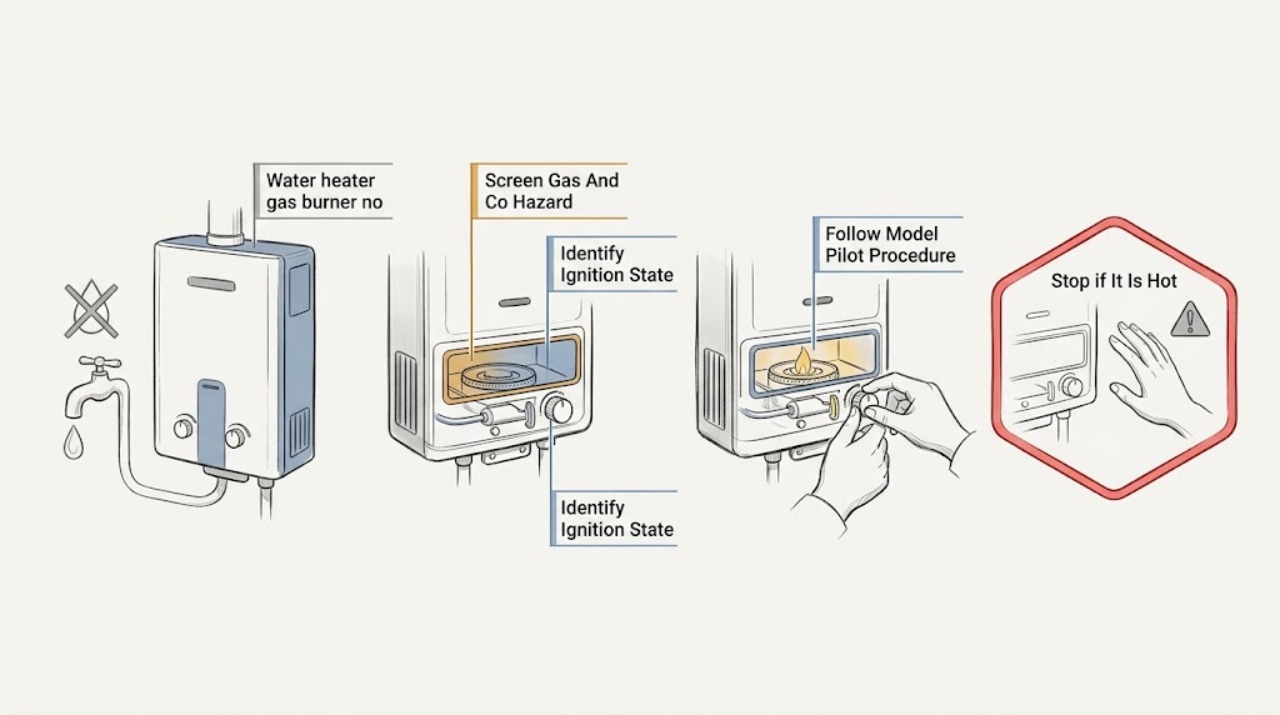
Work through in order
Diagnostic checks
Use only checks that match the exact appliance or system and its official guide.
-
Check 1
From a safe position outside the suspected odor area, note whether there is a rotten-egg gas odor, hissing, a carbon-monoxide alarm, smoke, or anyone with headache, dizziness, nausea, confusion, or unusual weakness; do not operate a switch, phone, lighter, or appliance control in the odor area.
Expected result: There is no gas odor, hissing, CO alarm, smoke, or illness, or one of those warning signs is present.
Next step: If any warning sign is present, leave the building or odor area, keep others away, and call 911 or the gas utility from a safe location. If none is present, continue without opening the heater or disturbing gas piping.
Stop if: Stop immediately for gas odor, hissing, a CO alarm, smoke, or symptoms that could be CO exposure; do not relight or re-enter until the responsible emergency or gas professionals say it is safe.
Why this matters
Why: A warning sign changes this from a hot-water diagnosis to an immediate gas or combustion-safety response; an absence of warning signs only permits the limited visual checks below.
-
Check 2
Read the heater's visible label and look through the intended viewport or at the exterior status indicator from ordinary standing access; record whether a pilot or ignition indication is present and record any displayed pattern without removing a door or panel.
Expected result: The pilot or ignition indication is absent, present and steady, repeatedly attempting to start, or showing a pattern that the model manual identifies as a fault; the viewport is intact or damaged/missing.
Next step: Use the exact model manual to interpret the indicator. If there is no indication, an unexplained code, or a damaged/missing viewport, photograph the label and arrange qualified service instead of opening the burner compartment.
Stop if: Do not remove the burner door, reach into the combustion chamber, jumper a sensor, or interpret an unfamiliar flash pattern as permission to keep operating the heater.
Why this matters
Why: No indication points toward the ignition, gas-control, or flame-sensing path, while a present pilot only establishes the small ignition flame and does not prove that the main burner is heating the tank. A damaged or missing viewport is a stop condition.
-
Check 3
Only when there is no gas odor, the viewport is intact, and the installed label or manual explicitly provides a homeowner relighting sequence, follow that sequence exactly; for a traditional pilot, the A. O. Smith guide describes turning the gas control off and waiting at least 10 minutes before attempting the model-directed pilot position and ignition, but the unit's own instructions take precedence.
Expected result: The pilot lights and remains lit after the control is released, the status indication returns to the normal pattern described by the manual, or the pilot will not light/stay lit after the permitted attempts.
Next step: If the model-directed sequence succeeds, continue to the safe burner observation and allow the unit to heat according to the manual. If it fails, stop, leave the gas control in the safe state specified by the manual, and request qualified gas-appliance service.
Stop if: Do not relight if gas is smelled, the viewport is damaged, the unit has soot or abnormal flame, the manual is unavailable, or the pilot repeatedly fails; do not use a hand flame where the unit specifies electronic ignition.
Why this matters
Why: A stable pilot or normal ignition indication makes a temporary ignition outage plausible, but a pilot that repeatedly goes out can involve the flame-sensing device, draft, combustion air, gas pressure, or control valve. Failure after the manual's permitted attempts is not a cue to keep trying.
-
Check 4
With all covers and doors in their normal installed position, create an ordinary hot-water demand as the manual describes and look only through the intended viewing window; do not touch the burner or gas fittings while observing whether the main burner starts and remains on.
Expected result: The main burner starts and continues heating, starts then drops out, or never starts even though the pilot or ignition indication is present.
Next step: Record the pattern and the exact model information. If the burner does not start or repeatedly drops out, stop use and arrange qualified service; if it runs normally, continue by comparing hot-water outlets and wait only for the model's documented heating period.
Stop if: Stop for a yellow or lazy flame, flame rollout, soot, unusual noise, smoke, smell, repeated dropout, or any need to remove the burner door or adjust gas components.
Why this matters
Why: A burner that never responds with a stable pilot makes the control, thermostat, gas-supply, or flame-sensing path more likely than a water-outlet fault. A burner that drops out repeatedly can indicate a safety, combustion, or control problem. A normal burner response does not prove that venting or water-side components are healthy.
-
Check 5
From floor level and without climbing, disassembly, or contact with hot surfaces, inspect only the visible vent termination and combustion-air openings for an obvious leaf, snow, lint, storage item, or other obstruction; do not reach into the vent or burner area.
Expected result: The visible path is clear, or an obstruction, soot/discoloration, damaged vent, or restricted opening is visible.
Next step: Keep people away and arrange qualified service for any obstruction that is not removable without touching the appliance, for soot/discoloration, damaged venting, or a recurring shutdown. Do not resume operation based only on a clear exterior view.
Stop if: Do not remove vent sections, open the combustion chamber, brush the burner, adjust draft, or continue operation when combustion or venting appears abnormal.
Why this matters
Why: A blockage or soot/discoloration can make combustion and venting unsafe and can contribute to pilot dropout or burner shutdown. A clear visible path does not certify the flue, draft, combustion air, or internal burner condition.
-
Check 6
After the heater has had the model's documented heating period and while keeping the test brief, compare hot-water temperature and flow at two fixtures; compare each with its cold-water flow and note whether only one outlet is affected or every hot outlet is cold.
Expected result: One fixture is cold while another is hot, hot-water flow is absent or much weaker than cold flow, or all hot outlets are cold despite a normal burner response.
Next step: Use the outlet pattern, burner pattern, model, and time since the last hot-water draw when requesting service. Do not increase the temperature setting beyond the label or bypass a mixing or safety control to force hot water.
Stop if: Stop for scalding temperature, a leak, water damage, unstable temperature, or any need to open a faucet cartridge, valve, wall, tank, or gas appliance.
Why this matters
Why: A single cold fixture makes a local faucet, mixing, or plumbing restriction more likely. All outlets cold with no burner response supports a heater-side ignition/control diagnosis; all outlets cold with a normal burner response shifts attention to recovery, thermostat, tank, outlet plumbing, or a mixing component.
Use your observations
Decision map
Find the observation that best matches what you see, then follow the next safe action.
-
PATH 01Next step
What you see
A gas odor, hissing, CO alarm, smoke, or possible CO symptoms occur at any point.
Do this next
Leave the area, warn others without creating sparks, and call 911 or the gas utility from a safe location. Do not relight, reset, investigate the leak, or return until emergency or gas personnel provide clearance.
Why this path and its safety boundary
Why it matters: The appliance may be leaking gas or producing/venting combustion products unsafely; lack of hot water is secondary to immediate life-safety risk.
-
PATH 02Next step
What you see
The visible ignition indication is absent, or a model-directed relight does not produce a stable pilot/normal status indication, while there is no gas odor and the viewport is intact.
Do this next
Stop after the manual's permitted sequence and arrange qualified gas-appliance service; provide the model, indicator pattern, whether a spark/click was observed, and whether the pilot stayed lit.
Why this path and its safety boundary
Why it matters: Ignition, flame sensing, gas supply, draft/air, or gas-control trouble is more likely than a faucet problem. Repeated failed attempts can leave the user closer to a gas or combustion hazard without identifying the cause.
-
PATH 03Next step
What you see
The pilot or ignition status remains normal, every hot outlet is cold, and the main burner never starts during an ordinary call for heat.
Do this next
Leave the heater in the state specified by its manual and request qualified service. Do not open the burner compartment, clean an orifice, adjust pressure, or bypass a safety control.
Why this path and its safety boundary
Why it matters: A thermostat/control, gas-supply, flame-sensing, or burner-control problem becomes more likely than a local fixture issue; the pilot alone is not proof that the tank is being heated.
-
PATH 04Next step
What you see
The main burner starts but drops out repeatedly, or a yellow/lazy flame, soot, damaged vent, blocked visible opening, or abnormal combustion sign is present.
Do this next
Stop using the heater and arrange a qualified gas-appliance and venting inspection. If gas odor, smoke, a CO alarm, or symptoms occur, use the emergency branch immediately.
Why this path and its safety boundary
Why it matters: Combustion-air, venting, gas-pressure, burner, or safety-control trouble is possible. A clear exterior opening cannot rule out an internal or draft problem.
-
PATH 05Next step
What you see
The burner starts and remains on normally, but one fixture is cold or has abnormal hot-water flow while another hot outlet works.
Do this next
Use the affected fixture's manufacturer guidance or request plumbing service, and do not alter the water heater's gas controls to compensate for a local outlet problem.
Why this path and its safety boundary
Why it matters: The water heater is less likely to be the sole cause; a fixture cartridge, local mixing path, or outlet restriction is more likely.
-
PATH 06Next step
What you see
The burner appears to run normally, every hot outlet remains cold after the model's documented heating period, and no gas/CO or venting warning is present.
Do this next
Stop repeated relighting and request model-specific plumbing or water-heater service with the burner duration, outlet comparison, model, age, and any indicator pattern. Keep temperature and safety controls at their documented settings.
Why this path and its safety boundary
Why it matters: A tank-side thermostat, outlet/mixing path, recovery problem, or internal water-heating fault is possible; the visible flame observation alone cannot identify which component has failed.
Helpful context
Understand the symptom
What the burner result tells you
A tank-style gas heater needs a safe ignition path, a flame-sensing safety system, gas control, and a burner that responds to a call for heat. A traditional pilot can supply the ignition flame continuously; if it goes out, the safety system can stop gas flow. Some newer units use electronic ignition instead, so the label and model manual control the interpretation. Do not assume that a visible pilot proves the main burner is operating.
Use the viewing window and the model instructions
Only use the controls and viewing window that the installed unit identifies for normal homeowner operation. The A. O. Smith guidance says its relighting page is secondary to the water heater's own label and manual, and that a missing or damaged viewport or a gas odor is a reason not to continue. A different brand or ignition design may use different indicators, sequences, or lockout behavior.
Burning and venting are safety boundaries, not DIY adjustments
A gas water heater's exhaust must leave the building and its combustion air must remain adequate. The EPA identifies gas water heaters as fuel-burning appliances that can produce dangerous carbon monoxide when not working or venting properly. Keep the inspection to ordinary safe access; do not remove a burner door, disconnect a vent, adjust gas pressure, clean an orifice, or defeat a flame-safety device.
Separate a burner failure from a fixture-side symptom
If one shower or faucet is cold but another receives hot water, the heater may not be the source. If all hot outlets are cold and the tank burner never responds, prioritize the heater's ignition and control path. If the burner does run but all outlets remain cold after the model's documented heating period, a thermostat, tank, outlet plumbing, or mixing component needs product-specific diagnosis rather than repeated relighting.
Safety boundary
Stop conditions
- Leave immediately for a gas odor, hissing, smoke, CO alarm, or possible CO symptoms; call emergency or gas service from a safe location and do not relight.
- Do not operate a heater with a missing or damaged viewport, visible soot, yellow or lazy flame, flame rollout, damaged vent, repeated burner dropout, or abnormal combustion sign.
- Do not remove burner doors or panels, reach into the combustion chamber, clean an orifice, adjust gas pressure, disconnect venting, jumper a sensor, or bypass any safety control.
- Do not keep repeating a failed relight sequence, use a hand flame where the unit specifies electronic ignition, or interpret an unfamiliar status pattern without the exact model manual.
- Stop for a water leak, scalding or unstable temperature, water damage, or any inspection that requires climbing, opening a wall, disturbing plumbing valves, or touching hot or energized parts.
Only after diagnosis
Potential parts
- pilot assembly or flame-sensing component
Consider this category only if qualified diagnosis confirms that the pilot will not remain lit or the flame-sensing circuit is defective after gas supply, draft, and combustion conditions are checked.
Confirm the exact water-heater model, fuel type, ignition design, and manufacturer fit information; do not substitute a generic assembly or alter the safety circuit. - gas control valve or thermostat
Consider this category only when the pilot is stable but the main burner does not respond, and a qualified technician has identified the control or thermostat as the failed component.
Match the exact model, gas type, control interface, and approved replacement instructions; gas-control replacement is not a user trial. - main burner assembly
Consider this category only if service inspection confirms burner damage or a model-specific burner fault after checking ignition, gas control, combustion air, and venting.
Confirm exact model and fuel compatibility with the manufacturer or qualified technician; do not clean, enlarge, or modify an orifice as a workaround.
When checks do not resolve it
Need a professional?
Arrange qualified gas-appliance or plumbing service when the pilot will not light or stay lit, the main burner does not respond with a stable pilot, the burner repeatedly drops out, venting or combustion looks abnormal, every hot outlet remains cold after the documented heating period, or a local outlet comparison does not isolate the issue. Treat gas odor, hissing, smoke, a CO alarm, and possible CO symptoms as an emergency rather than a routine service visit.
Safety scope: This article supports ordinary-access observation and one model-directed relight sequence only when the label permits it and no hazard is present. A qualified person must handle gas-train, burner, venting, combustion, flame-safety, thermostat, and internal plumbing diagnosis or repair.
Common questions
FAQ
Why is there no hot water if the gas water-heater pilot is lit?
A pilot is only the small ignition flame. The main burner still has to respond to a call for heat and remain operating safely. If every hot outlet is cold and the burner never starts, or it starts and drops out, record that pattern and arrange qualified service rather than opening the burner compartment.
Can I relight a gas water-heater pilot myself?
Only if the installed label or manual explicitly provides a homeowner procedure, the viewport is intact, and there is no gas odor, smoke, abnormal flame, or other hazard. Follow that exact procedure once within its permitted attempts. Do not use a hand flame where the unit specifies electronic ignition, and stop for a pilot that will not stay lit.
What should I do if I smell gas near the water heater?
Do not troubleshoot or relight. Leave the area, avoid switches, phones, flames, and appliance controls near the odor, keep others away, and call 911 or the gas utility from a safe location. Wait for emergency or gas personnel to say it is safe before returning.
What if the burner runs but the faucets are still cold?
Compare more than one hot outlet and allow only the heating period documented for the model. One cold fixture with another hot fixture points toward a local faucet or plumbing problem. Every outlet cold despite a normal burner response needs model-specific diagnosis of recovery, thermostat, tank, outlet plumbing, or mixing components.
Is a yellow flame or soot just a burner-cleaning issue?
Treat yellow or lazy flame, soot, damaged venting, or repeated burner dropout as a combustion or venting stop condition. Do not remove the burner door or attempt to clean an orifice; stop using the heater and arrange qualified inspection.
Read the exact guide
Official sources
- Natural Gas Consumer SafetyPublic Service Commission of Wisconsin · State public-utility safety guidance used for household gas-odor and visible vent/air-path boundaries.
- Recognizing and Responding to Pipeline EmergenciesU.S. Department of Transportation Pipeline and Hazardous Materials Safety Administration · Emergency response to suspected odorized natural-gas leaks near a home or gas appliance.
- What to Do Before Calling a Plumber or Replacing Your Water HeaterRheem Manufacturing Company · General manufacturer homeowner guidance for documenting water-heater symptoms and knowing when to arrange service; it does not replace the exact unit manual.
- How To Relight a Water Heater’s Pilot LightA. O. Smith · General homeowner guidance from a water-heater manufacturer; the installed unit's label and exact manual control when model procedures differ.
- Protect Your Family and Yourself from Carbon Monoxide PoisoningU.S. Environmental Protection Agency · General household safety for gas water heaters and other fuel-burning appliances.
Community feedback
Share a repair observation
Share a plain-text repair observation. Accepted observations are published automatically; this page may take a moment to update.