
On this page
Start here
Quick answer
If an A. O. Smith gas water-heater pilot keeps going out, first stop for gas odor, hissing, soot, flame rollout, a carbon-monoxide alarm, or anyone feeling ill: leave the area and get emergency help from a safe location. If the area is safe, use the lighting instructions on the heater label or in the exact model manual, turn the gas control to OFF and wait as directed before one controlled relight, and observe the pilot only through the intended sight glass or opening. Note whether the pilot dies as soon as the control knob is released, after it runs for a while, or when the main burner starts. A recurring outage can involve the thermocouple or thermopile, pilot flame, gas supply, draft or combustion air, ignition system, or gas control valve. Do not adjust gas pressure, open the burner compartment, bypass the flame-safety circuit, or keep repeating relights; unresolved or recurring outages need qualified gas-appliance service.
Before you begin
Safety first
- This article supports a gas or CO hazard stop, model identification, ordinary-access label and status-light observation, and one exact-manual relight when the area is safe. Do not open the burner compartment, alter the gas train or venting, adjust gas pressure, bypass flame safety, or access live circuits.
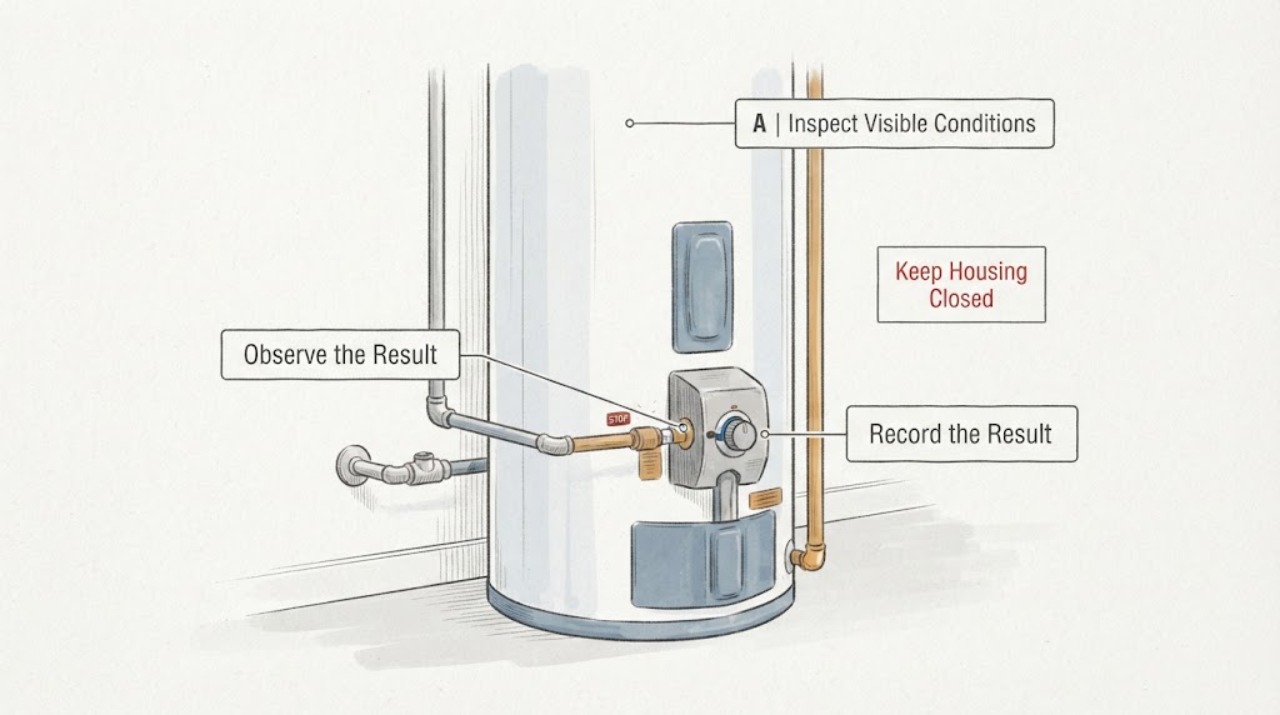
Work through in order
Diagnostic checks
Use only checks that match the exact appliance or system and its official guide.
-
Check 1
Before touching the gas control valve or igniter, observe from a safe position for gas odor, hissing, soot, flame rollout, an active carbon-monoxide alarm, or symptoms such as headache, dizziness, nausea, weakness, or confusion.
Expected result: There is gas odor or hissing, the CO alarm sounds, anyone feels ill, soot or flame is escaping, or none of those warning signs is present.
Next step: For gas odor, hissing, alarm, symptoms, soot, or flame rollout, leave immediately, call emergency services or the gas utility from a safe location, and do not reenter or operate the heater until cleared. If none is present, keep the heater off until the exact label and model manual are ready.
Stop if: Stop immediately for any gas odor, CO alarm, illness, visible flame outside the intended viewing area, smoke, soot, sparking, or uncontrolled gas release.
Why this matters
Why: Gas odor or combustion warning signs make continued troubleshooting unsafe. A CO alarm or symptoms require treating the home as contaminated even though CO cannot be seen or smelled; no warning sign only permits the limited model-manual checks below, not a gas-train repair.
-
Check 2
From ordinary access, photograph or read the A. O. Smith model and the lighting label, identify whether the unit uses a standard pilot or electronic control, and record the gas-control knob position and status-light pattern without opening the burner compartment.
Expected result: The label shows a standard or electronic gas control, the status light is flashing as the manual describes, the light is on or off without the expected pattern, or the control style cannot be identified.
Next step: Use the exact model manual and label for the next step; if the status code is abnormal or the control cannot be identified, stop and arrange qualified gas-appliance service rather than opening the assembly.
Stop if: Do not remove an inner burner door, pull wires, turn an unlabeled gas fitting, or continue if the label is missing, damaged, or inconsistent with the installed control.
Why this matters
Why: A. O. Smith uses different ignition and status-light behaviors. A light that is not showing the model's normal pattern supports a pilot or safety-control fault, while an unidentified control makes a generic relight unsafe or inapplicable.
-
Check 3
Only when the area is safe and the label or exact manual authorizes a homeowner relight, set the gas control to OFF and wait the specified dissipation period, then follow the model's Pilot and igniter sequence once while watching only through the designed sight glass or opening.
Expected result: The pilot does not light, lights but goes out when the knob is released, remains lit with the expected status indication, or the manual's attempt limit is reached without a stable pilot.
Next step: If the pilot is stable, leave settings at the manual's normal position and monitor without opening the burner area. If it will not stay lit or the attempt limit is reached, turn the control to OFF, close the appliance gas supply only as the manual directs, and arrange qualified service.
Stop if: Do not relight if gas is smelled, do not exceed the manual's attempt limit, do not use an unapproved flame source, and do not touch or open the burner compartment during ignition.
Why this matters
Why: No flame can indicate absent gas, ignition, or pilot-path trouble. Extinguishing at release makes a flame-safety signal or gas-control problem more likely. A stable pilot after one authorized attempt does not prove the main burner, venting, or control valve is healthy; a repeated failure establishes a service boundary.
-
Check 4
If a model-authorized attempt produces a visible pilot, observe from outside the designed viewing area whether its flame is steady and whether it extinguishes immediately on knob release, later during standby, or when the main burner starts; do not open the combustion chamber.
Expected result: The flame is weak or unstable, the pilot dies at knob release, it dies only after running, it dies when the main burner starts, or the flame remains stable while the status light is abnormal.
Next step: Stop using the heater and provide the timing, flame observation, status light, and surrounding conditions to a qualified gas-appliance technician; do not clean an orifice, adjust gas pressure, alter venting, or replace a safety part based only on the symptom.
Stop if: Stop immediately for a yellow or lifting flame, soot, flame outside the sight glass, unusual combustion noise, draft that cannot be controlled, or any need to open the burner door or vent.
Why this matters
Why: A. O. Smith links knob-release failure to thermocouple or thermopile and gas-valve safety signaling, while drafts, limited combustion air, gas-pressure changes, restricted tubes, ignition faults, and control-valve failure can produce other recurring patterns. Flame color, soot, or abnormal movement can signal unsafe combustion rather than a user adjustment.
-
Check 5
After a recurring outage or an abnormal status-light result, leave the gas control in the safe OFF state required by the label, preserve the observed condition, and arrange qualified gas-appliance service rather than testing the gas control valve or flame-safety circuit yourself.
Expected result: The pilot repeatedly goes out, the control knob will not behave as labeled, the status light remains abnormal, hot water is absent, the unit shows combustion damage, or the pilot stays lit but the main burner does not operate.
Next step: Give the technician the exact model, fuel type, failure timing, status-light pattern, flame description, recent service or installation history, and any gas or CO warning. Keep the heater out of service until diagnosis if the pilot cannot remain lit or any combustion warning occurred.
Stop if: Do not bypass a safety control, measure live gas or electrical circuits, open the gas valve body, remove the burner assembly, or continue relighting a pilot that repeatedly fails.
Why this matters
Why: A repeated symptom can involve the thermocouple or thermopile, pilot assembly, gas supply, combustion air, venting, ignition system, or gas control valve. The symptom does not establish which part is safe or compatible to replace.
Use your observations
Decision map
Find the observation that best matches what you see, then follow the next safe action.
-
PATH 01Safety boundary
What you see
Gas odor, hissing, soot, flame rollout, a CO alarm, or possible CO symptoms are present.
Do this next
Leave the area, call emergency services or the gas utility from a safe location, and do not reenter or operate the water heater until responders or trained personnel clear it.
Why this path and its safety boundary
Why it matters: This is an immediate gas or combustion-safety event, not a pilot-relight problem.
Safety stop: Do not search for the leak, relight, switch electrical devices, or silence and ignore the CO alarm inside the home.
-
PATH 02Safety boundary
What you see
The pilot lights but extinguishes as soon as the gas-control knob is released, with no gas odor or CO warning.
Do this next
Stop after the model-authorized attempt and arrange qualified diagnosis of the pilot assembly, flame-safety sensor, and gas control; do not bypass the safety circuit or adjust the valve.
Why this path and its safety boundary
Why it matters: A flame-safety signal from the thermocouple or thermopile, the pilot flame itself, or the gas control valve becomes more likely.
Safety stop: Do not hold the knob indefinitely, bridge a sensor, open the burner compartment, or keep repeating the relight.
-
PATH 03Safety boundary
What you see
The pilot stays lit after knob release but goes out later during standby or when the heater calls for heat.
Do this next
Stop using the heater and arrange gas-appliance service with the timing and status-light observations; have the technician assess combustion air, venting, fuel supply, and the control valve.
Why this path and its safety boundary
Why it matters: Draft, combustion-air limitation, gas-pressure change, restricted fuel tubing, ignition or control behavior, or venting is more likely than a simple knob-release failure.
Safety stop: Do not block or modify vents, adjust gas pressure, clean fuel orifices, or open the burner door.
-
PATH 04Safety boundary
What you see
The authorized igniter produces no stable pilot, the pilot does not light after the manual's sequence, or the status light never reaches the model's expected pattern.
Do this next
Turn the gas control and appliance supply to the OFF state required by the manual and arrange qualified service; provide the model, fuel type, spark observation, status-light behavior, and installation history.
Why this path and its safety boundary
Why it matters: Absent gas, air in a new gas line, ignition failure, pilot-path restriction, gas-supply trouble, or gas-control fault is possible; the exact cause cannot be inferred safely from the spark alone.
Safety stop: Do not open the gas valve, remove the burner door, unplug wires, clean an orifice, or repeat attempts after the manual limit.
-
PATH 05Safety boundary
What you see
The pilot remains lit with the expected status indication, but the main burner does not respond or hot water remains unavailable.
Do this next
Leave the settings at the label's normal position, do not open the burner area, and arrange qualified service for the main-burner and gas-control diagnosis.
Why this path and its safety boundary
Why it matters: The pilot alone does not prove the main gas-control, thermostat, burner, or combustion path is operating; a call-for-heat or control fault is possible.
Safety stop: Do not raise the temperature to force a cycle, bypass a thermostat or safety, or manually open the gas valve.
-
PATH 06Safety boundary
What you see
The pilot can be relit but goes out again, the status light becomes abnormal, or the issue returns after a short period.
Do this next
Keep the heater out of service and arrange qualified gas-appliance diagnosis; record the interval to failure, flame and status-light behavior, and any changes in weather, doors, ventilation, or gas use.
Why this path and its safety boundary
Why it matters: A recurring fault is more likely than a one-time outage and may involve the flame-safety sensor, pilot, gas supply, draft, combustion air, ignition system, or gas control valve.
Safety stop: Do not keep relighting, replace the gas control valve based on the symptom alone, alter venting, or use the heater after any CO alarm or combustion warning.
Helpful context
Understand the symptom
Safety comes before relighting
A pilot outage is not a reason to keep pressing the igniter. Before any observation, check the area from a safe position for gas odor, hissing, soot, unusual flame behavior, a carbon-monoxide alarm, headache, dizziness, nausea, weakness, or confusion. Carbon monoxide has no smell or color, so the absence of gas odor does not prove the combustion system is safe. Leave immediately for an alarm, suspected CO, symptoms, or an uncontrolled gas leak, and do not reenter or reuse the heater until qualified responders or a trained technician says it is safe.
The failure timing changes the diagnosis
A pilot that extinguishes the moment the gas-control knob is released points toward a flame-safety signal, pilot flame, or control problem. A pilot that stays lit until the main burner starts can instead make draft, combustion-air, gas-supply, or venting conditions more important. An electronic model may not have a continuously burning pilot at all. Use the model label, status light, and manual to identify the control style rather than applying a generic sequence.
Use one model-authorized lighting attempt
A. O. Smith's general guidance is secondary to the heater's label and owner manual. On models with a standard or electronic gas control, the label may direct the user to set the control to Pilot, hold the knob while operating the igniter, and wait before another attempt if the status light does not respond. The exact timing and status-light pattern vary by model. Stop after the manual's limit or any abnormal result; do not improvise a jumper, bypass, or burner-door procedure.
A recurring outage is a service diagnosis, not a valve adjustment
The thermocouple or thermopile supplies the flame-safety signal that allows the gas valve to continue operating. A weak pilot, draft, blocked combustion air, gas-pressure change, restricted tube, ignition fault, or failing gas control valve can interrupt that path. These causes overlap in symptoms and cannot be safely separated by adjusting gas pressure or opening the burner assembly. Record what happened and give the technician the model and status-light behavior.
Safety boundary
Stop conditions
- Leave immediately for gas odor, hissing, a CO alarm, headache, dizziness, nausea, weakness, confusion, soot, smoke, or flame outside the intended viewing area; call emergency services or the gas utility from a safe location.
- Do not relight after a gas or CO warning, do not reenter until cleared, and do not operate the heater until trained personnel inspect a suspected combustion or CO problem.
- Do not bypass the thermocouple or thermopile safety, adjust gas pressure, open the gas control valve, clean an orifice, disconnect wires, or remove the burner assembly as a user test.
- Do not exceed the exact model manual's relight attempts or wait procedure; stop for an abnormal flame, status light, combustion noise, draft, heat, or repeated outage.
- Arrange qualified gas-appliance service for any pilot that will not remain lit, any persistent status fault, absent main burner, or suspected gas control, venting, combustion-air, or fuel-supply problem.
Only after diagnosis
Potential parts
- A. O. Smith thermocouple or thermopile
Consider this category only when a qualified diagnosis finds that the flame-safety sensor does not provide the required signal after the pilot flame and installation conditions are verified.
Confirm the exact A. O. Smith model, gas-control valve, connector, and sensor type; do not replace or bypass a safety sensor based only on knob-release timing. - A. O. Smith pilot assembly or igniter component
Consider this category only when service confirms a weak or unstable pilot, failed ignition component, or pilot-path defect after gas supply and combustion conditions are checked.
Confirm the exact model and fuel configuration; pilot and ignition components are gas-appliance work, not ordinary user cleaning or adjustment. - A. O. Smith gas control valve
Consider this category only when a qualified technician diagnoses the gas control valve or its safety circuit as the cause after pilot, sensor, gas supply, combustion-air, and venting checks.
Confirm exact model, fuel type, valve family, and required installation procedure; never open, adjust, or bypass a gas control valve as a user repair.
When checks do not resolve it
Need a professional?
Arrange qualified A. O. Smith gas-appliance service when the pilot goes out again after one model-authorized relight, dies when the knob is released, fails when the main burner starts, or leaves an abnormal status-light pattern; when the pilot will not light, the main burner does not respond, hot water remains unavailable, or the gas control valve, flame-safety sensor, pilot assembly, combustion air, venting, or fuel supply may be involved. For a gas odor, hissing, CO alarm, soot, flame rollout, or possible CO symptoms, leave immediately and contact emergency services or the gas utility from a safe location. Give the technician the model, fuel type, control style, status-light pattern, relight timing, flame description, recent installation or service history, and any safety warning.
Safety scope: This article supports a gas or CO hazard stop, model identification, ordinary-access label and status-light observation, and one exact-manual relight when the area is safe. Do not open the burner compartment, alter the gas train or venting, adjust gas pressure, bypass flame safety, or access live circuits.
Common questions
FAQ
Why does my A. O. Smith water-heater pilot go out when I release the knob?
A. O. Smith explains that the thermocouple or thermopile provides the flame-safety signal that allows the gas valve to continue operating. A weak pilot, sensor, wiring or control-valve fault can interrupt that signal. Use the exact label or manual once when the area is safe, then arrange qualified service if the pilot will not remain lit.
Can I keep relighting an A. O. Smith pilot that keeps going out?
No. Follow only the exact model label or manual, including its gas-off wait and attempt limit. If the pilot goes out again, leave the gas control in the safe state required by the instructions and arrange gas-appliance service rather than repeating relights or bypassing a safety control.
What if the pilot goes out when the main burner starts?
That timing can make draft, combustion air, gas supply, restricted tubing, ignition, venting, or gas-control behavior more important than a simple knob-release problem. Stop using the heater and have a qualified technician diagnose it; do not alter the vent, gas pressure, or burner compartment.
What should I do if my carbon-monoxide alarm sounds near the water heater?
Leave immediately for fresh air, call emergency services from outside, and do not reenter until responders give permission. CPSC says not to operate a fuel-burning appliance identified as a source until it has been properly serviced by trained personnel.
Read the exact guide
Official sources
- A. O. Smith Water Heaters at LowesA. O. Smith · Use for the supported A. O. Smith control and ignition sequence only; the printed model instructions govern the installed heater.
- How To Relight A Water Heater's Pilot LightA. O. Smith · Use as general A. O. Smith guidance only; the installed water-heater label and owner manual supersede this page and control the applicable ignition procedure.
- Carbon Monoxide Fact SheetU.S. Consumer Product Safety Commission · Use for the emergency safety boundary around a gas water heater; it is not a model-specific repair guide.
- How to Turn a Water Heater On & OffA. O. Smith · Use for general standard or electronic gas-control guidance; status-light timing and controls vary by exact model.
Community feedback
Share a repair observation
Share a plain-text repair observation. Accepted observations are published automatically; this page may take a moment to update.