
On this page
Start here
Quick answer
A. O. Smith gas water heater pilot outages are safe to troubleshoot only when there is no gas odor, smoke, or other immediate hazard. Start with the model label and manual, then determine whether the flame dies when the control is released, during burner operation, or after a draft or airflow change. If the exact manual allows a relight, turn the gas control to Off and wait at least 10 minutes before one label-directed attempt; do not keep trying when the pilot will not hold. A pilot that drops out again, a weak or unstable flame, a blocked air path or vent, a discolored flame-arrestor area, or any gas odor needs the heater left out of service and qualified gas-appliance service.
Before you begin
Safety first
- This article covers safe observation and, only when the exact label permits it and no hazard is present, one model-directed relight attempt after the specified wait. It does not authorize gas-pressure tests, live electrical tests, safety bypasses, burner disassembly, vent alteration, or control-valve work.
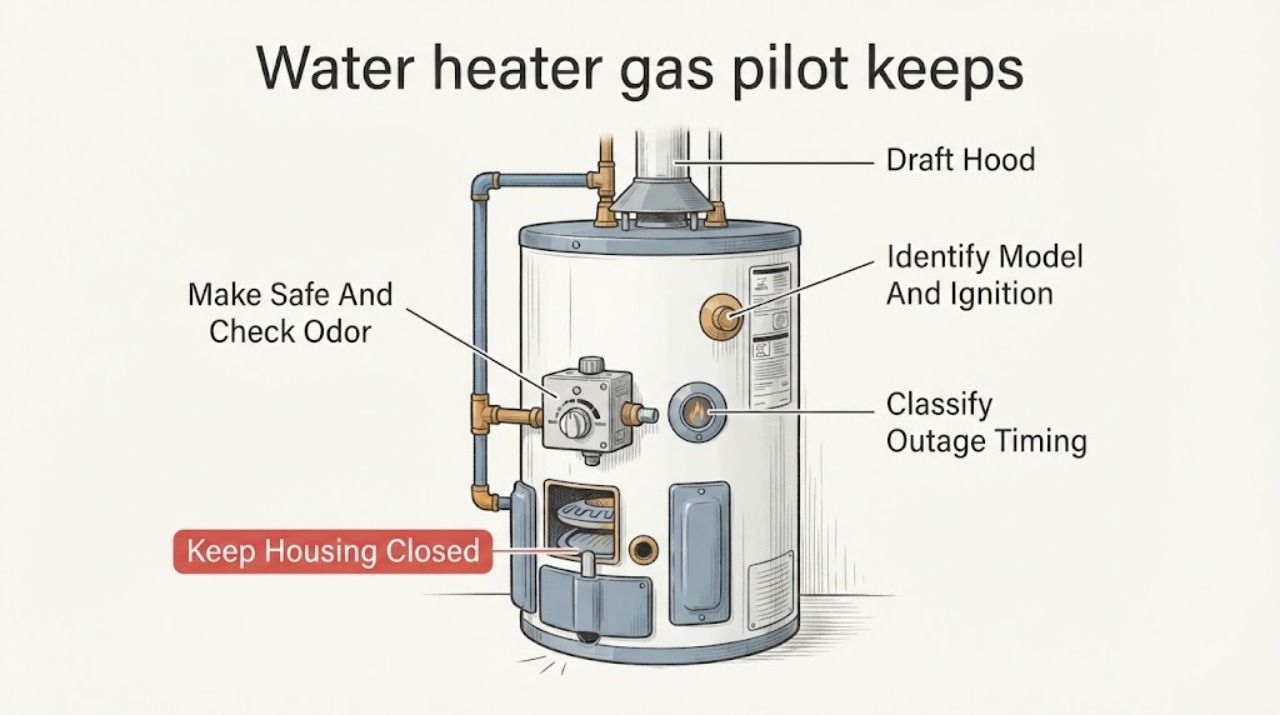
Work through in order
Diagnostic checks
Use only checks that match the exact appliance or system and its official guide.
-
Check 1
Before touching the controls, look and smell from a safe position for a gas odor, smoke, soot, flame outside its intended viewing area, or an unusual burning or exhaust smell; do not create a spark or operate an electrical switch to investigate.
Expected result: There is no gas odor, smoke, soot, abnormal flame, or unusual exhaust concern, or one of those hazards is present.
Next step: If any hazard is present, leave the area when necessary, avoid ignition sources, and contact the gas supplier or emergency service from a safe location. Otherwise continue with the model-specific identification check.
Stop if: Do not attempt to light the pilot when gas is smelled or when smoke, soot, uncontrolled flame, or an exhaust concern is present.
Why this matters
Why: A clear area permits only the ordinary label-directed checks below. Any gas or combustion warning is a stop-use condition, not a relight branch.
-
Check 2
Read the rating label and instruction panel from ordinary safe access and note the model, gas type shown on the label, control style, igniter style, status-light behavior, and any displayed pattern; do not remove the burner, manifold, wiring, or control cover.
Expected result: The heater has a traditional standing pilot, an electronic or direct-spark sequence, or an unclear system; the manual and label are available or missing.
Next step: Use the exact A. O. Smith manual for the recorded model. If the system cannot be identified, stop and provide the label information to qualified service rather than guessing at the control sequence.
Stop if: Do not use a match or lighter, move gas controls, or open access covers unless the exact model instructions expressly require and permit that step and the area remains free of hazards.
Why this matters
Why: The relight and status indications are model-dependent. A missing manual or an unclear ignition system removes the basis for a safe generic sequence.
-
Check 3
From the normal viewing position, record when the pilot disappears: immediately when the control is released, after the burner starts, after the heater has run for a while, or before a flame can be established; do not hold the control open to extend the test.
Expected result: The flame dies on release, dies during burner operation, goes out after a repeatable interval, or never lights; record any status-light change at the same time.
Next step: Use this timing to select the matching branch below and give the record to the technician. Do not infer that replacing a thermocouple will correct a draft, vent, or airflow problem.
Stop if: Stop immediately if the flame lifts, rolls out, changes abnormally, produces soot, or cannot be viewed safely through the intended opening.
Why this matters
Why: Dropout on release makes the thermocouple or thermopile, pilot flame quality, connection, or gas control more likely. Dropout during operation makes a draft, combustion-air, vent, flame-arrestor, thermal-switch, or gas-supply issue more important. No flame can also involve ignition or a blocked pilot route.
-
Check 4
Only if there is no gas odor and the exact model label permits a homeowner relight, turn the gas control to the required Off position, wait at least 10 minutes, and follow that label's Pilot and igniter sequence once; do not improvise a different sequence or continue repeated attempts.
Expected result: The pilot lights and remains lit after the control is released, the pilot lights but goes out on release, the pilot never lights, or the model status light does not show the expected result.
Next step: If the pilot fails, goes out again, or the status indication is not the manual's expected result, turn the control Off and arrange qualified service. If it stays lit, observe only for the normal sequence and stop if the outage returns.
Stop if: Do not relight more than the exact manual allows, hold the control open, bypass a safety device, or keep operating the heater after a repeat outage.
Why this matters
Why: A pilot that remains lit after the label-directed attempt makes a temporary outage or control-state issue possible, but recurrence is not resolved. Failure on release supports a flame-sensing, pilot, connection, or control problem; no flame or an unexpected status pattern needs model-specific service diagnosis.
-
Check 5
With the heater Off and cool, inspect only the accessible area around the combustion-air openings, the base-ring or flame-arrestor exterior if the model manual identifies it, and the visible vent termination; remove only loose household debris that the exact manual says a homeowner may remove, without disassembly.
Expected result: The air path and vent termination are clear, lint or dust is present, the flame-arrestor area is discolored, the vent is restricted, or the inspection cannot be completed without opening the heater.
Next step: Keep the heater Off and request qualified gas-appliance service for a restricted vent, discoloration, repeated dropout, or any inspection requiring a cover or burner access. Do not block air openings or relocate stored items into the required clearance.
Stop if: Do not remove the flame arrestor, alter venting, defeat a thermal switch, use compressed air into the burner, or operate the heater with a restricted or discolored combustion path.
Why this matters
Why: A blocked air path, draft, vent restriction, or dirty flame-arrestor area can extinguish the pilot or activate protection. Discoloration or a restricted vent can indicate an unsafe combustion condition rather than routine dirt.
-
Check 6
Record the model and fuel label, outage timing, status-light pattern, number of permitted relight attempts, visible pilot or burner behavior, recent changes near the heater, and whether other gas appliances are operating normally; take exterior photos only from a safe position.
Expected result: The record shows an isolated pilot issue, a whole-gas-supply symptom, a repeatable status pattern, an airflow or vent concern, or insufficient information to distinguish them.
Next step: Give the complete record to a qualified plumbing or gas-appliance technician and the gas supplier when the symptom affects more than this heater. Leave the heater Off until the repeat outage has been assessed.
Stop if: Do not test gas pressure, electrical output, live wiring, the gas control, or vent draft as a homeowner check.
Why this matters
Why: An isolated pilot issue can involve the pilot assembly, flame-sensing part, wiring, or gas control. A broader gas symptom can involve supply pressure or the gas supplier. A repeatable status pattern can narrow the model-specific diagnosis, but it is not a universal code.
Use your observations
Decision map
Find the observation that best matches what you see, then follow the next safe action.
-
PATH 01Safety boundary
What you see
Gas odor, smoke, soot, flame outside the intended viewing area, or an unusual exhaust or burning smell is present.
Do this next
Do not light or relight the heater, operate switches, or continue inspection. Leave the area when appropriate and contact the gas supplier or emergency service from a safe location.
Why this path and its safety boundary
Why it matters: The symptom is no longer a routine pilot relight problem; ignition and combustion hazards take priority.
Safety stop: Keep the appliance out of service until the appropriate gas or emergency authority makes the area safe.
-
PATH 02Safety boundary
What you see
The pilot lights during the label-directed sequence but goes out as soon as the control is released, with no gas odor and no visible combustion hazard.
Do this next
Turn the control Off and arrange qualified service; provide the model, timing, status indication, and whether the pilot flame looked weak or unstable. Do not hold the control open or bypass the safety path.
Why this path and its safety boundary
Why it matters: The flame-sensing path, thermocouple or thermopile, pilot flame, connection, thermal switch, or gas control is more likely than a simple control-setting error.
Safety stop: Do not keep repeating relights or replace a safety component without exact model diagnosis.
-
PATH 03Safety boundary
What you see
The pilot stays lit initially but drops out when the main burner runs or after a repeatable run interval; the accessible air path or vent is blocked, restricted, or discolored.
Do this next
Leave the heater Off and request qualified service for an airflow, vent, combustion, and safety-control assessment. Do not clear internal passages or alter the vent as a test.
Why this path and its safety boundary
Why it matters: Combustion air, draft, venting, flame-arrestor contamination, or heat-related protection becomes more likely than a standalone flame-sensing part.
Safety stop: Do not operate the heater with a restricted vent, discolored flame-arrestor area, soot, flame rollout, or recurring dropout.
-
PATH 04Safety boundary
What you see
The pilot never establishes, the status light does not show the model's expected result, or other gas appliances also have weak or absent gas service.
Do this next
Turn the water-heater control Off and arrange model-specific service; contact the gas supplier for a broader supply symptom. Do not test pressure or disassemble the pilot or control.
Why this path and its safety boundary
Why it matters: The issue may involve the igniter, pilot route, model-specific lockout, gas supply, or an external gas-line condition; the water heater alone cannot be diagnosed from a generic relight step.
Safety stop: Stop after the permitted label-directed attempt and keep the heater Off until the failed ignition or supply condition is assessed.
Helpful context
Understand the symptom
First identify when the flame goes out
A flame that disappears as soon as the control is released points toward the flame-sensing or safety-control path. A flame that works briefly and then dies when the main burner runs makes combustion air, a draft, venting, a dirty air opening, or heat-related protection more important. A flame that cannot be established at all can instead involve the gas supply, pilot route, igniter, or a model-specific lockout. The same symptom can therefore require different next steps, so record the timing before changing anything.
Use the exact A. O. Smith instructions for a relight
A. O. Smith says its online pilot guide is secondary to the water heater label and instruction manual. If there is no gas odor and the exact instructions permit a homeowner relight, use only that sequence: place the control in the required Off position, wait at least 10 minutes, and follow the label for the Pilot position and igniter. A different model may use a different control, status light, or ignition system. A single permitted attempt is a diagnostic boundary, not a way to keep a failing heater running.
Do not defeat the safety system
The thermocouple or thermopile is part of the pilot safety path, and the flame-arrestor or combustion-air path protects the burner from unsafe operating conditions. Do not hold a control open, bypass a thermal switch, remove an access panel for a live test, alter gas pressure, or substitute a sensor or gas control without model-specific diagnosis. Keep the appliance out of service when the cause is not resolved.
Safety boundary
Stop conditions
- Do not attempt to light or relight the heater when gas is smelled, smoke or soot is present, the flame is outside its intended area, or an unusual exhaust or burning smell is noticed.
- Do not keep repeating relight attempts after the exact model procedure fails; turn the control Off and arrange qualified service.
- Do not hold a gas control open, bypass a thermocouple, thermopile, thermal switch, or other safety device, test live wiring, test gas pressure, or open the gas control as a homeowner check.
- Do not operate the heater with a restricted vent, blocked combustion-air path, discolored flame-arrestor area, soot, flame rollout, or recurring pilot dropout.
- Do not replace a pilot assembly, flame-sensing part, gas control, igniter, or vent component by appearance alone; confirm the exact model and diagnosis with qualified service.
Only after diagnosis
Potential parts
- pilot assembly or thermocouple/thermopile
Consider this category only when the pilot lights but will not remain lit on control release and a qualified diagnosis rules out flame quality, airflow, venting, and gas-supply causes.
Confirm the exact water-heater model, fuel type, ignition system, and manufacturer fit information before ordering; appearance alone does not establish compatibility. - pilot burner or igniter component
Consider this category only when the exact model procedure produces no pilot flame or weak ignition and a technician confirms a blocked, damaged, or failed pilot or igniter component.
Use the exact model documentation and qualified diagnosis to identify the assembly; do not substitute a generic igniter or pilot route. - gas control valve or thermal safety component
Consider this category only after a qualified technician confirms the safety-control or gas-control fault and has ruled out the pilot, flame-sensing, airflow, vent, and supply branches.
Confirm model, fuel, control family, and manufacturer fit information through qualified service; gas-control work is not a homeowner substitution test.
When checks do not resolve it
Need a professional?
Arrange qualified plumbing or gas-appliance service whenever the pilot goes out again after the exact label-directed sequence, will not stay lit when the control is released, drops out during burner operation, shows an unexpected status pattern, or is associated with a blocked or discolored combustion path. Contact the gas supplier for a broader gas-supply symptom. For gas odor, smoke, flame rollout, or an exhaust concern, leave the area when necessary and contact the appropriate gas or emergency service from a safe location.
Safety scope: This article covers safe observation and, only when the exact label permits it and no hazard is present, one model-directed relight attempt after the specified wait. It does not authorize gas-pressure tests, live electrical tests, safety bypasses, burner disassembly, vent alteration, or control-valve work.
Common questions
FAQ
Why does my A. O. Smith pilot go out when I release the knob?
That timing makes the flame-sensing safety path, thermocouple or thermopile, pilot flame, connection, thermal switch, or gas control more likely. Follow the exact model relight instructions only once when safe; if the flame will not hold, turn the control Off and arrange qualified service.
Can I keep relighting the pilot until it stays on?
No. Use the exact model label and manual, including the required wait after turning the control Off, and stop when the permitted attempt fails or the pilot goes out again. Repeated attempts can hide an airflow, vent, gas-supply, or safety-control fault.
What if the pilot stays lit until the burner starts and then goes out?
That pattern makes combustion air, draft, venting, the flame-arrestor area, heat-related protection, or gas supply more important than a simple control-setting issue. Check only accessible exterior conditions described by the exact manual, keep the heater Off for a repeated outage, and request qualified service.
Should I clean the pilot or flame-arrestor area myself?
Only perform an exterior, ordinary-access cleaning step when the exact A. O. Smith manual expressly directs it and the heater is Off and cool. Do not remove the flame arrestor, open the burner or gas control, force a cover, or use cleaning as a substitute for diagnosing a restricted or discolored combustion path.
What should I do if I smell gas near the water heater?
Do not light the heater, operate switches, or continue testing. Leave the area when necessary and contact the gas supplier or emergency service from a safe location. A gas odor changes the problem from a pilot troubleshooting question to an immediate safety response.
Read the exact guide
Official sources
- Water Heater Repair: Things to ConsiderA. O. Smith · General repair boundary for gas-water-heater work; it does not identify a part for an unspecified model.
- Check Gas Supply ValveA. O. Smith Support · Support page used for the no-flame branch; exact model controls the sequence and access boundaries.
- Generic FVIR Whlsle Res Gas Manual 184165-002 0604.P65A. O. Smith · Official generic manual used only to support the boundary that a pilot that will not remain lit after permitted attempts requires service; the installed model controls.
- 320386-002 Smith HW.inddA. O. Smith · Official GCV-series manual used for model-specific examples of pilot, air, vent, status, and flame-arrestor decision boundaries; not a universal substitute for another model manual.
- How to Relight a Water Heater’s Pilot LightA. O. Smith (AO Smith) · General A. O. Smith gas-water-heater pilot guidance; the product label and exact model manual take precedence.
Community feedback
Share a repair observation
Share a plain-text repair observation. Accepted observations are published automatically; this page may take a moment to update.