
On this page
Start here
Quick answer
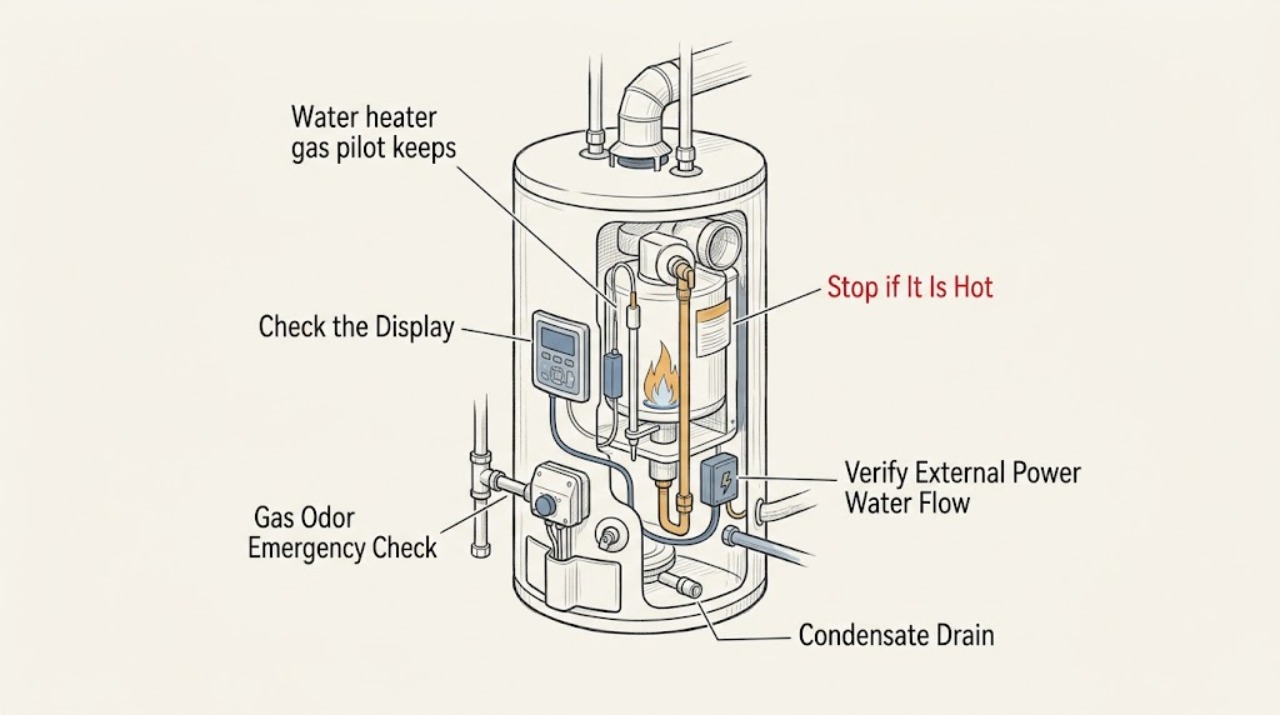
First confirm what kind of Rinnai heater you have. Rinnai tankless gas water heaters use direct-spark electronic ignition rather than a standing pilot: the burner lights when a hot-water tap creates demand and goes out when the tap closes. If the burner lights and then drops out while a tap remains open, or the controller shows an ignition or flame-failure code, treat it as an ignition/flame-proving fault, not as a pilot-light adjustment. From outside the cabinet, record the model and code, check for gas odor, confirm that the heater has power and water flow, and look for blocked vent or combustion-air terminations. Rinnai diagnostic guidance associates ignition failure with gas supply, spark, flame-rod, gas-valve, venting, combustion-air, and condensate conditions, but its internal tests are for trained professionals. Do not remove the front panel, adjust the internal gas valve, probe live ignition wiring, or repeatedly attempt ignition.
Before you begin
Safety first
- This article supports model identification, code recording, gas-odor emergency response, ordinary-access flow and power observations, and safe exterior inspection only. A trained professional handles internal ignition, flame rod, gas pressure, gas valve, burner, venting, condensate, electrical, and live diagnostic work.
Work through in order
Diagnostic checks
Use only checks that match the exact appliance or system and its official guide.
-
Check 1
Read the model label and controller display without opening the cabinet, then open one normal hot-water tap only if there is no gas odor, smoke, water intrusion, or other hazard; do not call the burner a standing pilot until the model is identified.
Expected result: Record whether the unit is a Rinnai tankless model with electronic ignition, whether the burner starts and then stops while the tap remains open, whether the flame goes out only when the tap closes, and any displayed diagnostic code or flashing indicator.
Next step: Stop the demand after recording the pattern and use the model manual or qualified service path for the displayed code; do not repeatedly cycle the tap to force ignition.
Stop if: Stop immediately for gas odor, smoke, abnormal combustion, a wet or submerged heater, a cracked vent, a shock, or any need to remove the front panel.
Why this matters
Why: A burner that goes out when demand ends is normal for a tankless Rinnai. Failure during continuing flow is an ignition, flame-proving, flow, gas, vent, or control symptom; the code and model determine which service path applies.
-
Check 2
Before any further ignition attempt, smell from a safe position around the heater and near the floor, without touching switches or using a phone in the building.
Expected result: Classify the result as no gas odor, a suspected or definite gas odor, or an odor that cannot be safely evaluated; note whether anyone feels unwell or a detector alarms.
Next step: If gas is suspected, leave the building and contact the gas supplier or fire department from a neighbor's location; do not return to reset or relight the heater until cleared.
Stop if: Do not operate switches, create a spark, relight, adjust a gas valve, or continue diagnosis when gas odor is present.
Why this matters
Why: A gas odor is an emergency, not a troubleshooting branch. Rinnai instructs users not to try to light an appliance, touch electrical switches, or use a phone in the building when gas is smelled.
-
Check 3
From normal user access, verify that the heater's display or controller has power, that the known water isolation valves are open, and that one hot tap has a steady flow; do not remove covers or measure gas or electrical values.
Expected result: Record a blank display, tripped breaker, loss of water flow, weak or intermittent hot-side flow, a unit that ignites only at one fixture, or normal flow with repeated ignition failure.
Next step: Restore only a clearly identified tripped breaker or fully closed water valve when safe and permitted by the model instructions; arrange service for a repeated trip, weak flow, or recurring ignition failure.
Stop if: Do not open electrical compartments, bypass a breaker, adjust gas pressure, or operate a heater that has been underwater or has wet wiring.
Why this matters
Why: No power prevents electronic ignition. Insufficient or unstable water flow can prevent a tankless unit from recognizing demand or can stop it after ignition. Normal flow with repeated failure points away from a simple demand issue and toward gas, spark, flame sensing, venting, or control service.
-
Check 4
From ground level or another safe position, inspect the exterior vent terminal and combustion-air opening for snow, ice, leaves, nests, debris, loose visible joints, or an obstruction; do not climb, disassemble the vent, or place hands near hot exhaust.
Expected result: Record whether the termination is visibly clear, partially blocked, damaged or loose, exposed to recirculating exhaust, or impossible to inspect safely; note whether the problem began after weather, landscaping, or vent work.
Next step: Remove only loose exterior debris that can be reached without tools, heat, or unsafe access; keep the heater off and call a qualified gas-appliance technician for any blockage, damage, clearance concern, or recurrence.
Stop if: Do not enter the vent, move a terminal, change vent length or fittings, block exhaust, or work near hot exhaust or elevated access.
Why this matters
Why: Rinnai identifies blocked or improperly arranged venting and combustion air as causes of incomplete combustion or ignition/flame-proving problems. A clear exterior does not prove the entire vent or burner path is correct.
-
Check 5
If the failure began during freezing weather, a power or gas interruption, or after vent or condensate work, inspect only visible external piping and drain terminations for ice, blockage, standing water, or a disconnected line; do not open the heater or drain trap.
Expected result: Record frozen or blocked exterior pipes, a blocked condensate termination, water around the cabinet, a wet vent connection, or no visible change; note whether freeze protection had power and gas available.
Next step: Keep the heater off when moisture, freezing damage, or a blocked drain is present and request qualified service; follow the exact owner manual for any approved freeze-protection or drain-down procedure.
Stop if: Do not apply an open flame or improvised heat, pour chemicals into a condensate line, remove the condensate trap, or use the heater if any part has been underwater.
Why this matters
Why: Rinnai warns that vent termination or condensate drain blockages can cause operational problems, and that plumbing and valves may freeze even when built-in heater protection is present. Moisture inside the combustion or electrical area is a service condition, not a pilot adjustment.
-
Check 6
Compile the model, gas type shown on the rating plate, controller code, ignition timing, hot-water flow pattern, power status, vent and condensate observations, and any recent installation or weather event for the technician; do not perform internal spark or flame-rod tests.
Expected result: Record whether there is never a spark or flame, a visible flame that drops out, repeated code 11 or 12-type ignition/flame symptoms if shown, a gas-related code, vent or air code, or no code at all.
Next step: Leave the unit off for a repeated failure and provide the complete record to a trained Rinnai service professional; use only model-specific manuals for any owner-level reset explicitly allowed.
Stop if: Do not adjust the internal gas valve, remove the panel, disconnect flame-rod or igniter wires, test live voltage, or keep resetting a recurring code.
Why this matters
Why: Rinnai's technical diagnostic paths distinguish no spark, flame rectification, low or incorrect gas supply, venting and air restrictions, moisture, and control faults. These observations narrow service but do not authorize live testing or part replacement.
Use your observations
Decision map
Find the observation that best matches what you see, then follow the next safe action.
-
PATH 01Safety boundary
What you see
The Rinnai tankless burner lights while a hot tap is open and goes out only after the tap is closed, with no error or unsafe symptom.
Do this next
No pilot repair is indicated; monitor hot-water delivery and consult the model manual only if the burner drops out while water is still flowing.
Why this path and its safety boundary
Why it matters: This is normal electronic-ignition operation, not a standing pilot that is failing.
Safety stop: Do not try to keep a tankless burner lit between hot-water demands or add a pilot assembly that the model does not use.
-
PATH 02Safety boundary
What you see
A hot tap is open but the burner never lights, the controller reports an ignition or no-flame condition, or no spark is observed by a qualified technician.
Do this next
Keep the unit off after the safe external checks and arrange trained Rinnai service with the model and diagnostic code.
Why this path and its safety boundary
Why it matters: Gas supply, electronic igniter, wiring, flame rod, gas valve, power, or control causes are possible; an owner cannot distinguish them by relighting.
Safety stop: Do not remove the front panel, perform live spark tests, adjust the gas valve, or substitute ignition parts.
-
PATH 03Safety boundary
What you see
The burner visibly ignites during continuing hot-water demand but then goes out, often with a flame or flame-proving code.
Do this next
Stop repeated ignition attempts and have a qualified technician inspect the flame-proving and gas/combustion systems using the model diagnostic procedure.
Why this path and its safety boundary
Why it matters: Flame rectification, flame-rod contamination or connection, low or unstable gas pressure, combustion-air or venting, moisture, or control faults become more likely than a missing pilot.
Safety stop: Do not clean or move the flame rod, open the burner box, measure gas pressure, or reset the code repeatedly as an owner test.
-
PATH 04Safety boundary
What you see
The heater starts with a strong hot-water demand but stops when the flow is reduced, a single low-flow fixture is used, or excessive cold water is mixed at the tap.
Do this next
Compare one fully open hot tap with the affected fixture, clean an accessible fixture aerator if appropriate, and request service for inlet-filter, plumbing, or unit-flow diagnosis if the behavior persists.
Why this path and its safety boundary
Why it matters: The unit may be falling below its required demand flow rather than losing a standing pilot; a clogged fixture aerator, inlet filter, or flow restriction can contribute.
Safety stop: Do not bypass flow sensors, remove internal filters without the model procedure, or change gas settings to compensate for low water flow.
-
PATH 05Safety boundary
What you see
Ignition failure begins after snow, ice, wind, vent changes, landscaping, or condensate work, and a vent or drain termination is blocked, damaged, or wet.
Do this next
Keep the heater off, clear only loose accessible exterior debris, and have a qualified installer or gas technician inspect the complete vent and condensate arrangement.
Why this path and its safety boundary
Why it matters: Combustion-air, exhaust recirculation, venting, or condensate obstruction is more likely than a simple igniter fault.
Safety stop: Do not alter vent materials or clearances, apply flame or heat, open the trap, or operate with blocked exhaust or moisture in the cabinet.
-
PATH 06Safety boundary
What you see
Gas odor, smoke, abnormal combustion, water intrusion, damaged venting, repeated breaker trips, or an unknown standing-pilot appliance is present.
Do this next
Leave the area as appropriate, avoid switches and ignition sources, shut the appliance down only if the emergency guidance permits, and contact the gas supplier, fire department, or qualified service provider from a safe location.
Why this path and its safety boundary
Why it matters: The situation is outside safe owner troubleshooting and may involve fire, explosion, carbon-monoxide, electrical, or scald hazards.
Safety stop: Do not relight, reset, enter the cabinet, operate a submerged heater, or return until the hazard is assessed and cleared.
Helpful context
Understand the symptom
A Rinnai tankless unit normally has no standing pilot
The phrase “pilot keeps going out” often describes a Rinnai tankless burner that fails to ignite or loses flame during a hot-water call. Rinnai's FAQ and operation manual state that tankless models use direct-spark electronic ignition, light automatically when a hot tap opens, and turn the burner off when the tap closes. If the tap is closed, the flame going out is normal. If the unit cannot keep a flame while water is flowing, identify the model and controller code before making any repair assumption.
Use the symptom and code to separate safe observations
A no-ignition symptom can mean no spark, no gas reaching the burner, incorrect gas type or supply, a flame that is not being proved by the flame rod, restricted venting or combustion air, or moisture or condensate in the wrong place. Rinnai's diagnostic document covers these as service paths and warns that fire or explosion can result if its instructions are not followed. An owner can record what the controller displays and inspect accessible exterior terminations, but live voltage, gas pressure, flame-rod cleaning, burner access, and gas-valve work belong to a trained technician.
Flow, power, and venting can change ignition behavior
Rinnai says the tankless unit needs sufficient hot-side flow to ignite and stay operating; low fixture flow, a dirty inlet filter, or excessive mixing with cold water can make the unit stop. Power loss also prevents operation, while blocked vent or air terminations and condensate problems can affect combustion. Check only what is visible and model-appropriate from outside. If a single hot tap cannot sustain operation, an error repeats, or the unit has been exposed to water or freezing, stop and arrange qualified service rather than changing gas settings.
Safety boundary
Stop conditions
- If you smell gas, do not try to light the appliance, touch electrical switches, or use a phone in the building; leave and contact the gas supplier or fire department from a safe location.
- Do not remove the front panel, adjust the internal gas valve, perform live ignition or voltage tests, or disconnect flame-rod or igniter wiring.
- Do not use the heater if it or its controls have been underwater, if wiring is wet, or if the vent or combustion-air termination is blocked or damaged.
- Do not apply open flame or improvised heat to frozen pipes or condensate, inject chemicals into drains, or alter vent materials, lengths, or clearances.
- Stop repeated resets or ignition attempts when a code recurs, the flame drops out during demand, hot water is lost, or abnormal combustion, smoke, electrical symptoms, or water intrusion appears.
Only after diagnosis
Potential parts
- Rinnai igniter or spark electrode
Consider this category only after a qualified technician confirms that the model's electronic ignition does not produce or correctly deliver spark and the exact model procedure identifies the assembly as failed.
Confirm the exact Rinnai model, electrode, gasket, connector, and ignition specification; do not perform live spark testing or substitute a generic pilot part. - Rinnai flame rod and gasket
Consider this category only when a trained technician confirms a flame-proving fault, damaged or contaminated flame rod, or a failed seal under the model diagnostic procedure.
Confirm the exact model, flame-rod position, wire, gasket, and service method; flame-rod removal and internal gas-appliance work are not owner checks. - Rinnai gas valve or control board
Consider this category only after qualified diagnosis rules out gas supply, flow, venting, ignition, flame sensing, and condensate causes and confirms the model-specific control or valve fault.
Confirm exact model, gas type, board or valve revision, certified part information, and professional installation; never adjust the internal gas valve or replace it from a code alone.
When checks do not resolve it
Need a professional?
Arrange trained Rinnai or qualified gas-appliance service when a tankless burner fails during continuing hot-water demand, an ignition or flame code recurs, the display is blank after a known power check, hot-side flow is inadequate or unstable, a flame starts and drops out, venting or condensate is blocked or damaged, the heater has been wet or frozen, or any gas, combustion, electrical, or scald hazard is present. Rinnai tankless units do not use a standing pilot, so do not order or adjust a pilot assembly without confirming a different appliance type and its exact manual.
Safety scope: This article supports model identification, code recording, gas-odor emergency response, ordinary-access flow and power observations, and safe exterior inspection only. A trained professional handles internal ignition, flame rod, gas pressure, gas valve, burner, venting, condensate, electrical, and live diagnostic work.
Common questions
FAQ
Does a Rinnai tankless water heater have a standing pilot?
Rinnai says its tankless gas water heaters do not have a standing pilot; they use direct-spark electronic ignition. The burner should light when a hot tap creates demand and go out when the tap closes.
Why does my Rinnai burner light and then go out?
If water is still flowing, possible service paths include flame-rod proving, gas supply, spark, venting, combustion air, condensate or moisture, water flow, or controls. Record the model and code, stop repeated ignition attempts, and arrange trained service.
What can I check when Rinnai will not ignite?
Without opening the cabinet, record the model and controller code, check for gas odor using the emergency rule, verify a known power source and hot-water flow, and inspect exterior vent and air terminations from a safe position. Do not perform internal spark, flame-rod, gas-pressure, or gas-valve tests.
Can low water flow make a Rinnai tankless heater shut off?
Yes. Rinnai says tankless gas units need sufficient hot-side flow to ignite and stay operating. A low-flow fixture, dirty inlet filter, or excessive cold-water mixing can contribute; compare one fully open hot tap and request service if the behavior persists.
Can a blocked vent cause Rinnai ignition failure?
It can. Rinnai's diagnostic guidance identifies vent, combustion-air, and exhaust recirculation problems as possible ignition or flame-proving causes. Inspect only the accessible exterior termination and have a qualified technician assess the complete vent system.
What should I do if I smell gas near the Rinnai heater?
Do not try to light the appliance, touch electrical switches, or use a phone in the building. Leave and contact the gas supplier or fire department from a safe location, following their instructions. Do not return to reset or relight the heater until cleared.
Read the exact guide
Official sources
- Freeze Protect Your Rinnai ProductRinnai · Official Rinnai residential freeze-protection guidance; model-specific manuals control drain-down and isolation procedures.
- U245-3250x01_00.indd — V Series Indoor Installation and Operation ManualRinnai · Official Rinnai V-Series indoor manual; it supports the electronic-ignition distinction and safety boundary, while exact model instructions control other units.
- Troubleshooting Tankless Water Heater Diagnostic CodesRinnai · Official Rinnai technical document covering listed tankless model series; internal tests are for trained and qualified professionals and do not establish fitment for an unspecified model.
- Frequently Asked QuestionsRinnai · Official Rinnai residential FAQ content; model-specific manuals and qualified installers control exact flow, controls, and service procedures.
Community feedback
Share a repair observation
Share a plain-text repair observation. Accepted observations are published automatically; this page may take a moment to update.