
On this page
Start here
Quick answer
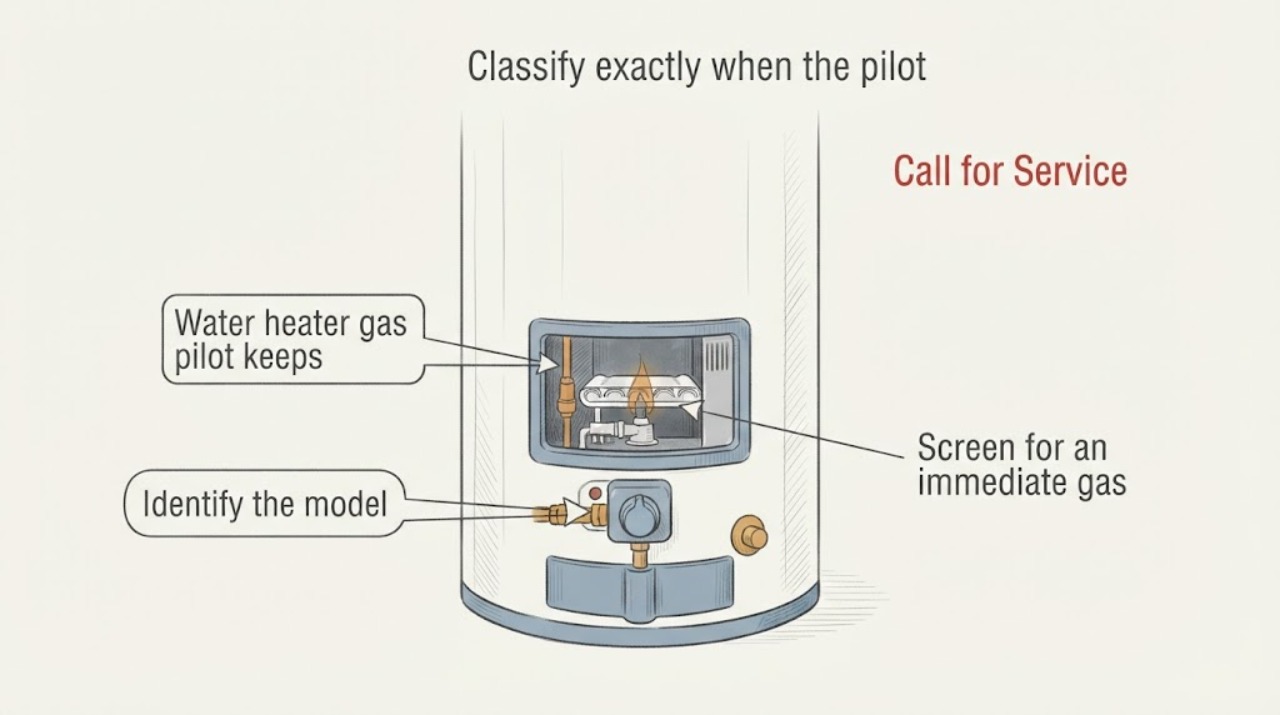
A Rheem gas water heater pilot that will not stay lit is a combustion and safety-control symptom, not a reason to keep relighting it. First check from ordinary safe access for a gas odor, hissing, smoke, soot, water damage, or a flame that behaves abnormally; leave the area and use the gas supplier or emergency procedure for a gas hazard. If there is no immediate hazard, identify the exact model and whether the pilot goes out when the control is released, when the main burner starts, or during drafts or fan operation. Rheem identifies the pilot assembly, thermocouple or thermopile, gas supply, combustion air, venting, and gas control as possible diagnostic areas. Follow only the lighting label and model manual; do not open the sealed combustion area, adjust gas pressure, clean an orifice, replace the sensor, or bypass a safety device. A pilot that repeatedly goes out needs qualified plumbing or gas-appliance service.
Before you begin
Safety first
- This article supports external identification and ordinary-access observation only. Gas, combustion, venting, pilot, flame-sensing, control, and safety-device work belongs to a qualified professional.
Work through in order
Diagnostic checks
Use only checks that match the exact appliance or system and its official guide.
-
Screen for an immediate gas or combustion hazard
From outside the appliance enclosure, look and smell only from a safe position for a gas odor, hissing, smoke, soot, scorching, water around the control area, a damaged vent, or a flame that is not contained as the model's viewing window shows. Do not operate switches or create a spark if gas may be present.
Expected result: There is no unusual odor, smoke, soot, water damage, abnormal flame, or visible vent damage; or any one of those hazards is present.
Next step: If any hazard is present, leave the area when appropriate, follow the gas supplier or emergency guidance from a safe location, and do not relight or continue testing. If clear, continue only with ordinary-access observations.
Stop if: Stop immediately for a gas odor, hissing, smoke, soot, scorching, uncontrolled flame, water on gas controls, or suspected carbon-monoxide symptoms; do not use an ignition source or electrical switch near suspected gas.
Why this matters
Why: A clean external check permits only limited identification and manual review. A gas, fire, combustion, water, or vent hazard is not a relighting problem and may make the appliance unsafe to operate.
-
Identify the Rheem model and ignition type
Read or photograph the rating plate and the operating label from a dry, safe position without removing covers. Record the model, fuel type, whether the unit has a standing pilot with a visible pilot control or an electronic ignition, and the exact wording of any status indicator or code.
Expected result: The unit is confirmed as a standing-pilot model with a model-specific lighting label, or it is an electronic-ignition or unfamiliar design with no safe user relight instruction.
Next step: Use the exact Rheem manual or label only to understand the normal sequence; if the sequence is unclear, stop and arrange qualified service. Do not keep cycling the control or attempt a generic relight procedure.
Stop if: Do not remove the burner cover, open a sealed combustion chamber, or operate a control when the model or lighting sequence is unknown.
Why this matters
Why: Rheem uses different ignition and gas-control arrangements across product families. A standing-pilot procedure must not be assumed for an electronic-ignition unit, and an unfamiliar design needs model-specific help before any operation.
-
Classify exactly when the pilot goes out
Using only the model's normal observation window and only if there is no gas odor or other hazard, note whether the pilot dies when the control is released, immediately when the main burner tries to light, after the heater has run, or when a nearby exhaust fan, ceiling fan, door, or wind condition changes.
Expected result: The outage follows control release, main-burner ignition, a draft or fan event, a long run, or no repeatable event.
Next step: Record the timing and surrounding conditions, then stop repeated relighting and provide the record to a qualified technician or gas supplier. Do not change draft conditions, gas pressure, or pilot position as a test.
Stop if: Stop observing if the flame lifts, rolls out, produces soot, changes color abnormally, or gas odor appears.
Why this matters
Why: Control-release outages make flame sensing, pilot flame contact, or the holding sequence more likely. A main-burner or draft-related outage makes pilot position, combustion air, venting, or gas-supply behavior more likely. A random outage still warrants service because the safety system is losing flame confirmation.
-
Check only the accessible combustion-air surroundings
From outside the heater, look for stored items, lint, dust, plastic, or other material obstructing the manufacturer's labeled air-intake or clearance area, and note whether a powerful exhaust fan, room fan, closed room, or noticeable draft coincides with the outage. Move only loose items that are clearly outside the appliance and can be removed without touching the heater, vent, burner, or gas controls.
Expected result: The labeled clearance and intake area are open with no unusual draft, or an obstruction, closed-room condition, or draft event is present.
Next step: Keep the area clear and stop using the heater if the outage continues. Arrange qualified service for any suspected venting, combustion-air, negative-pressure, or room-ventilation problem; do not modify vents or add openings yourself.
Stop if: Do not remove vent sections, alter intake screens, seal or enlarge openings, test draft with flame, or enter a confined or poorly ventilated space.
Why this matters
Why: Rheem's pilot-outage guidance considers combustion air and drafts as possible contributors, especially when the symptom follows a fan or venting event. Clearing loose storage does not prove the vent or combustion system is sound.
-
Observe the pilot flame only through the approved view
If the exact Rheem model provides a normal viewing window and the area is free of gas odor, observe without opening or touching the combustion chamber whether the pilot appears stable and remains directed at the model's flame-sensing area. Do not poke the pilot, clean an orifice, reposition the assembly, or use a flame to test airflow.
Expected result: The pilot is stable and consistently sensed, weak or wavering, lifts away from the sensor area, is not visible, or goes out as the main burner starts.
Next step: Stop using the heater if the pilot cannot remain stable or the main burner triggers the outage, and provide the observation to a qualified gas-appliance technician. Follow no cleaning or adjustment procedure unless the exact Rheem manual assigns it to a qualified person.
Stop if: Do not open a sealed combustion chamber, reach near the flame, adjust the pilot, remove a thermocouple or thermopile, or bypass the flame-sensing safety circuit.
Why this matters
Why: A weak or misplaced-looking flame, loss of flame contact, or an outage at burner ignition can involve the pilot assembly, thermocouple or thermopile, draft, gas supply, or control. A stable-looking pilot does not rule out a sensor or gas-control fault.
-
Stop repeated relighting and document the failure
After one safe observation of the model's normal sequence, record whether the pilot stays lit, how long it remains lit, whether hot water returns, and whether the outage repeats without changing any gas, vent, or safety component.
Expected result: The pilot remains lit normally, goes out again, the main burner never operates, or the unit enters a lockout or displays a fault indication.
Next step: Leave the heater out of service when the pilot will not stay lit, contact qualified plumbing or gas-appliance service, and provide the model, outage timing, flame observation, draft conditions, and any indicator information.
Stop if: Do not repeatedly relight, hold a control down longer than the model label instructs, or continue operation after a repeated outage or lockout.
Why this matters
Why: A single successful relight does not establish a repair. A repeated outage, failed burner start, or lockout indicates an unresolved flame-sensing, gas, combustion, venting, or control issue and should not be chased with repeated ignition attempts.
Use your observations
Decision map
Find the observation that best matches what you see, then follow the next safe action.
-
PATH 01Next step
What you see
The pilot lights but goes out as soon as the model's normal control sequence is released.
Do this next
Stop repeated relighting and request qualified service; provide the exact model, the control sequence, and whether the pilot flame looked stable through the approved window.
Why this path and its safety boundary
Why it matters: Flame confirmation, pilot-flame contact, the thermocouple or thermopile, or the gas control's holding circuit is more likely than a simple room draft.
-
PATH 02Next step
What you see
The pilot remains lit until the main burner attempts to ignite, then goes out or the heater locks out.
Do this next
Keep the heater out of service and arrange a qualified gas-appliance inspection of the pilot assembly, combustion path, venting, supply, and control sequence.
Why this path and its safety boundary
Why it matters: Pilot position or flame sensing, combustion-air or draft behavior, gas supply, and gas-control response need professional assessment; do not assume the pilot only needs cleaning.
-
PATH 03Next step
What you see
The outage coincides with a vent fan, ceiling fan, open or closed door, wind, or another change in room airflow.
Do this next
Do not alter the room or vent system as a permanent fix. Stop using the heater if the pilot cannot remain lit and have a qualified professional evaluate combustion air and venting.
Why this path and its safety boundary
Why it matters: A draft, negative-pressure, combustion-air, or venting condition is more likely, especially if the heater previously operated normally.
-
PATH 04Next step
What you see
The visible pilot is weak, unstable, lifted away from its sensing area, sooty, or not visible through the normal viewing window.
Do this next
Stop operation and arrange qualified gas-appliance service. Do not poke, drill, brush, reposition, or replace pilot parts without model-specific professional diagnosis.
Why this path and its safety boundary
Why it matters: A pilot assembly or orifice restriction, gas-supply issue, flame-sensing problem, or combustion condition is possible; an ordinary visual check cannot identify which part is safe to replace.
-
PATH 05Next step
What you see
There is a gas odor, hissing, smoke, soot, scorching, water on gas controls, damaged venting, uncontrolled flame, or evidence of fire, flood, or physical damage.
Do this next
Leave the area when appropriate, follow the gas supplier or emergency procedure from a safe location, and do not operate the heater until the appropriate qualified professional has inspected it.
Why this path and its safety boundary
Why it matters: This is an immediate stop-use condition, not a pilot adjustment. Continuing to ignite the heater can increase fire, explosion, combustion, or electrical risk.
-
PATH 06Next step
What you see
The unit is electronic ignition, has no ordinary standing-pilot control, or the label and model instructions cannot be identified.
Do this next
Do not attempt a manual relight or open the burner compartment. Give the rating-plate information to Rheem or a qualified technician for the correct model-specific procedure.
Why this path and its safety boundary
Why it matters: A generic standing-pilot procedure may be wrong for the unit and could defeat its intended ignition or diagnostic sequence.
Helpful context
Understand the symptom
The timing of the outage is the most useful clue
A pilot that dies as soon as the control is released is different from one that dies only when the main burner lights or only when a fan, wind, or exhaust appliance is operating. The first pattern can implicate flame sensing or the pilot flame; the second can implicate pilot position, combustion air, drafts, or a control response. A pilot that goes out at random still needs service because the safety control is doing its job by stopping gas flow when it cannot confirm a flame.
Keep the combustion path and safety parts intact
Rheem describes the pilot assembly as including the pilot, ignitor, and thermocouple, and describes the thermocouple as a sensor that detects the pilot flame. Do not drill a pilot opening, reposition the pilot, remove a screen, bypass a thermocouple or thermopile, or substitute a gas-control part based on appearance. These changes can create an unsafe combustion or gas-release condition and require model-specific service.
When a pilot outage is a stop-use event
Do not troubleshoot through a gas odor, soot, scorching, water intrusion, abnormal flame, damaged vent, or a control that does not shut gas off. Rheem's safety literature says to stop and get qualified help when operating instructions are not understood and to keep an appliance with fire, flood, physical damage, or a gas shutoff problem out of service until inspected.
Safety boundary
Stop conditions
- Stop immediately for a gas odor, hissing, smoke, soot, scorching, uncontrolled flame, suspected carbon-monoxide symptoms, water on gas controls, or damaged venting; leave the area when appropriate and use the gas supplier or emergency procedure from a safe location.
- Do not repeatedly relight a pilot that goes out, hold a control beyond the exact model label, or continue using a heater that enters a lockout or will not prove a stable flame.
- Do not open a sealed combustion chamber, remove covers, test gas pressure, adjust a regulator, clean an orifice, reposition a pilot, or bypass a thermocouple, thermopile, thermal-release, or other safety device.
- Do not modify combustion-air openings or venting, test draft with a flame, or use a fan or open door as a permanent workaround.
- Keep the appliance out of service after fire, flood, overheating, physical damage, or a gas supply that does not shut off until a qualified technician inspects it.
Only after diagnosis
Potential parts
- pilot flame sensor or thermocouple
Consider this category only when qualified diagnosis finds that the pilot flame is present but the flame-sensing device fails to hold the gas control or is damaged.
Confirm the exact Rheem model, fuel type, sensor design, connection, and manufacturer fit information; do not replace or bypass the sensor as a generic test. - Rheem pilot assembly
Consider this category only when the pilot orifice, ignitor, pilot position, or flame path is confirmed by a qualified technician to be damaged, obstructed, or model-specific.
Confirm exact model and assembly configuration with Rheem or the technician; never enlarge an orifice or substitute a visually similar assembly. - gas control valve
Consider this category only after service diagnosis confirms that the gas control is not maintaining the pilot or is not responding correctly after the pilot and supply checks.
Confirm exact model, fuel type, control family, and approved replacement procedure; gas-control replacement is professional work. - thermal-release or combustion-safety device
Consider this category only if the model-specific safety device is confirmed to have opened or failed after a qualified inspection of the surrounding cause.
Confirm the exact model and safety-device requirements; never bypass, reset, or substitute a safety device to restore operation.
When checks do not resolve it
Need a professional?
Arrange qualified plumbing or gas-appliance service when the Rheem pilot goes out more than once, goes out when the control is released or the main burner starts, shows a weak or abnormal flame, coincides with a draft or fan event, or the ignition type is unclear. Use emergency or gas-supplier assistance from a safe location for a gas odor, hissing, smoke, fire, uncontrolled flame, or suspected carbon-monoxide exposure. Do not replace a thermocouple, pilot assembly, gas valve, or vent component based only on the symptom.
Safety scope: This article supports external identification and ordinary-access observation only. Gas, combustion, venting, pilot, flame-sensing, control, and safety-device work belongs to a qualified professional.
Common questions
FAQ
Why does my Rheem gas water-heater pilot keep going out?
The outage can involve flame sensing, the pilot assembly, combustion air, a draft or venting condition, gas supply, or the gas control. The timing matters: control release, main-burner ignition, and fan or wind events point to different diagnostic areas, but repeated outages should be handled by qualified service.
Can I keep relighting the Rheem pilot until it stays lit?
No. Follow the exact model label only to understand the normal sequence, and stop when the pilot goes out again. Repeated relighting can mask a flame-sensing, combustion, gas, or safety-control problem. Rheem identifies a pilot that will not stay lit as a reason to call a plumber.
Is a weak or yellow pilot flame safe to clean myself?
Do not poke, drill, brush, reposition, or disassemble the pilot orifice or combustion chamber as a user test. A weak, unstable, lifted, sooty, or missing flame can have several causes and needs qualified gas-appliance diagnosis.
What should I do if I smell gas near the water heater?
Stop troubleshooting, avoid switches or ignition sources, leave the area when appropriate, and follow the gas supplier or emergency procedure from a safe location. Do not relight the pilot or return the heater to service until the hazard has been addressed by the appropriate qualified professional.
Does every Rheem water heater have a pilot that I can relight?
No. Rheem product families use different ignition and control arrangements. Confirm the model and the exact operating label before doing anything; if the ignition type or instructions are unclear, do not attempt a generic standing-pilot procedure.
Read the exact guide
Official sources
- 7 Signs You Need to Call a PlumberRheem Manufacturing Company · Rheem homeowner service guidance used to support escalation for a pilot that will not stay lit; it does not replace model-specific safety instructions.
- urgent helpRheem Manufacturing Company · Rheem urgent-help page used only for the boundary of moving to a safe location and obtaining professional help when gas or appliance hazards are suspected.
- OPERATION SAFETY PRECAUTIONSRheem Manufacturing Company · Rheem water-heater safety manual used for general stop-use boundaries; the installed unit's label and manual control the exact model.
- Water Heating Plumbing Terminology 101Rheem Manufacturing Company · Rheem homeowner terminology guide used to explain pilot, ignitor, thermocouple, combustion chamber, and gas-control concepts; it is not a model-specific repair procedure.
- Pilot Outage TroubleshootingRheem Manufacturing Company · Rheem technical bulletin used for decision clues involving combustion air, drafts, venting, pilot behavior, flame sensing, and gas supply; exact model instructions and qualified service control the repair.
Community feedback
Share a repair observation
Share a plain-text repair observation. Accepted observations are published automatically; this page may take a moment to update.