
On this page
Start here
Quick answer
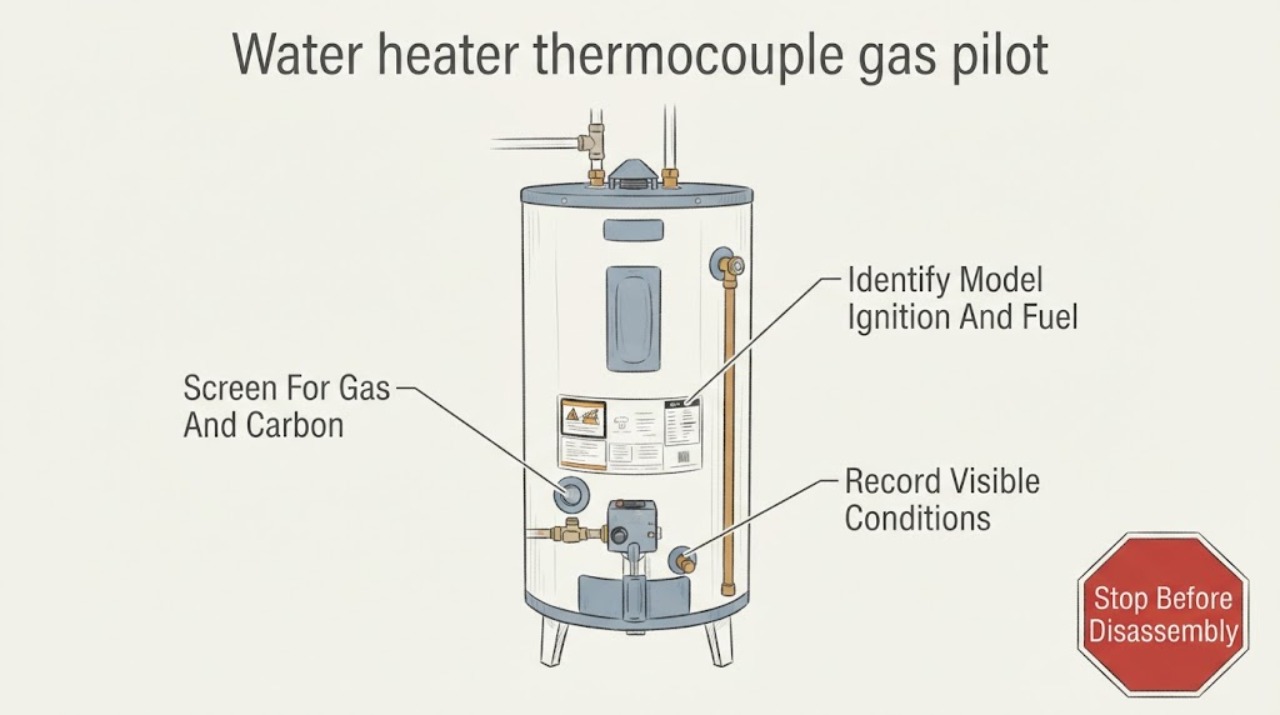
A gas pilot that goes out after the control is released is not proof that the thermocouple alone is bad. The thermocouple or thermopile must sense pilot heat so the gas control can keep the safety valve open, but a weak or misdirected flame, blocked air intake or vent, draft, gas-supply problem, loose connection, control-valve fault, or a model-specific safety condition can produce the same symptom. First treat gas odor, carbon-monoxide alarms, scorching, water intrusion, or abnormal venting as a stop condition. If there is no danger signal, use the heater label and exact manual to identify the model, record the status-light pattern, and make only external observations. Do not remove the inner door, adjust gas pressure, clean an orifice, replace a thermocouple, or test live gas controls as a homeowner shortcut; recurring pilot loss needs a qualified water-heater technician.
Work through in order
Diagnostic checks
Use only checks that match the exact appliance or system and its official guide.
-
Check 1
Before touching the control, check from a safe position for a gas odor, hissing, a carbon-monoxide alarm, smoke or soot, flame outside the normal viewing area, water around the heater, or a damaged vent or viewport. Do not open the combustion chamber to inspect it.
Expected result: Any gas odor, alarm, hissing, abnormal flame, soot/scorching, water intrusion, damaged viewport, or suspected blocked vent is present; or none of these signs is present.
Next step: If any danger sign is present, leave the area and contact the gas supplier, fire department, emergency service, or a qualified technician from a safe location. If no danger sign is present, continue without opening the inner door or disturbing gas connections.
Stop if: Stop immediately for gas odor, a carbon-monoxide alarm, visible flame outside the chamber, scorched/discolored combustion parts, water submersion, or an unsafe vent condition.
Why this matters
Why: A danger sign makes relighting or diagnosis unsafe and can indicate a gas leak, combustion problem, flammable-vapor event, flood damage, or carbon-monoxide risk. The absence of a danger sign permits only the low-risk identification checks below; it does not prove the appliance is safe to repair.
-
Check 2
Read the rating label and lighting instructions from outside the heater, and record the complete model and serial numbers, fuel type shown on the label, ignition style, and whether the control uses a thermocouple or thermopile. Do not assume that an AO Smith procedure for one heater applies to another.
Expected result: The model, fuel type, control style, and lighting label are clear; or the label is missing, unreadable, inconsistent, or the heater's design is uncertain.
Next step: If the identity is clear and there is no safety sign, use only that model's manual for any permitted user operation. If it is unclear, keep the gas control off and request manufacturer support or qualified service.
Stop if: Stop if the label is damaged, the stated fuel does not match the supply, the viewport is broken, or the unit's ignition style cannot be identified.
Why this matters
Why: The label and model determine whether the unit has a manually lit pilot, electronic ignition, a thermocouple, a thermopile, or model-specific status codes. An uncertain identity makes a generic relighting or part recommendation unsafe.
-
Check 3
Without removing the inner combustion door or touching the burner, observe the status light and the pilot only through the heater's intended sight glass or indicator, if present. Record whether the pilot lights but goes out immediately when the control is released, stays lit briefly and then drops out, or goes out during burner operation; record the status-light pattern without guessing its meaning.
Expected result: The pilot is not visible, the status light does not reach the model's normal indication, a model-specific fault pattern repeats, or the pilot drops out at a consistent point.
Next step: Write down the exact timing and status-light pattern for the technician and consult only the matching manual. Do not repeatedly relight, bypass a safety, or test sensor output or gas pressure yourself.
Stop if: Stop after a failed or abnormal attempt, any repeated fault pattern, or any need to open the combustion door, access wiring, or expose the burner.
Why this matters
Why: A pilot that drops out when the control is released is consistent with insufficient sensor heat, a weak or misdirected pilot, a thermocouple/thermopile or connection fault, or a gas-control issue. A pilot that goes out during operation makes draft, combustion air, venting, flame-arrestor, gas supply, or safety-limit causes more important. The observation cannot distinguish these parts by itself.
-
Check 4
From outside the appliance, look for boxes, lint, dust, storage, or other material blocking the heater's air-intake area or the visible vent termination. Note whether a furnace, air handler, exhaust fan, or newly closed door changes when the pilot goes out. Do not move the heater, alter venting, remove a screen, or test draft with a flame.
Expected result: The intake or vent termination is obstructed, storage has been placed around the heater, the pilot loss coincides with another air-moving appliance, or no external airflow issue is visible.
Next step: If an obstruction can be removed without touching the heater, clear the surrounding area only. Do not modify the vent or relocate the heater; a persistent issue or any concern about combustion air or draft requires a qualified technician.
Stop if: Stop if the vent is damaged or disconnected, combustion parts are discolored, an appliance exhaust changes the flame, or inspection would require climbing, dismantling, or entering a confined space.
Why this matters
Why: AO Smith troubleshooting materials identify blocked air intake, insufficient combustion air, draft, and interactions with return-air equipment as possible pilot-extinguishing conditions. A clear exterior does not rule out a venting or combustion fault inside the system.
-
Check 5
Verify only from the normal control position that the gas-control knob is not accidentally set to OFF and that the manual gas shutoff has not been changed, using the model label and safe access. Do not force a knob, adjust a regulator, loosen a gas fitting, or infer pressure from flame appearance.
Expected result: The control is OFF, the manual shutoff is closed, the knob will not move by hand, the appliance fuel does not match the label, or the control and supply appear correctly positioned.
Next step: If the control was accidentally set incorrectly and there is no gas odor or other hazard, follow the heater label's user instructions once. If the knob is stiff, fuel is mismatched, or the pilot still fails, leave the control OFF and call a qualified technician or gas supplier.
Stop if: Stop for a stiff knob, gas odor, hissing, a suspected supply defect, any need to remove a fitting, or any need to measure or change gas pressure.
Why this matters
Why: An OFF control or closed supply can explain an extinguished pilot, but a stiff control or mismatched fuel is a safety/service condition. Correct position does not rule out unstable gas pressure, a blocked pilot path, a sensor problem, or a failed control valve.
-
Check 6
Prepare a service note with the model and serial numbers, fuel type, ignition style, exact status-light pattern, pilot timing, recent installation or maintenance, nearby airflow changes, and every safety observation. State that the pilot repeatedly goes out and that the suspected component is the thermocouple or thermopile, not a confirmed diagnosis.
Expected result: The symptom and identifying information are complete, or the heater cannot be safely observed or identified.
Next step: Arrange qualified water-heater service for recurring pilot loss. Keep the gas control OFF until the technician confirms the appliance is safe, especially if the pilot will not stay lit after the model's normal label procedure.
Stop if: Stop all DIY work if the next step involves removing the inner door, burner or pilot assembly, thermocouple, wiring, gas valve, vent, or flame-arrestor parts.
Why this matters
Why: The same pilot symptom can arise from a sensor, weak flame, gas supply, combustion air, venting, wiring, gas control, thermal safety, or flammable-vapor event. A precise service note helps the technician choose a model-correct test without bypassing safety controls.
Use your observations
Decision map
Find the observation that best matches what you see, then follow the next safe action.
-
PATH 01Next step
What you see
Gas odor, a carbon-monoxide alarm, unusual flame, soot, scorching, water submersion, damaged viewport, or suspected flammable-vapor event is present.
Do this next
Do not light or switch anything in the building. Leave and contact the gas supplier or emergency services from a safe location; do not use the heater until a qualified technician clears it.
-
PATH 02Next step
What you see
The pilot is visible through the intended sight glass but goes out as the control is released, with no gas odor or visible combustion danger.
Do this next
Follow the exact model manual only for permitted user checks and record the status indication. If it repeats, leave the control off and have a qualified technician test the pilot assembly and gas control without bypassing the safety system.
-
PATH 03Next step
What you see
The pilot stays lit initially but goes out when the main burner operates or when another air-moving appliance starts.
Do this next
Keep the area around the appliance clear of storage and record the timing, but do not modify the vent, test draft with flame, or move the heater. Arrange professional combustion and venting inspection.
-
PATH 04Next step
What you see
The exact model manual links the observed status pattern to low thermopile output, a weak pilot, loose connections, or gas-control trouble.
Do this next
Record the pattern and request service for the pilot/thermopile and gas-control circuit. Do not open the control compartment, tighten gas fittings, or replace the thermocouple based on the code alone.
-
PATH 05Next step
What you see
The heater model, fuel type, ignition style, or lighting label cannot be confirmed, or the gas supply does not match the appliance label.
Do this next
Do not relight or alter the appliance. Contact the gas supplier or a qualified water-heater technician with photographs and identification information from a safe location.
Helpful context
Understand the symptom
Why a thermocouple is only one possibility
On traditional gas controls, pilot heat produces the signal that allows a safety valve to remain open. If the pilot flame is weak, misses the sensor, is blown by a draft, or cannot receive stable gas, the safety system can shut the pilot gas off even when the sensor itself is sound. A pilot that goes out only after the knob is released is therefore useful evidence, not a complete diagnosis.
Identify the ignition and control style first
A. O. Smith gas water heaters can use different ignition, gas-control, status-light, thermocouple, or thermopile arrangements. The lighting label on the heater and the model-specific manual take priority over a generic checklist. Record the complete model and serial information before interpreting a flash pattern or ordering a sensor.
Gas and carbon-monoxide boundary
If you smell gas, hear hissing, see flame outside the combustion area, see scorching or unusual soot, or a carbon-monoxide alarm sounds, do not light or relight the pilot. Leave the area, avoid switches, flames, and phones inside the building, and contact the gas supplier or emergency services from a safe location. A blocked vent or combustion-air problem also needs professional attention because combustion products can include carbon monoxide.
Safety boundary
Stop conditions
- If you smell gas or a carbon-monoxide alarm sounds, do not light the pilot, touch switches, or use a phone inside; leave and contact the gas supplier or emergency services from a safe location.
- Do not remove the inner combustion door, burner assembly, pilot assembly, thermocouple, thermopile, gas valve, or wiring as an ordinary homeowner check.
- Do not adjust gas pressure, loosen gas fittings, bypass a safety switch, jumper a control, or test energized gas-control wiring.
- Do not use a flame to test for draft or leaks, and do not continue relighting attempts after the model instructions say to stop or after a repeated failure.
- Do not use the heater after flooding, water submersion, flammable-vapor ignition, damaged viewport, scorching, abnormal soot, or a blocked/damaged vent until a qualified technician inspects it.
Only after diagnosis
Potential parts
- thermocouple or thermopile
Consider only when model-specific service confirms that the pilot flame is adequate and correctly positioned but the sensor signal is insufficient or the sensor is damaged.
AO Smith heaters use different pilot assemblies and controls; confirm the complete model, fuel, connection, and manufacturer's fit information before ordering. - pilot assembly
Consider only when service confirms a weak, misdirected, blocked, or damaged pilot assembly rather than a supply, venting, combustion-air, sensor, or gas-control issue.
Do not infer fit from the brand alone. Gas and ignition configuration must match the complete water-heater model. - gas control valve or thermostat
Consider only after qualified testing rules out the pilot flame, thermocouple/thermopile, wiring, air, vent, and gas-supply causes and identifies a control fault.
Gas-control replacement is a professional repair; confirm fuel type, model, certification, and service instructions. - burner or air-intake service component
Consider only when a qualified inspection finds a blocked, damaged, or discolored combustion-air or burner component that explains pilot loss.
Combustion components and venting are safety-critical; use model-specific professional diagnosis and fitment information.
When checks do not resolve it
Need a professional?
Call a qualified water-heater technician or gas supplier when the pilot goes out again after the exact model's permitted lighting procedure, when it will not remain lit after the control is released, when the status light shows a recurring fault, when airflow or venting is questionable, or when the suspected thermocouple, thermopile, pilot assembly, wiring, gas valve, or gas pressure requires testing. Treat gas odor, a carbon-monoxide alarm, water submersion, scorching, or a suspected flammable-vapor event as an immediate stop and emergency/service condition.
Have this ready
- Complete AO Smith model and serial numbers; fuel type; ignition style; exact status-light pattern; whether the pilot goes out on control release or during burner operation; recent installation or maintenance; nearby airflow changes; and any gas odor, alarm, soot, discoloration, water, or vent observation.
Common questions
FAQ
Does a pilot that goes out mean the AO Smith thermocouple is bad?
Not necessarily. The thermocouple or thermopile may be unable to provide the needed signal, but a weak or misdirected pilot, draft, blocked air intake, venting, gas-supply, wiring, or gas-control issue can create the same symptom. Have the complete model and timing of the outage ready for a qualified diagnosis.
Why does the pilot go out when I release the control knob?
That timing is consistent with insufficient sensor heat or a thermocouple/thermopile, pilot, connection, or gas-control problem. It is a diagnostic clue, not proof of one failed part. Do not hold the knob indefinitely, bypass the safety, or replace the sensor without the exact model procedure and qualified diagnosis.
Can a draft or blocked air intake extinguish a gas water-heater pilot?
Yes. A. O. Smith identifies drafts, inadequate combustion air, blocked air intake, and venting conditions as possible causes. Clear only loose storage around the appliance; do not modify venting, test draft with a flame, or continue using the heater when combustion conditions are uncertain.
What should I do if the pilot is out and I smell gas?
Do not relight it or operate switches, flames, or phones inside the building. Leave immediately and contact the gas supplier or emergency services from a safe location. Do not return the heater to service until qualified personnel say it is safe.
What does a repeating AO Smith status-light pattern mean?
The meaning depends on the exact gas control and model. Record the number and timing of flashes and compare it only with the matching owner manual. A pattern may narrow the path toward a weak pilot, sensor output, control, or safety condition, but it does not authorize bypassing or replacing a gas component yourself.
Can I replace the thermocouple myself?
Because the sensor is part of a gas safety circuit and access may require opening the combustion chamber, do not treat replacement as a generic homeowner repair. Have a qualified technician confirm the diagnosis, shut down the gas safely, install the model-correct assembly, and verify combustion and safety operation.
Read the exact guide
Official sources
- Learn About Gas Water Heater Parts & Operation | A. O. SmithA. O. Smith · AO Smith gas water heater thermopile, gas control, burner, combustion, and venting operation
- 100277328 - 2000536053 res gas dvs mh.inddA. O. Smith · AO Smith residential gas water heater pilot troubleshooting, air-intake checks, status-light diagnosis, and qualified-service escalation
- 320386-002 Smith HW.inddA. O. Smith · AO Smith gas water heater pilot outage, combustion air, venting, flame-arrestor, thermal safety, and status-light troubleshooting
- 100300052_2000553744_3000020806_500012631.inddA. O. Smith · AO Smith gas water heater gas odor, ignition, electrical, flooding, flammable-vapor, and qualified-service safety instructions
- How To Relight A Water Heater’s Pilot Light | A.O. SmithA. O. Smith · AO Smith gas water heater pilot operation, thermocouple/thermopile function, pilot outage causes, drafts, combustion air, and service boundary
Community feedback
Share a repair observation
Share a plain-text repair observation. Accepted observations are published automatically; this page may take a moment to update.