
On this page
Start here
Quick answer
A gas water-heater pilot that lights and then goes out can involve the thermocouple or thermopile flame sensor, a weak or dirty pilot, a loose connection, gas supply or pressure, combustion-air restriction, a thermal safety switch, draft or venting, or the gas control itself. The thermocouple is a safety sensor that helps prevent gas flow when a pilot flame is not detected, so bypassing it or holding a control open is unsafe. Use only the lighting procedure printed on the heater and observe the pilot through the designed viewing point; do not remove the burner door, adjust the gas valve, probe an orifice, or dismantle the combustion chamber. If you smell gas, see soot or flame rollout, a carbon-monoxide alarm sounds, the pilot repeatedly goes out, or the heater needs internal access, turn the control and gas supply off if it is safe, leave the area, and call the gas utility, emergency service, or a qualified water-heater technician.
Before you begin
Safety first
- This article supports reading the label, recording timing, and observing exterior conditions only. A qualified technician handles the burner, pilot assembly, thermocouple, gas valve, thermal safety devices, gas pressure, combustion-air and vent testing, and any internal cleaning or replacement.
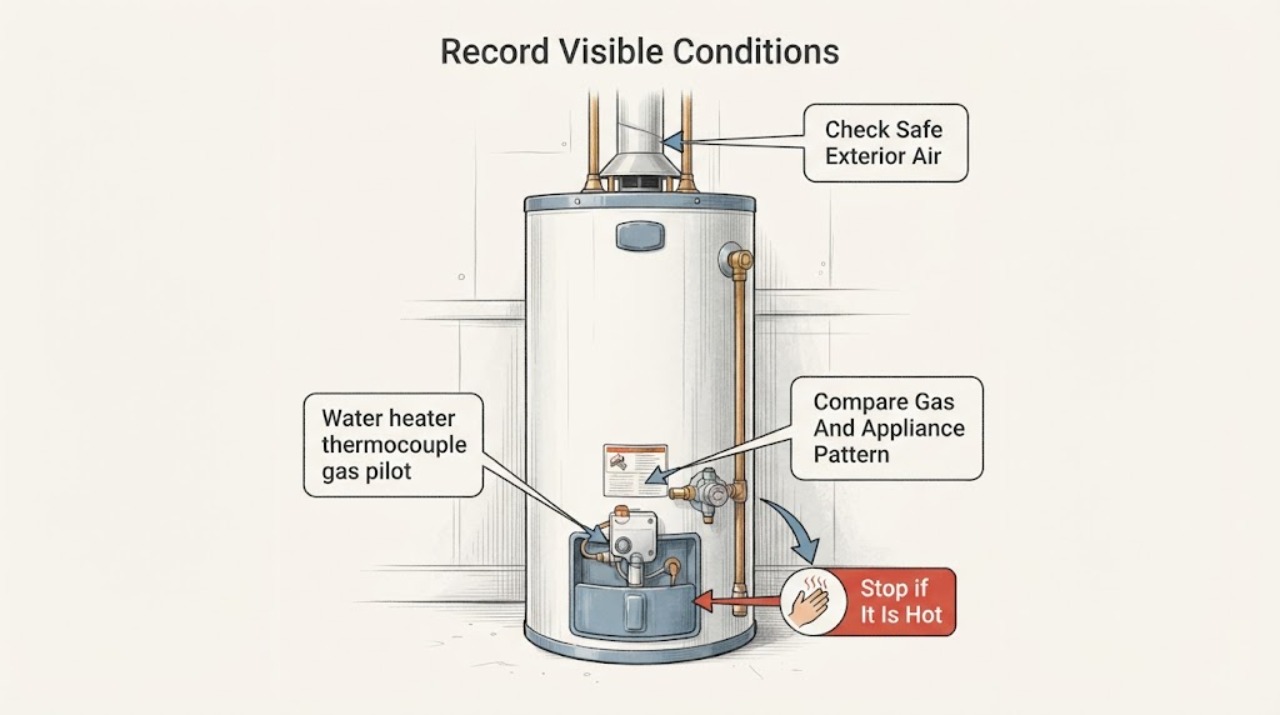
Work through in order
Diagnostic checks
Use only checks that match the exact appliance or system and its official guide.
-
Check 1
From outside the burner compartment, record the water-heater model and the exact pilot behavior while following only the lighting label or owner manual; do not remove the sealed or outer burner door.
Expected result: Note whether the pilot will not light, lights but dies when the control is released, stays lit until the main burner starts, or goes out after the heater runs; record any status light or diagnostic message.
Next step: Save the model, timing, status, and a photo of the rating plate from a safe position for a qualified technician; do not repeat relighting beyond the manual's stated procedure.
Stop if: Stop immediately for gas odor, hissing, soot, flame outside the intended viewing area, a CO alarm, headache, dizziness, nausea, or any need to remove a burner door.
Why this matters
Why: Immediate dropout keeps the pilot-flame and thermocouple/thermopile sensing path in focus. Dropout during burner operation or after heating makes draft, combustion air, thermal protection, gas supply, or a control fault more plausible; failure to light has a different diagnostic path.
-
Check 2
From a safe standing position, inspect only the exterior around the heater for blocked combustion-air openings, lint or dust at an owner-serviceable filter if the manual identifies one, damaged vent sections, loose vent joints, stored flammables, or a strong draft; do not remove a cover or reach into the burner.
Expected result: Record clean and unobstructed air openings, visible lint or blockage, a vent that is disconnected or corroded, a draft or downdraft, or flammable liquids or vapors near the appliance.
Next step: Remove only ordinary stored flammables from the area if this can be done without approaching an active gas hazard; otherwise leave and call qualified service. Request a combustion-air and vent inspection when the pilot goes out during burner operation.
Stop if: Do not vacuum or brush inside the burner, flame arrestor, pilot tube, or vent; stop for soot, flame rollout, vent separation, corrosion, smoke, or a CO alarm.
Why this matters
Why: Restricted combustion air, venting problems, or drafts can extinguish a pilot or create improper combustion, while flammable vapors create a fire hazard. A clear exterior does not prove the flame arrestor, pilot orifice, vent draft, or gas pressure is correct.
-
Check 3
Without touching gas fittings, note whether other gas appliances operate normally and whether the pilot outage began after a gas-service interruption, renovation, weather change, new exhaust fan, or change in the heater location or enclosure.
Expected result: Record normal or abnormal operation at other appliances, a recent gas outage, low gas pressure concern, strong exhaust or negative-air condition, cold draft, or no related change.
Next step: Contact the gas utility for supply concerns and the water-heater technician for appliance-specific diagnosis; do not adjust the gas regulator, valve, pilot flame, or orifice.
Stop if: Do not use another gas appliance as a test if there is an odor, abnormal flame, CO symptom, or suspected gas leak; leave and call emergency or utility service.
Why this matters
Why: Multiple gas appliances affected or a recent supply interruption points toward gas service or pressure rather than one thermocouple. A new exhaust fan, tight enclosure, or draft can change combustion air; no external pattern leaves the pilot assembly, sensor, control, and internal venting unresolved.
-
Check 4
Check the room from the doorway for a working carbon-monoxide alarm, water leakage, scorching, melted insulation, unusual heat, and whether hot water is absent; do not enter a space with a sounding alarm or suspected combustion hazard.
Expected result: Record a normal alarm with no damage, a CO alarm or CO-like symptoms, soot or heat damage, a water leak, or no hot water because the pilot is out.
Next step: For a CO alarm or symptoms, leave immediately for fresh air and call emergency services; for gas odor or appliance damage, call the gas utility and qualified service. Provide the technician with photos only from a safe position.
Stop if: Never ignore a CO alarm, reenter before responders permit it, or operate the heater after an alarm or combustion-damage finding until trained personnel service it.
Why this matters
Why: A CO alarm, symptoms, soot, or heat damage makes this an immediate life-safety event, not a thermocouple replacement decision. Water damage or no hot water affects urgency but does not make the gas controls safe to service without diagnosis.
-
Check 5
Arrange qualified gas-appliance or plumbing service and provide the exact model, pilot timing, status code, air and vent observations, gas-service history, alarm status, and any relighting attempts; request a complete pilot and combustion-safety diagnosis.
Expected result: Ask the technician to identify whether the cause is the thermocouple or thermopile, pilot flame or orifice, connection, gas pressure, thermal switch, combustion air, venting, gas control, or another model-specific condition.
Next step: Keep the heater off or in the safe state directed by the technician until combustion, venting, gas shutoff, safety devices, and pilot operation are verified under the exact manual.
Stop if: Do not open the combustion chamber, bypass the thermocouple, adjust gas pressure, clean an orifice with a wire, or replace a gas valve without qualified training and model-specific procedures.
Why this matters
Why: A confirmed sensor fault can justify an exact compatible replacement, but a recurring outage can also be the appliance's safety response to poor combustion or venting. Replacing the sensor without correcting the underlying condition can leave the hazard unresolved.
Use your observations
Decision map
Find the observation that best matches what you see, then follow the next safe action.
-
PATH 01Safety boundary
What you see
The pilot lights through the normal procedure but goes out as soon as the control is released, with no gas odor or visible combustion hazard.
Do this next
Stop repeated attempts and request model-specific gas-appliance service for the pilot assembly and safety circuit.
Why this path and its safety boundary
Why it matters: A weak or misdirected pilot flame, thermocouple/thermopile sensing problem, loose connection, or gas-control issue is plausible; the symptom does not identify which part.
Safety stop: Do not hold the control open, bypass the sensor, bend the thermocouple, or adjust the pilot or gas valve yourself.
-
PATH 02Safety boundary
What you see
The pilot stays lit briefly but goes out when the main burner starts or after the heater runs.
Do this next
Leave the heater off and have a qualified technician inspect combustion air, venting, thermal switch, pilot flame, gas supply, and controls.
Why this path and its safety boundary
Why it matters: Draft, venting, combustion-air restriction, thermal protection, gas pressure, or flame disturbance is more concerning than a simple sensor replacement.
Safety stop: Stop for soot, yellow or lifting flame, flame rollout, vent separation, headache, dizziness, or any CO alarm; leave and call emergency or utility service.
-
PATH 03Safety boundary
What you see
The heater is in a tight enclosure, an air filter or flame-arrestor area is visibly blocked from the outside, or the outage follows a vent or exhaust-air change.
Do this next
Do not open the burner; ask a qualified technician to evaluate the air supply, vent draft, flame arrestor, and local installation requirements.
Why this path and its safety boundary
Why it matters: Insufficient combustion air or altered draft can extinguish the pilot and can create carbon-monoxide risk; the root cause is not established as the thermocouple.
Safety stop: Do not enlarge vents, remove a screen, block a combustion opening, or keep relighting the heater without a combustion-safety inspection.
-
PATH 04Safety boundary
What you see
Other gas appliances also have abnormal flames or supply, or the outage follows a gas interruption or suspected low-pressure event.
Do this next
Stop using affected gas appliances and contact the gas utility or emergency service; have the water heater inspected before relighting.
Why this path and its safety boundary
Why it matters: A utility or gas-supply issue is more likely than an isolated thermocouple, and repeated ignition attempts may be unsafe.
Safety stop: Do not adjust a regulator, bleed a line, disconnect a gas fitting, or use flame to search for a leak.
-
PATH 05Safety boundary
What you see
There is gas odor, hissing, soot, flame rollout, visible vent failure, a CO alarm, or symptoms such as headache, dizziness, nausea, or shortness of breath.
Do this next
Leave immediately for fresh air, avoid flames and electrical switches, call emergency services or the gas utility from outside, and do not reenter or operate the heater until responders and trained personnel permit it.
Why this path and its safety boundary
Why it matters: This is an immediate gas, fire, or carbon-monoxide hazard; troubleshooting the pilot is no longer appropriate.
Safety stop: Do not try to locate the leak, relight the pilot, silence the alarm, ventilate by operating switches, or service the appliance.
Helpful context
Understand the symptom
The thermocouple is a safety signal, not a reset button
On a standing-pilot heater, the pilot assembly includes the pilot, ignitor, and thermocouple. The sensor must detect enough flame for the gas control to keep the pilot supply open. A pilot that dies as soon as the control is released can be consistent with a weak flame, poor sensor position, a connection fault, or a failed sensor, but the same symptom can also come from gas pressure, a blocked pilot path, a tripped thermal switch, or a combustion-air problem. Do not bypass the sensor or hold the gas control open.
Pilot timing helps separate causes without opening the burner
Note whether the flame dies immediately when the control is released, after the heater runs, when the main burner starts, during a draft or weather event, or after several minutes of heating. Immediate dropout keeps the flame-sensing path and pilot flame in focus. Dropout after heating or when the burner starts raises concern about combustion air, venting, drafts, thermal protection, or gas supply. These are decision clues only; internal testing and gas adjustments belong to a qualified technician.
Gas and carbon-monoxide safety outrank relighting attempts
A pilot is an open flame and a gas appliance can produce carbon monoxide if combustion or venting is wrong. Never store or use gasoline, solvents, aerosols, or other flammable vapors near the heater. If you smell gas, hear hissing, see soot, yellow or lifting flame, flame rollout, vent damage, or a CO alarm, do not try to identify the failed part: leave for fresh air, avoid switches or flames, call the gas utility or emergency service, and do not operate the appliance until it is inspected.
Safety boundary
Stop conditions
- If you smell gas, hear hissing, see soot, flame rollout, vent damage, or a yellow or lifting flame, leave the area and call the gas utility or emergency service from outside.
- If a carbon-monoxide alarm sounds or anyone has headache, dizziness, nausea, shortness of breath, confusion, or unusual fatigue, move outside and call emergency services; do not reenter until responders permit it.
- Do not bypass, short, hold open, bend, or defeat the thermocouple, thermopile, thermal switch, ECO, flame sensor, or gas-control safety device.
- Do not remove burner doors, probe pilot orifices, adjust gas pressure or flame, disconnect gas fittings, or change venting and combustion-air openings as a DIY test.
- Stop repeated relighting when the pilot goes out again, the cause is unclear, or any inspection requires internal access; arrange qualified gas-appliance service.
Only after diagnosis
Potential parts
- thermocouple or thermopile flame-sensor assembly
Consider only after qualified diagnosis confirms the sensor or its complete pilot assembly is defective or incompatible with the exact heater.
Match gas type, pilot assembly, connector, length, mounting, control valve, safety certification, and model-specific installation instructions; never bypass the existing sensor. - manufacturer-approved pilot or igniter assembly
Consider only when the technician finds a dirty, damaged, misaligned, or failed pilot/ignition assembly and confirms the replacement for the exact heater.
Confirm fuel type, burner and control design, connector, flame pattern, safety approvals, and installation procedure; internal gas-appliance work is not a user repair. - gas control valve or thermal safety component
Consider only after testing rules out the pilot, sensor, gas supply, combustion air, venting, and other causes and a qualified technician identifies the control as failed.
Confirm exact model, fuel, gas pressure, control interface, safety certification, venting configuration, and local code; do not substitute or adjust a gas valve by appearance.
When checks do not resolve it
Need a professional?
Call a qualified gas-appliance technician or plumber when the pilot repeatedly goes out, goes out when the main burner starts, will not stay lit after the manual procedure, or appears related to the thermocouple, pilot assembly, gas control, thermal switch, combustion air, or venting. Contact the gas utility or emergency service immediately for gas odor, hissing, soot, flame rollout, vent failure, or a CO alarm or symptoms. Do not operate the heater after a combustion or CO event until trained personnel inspect it.
Safety scope: This article supports reading the label, recording timing, and observing exterior conditions only. A qualified technician handles the burner, pilot assembly, thermocouple, gas valve, thermal safety devices, gas pressure, combustion-air and vent testing, and any internal cleaning or replacement.
Common questions
FAQ
Does a pilot that keeps going out always mean the thermocouple is bad?
No. The sensor is one possibility, but a weak or dirty pilot, loose connection, gas supply, combustion air, draft, thermal switch, venting, or gas control can produce the same symptom. A qualified technician should diagnose the safety chain before replacing a part.
Can I bypass the thermocouple to keep the pilot lit?
Never. The thermocouple is a safety device that helps stop gas flow when a pilot is not detected. Bypassing it or holding a control open can allow unburned gas to accumulate and removes a designed protection.
Why does the pilot go out when the main burner starts?
That timing can point to draft, venting, combustion-air, thermal-protection, gas-pressure, or flame-disturbance issues rather than a sensor alone. Stop using the heater and have qualified service check combustion and vent safety.
Can a dirty air filter cause a water-heater pilot outage?
On models that use an accessible air filter or flame arrestor, restricted combustion air can contribute to pilot outages and improper combustion. Check only what the exact manual identifies as user-serviceable; do not open the burner or clean internal gas paths yourself.
What should I do if the CO alarm sounds near the water heater?
Leave immediately for fresh air, call emergency services or the fire department from outside, and do not reenter or operate the heater until responders and trained personnel permit it. Never try to find the CO source while inside.
Read the exact guide
Official sources
- Cleaning the Air Filter and Flame ArrestorA. O. Smith Water Heaters · A. O. Smith model-family support guidance; exact owner's manual and installation govern a particular heater.
- 7 Signs You Need to Call a PlumberRheem Manufacturing Company · Rheem general homeowner guidance; diagnosis and repair depend on the exact heater and local qualified service.
- Water Heating Plumbing Terminology 101Rheem Manufacturing Company · Rheem terminology guidance; component arrangement and service instructions vary by model and manufacturer.
- Residential Gas Water Heater Installation and Use Manual 100279884A. O. Smith Corporation · A. O. Smith manual for specified models; do not generalize its controls, timing, or parts to another heater.
- Carbon Monoxide Fact SheetU.S. Consumer Product Safety Commission · CPSC consumer safety guidance; emergency responders, gas utilities, and qualified technicians govern a specific incident.
Community feedback
Share a repair observation
Share a plain-text repair observation. Accepted observations are published automatically; this page may take a moment to update.