
On this page
Start here
Quick answer
A Bradford White gas water heater pilot should not need frequent relighting. First check for a gas odor, fire or heat damage, or an unsafe vent or air-intake condition from a safe position; if gas is suspected, do not light anything, operate switches, or use a phone in the building. Leave and contact the gas supplier or emergency services from a safe location. If there is no odor and the heater is intact, record the model and control type and follow only the lighting label or installation manual for that exact heater. A pilot that goes out when the control is released can involve the pilot flame, thermocouple or thermopile, gas control, or safety cutoff; an outage after heating cycles can involve combustion air, venting, or gas supply. Bradford White says nuisance pilot outages require a plumbing professional, so stop after safe identification and model-specific user instructions rather than opening the burner compartment, testing gas pressure, or replacing controls yourself.
Before you begin
Safety first
- This article supports safety screening, model identification, ordinary-access observation, and an exact-manual decision only. Qualified service is required for burner or pilot removal, thermocouple or thermopile testing, gas-pressure checks, gas-control work, vent diagnosis, combustion-air diagnosis, and safety-circuit testing.
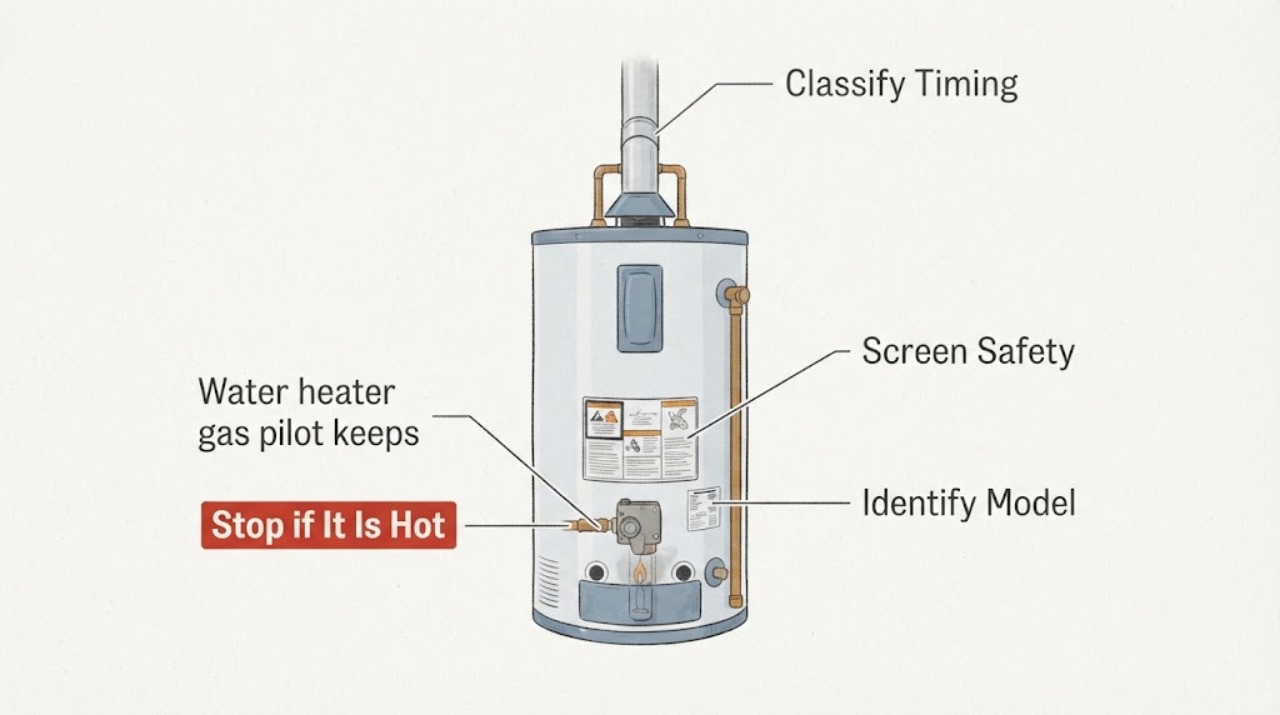
Work through in order
Diagnostic checks
Use only checks that match the exact appliance or system and its official guide.
-
Check 1
From a safe position, check for a gas odor, unusual hissing, soot or scorch marks, melted wiring, a damaged sight glass or enclosure, or standing water around the heater; do not touch controls if gas is suspected.
Expected result: Record whether there is any gas odor or uncertainty about gas, visible fire or heat damage, damaged enclosure, or no apparent hazard.
Next step: If gas is suspected, leave the area, avoid flames, switches, and phones in the building, and contact the gas supplier or fire department from a safe location. If there is no odor or damage, keep the heater off and continue without opening the burner compartment.
Stop if: Do not attempt to light the pilot, operate electrical switches, use a phone in the building, or investigate a suspected gas leak from inside the building.
Why this matters
Why: Gas odor or uncertainty is an emergency safety boundary, not a pilot-light troubleshooting branch. Damage can make relighting unsafe. No odor and no visible damage allow only limited identification checks.
-
Check 2
Photograph the rating plate and the outside of the gas control without removing covers, disconnecting wires, or disturbing the vent; note the model or serial number, fuel type, control markings, status light, sight glass, and whether a blower is present.
Expected result: Classify the heater as a standing-pilot or electronic-ignition design only when the label makes that clear, and record any repeating status-light pattern and when the pilot goes out.
Next step: Use the model or serial number in Bradford White's technical-document lookup and read the exact lighting and operating instructions; contact a plumber if the label is missing, unreadable, or the design is unclear.
Stop if: Do not remove the outer or inner burner door, disconnect the gas control, or copy a procedure from a different model.
Why this matters
Why: Bradford White procedures differ by model, control, and vent design. A model number and outage pattern are more useful than assuming all Bradford White heaters use the same relight or sensing procedure.
-
Check 3
Without opening the burner compartment, observe the intended sight glass or status indicator only if the exact model instructions identify it as an owner observation point; note whether the pilot fails immediately on releasing the control or later after a heating cycle.
Expected result: Record whether the pilot will not stay lit when the button or control is released, goes out during or after burner operation, goes out periodically, or cannot be observed safely.
Next step: Follow only the exact model's relight instructions once if the manual permits and all safety conditions are satisfied; otherwise leave the heater off and provide the timing and indicator information to a qualified plumber.
Stop if: Do not hold a gas-control button open beyond the exact manual instruction, bypass a safety device, or continue relighting after another failure.
Why this matters
Why: Immediate release failure makes the pilot flame, thermocouple or thermopile, gas control, or safety cutoff more likely. Periodic or cycle-related outage makes combustion air, venting, or gas-supply issues more likely. An unclear pattern needs service.
-
Check 4
From ordinary safe access, look at the visible exterior of the vent termination and combustion-air openings for snow, lint, stored material, a blockage, or a displaced section; do not climb, remove vent parts, enter a confined space, or clean inside the burner enclosure.
Expected result: Record whether the exterior path looks clear, has an obvious obstruction that can be removed without touching the appliance, shows damage or disconnection, or cannot be safely inspected.
Next step: Remove only loose material that is plainly away from the appliance and safe to reach; otherwise leave the heater off and arrange service for venting, combustion air, burner, and gas-supply checks.
Stop if: Do not alter vent routing, cover or uncover combustion-air paths as an experiment, enter a confined space, or work inside the combustion chamber.
Why this matters
Why: A periodic outage can be consistent with insufficient combustion air or a vent problem, but a clear exterior does not prove adequate draft or gas pressure. Damage or an inaccessible path requires qualified diagnosis.
-
Check 5
Stop repeated relight attempts and prepare a service record with the model, fuel type, control type, outage timing, indicator pattern, gas-odor result, visible vent or air-intake condition, and any recent work or interruption.
Expected result: Note whether the pilot stayed lit after the exact manual procedure, failed again, or could not be tested safely; also record whether hot water is absent and whether any alarm or damage is present.
Next step: Keep the heater in the safe state specified by its instructions and arrange qualified plumbing or gas-appliance service. Share the record and model documentation rather than opening the gas train or testing pressure yourself.
Stop if: Do not measure gas pressure, test live electrical circuits, remove the gas valve, replace the pilot assembly, or bypass a safety cutoff as a homeowner step.
Why this matters
Why: A pilot that fails again is a nuisance outage requiring professional diagnosis, not evidence that another part should be swapped. Alarms, gas odor, damage, repeated lockout, or no safe isolation increase urgency.
Use your observations
Decision map
Find the observation that best matches what you see, then follow the next safe action.
-
PATH 01Safety boundary
What you see
A gas odor, hissing, suspected leak, fire damage, or uncertainty about gas presence is noticed near the heater.
Do this next
Do not light an appliance or operate switches or phones in the building. Leave and contact the gas supplier or fire department from a safe location.
Why this path and its safety boundary
Why it matters: The appliance is outside the safe relight boundary; a pilot attempt could create fire or explosion risk.
Safety stop: Do not return to relight, sniff-test fittings, or troubleshoot the gas control until the gas supplier or qualified responder declares the area safe.
-
PATH 02Safety boundary
What you see
The pilot lights but goes out as soon as the lighting control is released, with no gas odor or visible damage.
Do this next
Use the exact model instructions only for a permitted relight attempt; if it fails again, leave the heater off and arrange a plumber or qualified gas-appliance technician.
Why this path and its safety boundary
Why it matters: A pilot-flame, thermocouple or thermopile, gas-control, or safety-cutoff issue is more likely than a simple setting error.
Safety stop: Do not bypass the safety circuit, hold the control open beyond the manual, or open the burner compartment to adjust sensing parts.
-
PATH 03Safety boundary
What you see
The pilot stays lit briefly but goes out after a burner cycle, overnight, or at repeating intervals.
Do this next
Observe the exterior vent and air-intake path only from safe access, record the timing, and arrange qualified service for the vent, combustion-air, and gas-supply checks.
Why this path and its safety boundary
Why it matters: Bradford White's troubleshooting chart makes insufficient combustion air, incorrect or clogged venting, and inconsistent gas supply or pressure plausible causes.
Safety stop: Do not alter venting, block or open combustion-air paths as an experiment, or test gas pressure yourself.
-
PATH 04Safety boundary
What you see
The model, control type, indicator pattern, or lighting procedure is unclear or the rating plate cannot be read.
Do this next
Keep the heater off, photograph what is visible, use Bradford White's model or serial lookup, and ask a qualified professional to identify the procedure.
Why this path and its safety boundary
Why it matters: A generic relight or replacement procedure could be wrong because Bradford White uses multiple controls and vent designs.
Safety stop: Do not copy instructions from a similar-looking heater or remove doors and wiring to identify the control.
-
PATH 05Safety boundary
What you see
A visible vent or air-intake obstruction, disconnected vent, damaged enclosure, soot, or stored flammable material is found.
Do this next
Keep the heater off, move people away from the appliance, remove only loose material that is safely away from the appliance, and arrange qualified service to inspect the system.
Why this path and its safety boundary
Why it matters: Combustion or venting may be unsafe; a pilot outage can be a protective response rather than a failed pilot part.
Safety stop: Do not enter a confined space, disassemble the vent or burner, store materials beside the heater, or restart it after damage is found.
-
PATH 06Safety boundary
What you see
The exact model manual permits a relight, all safety checks are clear, the pilot lights, but it goes out again or the heater locks out.
Do this next
Stop relighting, leave the gas control in the safe state specified by the manual, and arrange qualified service with the outage timing and indicator information.
Why this path and its safety boundary
Why it matters: The recurring fault remains unresolved even if the pilot can be temporarily restored.
Safety stop: Do not replace a thermocouple, pilot assembly, gas valve, or safety device based only on symptoms or a generic fit.
Helpful context
Understand the symptom
Treat repeated pilot outages as a fault
Bradford White says a pilot normally needs lighting only during installation and initial setup. The timing matters: failure as soon as the control is released points toward the pilot flame, thermocouple or thermopile, gas control, or safety cutoff; failure after burner cycles points more toward combustion air, venting, or gas supply. These are not interchangeable parts or universal adjustments.
Use the exact model documentation
Bradford White has several gas-control and venting designs. Photograph the rating plate and note whether the unit has a standing pilot, spark ignition, a status light, a blower, or a different control. Use Bradford White's documentation lookup with the model or serial number, then follow the lighting label or installation and operation manual for that unit. Do not infer a procedure from another model or remove the burner access or inner door as a homeowner troubleshooting step.
Keep gas and combustion safety ahead of diagnosis
Do not attempt to light the heater if you smell gas, are unsure whether gas is present, see scorch marks or damaged wiring, or find a damaged combustion enclosure. Bradford White's safety instructions say not to light any appliance, touch an electrical switch, or use a phone in the building when gas is suspected. Leave and contact the gas supplier or fire department from a safe location. Keep flammable vapors and materials away from the heater and vent or air-intake system.
Safety boundary
Stop conditions
- Do not attempt to light the heater if gas is smelled or suspected; leave and contact the gas supplier or emergency services from a safe location.
- Do not operate switches or phones in the building during a suspected gas leak, and keep flames and flammable vapors away from the appliance.
- Do not remove burner doors, open the gas train, test gas pressure, test live electrical circuits, or bypass a safety cutoff as a homeowner troubleshooting step.
- Do not alter vent routing or combustion-air openings, enter a confined space, or restart a heater with damaged or disconnected venting.
- Stop repeated relighting and arrange qualified service when the pilot goes out again, the model procedure is unclear, a status pattern repeats, or hot-water service is not restored.
Only after diagnosis
Potential parts
- model-specific thermocouple or thermopile
Consider this category only if qualified diagnosis confirms that the sensing component is weak, damaged, or incorrectly positioned and the exact heater model uses that component.
Confirm the model, gas control, pilot assembly, connection, and manufacturer part information; do not replace it from a generic symptom match. - model-specific pilot assembly
Consider this category only when the exact model's qualified service diagnosis identifies a blocked, damaged, or failed pilot assembly after gas, air, vent, and safety causes are assessed.
Confirm fuel type, gas control, ignition and flame-sensing design, gasket requirements, and the exact Bradford White documentation before ordering. - compatible Bradford White gas control
Consider this category only after qualified testing identifies a failed gas control or safety circuit; a recurring pilot outage alone does not justify this replacement.
Confirm the exact model, fuel, control family, safety features, connections, and installation requirements with Bradford White or a qualified service provider.
When checks do not resolve it
Need a professional?
Bradford White says nuisance pilot outages require a plumbing professional. Arrange qualified service after a pilot goes out again, fails when the control is released, shuts down after heating cycles, or shows a repeating status pattern. Seek urgent gas-supplier or emergency help for gas odor or uncertainty, fire or scorch damage, a damaged combustion enclosure, suspected venting hazard, or any condition in which gas cannot be safely controlled.
Safety scope: This article supports safety screening, model identification, ordinary-access observation, and an exact-manual decision only. Qualified service is required for burner or pilot removal, thermocouple or thermopile testing, gas-pressure checks, gas-control work, vent diagnosis, combustion-air diagnosis, and safety-circuit testing.
Common questions
FAQ
How often should a Bradford White water heater pilot need lighting?
Bradford White says the pilot should normally be lit once during installation and initial setup. Repeated or nuisance outages are a reason to contact a plumbing professional, not to keep relighting it indefinitely.
What if the pilot goes out as soon as I release the button?
That pattern can involve the pilot flame, thermocouple or thermopile, gas control, or a safety cutoff. Follow the exact model's lighting instructions only when the safety checks are clear; if it fails again, leave the heater off and arrange qualified service.
Why does the pilot go out after the water heater heats?
Bradford White's service chart lists combustion-air, venting, and inconsistent gas-supply or pressure issues for periodic outages. These require qualified diagnosis; do not alter the vent or test gas pressure yourself.
Can I replace the thermocouple myself on a Bradford White heater?
Do not choose or replace it from the symptom alone. Bradford White's detailed thermocouple, pilot, gas-control, and safety procedures are service work; a qualified technician should confirm the exact model and cause before replacing a part.
What should I do if I smell gas near the water heater?
Do not try to light any appliance, touch electrical switches, or use a phone in the building. Leave the area and contact the gas supplier or fire department from a safe location, following their instructions.
Read the exact guide
Official sources
- How often do I have to light the pilot?Bradford White Water Heaters · Bradford White consumer FAQ; exact model manuals and a qualified plumbing professional control model-specific diagnosis.
- 238-51542-00_ABradford White Water Heaters · Bradford White Defender gas-water-heater service manual; it is technical guidance for qualified service providers and is not a universal homeowner repair procedure.
- Where can I find the manual to my water heater?Bradford White Water Heaters · Bradford White documentation-locator guidance; the owner must match the exact model or serial number before using operating instructions.
- 47150_A Service Manual for Bradford White TTW Series Gas Water HeatersBradford White · Bradford White TTW gas-water-heater service manual; safety warnings are relevant to gas appliances, while operating details vary by model.
Community feedback
Share a repair observation
Share a plain-text repair observation. Accepted observations are published automatically; this page may take a moment to update.