
On this page
Start here
Quick answer
A Bradford White gas water-heater pilot that keeps going out is not a normal repeated-lighting task. If you smell gas, hear hissing, see soot or flame outside the combustion area, receive a carbon-monoxide alarm, or feel unwell, leave immediately, avoid switches or flames, and contact emergency or gas utility services from a safe location. Otherwise, leave the heater off and have a qualified plumbing professional inspect the model-specific pilot, thermocouple or flame-sensing path, gas control valve, combustion air, venting, and gas supply. Bradford White says the pilot normally needs lighting only at initial setup and directs owners with nuisance outages to a plumbing professional; do not adjust the gas valve, bypass a safety, open the burner compartment, or repeatedly relight it.
Before you begin
Safety first
- Leave the heater off for recurring outages. Do not adjust the gas valve, bypass safety controls, open the burner compartment, loosen gas or pilot connections, or relight after a gas or carbon-monoxide warning until qualified personnel clear the unit.
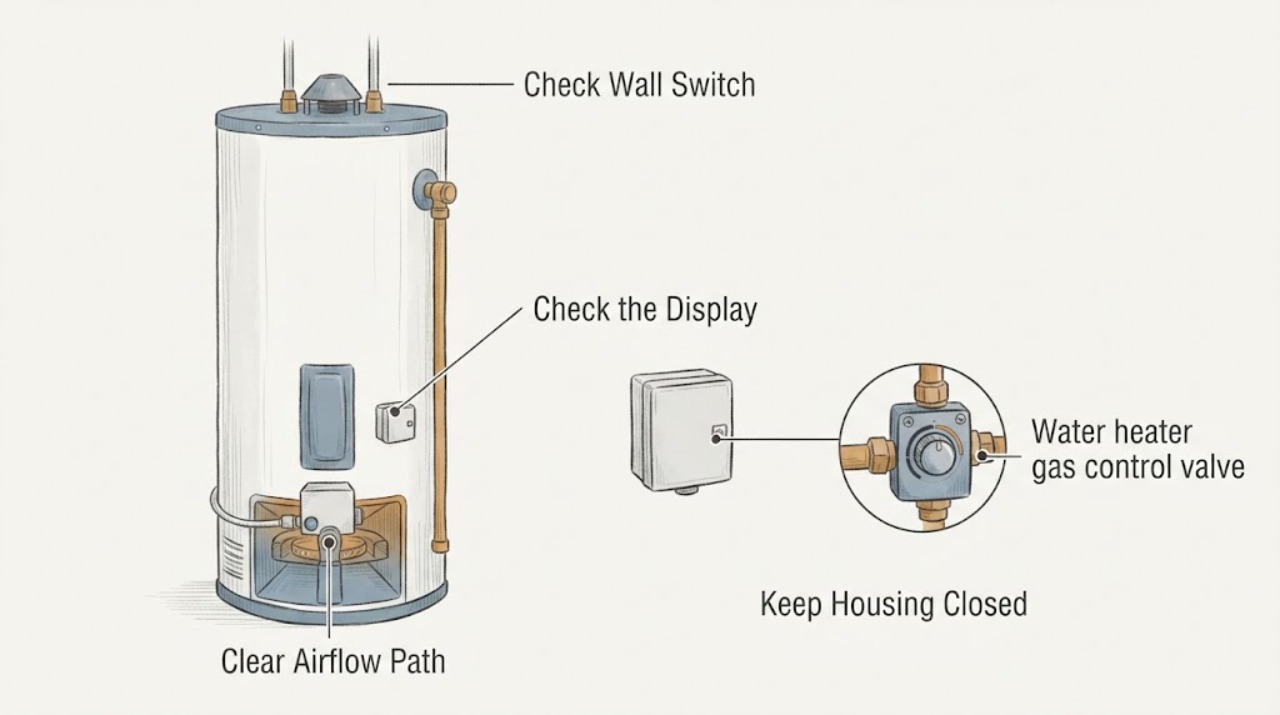
Work through in order
Diagnostic checks
Use only checks that match the exact appliance or system and its official guide.
-
Check 1
If there is any gas odor, hissing, visible flame outside the heater, soot, a carbon-monoxide alarm, or illness, do not touch the heater or electrical switches. Leave the building, warn others from outside, and contact emergency or gas utility services from a safe location. If there is no hazard signal, turn the water heater's external gas control to the model-documented off position only if it can be done without approaching a suspected leak, and stop relighting attempts.
Expected result: A gas or combustion warning is present, or there is no warning but the pilot has gone out repeatedly.
Next step: For any warning, remain outside and obtain emergency or gas-safety help. Otherwise, leave the heater off and arrange qualified Bradford White service; do not restart it to see whether the pilot holds.
Why this matters
Why: A warning can indicate an immediate fuel or combustion hazard and overrides troubleshooting. Without a warning, the recurring outage still indicates a fault that Bradford White says should be handled by a plumbing professional.
-
Check 2
From a safe distance and without removing doors or covers, note whether the pilot goes out immediately when the lighting control is released, after the main burner runs, or at an irregular interval. Do not relight it repeatedly or hold a control down beyond the exact lighting label's one-time procedure.
Expected result: The pilot will not stay lit after release, goes out after a heating cycle, or fails at unpredictable intervals.
Next step: Record the timing and leave the heater off. A qualified professional must perform any pilot, thermocouple, gas-pressure, vent, or gas-control tests.
Why this matters
Why: An immediate failure keeps the pilot flame, thermocouple or flame-sensing path, connection, and gas-control safety in consideration. A periodic failure makes combustion air, venting, gas supply, or a heat-related control fault more relevant; timing alone does not identify the valve.
-
Check 3
Without moving the heater or entering the combustion chamber, inspect the room around the heater for blocked or covered combustion-air openings, stored items, lint, dust, or new construction that could restrict airflow. Do not remove a jacket door, brush an internal flame arrestor, or use compressed air near the burner as a homeowner test.
Expected result: Air openings are blocked or contaminated, the installation environment recently changed, or the visible area is clear.
Next step: Move only an obvious external storage item away without touching the heater. Leave the unit off and arrange professional inspection for internal cleaning, combustion testing, or any uncertain airflow condition.
Why this matters
Why: Bradford White's periodic-pilot guidance identifies insufficient combustion air as a possible cause. A clear visible area does not prove internal airflow, flame-arrestor, or vent performance is safe.
-
Check 4
From outside and without climbing, dismantling, or opening the heater, look at the vent connector and terminal for a visibly displaced section, obstruction, damage, or a change in the exhaust route. Do not probe the vent, seal it with tape, alter its size, or operate the heater while venting is questionable.
Expected result: The vent path appears damaged or obstructed, exhaust behavior is abnormal, or no visible issue is found.
Next step: Keep the heater off and have a qualified professional inspect venting and combustion. Do not clear an internal obstruction or relight the pilot to test a questionable vent.
Why this matters
Why: Bradford White identifies an incorrect or clogged vent system or terminal as a cause of periodic pilot loss, and its venting guidance explains that draft supplies combustion air. No visible defect does not verify vent sizing, draft, or carbon-monoxide safety.
-
Check 5
Read the rating plate without opening the heater and record the complete Bradford White model and serial number, fuel type, vent style, pilot or gas-valve indicator, outage timing, and any display or status light pattern. Use the model record to retrieve the matching installation and operation manual; do not infer a gas-control diagnosis from a light pattern.
Expected result: The model and serial are available, the fuel and vent type are clear, or the rating plate and control information are uncertain.
Next step: Give the record to a qualified plumbing professional. If the model or fuel type is uncertain, do not attempt to light or adjust the heater.
Why this matters
Why: Bradford White says model or serial information is needed to locate the correct documentation, and its gas-valve indicators are intended to assist professional troubleshooting. A similar-looking control or manual may not apply.
-
Check 6
Observe only whether hot-water service is absent or intermittent after the pilot outage; do not open the burner compartment, loosen pilot tubing, measure gas pressure, probe a thermocouple, or adjust the combination thermostat/gas valve. Photograph the external rating plate and control without showing private household information.
Expected result: There is no hot water, hot water returns briefly after a relight, or the unit remains off and the pilot cannot be safely evaluated.
Next step: Leave the heater off, provide the model and symptom record to a qualified plumber, and request a complete safety diagnosis before any part is selected or the unit is returned to service.
Why this matters
Why: A pilot that will not remain established prevents normal burner operation, but a temporary relight does not prove that the pilot assembly, thermocouple, gas control, combustion air, vent, or gas supply is safe. Bradford White's technical support and maintenance guidance place these tests with professionals.
Use your observations
Decision map
Find the observation that best matches what you see, then follow the next safe action.
-
PATH 01Next step
What you see
There is gas odor, hissing, soot, a flame outside the heater, a carbon-monoxide alarm, or anyone feels ill.
Do this next
Leave immediately, avoid switches, flames, and ignition sources, warn others from outside, and contact emergency or gas utility services from a safe location. Do not re-enter until cleared.
Why this path and its safety boundary
Why it matters: This is an immediate gas or combustion safety event, not a pilot-adjustment problem.
-
PATH 02Next step
What you see
The pilot goes out as soon as the lighting control is released, while no gas odor or CO warning is present.
Do this next
Stop relighting and leave the heater off. Have a qualified professional perform the model-specific pilot and gas-control diagnosis; do not bypass the thermocouple or safety circuit.
Why this path and its safety boundary
Why it matters: A pilot flame, thermocouple or flame-sensing path, connection, thermal safety, or gas-control fault is more likely, but the valve cannot be identified from this symptom.
-
PATH 03Next step
What you see
The pilot runs initially but goes out after heating cycles or at irregular intervals, and visible combustion-air openings or venting have changed or appear restricted.
Do this next
Keep the heater off and have a qualified professional inspect combustion air, the flame-arrestor area, vent system, draft, and gas supply. Do not clear internal openings or relight to test them.
Why this path and its safety boundary
Why it matters: Combustion-air, venting, draft, or inconsistent gas-supply conditions are more likely than a proven gas-control-valve failure.
-
PATH 04Next step
What you see
The visible room and vent path appear clear, but the pilot still goes out repeatedly or the gas-valve indicator shows an operating fault.
Do this next
Use the model and serial record to request professional diagnosis. Do not adjust the gas control, open the combustion chamber, test gas pressure, or replace a control by appearance.
Why this path and its safety boundary
Why it matters: An internal pilot assembly, flame sensor, thermocouple, thermal safety, control, gas supply, or gas-control issue remains possible; an external check cannot isolate it.
-
PATH 05Next step
What you see
The heater has flooded, sustained physical damage, has a damaged vent or gas line, or the model, fuel type, or control cannot be identified.
Do this next
Leave the heater off, isolate gas only from a safe known shutoff if instructed by emergency or gas-safety personnel, and obtain qualified professional evaluation before repair or replacement.
Why this path and its safety boundary
Why it matters: The unit's fuel and combustion safety cannot be verified and ordinary troubleshooting is unsafe.
Helpful context
Understand the symptom
A recurring pilot outage is a safety symptom
A pilot that goes out when the lighting control is released is different from a pilot that fails after a heating cycle. Bradford White's service literature lists pilot or thermocouple, combustion-air, venting, gas-supply, thermal-safety, and gas-control possibilities. The visible symptom does not identify a failed gas control valve, and repeated relighting can leave an unsafe condition undiscovered.
Bradford White directs nuisance-outage work to professionals
Bradford White states that normal operation should require pilot lighting only during initial setup and tells owners with nuisance pilot outages to contact a plumbing professional. Its technical support page also limits troubleshooting support to plumbing professionals. Use the rating plate to identify the exact model and obtain the matching installation and service documentation, but do not use that documentation as permission to alter the gas control or bypass a safety.
Keep gas and carbon-monoxide boundaries explicit
Do not inspect an open combustion chamber, loosen pilot tubing, test gas pressure, adjust a gas valve, defeat a thermal switch, or bypass a thermocouple as an ordinary-user check. If a CO alarm sounds or anyone has headache, dizziness, nausea, weakness, confusion, or unusual sleepiness, leave the building and seek emergency help from outside.
Safety boundary
Stop conditions
- If gas odor, hissing, soot, flame outside the combustion area, a carbon-monoxide alarm, or illness is present, leave immediately and contact emergency or gas utility services from outside. Do not operate switches or relight the heater.
- Keep the water heater off after a recurring pilot outage. Do not adjust the gas control valve, test line pressure, loosen pilot tubing, open the combustion chamber, bypass a thermocouple or thermal safety, or defeat a venting safeguard.
- Do not clean an internal flame arrestor, remove jacket or burner doors, or clear venting as an ordinary-user action. Bradford White directs nuisance pilot-outage troubleshooting to plumbing professionals.
- Stop for flooding, damaged gas or vent lines, physical damage, an unidentified model or fuel type, or any symptom that returns after a permitted model-specific check, and obtain qualified service.
Only after diagnosis
Potential parts
- water heater thermocouple
Consider this only after a qualified diagnosis confirms that the model-specific thermocouple or flame-sensing path fails its safety test and combustion and gas-supply conditions are acceptable.
Thermocouple connections, lengths, and pilot assemblies vary by Bradford White model and gas-control system. Confirm the complete model and professional diagnosis before selecting one. - water heater pilot assembly
Consider this only when professional inspection identifies a damaged, obstructed, weak, or non-sensing pilot assembly after venting, combustion air, gas supply, and control checks.
Pilot burners, flame sensors, tubing, and connectors are model- and fuel-specific. Do not select or install one by appearance; use the exact documentation and qualified service. - water heater gas control valve
Consider this only after a qualified professional rules out pilot, thermocouple or flame sensing, combustion air, venting, gas supply, and safety-switch causes and confirms the gas control is defective.
Gas-control valves are fuel-, model-, and safety-system-specific and require qualified installation and leak or combustion checks. Never adjust or bypass one as a homeowner test.
When checks do not resolve it
Need a professional?
Request service immediately for gas odor, hissing, soot, combustion spillage, a carbon-monoxide alarm, illness, a damaged gas or vent line, flooding, or an uncontrolled pilot condition. Request prompt qualified service for every recurring pilot outage even without a warning signal.
Safety scope: Leave the heater off for recurring outages. Do not adjust the gas valve, bypass safety controls, open the burner compartment, loosen gas or pilot connections, or relight after a gas or carbon-monoxide warning until qualified personnel clear the unit.
Have this ready
- Provide the complete Bradford White model and serial number, fuel and vent type, outage timing, whether the pilot stays lit when the control is released, any status-light pattern, visible external airflow or vent observations, recent installation or room changes, and any gas or CO warning without operating the heater to reproduce it.
Common questions
FAQ
Why does my Bradford White water heater pilot keep going out?
Bradford White service literature lists pilot or thermocouple, combustion-air, venting, gas-supply, thermal-safety, and gas-control possibilities. The symptom does not identify a failed gas control valve, and Bradford White directs nuisance outages to a plumbing professional.
Should I keep relighting a Bradford White pilot?
No. Bradford White says normal operation should require lighting only during initial setup. Leave the heater off after a recurring outage and arrange qualified service rather than repeatedly relighting it.
What if the pilot goes out when I release the control?
That pattern keeps the pilot flame, thermocouple or flame-sensing path, safety circuit, and gas control in consideration. Stop relighting and have a qualified professional diagnose the model-specific heater.
What if the Bradford White pilot goes out after a heating cycle?
Bradford White identifies insufficient combustion air, an incorrect or clogged vent system, and inconsistent gas supply as possible periodic-outage causes. Keep the heater off and have those conditions professionally checked.
Can I adjust the Bradford White gas control valve?
No. Do not adjust or bypass the gas control, thermocouple, thermal switch, or other safety circuit. Bradford White directs gas-water-heater troubleshooting and service to qualified plumbing professionals.
How do I know whether the thermocouple or gas valve failed?
A pilot outage alone cannot distinguish them. A professional must evaluate the pilot flame or sensing path, safety circuit, combustion air, venting, gas supply, and gas-control operation using the exact model documentation.
What should I do if I smell gas or a CO alarm sounds?
Leave immediately, avoid switches, flames, and ignition sources, warn others from outside, and contact emergency or gas utility services from a safe location. Do not relight or re-enter until cleared.
What information should I give the Bradford White plumber?
Provide the complete model and serial number, fuel and vent type, when the pilot goes out, whether it stays lit after release, any status-light pattern, visible external airflow or vent changes, and any gas or carbon-monoxide warning.
Read the exact guide
Official sources
- My Water HeaterBradford White · Bradford White rating-plate model and serial lookup for exact manuals and service documentation
- 238-44943-00_ABradford White · Bradford White gas-water-heater troubleshooting chart for pilot not staying lit and related gas-control safety causes
- 238-51636-00_CBradford White · Bradford White gas-control troubleshooting for pilot outages after heating cycles and periodic pilot loss
- FAQs - Bradford White Water HeatersBradford White · Bradford White professional installation and service, model documentation, gas-valve indicators, and nuisance-pilot guidance
- USA & International Contact InformationBradford White · Bradford White technical-support scope and professional referral for pilot-will-not-stay-lit problems
- How often do I have to light the pilot?Bradford White · Bradford White normal pilot-lighting frequency and professional-service boundary for nuisance outages
- Atmospheric Vent Gas Water Heaters and Attic InstallationsBradford White For The Pro · Bradford White atmospheric-vent combustion-air and draft context for sustained pilot operation
Community feedback
Share a repair observation
Share a plain-text repair observation. Accepted observations are published automatically; this page may take a moment to update.