
On this page
Start here
Quick answer
Stop adding water and first identify whether one fixture is blocked or several fixtures are backing up together. A single sink, tub, or shower that is slow or standing full usually points to a local trap or branch restriction; backup at more than one fixture, a low floor drain, or dirty water coming up when another fixture runs points farther downstream toward the building drain, private lateral, septic system, or public sewer. From a safe position, record the affected fixtures, where water appears, and when it happens. If no chemical opener has been used and the water is not sewage, a properly sealed plunger is a reasonable low-risk first attempt on one fixture; stop if it does not restore flow, returns quickly, spreads to other fixtures, or requires opening a concealed line. Do not mix drain chemicals, work on contaminated wastewater, or keep testing a worsening backup. Arrange qualified plumbing or drain service for a persistent or multi-fixture backup.
Before you begin
Safety first
- The user checks in this article are limited to dry-position observation and one controlled plunger attempt only when there is no sewage and no chemical history. A professional handles drain opening, contaminated water, chemical residue, concealed or pressurized lines, powered equipment, camera inspection, excavation, septic work, and public-sewer coordination.
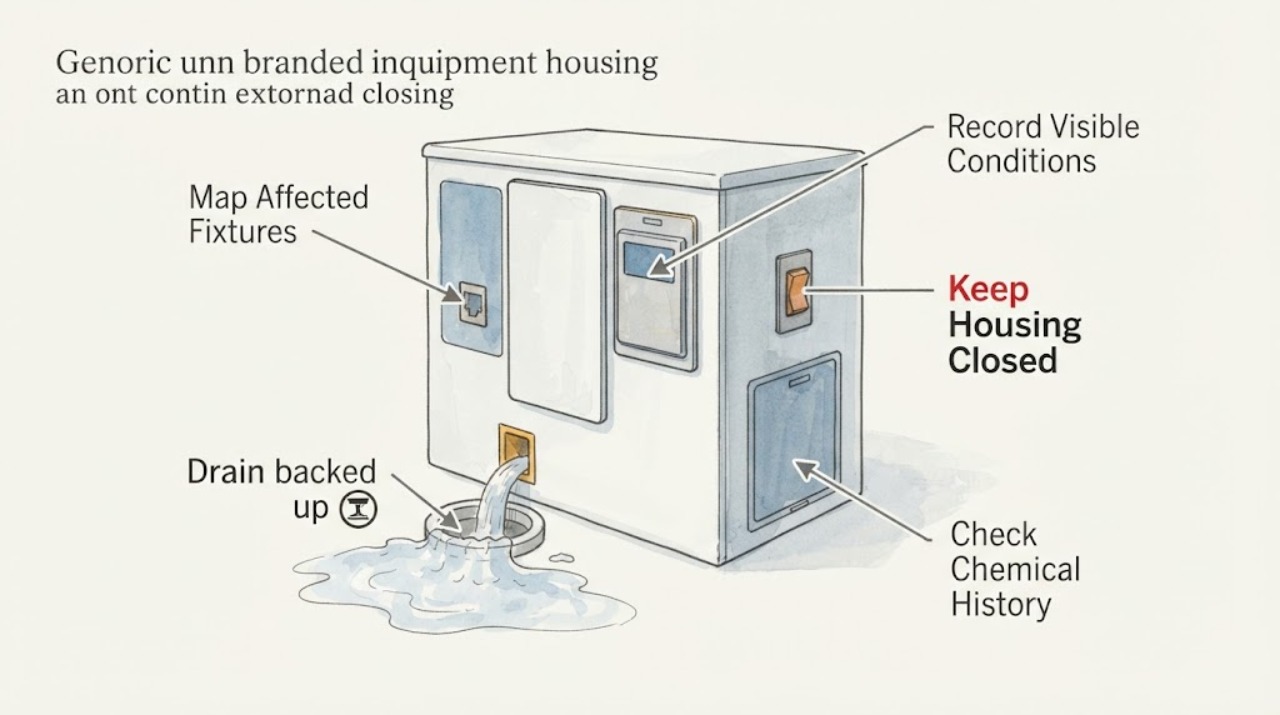
Work through in order
Diagnostic checks
Use only checks that match the exact appliance or system and its official guide.
-
Check 1
Stop adding water and, from dry safe positions, list every fixture that is slow, full, gurgling, or overflowing; include sinks, tubs, showers, toilets, laundry drains, and floor drains.
Expected result: Record whether the symptom is limited to one fixture, appears in fixtures on the same level, or affects several levels or a low floor drain. Note whether standing water is clear, gray, foul-smelling, or visibly contaminated without touching it.
Next step: Leave all affected fixtures unused, photograph the water level and locations from a safe position, and use the single-fixture or multi-fixture branch below when requesting service.
Stop if: Stop immediately for sewage, flooding, electrical contact, strong chemical odor, fumes, illness, or any need to enter contaminated water.
Why this matters
Why: One isolated fixture supports a local trap or branch-drain path. Several fixtures, a low drain, or wastewater rising when another fixture runs makes a shared downstream, lateral, septic, or public-sewer problem more likely; it is not proof of which component has failed.
-
Check 2
Record when the backup began and what preceded it, using only normal household use that has already occurred; do not create a large flow test.
Expected result: Note whether the symptom followed a sink, shower, toilet, dishwasher, or washing-machine discharge; heavy rain; a recent plumbing change; repeated slow drainage; or prior clearing. Record whether the water level falls on its own and whether the problem returns after a short interval.
Next step: Give the timeline and affected-fixture map to the plumber or drain service; do not repeat the trigger to see whether the backup returns.
Stop if: Stop testing if water rises, spills, reaches wiring or equipment, spreads to another room, or becomes foul-smelling or contaminated.
Why this matters
Why: A fixture-use trigger can help locate a branch relationship, while rain-linked or recurring backup can point toward a lateral, public-sewer, septic, capacity, root, or pipe-condition investigation. A temporary fall in water level does not show that the line is fully clear.
-
Check 3
Ask everyone in the home whether a drain opener, bleach, acid, solvent, or other cleaner was poured into the affected line, and keep the original container or product name if known.
Expected result: Classify the history as no product used, a known product used with its approximate time, or an unknown product possibly present. Do not lean over the opening, sniff it, add another product, or touch standing water to identify it.
Next step: If any chemical may be present, do not plunge, snake, remove a trap, or add water as a test; ventilate only from a safe position and tell the service provider the product and time if known.
Stop if: Leave the area and seek poison-control or emergency help for eye or skin contact, breathing difficulty, swallowing, severe pain, fumes, or a reaction; do not induce vomiting after ingestion unless directed by poison control or a clinician.
Why this matters
Why: A known or possible chemical changes the risk of splashing, fumes, and mechanical work. Drain-opening agents can be corrosive, and mixed household hazardous products can react; an unknown history must be disclosed before a professional opens the line.
-
Check 4
Only when one fixture is affected, the water is not sewage, and no chemical opener was used, place the correct plunger over the drain opening and create a complete seal; for a sink with an overflow, block that overflow with a damp cloth while keeping your face away from splash.
Expected result: After a few controlled strokes, observe whether the water level falls and then drains normally, falls only temporarily, or does not move. Do not force a fixture, use a powered tool, or continue if the seal cannot be made safely.
Next step: If flow remains normal, use the fixture sparingly and monitor for recurrence. If it remains blocked or returns, stop and arrange qualified drain service with the fixture, timing, and result recorded.
Stop if: Do not plunge when chemical residue, sewage, glass or sharp debris, overflowing water, or an unsafe fixture condition is present; stop for splashing, leaks, or water near electrical equipment.
Why this matters
Why: A sustained return of flow supports a simple local obstruction but does not prove it is gone. Temporary or absent improvement suggests a deeper, solid, or recurring restriction, or an unsuitable access point; it is not a reason to add chemical cleaner.
-
Check 5
From an ordinary standing position, look for visible leaks, swelling, disconnected joints, a full cleanout, or water around the accessible fixture trap without loosening, cutting, probing, or removing plumbing.
Expected result: Record a dry intact visible connection, a localized drip or wet joint, water in a cleanout, or no safe view of the line. Do not open a cleanout or trap when the line may contain sewage or chemical product.
Next step: Take close photos from outside the wet area and send them with the fixture map and chemical history; ask the service provider whether drain cleaning, camera inspection, lateral assessment, or septic/public-utility coordination is appropriate.
Stop if: Stop for contaminated water, chemical history, structural damage, mold, exposed wiring, unstable flooring, or any access requiring disassembly, a crawlspace, roof, excavation, or powered equipment.
Why this matters
Why: A visible leak or full access point helps a professional choose the inspection path, but it does not identify the blockage or justify replacing a part. No visible defect leaves concealed branch and downstream causes unresolved.
-
Check 6
Use the fixture count, water type, trigger, chemical history, recurrence, and visible condition to choose the service response; do not choose a part or repair method from the symptom alone.
Expected result: Classify the situation as an isolated non-contaminated clog that did not clear, a recurring or multi-fixture backup, a sewage or floor-drain backup, or a possible chemical exposure.
Next step: Contact a qualified plumber or drain service and provide the affected-fixture list, water description, timeline, safe observations, previous products, and photos. Contact the local sewer or utility authority as well when neighbors or public areas show similar backup symptoms.
Stop if: Do not continue household testing after a failed controlled attempt, a repeat backup, contamination, chemical history, flooding, or any sign of electrical or structural danger.
Why this matters
Why: The first category usually needs prompt drain service; recurring or multi-fixture symptoms need downstream diagnosis; sewage backup needs urgent containment and professional plumbing or utility response; chemical exposure is a safety incident rather than a clog-clearing experiment.
Use your observations
Decision map
Find the observation that best matches what you see, then follow the next safe action.
-
PATH 01Next step
What you see
Only one fixture is affected, the water is not sewage, no chemical opener was used, and a complete plunger seal can be made safely.
Do this next
Try one controlled plunger attempt, then monitor briefly. If flow is not sustained, arrange qualified drain service rather than escalating to chemicals or forced disassembly.
-
PATH 02Next step
What you see
The problem returns, affects more than one fixture, appears when another fixture discharges, or involves a low floor drain.
Do this next
Stop household water use and request downstream plumbing or drain assessment. Ask whether the private lateral, septic system, or public sewer needs separate evaluation; do not assume a local sink clog.
-
PATH 03Next step
What you see
Foul or visibly contaminated wastewater is rising, spreading, or entering from a floor drain, toilet, tub, or other low fixture.
Do this next
Keep people and pets out, stop adding water, avoid contact, and call qualified plumbing or emergency sewer response. Arrange appropriate cleanup after the source is controlled.
-
PATH 04Next step
What you see
A drain opener or unknown cleaner may be in the line, or fumes or symptoms are present.
Do this next
Do not plunge, snake, open the trap, or mix products. Leave the area for fumes or symptoms and contact poison control or emergency services as appropriate; disclose the product history to the plumber.
Helpful context
Understand the symptom
The first question is local fixture or shared drain
A backed-up drain is a symptom, not a diagnosis. If only one sink, tub, or shower is affected, the restriction may be close to that fixture. If toilets, tubs, sinks, a laundry standpipe, or a basement floor drain are affected together, the restriction may be farther downstream. Note the sequence without deliberately sending more water into the system; this distinction is more useful to a plumber than repeatedly trying the same opening.
Treat dirty water as a contamination and escalation problem
Water that is foul-smelling, dark, contains sewage, or rises from a floor drain should not be handled like an ordinary sink clog. Keep people and pets away, avoid contact and splashing, and stop using fixtures that add to the flow. Public-works guidance distinguishes a private lateral from a city sewer and recommends professional assessment when wastewater is backing up.
Chemical history changes what is safe
Before any mechanical attempt, establish whether a drain opener or other chemical has already been poured into the line. Corrosive drain-opening agents can injure skin, eyes, airways, and the digestive tract, and incompatible products can react. Do not combine products or plunge a line that may contain an unknown chemical; tell the plumber exactly what was used and when.
Safety boundary
Stop conditions
- Do not mix drain cleaners or add a second product to a blocked line.
- Do not use a plunger, snake, powered tool, or open a trap when chemical residue or sewage may be present.
- Stop for foul or contaminated wastewater, flooding, strong fumes, breathing difficulty, eye or skin exposure, or water near electrical equipment.
- Stop repeated testing when the backup returns, spreads to multiple fixtures, or does not respond to one controlled low-risk attempt.
- Do not excavate, cut pipe, remove a concealed cleanout, enter a crawlspace, or select a replacement part from the symptom alone.
Only after diagnosis
Potential parts
- manual drain plunger
Consider only for one non-contaminated fixture with no chemical history and a drain opening that can be sealed safely; a plunger cannot diagnose a downstream or recurring backup.
Match the plunger style to the fixture opening and follow its instructions; stop if a seal or safe splash control is not possible. - replacement trap gasket
Only after a qualified professional identifies a failed or disturbed trap seal; a backed-up drain alone does not justify ordering a gasket.
Confirm exact pipe size, material, connection type, and local requirements before any replacement.
When checks do not resolve it
Need a professional?
Call a qualified plumber or drain service when an isolated drain stays blocked after one safe controlled attempt, when the backup recurs, or when the obstruction may be beyond the fixture trap. Treat a multi-fixture, floor-drain, sewage, flooding, or rain-linked backup as urgent and ask whether the private lateral, septic system, or public sewer also needs assessment. If a chemical opener may be present, do not perform more clearing steps; disclose the product and contact poison control or emergency services for any exposure or symptoms.
Safety scope: The user checks in this article are limited to dry-position observation and one controlled plunger attempt only when there is no sewage and no chemical history. A professional handles drain opening, contaminated water, chemical residue, concealed or pressurized lines, powered equipment, camera inspection, excavation, septic work, and public-sewer coordination.
Common questions
FAQ
How can I tell whether the blockage is in one fixture or farther downstream?
Map every affected sink, tub, shower, toilet, laundry drain, and floor drain without adding more water. One isolated fixture points toward a local path; simultaneous or linked backups suggest a shared downstream, lateral, septic, or public-sewer issue, but only a professional can locate the obstruction.
Should I pour drain cleaner into a backed-up drain?
Do not mix products or add a cleaner when the line may contain another chemical, sewage, or unknown residue. Chemical drain openers can cause serious injury. Use the product label and local hazardous-waste guidance, and tell a plumber what was used.
Can I use a plunger?
Only consider one controlled attempt for one non-contaminated fixture when no chemical opener was used and a safe seal is possible. Stop if the water does not move, the backup returns, splashing occurs, or the line may contain sewage or chemicals.
What if a basement floor drain is backing up?
Stop using fixtures and keep people and pets away. A low floor-drain backup or dirty wastewater can indicate a shared building drain, private lateral, septic system, or public sewer problem and needs urgent professional assessment; do not try to stop contaminated flow by opening the line.
What information should I give the plumber?
Provide the affected-fixture list, water description, start time, triggers, prior slow drainage, recurrence, safe photos, and any drain-cleaner product and timing. This helps the professional choose the right access and downstream checks without relying on a guessed replacement part.
Read the exact guide
Official sources
- Sewer problems in the homeCity of Minneapolis Public Works · Municipal homeowner guidance used for fixture-pattern triage and professional escalation; contact pathways and utility ownership vary by location.
- Sewer BackupsNew York City Department of Environmental Protection · Municipal sewer-backup guidance used for distinguishing wastewater backup, blockage causes, private lines, and public response; local procedures vary by municipality.
- Drain opener poisoningMedlinePlus, U.S. National Library of Medicine · Medical safety guidance used only for chemical-exposure stop conditions; it is not a plumbing repair guide.
- This Way to a Better HomeU.S. Department of Housing and Urban Development · General homeowner maintenance reference used for plunger and visible trap concepts; the article omits its chemical-cleaner and boiling-water suggestions where product, fixture, or safety conditions are unknown.
- What to Do After a Sewer BackupCity of Portland Bureau of Environmental Services · Municipal sewer-backup guidance used for contaminated-water escalation, cleanup precautions, and professional response; local emergency contacts and programs vary.
- Household Hazardous Waste (HHW)U.S. Environmental Protection Agency · General U.S. household hazardous-waste guidance used to avoid mixing products and to prefer a plunger or plumber's snake over drain cleaner; local disposal rules control.
Community feedback
Share a repair observation
Share a plain-text repair observation. Accepted observations are published automatically; this page may take a moment to update.