
On this page
Start here
Quick answer
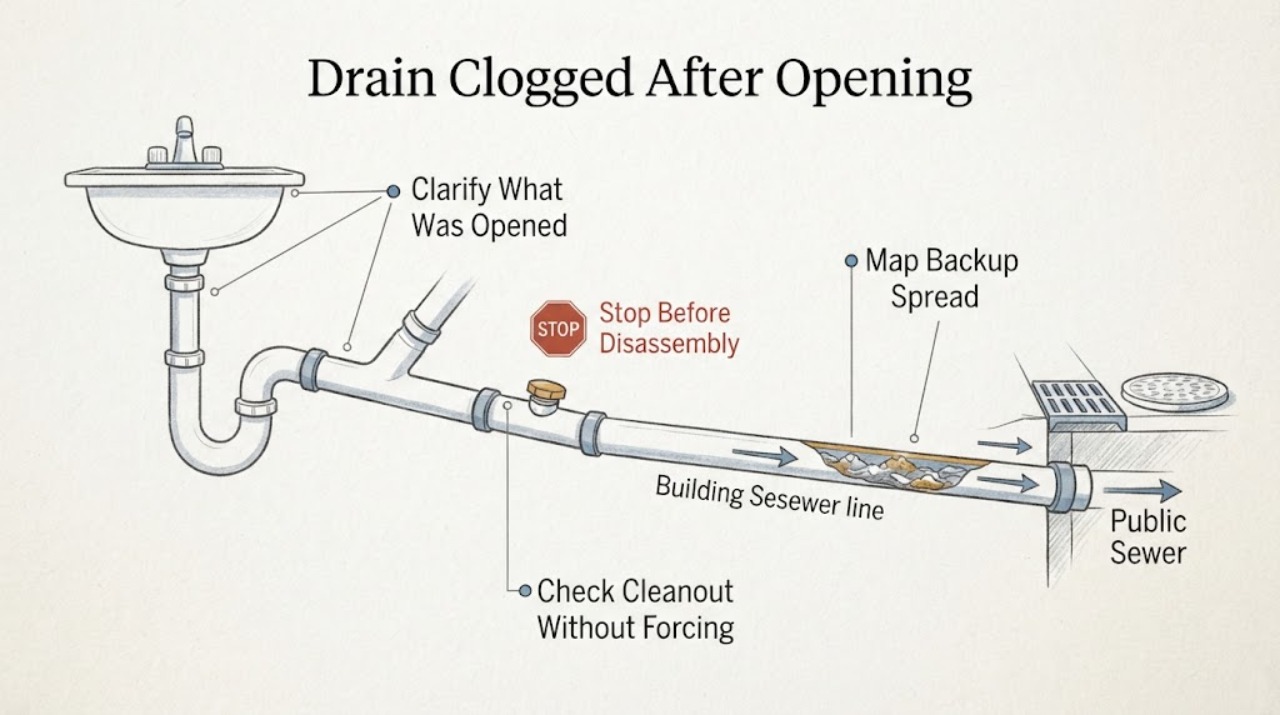
If a drain backs up or stays clogged after something was opened, first clarify what opening changed: a faucet or tap was turned on, a trap or cleanout cap was loosened, or an access cover was removed. Stop adding water and record which fixture receives the backup, whether other fixtures are slow, and whether dirty water rises at the cleanout or floor drain. A single fixture with no chemical in the pipe may permit a cautious plunger or a plumber's hand tool used exactly as directed; a cleanout full of wastewater, several affected fixtures, sewage, or water returning from an open access point indicates a branch or main sewer risk and needs a plumber or utility investigation. Never open a pressurized or overflowing cleanout, put hands into wastewater, mix drain products, or use electrical equipment in wet conditions. If chemical cleaner was used, disclose the product and keep everyone away from splashes and fumes.
Work through in order
Diagnostic checks
Use only checks that match the exact appliance or system and its official guide.
-
Check 1
Without adding more water, identify what was opened: a faucet or tap, the trap below a fixture, a pipe fitting, an indoor cleanout, an outdoor cleanout, or another access cover. Note whether the opening was dry, held clear water, contained dirty water, or immediately released wastewater.
Expected result: Only a fixture control was opened, a local trap or fitting was loosened, a cleanout cap was removed, or an opening immediately filled or overflowed.
Next step: Close or secure the opening without forcing it, stop water use, and continue with a dry visual survey only. If wastewater is rising or the opening is under pressure, leave it alone and request qualified help.
Stop if: Stop for wastewater release, visible pressure, strong sewer gas, chemical odor, flooding, a damaged fitting, or any need to reach into the pipe or enter water near electricity.
Why this matters
Why: A fixture-control opening only tests flow. A trap or fitting points to a local obstruction but may release retained wastewater. A full cleanout indicates water is backed up in the lateral or building drain and should not be treated as a simple fixture clog.
-
Check 2
With all water use stopped, inspect the affected fixture and nearby lower fixtures without opening more fittings. Ask whether another sink, shower, toilet, laundry outlet, or floor drain is slow, gurgling, or receiving dirty water when a different fixture is used.
Expected result: Only one fixture is affected, two or more fixtures are affected, a low floor drain receives wastewater, or no other fixture changes.
Next step: For one isolated fixture with no chemical exposure and no overflow, use only a low-risk clearing method suitable for that fixture and follow its instructions. For multiple fixtures, dirty water, or a low drain backup, stop local clearing and call a licensed plumber or utility.
Stop if: Stop for sewage, flooding, strong sewer gas, chemical residue, a fixture that may tip or break, or any need to remove a toilet or open a pressurized pipe.
Why this matters
Why: A single fixture keeps the first suspect near its opening or trap. Several fixtures or a low drain receiving wastewater indicate a branch or building sewer obstruction, because multiple fixtures share downstream pipework.
-
Check 3
If a cleanout was already safely exposed and is cool, stable, and not under pressure, observe the water level and whether it rises when an unrelated fixture is used; do not remove a stuck cap, insert a tool, or stand over the opening. If no cleanout is visible, locate it from the property records or a dry visual survey rather than opening walls or floors.
Expected result: The cleanout is dry or empty, contains standing wastewater, overflows when water is used, is on private property, or may connect toward the public sewer.
Next step: Keep the cap secure if it can be replaced without force and stop all water use. Photograph the safe exterior state for the plumber or utility. Do not snake, pump, or pour chemicals through the opening unless a qualified professional directs the procedure.
Stop if: Stop for a bulging or leaking cap, flowing wastewater, strong gas, a buried or damaged cleanout, chemical residue, flooding, or any need to force the cap or insert equipment.
Why this matters
Why: A dry cleanout with one local fixture affected supports a more local obstruction. Standing or rising wastewater at a cleanout indicates a downstream blockage. Municipal guidance uses cleanout access to help distinguish a private lateral issue from a public sewer issue, but ownership boundaries require local confirmation.
-
Check 4
Before any plunger, hand tool, trap work, or professional visit, record whether drain opener, bleach, acid, solvent, or another cleaner was added, when it was added, and whether it remains pooled near the opening. Keep labels or containers available for the technician and do not add another product to dilute or neutralize it.
Expected result: No chemical was used, one product was used and remains unknown in the pipe, multiple products were used, fumes or heat are present, or wastewater has splashed.
Next step: If any chemical is present, stop DIY clearing, keep people away, ventilate from a safe position, and tell the plumber the product and timing. Follow the product label and local poison or emergency guidance after exposure.
Stop if: Stop for fumes, heat, skin or eye exposure, a mixed product, corrosive residue, an unknown chemical pool, or a person feeling unwell.
Why this matters
Why: An unknown or mixed chemical can burn skin and eyes or produce harmful gas when disturbed. Government guidance says household chemical products must not be mixed and must be handled and disposed of according to their labels.
-
Check 5
Only when one fixture is affected, no chemical or wastewater is present, the fixture is stable, and the opening is accessible, use a suitable plunger or fixture-specific hand tool exactly as directed, protecting nearby surfaces from splash. Stop after one controlled attempt if flow does not improve; do not use high-pressure equipment or force a cable through an unknown fitting.
Expected result: Flow restores and stays clear, the obstruction shifts but the fixture remains slow, dirty water returns, the tool meets hard resistance, or another fixture begins backing up.
Next step: If flow remains normal, use the fixture conservatively and monitor recurrence. If it remains slow or another fixture changes, stop and arrange a plumber; disclose any tool or cleaner used.
Stop if: Stop for wastewater splash, chemical residue, hard resistance, a damaged fixture, flooding, strong gas, or any need to use powered or high-pressure equipment.
Why this matters
Why: Stable flow after one safe attempt supports a local soft obstruction. Repeated slowness, hard resistance, returning dirty water, or a newly affected fixture indicates a deeper or shared-line issue and is not proof that more force will help.
-
Check 6
For multiple affected fixtures, a full or overflowing cleanout, wastewater at a low drain, or a backup that returns after local clearing, stop all water use and note the lowest affected point, safe cleanout location, and whether neighbors or public areas show a similar issue. Do not open a manhole or remove a cleanout cap under pressure.
Expected result: The cleanout overflows, the private line appears full, a public sewer or street area is affected, only the home is affected, or the location cannot be safely determined.
Next step: Contact the local sewer or public-works utility for a possible public-line check and arrange a licensed plumber for the private side. Keep people and pets away from wastewater and protect the area without entering contaminated water.
Stop if: Stop for sewage overflow, flooding, strong sewer gas, a public manhole or cleanout, electrical equipment in wet areas, or any need to perform excavation or powered clearing.
Why this matters
Why: A broad backup is consistent with a downstream building sewer, lateral, or public-line obstruction. Municipal sources explain that a utility can inspect its sewer while a private-line issue may require a licensed plumber; the exact boundary depends on local rules.
-
Check 7
Arrange a licensed plumber when the drain remains clogged after one safe isolated-fixture attempt, when a trap or cleanout needs to be opened or cleared, when several fixtures are involved, or when wastewater or chemical exposure is present. Provide the exact opening used, the backup spread, cleanout water level, chemical history, and safe photographs.
Expected result: The obstruction returns, the cleanout remains full, several fixtures are slow, dirty water rises, a tool cannot pass, or the cause may be in the public sewer.
Next step: Stop water use, keep openings secured, protect people from contamination and fumes, and use the plumber or utility to determine the responsible section and safe clearing method.
Stop if: Do not continue after sewage, fumes, flooding, visible pipe damage, strong gas, electrical wetness, or any need to force an opening or use powered equipment.
Why this matters
Why: The remaining possibilities include a trap or branch obstruction, building sewer blockage, root or pipe damage, a vent or backwater condition, or a public sewer issue. A symptom alone cannot identify the obstruction or justify a particular chemical or replacement.
Use your observations
Decision map
Find the observation that best matches what you see, then follow the next safe action.
-
PATH 01Next step
What you see
Sewage, dirty water, chemical fumes, skin or eye exposure, flooding, strong sewer gas, or electrical equipment near water is present.
Do this next
Arrange qualified service and follow the exact model guidance.
Why this path and its safety boundary
Why it matters: Stop water use and local clearing, move people and pets away, ventilate only from a safe position, and contact qualified plumbing, utility, emergency, poison, or medical help as appropriate. Do not mix products or enter contaminated water.
-
PATH 02Next step
What you see
Opening meant turning on a faucet or tap, and no other fixture or cleanout is backing up.
Do this next
Arrange qualified service and follow the exact model guidance.
Why this path and its safety boundary
Why it matters: Treat the symptom as an isolated fixture check. Stop adding water, inspect the accessible drain and trap area, and use at most one suitable low-risk clearing attempt when no chemical or wastewater hazard exists.
-
PATH 03Next step
What you see
A trap or local pipe fitting was opened and held water or debris, but there is no broad backup or chemical exposure.
Do this next
Arrange qualified service and follow the exact model guidance.
Why this path and its safety boundary
Why it matters: Stop water use, contain the retained water, secure the fitting without force, and arrange a plumber if the blockage is not immediately accessible and safe. Do not reach into wastewater or use a powered tool.
-
PATH 04Next step
What you see
A cleanout is full, rises when water is used, or overflows after its cap was opened.
Do this next
Arrange qualified service and follow the exact model guidance.
Why this path and its safety boundary
Why it matters: Do not reopen or insert equipment. Stop all water use, keep the opening secured if safe, and call a licensed plumber; ask the local utility whether a public sewer check is appropriate.
-
PATH 05Next step
What you see
Only one fixture is slow or blocked, no other fixture changes, and no chemical or wastewater hazard is present.
Do this next
Arrange qualified service and follow the exact model guidance.
Why this path and its safety boundary
Why it matters: Use a fixture-appropriate plunger or hand tool once and stop if flow does not stay clear. Persistent resistance or recurrence needs a plumber to assess the local trap or branch.
-
PATH 06Next step
What you see
Several fixtures are slow, gurgling, or receiving dirty water, or a low drain backs up when another fixture is used.
Do this next
Arrange qualified service and follow the exact model guidance.
Why this path and its safety boundary
Why it matters: Treat the problem as downstream of a shared section. Stop water use and arrange plumbing and utility investigation instead of repeatedly clearing individual openings.
-
PATH 07Next step
What you see
A drain product or other household chemical was added, the product is unknown, or more than one product may be present.
Do this next
Arrange qualified service and follow the exact model guidance.
Why this path and its safety boundary
Why it matters: Do not add water, mix products, plunge, or cable the line. Keep people away from fumes and splashes, preserve the label, and tell the plumber or poison service exactly what was used.
Helpful context
Understand the symptom
What did opening mean?
Write down exactly what changed. Opening a tap or faucet tests whether incoming water can pass through the fixture. Loosening a trap or pipe fitting exposes a local section and can release retained wastewater. Removing a cleanout cap exposes the building sewer or lateral, where a full pipe may spill immediately. Do not assume that a cleanout, a trap, and a fixture opening are interchangeable access points.
Use the spread of the backup to locate the risk
One slow or backed-up fixture usually keeps the first check near that fixture and its trap. Several fixtures, a toilet that gurgles when another fixture drains, or wastewater at a low floor drain points farther downstream toward a branch or building sewer. A cleanout that is full or overflowing can show that the blockage is downstream of that access point, but exact responsibility varies by property and utility boundary.
Keep wastewater and chemicals contained
Stop water use as soon as wastewater rises. Keep children and pets away, ventilate without spreading contaminated droplets, and use suitable gloves and footwear if a safe cleanup is unavoidable. Never combine drain products, add a second product to an unknown one, or use a plunger, cable, or wet electrical tool where corrosive liquid may be present. Tell the plumber exactly what was used.
When an opening becomes a stop condition
Do not loosen a cap that is bulging, leaking, or under visible pressure. Do not reach into wastewater or enter a flooded area with electrical equipment. If the cleanout overflows, several fixtures back up, sewer gas is strong, the property is flooding, or a public sewer may be involved, stop local clearing attempts and contact a licensed plumber or the responsible utility.
Safety boundary
Stop conditions
- Sewage, dirty water, chemical fumes, skin or eye exposure, flooding, strong sewer gas, or an unsafe contaminated area is present.
- A cleanout cap is bulging, leaking, under pressure, stuck, damaged, or letting wastewater out.
- Several fixtures back up, a low drain receives wastewater, or the cleanout remains full after water use stops.
- Any chemical product is unknown, mixed, pooled, or still in the pipe; never add another product to it.
- Water is near electrical equipment, or clearing would require a powered tool, high-pressure equipment, excavation, or entry into a wet area.
- The drain remains clogged after one safe isolated-fixture check, the obstruction returns, or a public sewer may be involved.
Only after diagnosis
Potential parts
- fixture trap or cleanout cap
Consider this category only when a plumber confirms a damaged or failed trap or cap after locating the obstruction and checking the existing configuration.
Confirm the pipe size, fitting type, access location, drainage code, and local requirements before selecting a component. - drain grate or hair screen
Consider this category only for an isolated fixture where the blockage history shows recurring surface debris and the existing opening accepts the accessory.
Confirm the fixture opening, dimensions, material, and safe access; this does not address a branch or sewer obstruction. - backwater valve or sewer access improvement
Consider this category only after a qualified assessment confirms recurring downstream backup risk and a suitable installation path.
Confirm local plumbing rules, pipe layout, maintenance access, and professional installation requirements; do not install from symptoms alone.
When checks do not resolve it
Need a professional?
Opening a trap, fitting, or cleanout released wastewater, showed pressure, or cannot be safely secured., Several fixtures are slow or backing up, a low drain receives wastewater, or dirty water returns after another fixture is used., A cleanout is full or overflowing, or the private versus public sewer section is unclear., A drain product, bleach, acid, solvent, or unknown chemical was used, especially if more than one product may be present., One safe isolated-fixture attempt fails, the obstruction returns, or any flooding, strong gas, electrical, structural, or contamination risk is present.
Common questions
FAQ
What does after opening mean for a clogged drain?
It can mean a tap was turned on, a trap or fitting was loosened, or a cleanout cap was removed. Those are different observations. Record which opening changed the symptom, stop water use, and do not assume an open cleanout is safe to clear.
What if water comes back when I open the cleanout?
Stop all water use and do not reopen, force, or insert a tool into the opening. A full or overflowing cleanout can indicate a downstream lateral or sewer obstruction. Keep people away and contact a licensed plumber; the local utility may need to check its section.
How do I know if one fixture or the main drain is clogged?
If only one fixture is affected, the first suspect is usually near that fixture or its trap. Several slow fixtures, gurgling, a low drain backup, or wastewater at a cleanout indicates a shared downstream section and needs a plumber or utility investigation.
Can I add another drain cleaner after opening the drain?
No. Do not mix products or add a second cleaner to an unknown chemical already in the pipe. Government guidance warns that household chemicals can create harmful gases, burns, fire, or explosions; preserve the label and tell the plumber what was used.
When should I stop trying to clear a clogged drain?
Stop for wastewater, fumes, strong sewer gas, flooding, a pressurized or damaged cleanout, multiple affected fixtures, water near electricity, chemical exposure, or a clog that remains after one safe isolated-fixture attempt. Keep the opening secured and arrange qualified help.
Read the exact guide
Official sources
- How it worksCity of Minneapolis Public Works · Municipal explanation of fixtures, traps, vents, building drains, laterals, and public sewer backup checks
- Sewage backupsThe City of Calgary · Municipal sewage-backup exposure, cleanout access, private-versus-public assessment, and water-use guidance
- Sewer CleanoutsCity of Minneapolis Public Works · Municipal sewer cleanout location, purpose, and homeowner access guidance
- Use household chemicals safelyHealth Canada · Government household chemical handling, no-mixing, ventilation, exposure, and disposal guidance
- Household Hazardous Waste (HHW)U.S. Environmental Protection Agency · Government household hazardous-waste handling, drain-cleaner disposal, and non-chemical alternatives
- What to Do if Your Sewer Backs UpCity of Lincoln Public Works · Municipal cleanout observation, stopping water use, and private-versus-public sewer guidance
Community feedback
Share a repair observation
Share a plain-text repair observation. Accepted observations are published automatically; this page may take a moment to update.