
On this page
Start here
Quick answer
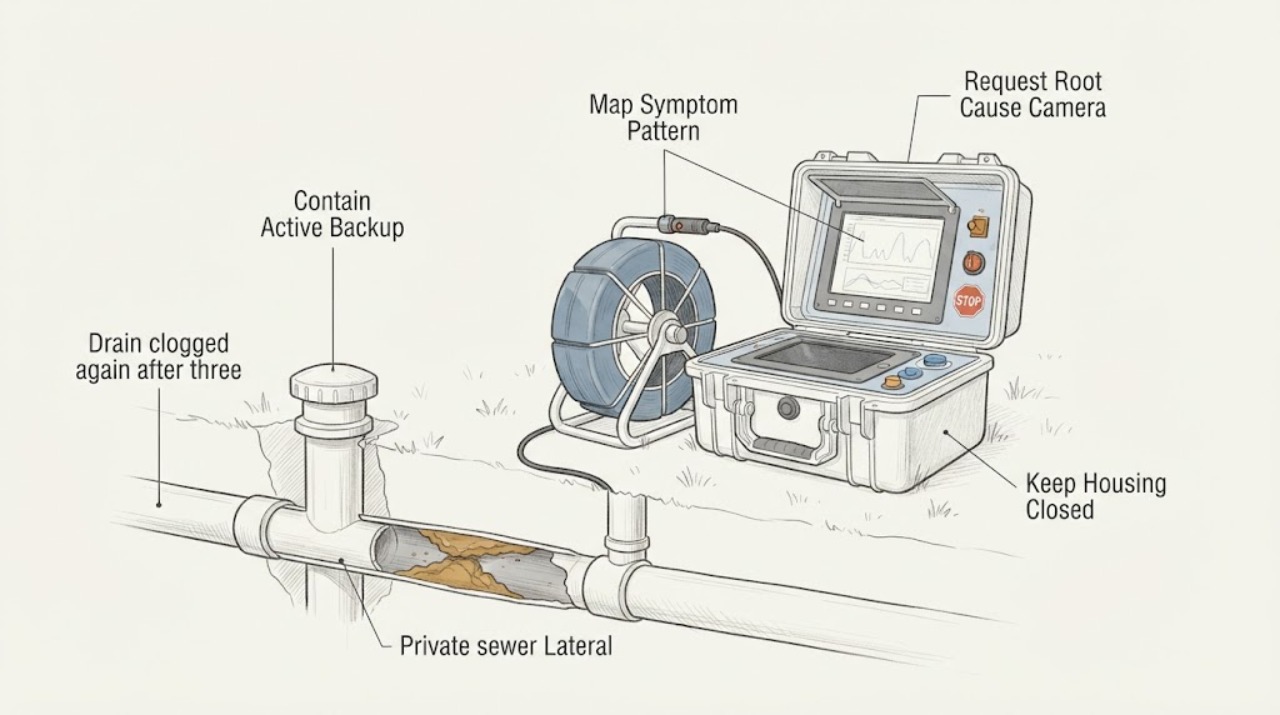
A drain that has needed three professional hydro-jets in six months needs a cause-and-location diagnosis, not an automatic fourth cleaning. Stop and document the pattern, reduce water use if wastewater is backing up, and ask a qualified plumber or the sewer utility to determine whether the problem is one fixture, a private lateral, or the public main. Request a camera inspection after the line is flowing, with the video and the distance from an identified cleanout recorded. The inspection should look for roots, grease or foreign material, a crack, offset, sag, collapse, or another structural defect; the correction depends on that finding. Do not approve excavation, a backwater device, or repeated jetting from a verbal guess alone. If sewage is standing or overflowing, keep people and pets out of it, avoid contact, stop nonessential water use, and arrange utility or qualified emergency service.
Before you begin
Safety first
- Do not enter sewage-contaminated water, touch wet electrical equipment, force a camera or jet through an unsafe access, open buried or public infrastructure, excavate, or authorize a repair based only on a verbal guess. Stop water use during an active backup and follow utility, licensed-professional, and local emergency guidance.
Work through in order
Diagnostic checks
Use only checks that match the exact appliance or system and its official guide.
-
Check 1
If wastewater is currently backing up, pooling, or overflowing, stop nonessential water use in the building, keep people and pets away from the water, and report the suspected sewer backup to the sewer utility or a qualified emergency plumber; do not enter standing water or handle wet electrical equipment.
Expected result: Record whether there is active wastewater, a sewage odor without visible water, a slow drain only, or no current symptom; record where it appears and whether other fixtures are being used when it rises.
Next step: For active backup, follow the utility or qualified professional's containment instructions and wait for the line to be made safe before testing or camera work. For a slow isolated fixture, continue only with ordinary observation and arrange diagnosis rather than another blind jet.
Stop if: Stop immediately for sewage contact, electrical equipment in or near water, rapidly rising wastewater, structural damage, or an unsafe access point; use qualified emergency help and local emergency guidance.
Why this matters
Why: Visible wastewater or a low-level backup creates a sanitation and possible electrical hazard and may involve a private lateral or a public main. A single slow fixture without backup is a different diagnostic branch.
-
Check 2
Make a dated recurrence log from the three hydro-jet visits: affected fixture or fixtures, backup location, slow-drain timing, recent rain or high-flow event, the access point used, the approximate cable or hose distance if provided, and what each visit said was removed.
Expected result: Classify the symptom as one fixture, one branch, several fixtures on a lower level, or most fixtures in the building; note whether using a toilet, washer, or other fixture makes another opening rise.
Next step: Give the log, prior invoices, jetting reports, photos, and any cleanout location to the plumber and the utility. Ask them to compare the three service access points and locations rather than repeating the same route without an explanation.
Stop if: Do not remove a toilet, open a wall or buried cleanout, or excavate to test a theory; stop and obtain qualified advice when access, contamination, or property-line responsibility is uncertain.
Why this matters
Why: One fixture supports a trap, branch, or local drain investigation. Several fixtures that respond together make a shared building drain, lateral, or main more plausible, but the pattern alone cannot assign responsibility.
-
Check 3
When flow has been safely restored, request a CCTV inspection from a suitable cleanout or other qualified access point and ask for the complete video, direction of travel, exact measured distance, pipe condition notes, and a line-locating or property-side explanation when applicable.
Expected result: Check whether the report identifies roots, grease or foreign material, an offset, crack, hole, fracture, sag, collapse, deformation, or no visible defect; note where the camera could not pass and why.
Next step: Have the provider explain the finding and options in writing. If the problem may be on the public side, send the video and location to the sewer utility; if it is private, obtain a repair or rehabilitation proposal that identifies the affected section and access requirements.
Stop if: Do not authorize excavation, lining, replacement, root treatment, or a backwater device solely from a verbal claim or an unlocated distance; stop for a second qualified opinion when the video is missing, cannot be tied to an access point, or the proposed work does not match the finding.
Why this matters
Why: A recurring blockage with a documented defect points to a correction matched to that defect. An incomplete or inconclusive view is not evidence that the whole lateral needs replacement and is not a reason to keep jetting indefinitely.
-
Check 4
Ask the utility or qualified plumber to identify the affected section relative to the property line, cleanout, easement, and public main before selecting who will clear or repair it; follow local call-before-you-dig and permit requirements before any ground disturbance.
Expected result: Record whether the utility finds a main-side obstruction, whether the private lateral remains blocked after the main is clear, and whether the inspection can reach the connection between private and public sections.
Next step: Use the utility's determination and the camera evidence to request the correct repair or maintenance plan. Keep written responsibility findings with the video and do not assume a municipal or private obligation from a generic service invoice.
Stop if: Stop before digging, exposing a buried line, or working in a public right-of-way when the line has not been located or approvals and qualified supervision are not in place.
Why this matters
Why: The same indoor symptom can come from different owners' sections. Utility confirmation may change the responsible party, the safe access method, and whether private excavation is appropriate.
-
Check 5
Compare the proposed correction with the documented defect: address the contributing material or root pattern, repair or rehabilitate a damaged section, or investigate a local trap, branch, or vent when the shared line is clear; set a follow-up inspection or monitoring date with the provider.
Expected result: The proposal should name the abnormal location and explain why it will prevent recurrence, what temporary limitations apply, and what result will confirm success; a proposal that only says 'jet again' without a cause leaves the recurrence unresolved.
Next step: Approve work only after the diagnosis, compatibility of the method with the pipe and site, local approvals, and the service provider's safety plan are clear. Retain the before-and-after video and schedule reinspection when the provider recommends it.
Stop if: Stop and obtain another qualified assessment if the proposed work has no video or measured location, requires unsafe entry, promises a guaranteed outcome without a finding, or would alter the sewer without required approvals.
Why this matters
Why: Roots, grease or foreign material, and structural failures are not interchangeable findings. A clean camera with an isolated fixture symptom may avoid unnecessary lateral work; a confirmed collapse or severe defect needs a qualified repair decision.
Use your observations
Decision map
Find the observation that best matches what you see, then follow the next safe action.
-
PATH 01Safety boundary
What you see
Wastewater is pooling, rising through a low fixture, or overflowing.
Do this next
Stop nonessential water use, keep people and pets out, report the backup to the utility or qualified emergency plumber, and wait for safe access and the main-versus-lateral assessment.
Why this path and its safety boundary
Why it matters: This is a sanitation and possible electrical hazard, and the blockage may be on the private lateral or public main.
Safety stop: Do not enter standing water, touch wet electrical equipment, or keep testing fixtures.
-
PATH 02Safety boundary
What you see
Only one sink, shower, toilet, or appliance drain is slow and other fixtures remain normal.
Do this next
Tell the plumber the symptom is isolated and ask for local trap/branch/vent diagnosis before authorizing a lateral replacement.
Why this path and its safety boundary
Why it matters: A trap, branch connection, vent, or local fixture issue is plausible; three prior whole-line services do not prove the entire lateral is defective.
Safety stop: Stop for leaks, sewage contact, unsafe disassembly, or a need to open walls or floors.
-
PATH 03Safety boundary
What you see
Several fixtures drain slowly together or using one fixture makes a lower-level drain or toilet rise.
Do this next
Limit water use, report the pattern, and request main-versus-lateral confirmation followed by CCTV after flow is restored.
Why this path and its safety boundary
Why it matters: A shared building drain, private lateral, or main-side problem is more plausible than a single trap, but the location still needs utility or camera evidence.
Safety stop: Do not keep flushing, run washing machines, or repeatedly jet without recording the access point and result.
-
PATH 04Safety boundary
What you see
The video documents roots, an offset, crack, hole, fracture, sag, collapse, or another obstruction at a measured location.
Do this next
Obtain a written repair, rehabilitation, or root-management proposal that identifies the section, access, approvals, and verification video; use the utility when the section may be public.
Why this path and its safety boundary
Why it matters: The recurring symptom has a documented candidate cause; a correction matched to the finding should be evaluated instead of treating the symptom with indefinite cleaning.
Safety stop: Do not dig or approve full replacement before the line is located and the proposed extent is supported by the video and local requirements.
-
PATH 05Safety boundary
What you see
The camera cannot pass, the pipe is full, the recording is incomplete, or the distance and access point are not documented.
Do this next
Ask the qualified provider to explain the limitation and propose a safe alternate access, flow-restoration, locating, or second-opinion plan; retain the incomplete recording.
Why this path and its safety boundary
Why it matters: The inspection has not established a safe, location-specific diagnosis.
Safety stop: Do not treat an inconclusive view as proof of collapse, full replacement, or a public-side defect, and do not force equipment through a damaged line.
Helpful context
Understand the symptom
Why three clearings in six months changes the next step
A hydro-jet can restore flow, but the return of the same symptom is evidence that the obstruction, the pipe condition, the contributing material, or the affected section has not been identified or corrected. That is a decision point, not proof of one specific defect. A drain problem may be limited to one fixture or branch, in a private building sewer or lateral, or in a public main. Madison Engineering describes a sewer backup as a blockage in either the private lateral or city main and lists roots, grease and debris, and aging-related cracks, holes, fractures, or collapse among possible causes. The practical next step after repeated service is to obtain location and condition evidence before authorizing more invasive work.
Get the line flowing safely before relying on a camera
A camera cannot give a useful view through standing blockage or heavy debris. Ask the service provider to state what was cleared, from which access point, and whether flow was restored before inspection. Keep the access point and the cable distance in the report. If the line will not drain, do not force a camera, open a buried cleanout, or dig to chase a suspected route; the provider should explain the safe access and escalation plan. Waterloo also advises reporting a sewer issue with the location, whether all drains or only one are affected, the symptom, and photos where possible.
Use the video to choose a repair category, not a product
Ask for the video, the direction of travel, the measured distance from the access point, and a written description of every abnormal segment. Root intrusion, grease or foreign material, an offset joint, a sag, a crack, or a collapse require different decisions. A clean-looking lateral with a single fixture symptom shifts the investigation toward the fixture trap, branch, or vent rather than a whole-lateral replacement. A finding on public property may require the utility to inspect or clear its side; a private-property finding may be the owner's responsibility under local rules. Do not infer responsibility or approve replacement solely from a camera distance without confirming the property line, easement, and local requirements.
Treat backup water as a sanitation and electrical boundary
If wastewater is rising through a floor drain, toilet, shower, or other low opening, stop all nonessential water use and keep people and pets away from standing water. Do not touch wet electrical equipment or enter contaminated water to retrieve items. Madison's sewer-backup guidance says to stop all water use and stay out of standing water; CDC guidance says sewage-contaminated water can make people sick and advises avoiding contact. A qualified utility, plumber, and cleanup professional can determine whether the main or lateral is involved and the safe restoration sequence.
When checks do not resolve it
Need a professional?
Safety scope: Do not enter sewage-contaminated water, touch wet electrical equipment, force a camera or jet through an unsafe access, open buried or public infrastructure, excavate, or authorize a repair based only on a verbal guess. Stop water use during an active backup and follow utility, licensed-professional, and local emergency guidance.
Common questions
FAQ
Should I schedule a fourth hydro-jet after three cleanings in six months?
Do not make another blind cleaning the default. If flow is not safe or there is an active backup, qualified emergency service or the utility may need to clear it first. Once flow is restored, request CCTV with a recorded access point, measured distance, complete video, and a written explanation of the cause and affected section.
What can cause a drain to clog again so quickly?
Possible causes include roots, grease or foreign material, a crack, offset, sag, collapse, or a local branch or fixture problem. The recurrence does not identify which one is present; the camera and location evidence should determine the next correction.
How do I know whether the city or I am responsible?
Ask the sewer utility to check the public main and confirm the property-line or easement boundary. Several municipal utilities distinguish a public-main obstruction from a private lateral, but responsibility and permit rules vary by location. Keep the utility's written finding and the camera video.
What if the camera cannot get past the blockage?
An incomplete view is not proof of a collapsed line or full replacement. Ask the qualified provider to explain why the camera stopped and propose a safe alternate access or second-opinion plan. Do not force equipment, dig, or approve replacement from an unlocated verbal diagnosis.
What should I do if sewage is already on the floor?
Stop nonessential water use, keep people and pets away, avoid contact with the water, and do not handle wet electrical equipment. Report the backup to the utility or qualified emergency service and follow professional cleanup and local safety instructions.
Read the exact guide
Official sources
- Guidelines for Septic and Onsite Wastewater SystemsCenters for Disease Control and Prevention · CDC safety guidance focuses on septic and flood-related wastewater hazards; the contamination and professional-service precautions also inform an active sewage backup boundary.
- Sewer BackupsCity of Madison Engineering · Municipal sewer-backup guidance; local utility ownership, response, permitting, and responsibility rules vary by location.
- Report a sewer blockageCity of Waterloo · Waterloo utility process; use the local sewer authority's contact, call-before-you-dig, property-line, and permit rules elsewhere.
Community feedback
Share a repair observation
Share a plain-text repair observation. Accepted observations are published automatically; this page may take a moment to update.