
On this page
Start here
Quick answer
Stop adding water and first determine whether one fixture is slow or several fixtures back up together. Keep wastewater contained, inspect only the visible drain opening, and use a suitable plunger only when no drain chemical has been added and there is no standing sewage or electrical hazard. Do not mix cleaners, pour more chemical into a blocked line, open a trap or cleanout containing unknown liquid, or force a connection. A whole-home backup, sewage, repeated clog, inaccessible line, or any prior chemical treatment needs a plumber; leave the area and seek chemical-emergency guidance if fumes, splashes, or burns are involved.
Before you begin
Safety first
- This article covers water-use isolation, safe observation, loose surface debris, and one limited untreated plunger check. Do not mix or add chemicals, open a trap or cleanout containing unknown liquid, use powered or pressure equipment, handle sewage, or work near water and electricity.
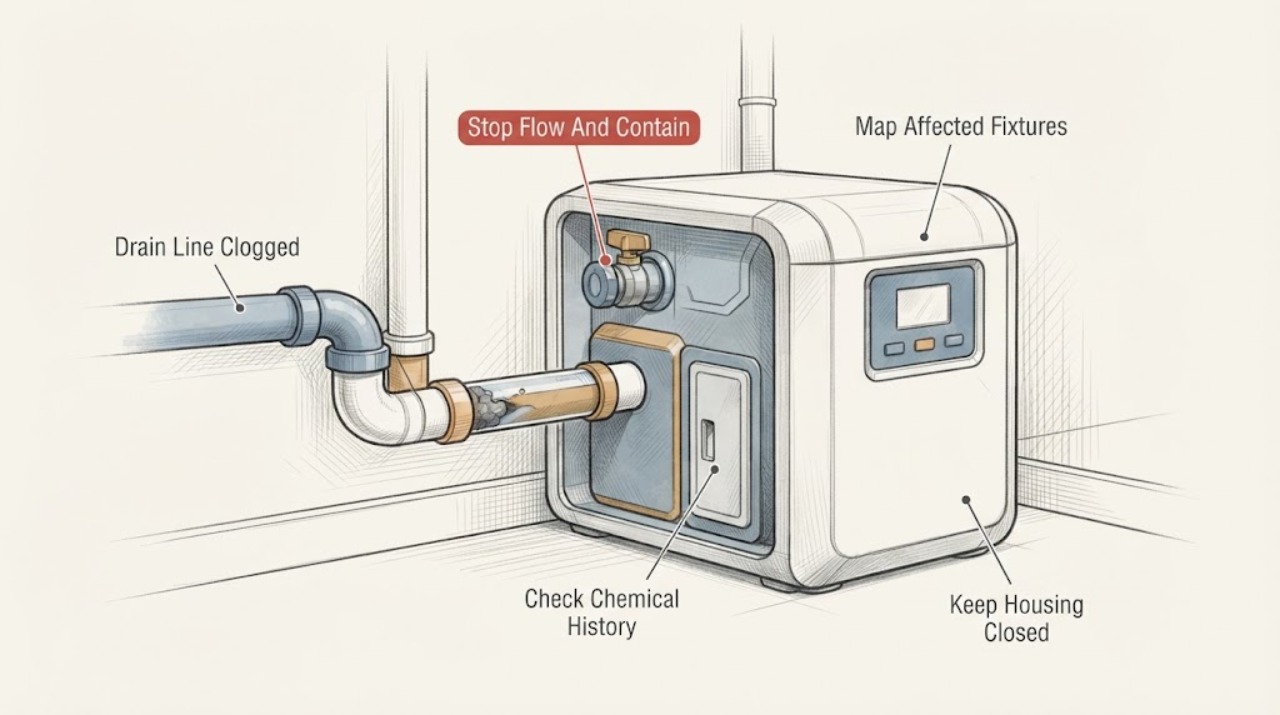
Work through in order
Diagnostic checks
Use only checks that match the exact appliance or system and its official guide.
-
Check 1
Stop using the affected fixture and nearby water sources, move people and pets away from the wet area, and place a container or absorbent material where it can safely catch a small amount of overflow without touching contaminated water.
Expected result: Record whether water is standing, rising, leaking from a joint, returning through another fixture, or carrying sewage, foul contents, or an unknown chemical product.
Next step: Keep water use stopped and move to the extent and chemical-history checks without opening the line.
Stop if: Stop all contact for sewage, unknown liquid, active flooding, electrical equipment near water, strong fumes, or any skin, eye, or breathing symptom.
Why this matters
Why: Standing wastewater, a leak at a joint, or sewage returning through another fixture raises the risk of contamination and property damage; this is no longer a simple visible-opening check.
-
Check 2
From dry, safe positions, check whether the clog affects only one fixture or whether nearby sinks, tubs, toilets, floor drains, or other branches are also slow or backing up; do not run extra water to create a test.
Expected result: Note the fixtures affected, whether the highest or lowest fixture behaves differently, whether flushing or draining another fixture causes a rise, and whether the issue is limited to one room.
Next step: For multiple fixtures, backup, or sewage, stop water use and arrange plumbing service. For one isolated, non-chemical fixture, continue only with the visible-opening check.
Stop if: Do not continue testing by flushing, running a washer, filling a tub, or adding water when another fixture rises or wastewater is present.
Why this matters
Why: One fixture supports a local opening or trap-side obstruction; several fixtures, cross-fixture movement, or a low-level backup suggests a branch, main, septic, or building-drain problem.
-
Check 3
Before touching the drain opening, ask whether any drain opener, bleach, toilet cleaner, descaler, or other chemical was poured into it, and keep the original product container or label available without opening or transferring it.
Expected result: Classify the line as untreated, treated with a known product and time, or unknown; note any fumes, heat, splash, discoloration, or symptoms.
Next step: For any chemical history or symptom, leave the area as needed, ventilate only without exposing yourself, and contact a plumber or appropriate chemical-exposure service with the product information.
Stop if: Never mix products, add a neutralizer, pour another cleaner, or continue work when fumes, heat, splash, burns, or breathing irritation are present.
Why this matters
Why: An untreated line may permit a limited mechanical check; a treated or unknown line can contain corrosive or reactive liquid and must not be plunged, disconnected, or opened by an unprotected homeowner.
-
Check 4
For one isolated untreated fixture, inspect only the drain cover, strainer, stopper, and visible opening from a dry stable position; remove loose surface hair or debris only if it comes away without reaching into standing water or dismantling the drain line.
Expected result: Record whether the opening is visibly blocked, the stopper or strainer is displaced, water level falls slowly, or the obstruction is not visible and lies beyond the opening.
Next step: If the opening is clear or the clog remains beyond it, use a suitable plunger only when the line is untreated and there is no sewage or electrical hazard; otherwise arrange service.
Stop if: Do not remove a trap, cleanout, stopper assembly, or drain cover that is sealed, pressurized, contaminated, or holding unknown liquid.
Why this matters
Why: A loose surface obstruction supports a limited cleaning step; a hidden obstruction, standing water, or a line that remains slow points beyond safe visible access.
-
Check 5
Only for an isolated, untreated, non-sewage fixture with a safe amount of water, fit the correct plunger over the opening and use controlled manual strokes according to the fixture type; keep splash away from your face and stop if the seal or fitting moves.
Expected result: Note whether water begins to drain, rises into another fixture, leaks at a joint, or remains unchanged after the limited attempt.
Next step: Rinse only through normal fixture use if the drain is stable and untreated; if flow does not restore, returns, or moves to another fixture, stop and request a plumber to select the appropriate line-clearing method.
Stop if: Do not plunge after chemical treatment, against sewage or unknown liquid, over a damaged fitting, or when the line backs up into another fixture.
Why this matters
Why: A restored drain supports a local obstruction, but a returning clog or movement at a joint suggests a deeper or mechanical problem; a rise elsewhere indicates the blockage is not localized.
-
Check 6
Classify the result after the limited check as a stable one-fixture drain, a returning or deeper clog, a multi-fixture or sewer backup, a leaking or damaged line, or a chemical-exposure situation.
Expected result: Record fixture locations, water level and flow changes, sewage or chemical history, visible joint condition, prior attempts, and whether the clog returned.
Next step: Give the plumber the fixture map, photos from a dry safe position, chemical history, and exact result; keep water use minimized until the line is assessed.
Stop if: Do not open a cleanout or trap, use a powered auger, add chemicals, pressure-flush the line, or enter a contaminated or flooded area as a homeowner troubleshooting step.
Why this matters
Why: Only a stable one-fixture improvement without contamination supports ordinary monitoring. Every other result needs a plumber or the appropriate emergency/chemical response because the blockage or hazard is beyond the visible opening.
Use your observations
Decision map
Find the observation that best matches what you see, then follow the next safe action.
-
PATH 01Safety boundary
What you see
Only one fixture is slow or clogged, there is no chemical history, no sewage, no active leak, and the visible opening is safely accessible.
Do this next
Remove only loose surface debris and use a suitable plunger with controlled strokes; stop if flow does not improve or the fitting moves.
Why this path and its safety boundary
Why it matters: A local obstruction is plausible and one limited manual-plunger check may be reasonable.
Safety stop: Do not add drain cleaner, dismantle the line, or keep plunging when wastewater or a second fixture rises.
-
PATH 02Safety boundary
What you see
Several fixtures are slow or backing up, or draining one fixture makes another rise.
Do this next
Stop nonessential water use, keep people away from wastewater, and arrange plumbing or septic service for line-level diagnosis.
Why this path and its safety boundary
Why it matters: The blockage may be in a branch, main building drain, sewer connection, or septic system rather than at one fixture opening.
Safety stop: Do not flush, run appliances, open a contaminated cleanout, or use chemicals to force a system-wide blockage through.
-
PATH 03Safety boundary
What you see
Any drain opener, bleach, toilet cleaner, descaler, or unknown chemical was added to the blocked line.
Do this next
Leave the line undisturbed, retain the product information, and contact a plumber; follow chemical-exposure guidance and move to fresh air if fumes or symptoms occur.
Why this path and its safety boundary
Why it matters: The standing liquid or residue may be corrosive or reactive, making plunging, disassembly, and mixing unsafe.
Safety stop: Never mix products, add a neutralizer, pour more water or cleaner to force movement, or touch a splash without appropriate emergency guidance.
-
PATH 04Safety boundary
What you see
The backup contains sewage, the floor is flooding, a drain joint leaks, or water is near electrical equipment.
Do this next
Stop water use, keep people and pets out, isolate the immediate area only if safe, and arrange emergency plumbing or water/electrical safety assistance.
Why this path and its safety boundary
Why it matters: Contamination and property risk exceed an ordinary clog check; the line or surrounding building systems need controlled service.
Safety stop: Do not touch sewage, enter standing water near electricity, open the line, or continue mechanical clearing.
-
PATH 05Safety boundary
What you see
The clog remains after one safe visible-opening check, returns soon, or lies beyond a safely accessible opening.
Do this next
Keep water use limited and request a plumber to choose a compatible snake, cleanout, camera, or repair method after inspecting the line.
Why this path and its safety boundary
Why it matters: A deeper obstruction, damaged pipe, root intrusion, grease accumulation, or other line condition is possible and cannot be identified safely from the fixture.
Safety stop: Do not use a powered auger, pressure device, improvised probe, or force a trap or cleanout connection as a homeowner experiment.
Helpful context
Understand the symptom
Start by locating the extent of the clog
A slow sink, shower, or floor drain can be a local obstruction, while several fixtures backing up at once points farther along the branch or building drain. Stop running water, note which fixtures are affected, and protect the floor before trying to clear anything. If wastewater is rising, contains sewage, or returns through another fixture, containment and service take priority over a forceful DIY attempt.
Keep chemical history visible
Ask whether anyone has poured drain opener, bleach, toilet cleaner, or another product into the line. Do not add a second product, and do not plunge, disconnect piping, or open a cleanout over liquid that may contain a corrosive cleaner. Keep the container or product label available for the plumber. EPA and CDC guidance treats household hazardous chemicals and caustic drain-cleaner ingredients as exposure and disposal hazards.
Use one low-risk mechanical check, then stop at the line boundary
When the affected fixture is isolated, there is no chemical history, and the water is not sewage or near electrical equipment, a properly fitted plunger may be a reasonable first mechanical check. Work from the fixture opening without dismantling the drain line. If the obstruction does not clear promptly, returns, or sits beyond the visible opening, a plumber can choose a snake, cleanout, camera, or other method after identifying the pipe condition.
Only after diagnosis
Potential parts
- drain strainer or stopper
Consider this only if the visible fixture check finds a damaged or missing strainer or stopper that is contributing to the local blockage.
Opening size, fixture style, and overflow design vary; confirm the exact fixture before ordering. - drain trap or cleanout fitting
Consider this only if a plumber finds a damaged, leaking, or inaccessible fitting during line diagnosis.
Pipe material, diameter, venting, access, and local plumbing requirements determine compatibility; do not open or replace a contaminated fitting as a first check.
When checks do not resolve it
Need a professional?
Safety scope: This article covers water-use isolation, safe observation, loose surface debris, and one limited untreated plunger check. Do not mix or add chemicals, open a trap or cleanout containing unknown liquid, use powered or pressure equipment, handle sewage, or work near water and electricity.
Common questions
FAQ
Should I pour drain cleaner into a clogged drain?
Do not add chemical cleaner by default, especially when the product history is unknown or water is standing. EPA lists a plunger or plumber's snake as alternatives and warns about disposal and chemical hazards; a plumber should handle a treated or persistent line.
Can I plunge a drain after using drain cleaner?
No. Treat the line as chemically contaminated until a plumber or appropriate safety professional advises otherwise. Do not plunge, disconnect piping, mix products, or add a neutralizer over unknown or corrosive liquid.
What does it mean when several drains back up together?
The blockage may be farther along a branch, main building drain, sewer connection, or septic system rather than at one fixture. Stop water use and arrange plumbing or septic service instead of flushing more water to test it.
Can I remove the trap or cleanout to clear a clog?
Only a qualified plumber should open a fitting that may contain sewage, pressure, or chemical residue. A visible untreated fixture obstruction can receive one limited plunger check; a deeper, leaking, contaminated, or inaccessible line needs controlled service.
What should I do if drain cleaner splashes or fumes affect me?
Leave the area and get to fresh air if fumes were inhaled. Follow CDC chemical-emergency guidance and seek emergency or poison advice for skin, eye, breathing, or ingestion exposure; do not continue clearing the drain.
Read the exact guide
Official sources
- Household Hazardous Waste (HHW)U.S. Environmental Protection Agency · EPA household hazardous-waste guidance; local disposal rules and product labels also apply.
- Trash It. Don’t Flush ItNew York City Department of Environmental Protection · Official municipal wastewater guidance; local sewer rules may vary.
- Sodium HydroxideNational Institute for Occupational Safety and Health, Centers for Disease Control and Prevention · CDC/NIOSH chemical-hazard information; the label and safety data for the actual product control.
- Frequent Questions on Septic SystemsU.S. Environmental Protection Agency · EPA septic-system guidance; the disposal warnings are especially relevant to properties with septic systems, while local rules govern municipal connections.
- About Getting CleanCenters for Disease Control and Prevention · CDC public guidance for chemical emergencies; emergency responders and product-specific instructions control an actual exposure.
Community feedback
Share a repair observation
Share a plain-text repair observation. Accepted observations are published automatically; this page may take a moment to update.