
On this page
Start here
Quick answer
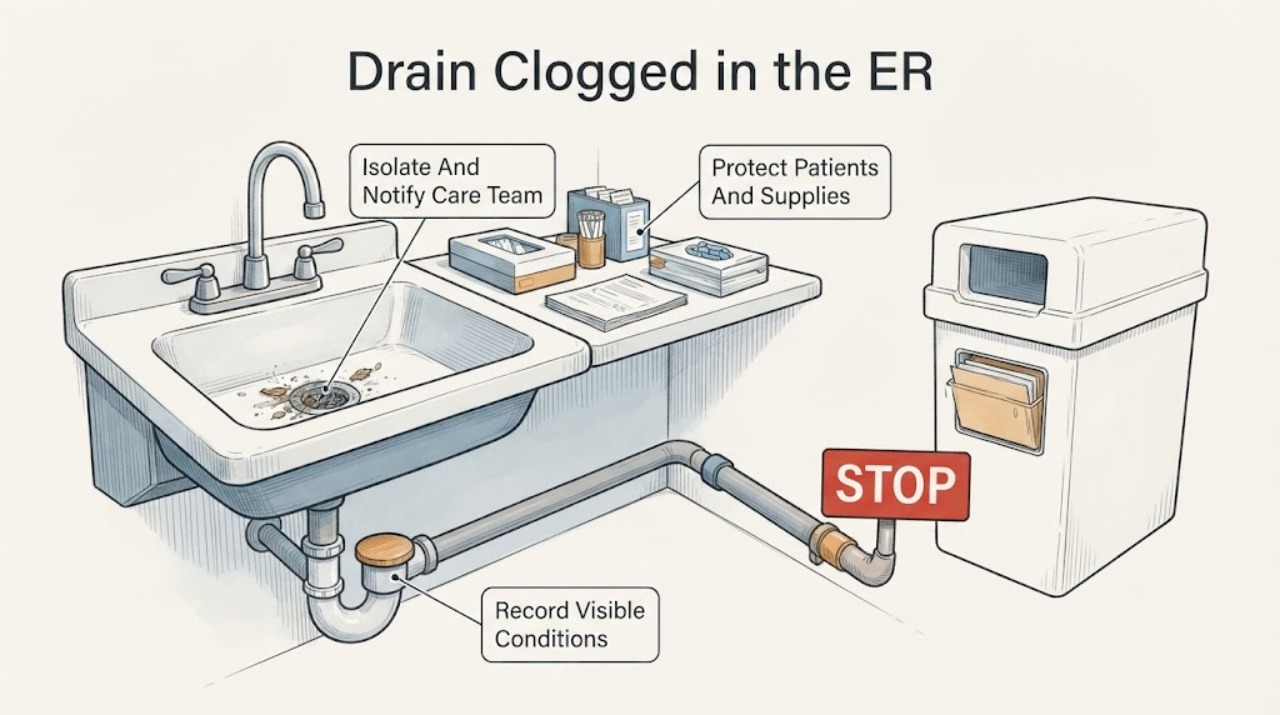
A clogged drain in an emergency room is an institutional water, sanitation and infection-control event, not a household drain-clearing job. Stop using the affected sink, toilet, hopper or drain; keep patients, staff, medications, sterile supplies and equipment away from splash or standing water; and notify the charge nurse or department lead, Facilities, Environmental Services and Infection Prevention through the facility's incident route. Do not plunge, snake, dismantle the trap, pour drain chemicals, or flush more water to test it. Record the exact location, whether water is rising or leaking, what may have entered the drain, and any patient-care exposure. CDC guidance notes that drains can harbor biofilms and that splashes can spread organisms, while sewage intrusion or flooding requires affected areas to be closed and managed under facility procedures. Treat sewage, blood or body-fluid backflow, flooding, electrical contact, or a patient-care interruption as urgent and use the facility emergency escalation process.
Before you begin
Safety first
- This article limits the reader to use restriction, safe observation and facility notification. Do not perform plumbing work, use chemical drain products, create splash, handle contaminated material or reopen the area without authorized facility clearance.
Work through in order
Diagnostic checks
Use only checks that match the exact appliance or system and its official guide.
-
Check 1
Stop using the affected drain immediately and place a clear temporary out-of-service barrier or sign according to ER policy. Notify the charge nurse or department lead, Facilities or Engineering, EVS, and Infection Prevention through the facility's incident route; do not leave the condition as an informal verbal handoff.
Expected result: The drain may be slow, fully blocked, overflowing, backing up, leaking below the fixture, or splashing when another fixture is used. Note whether the affected point is a handwashing sink, utility sink, toilet, hopper, shower or another drain.
Next step: Keep people and supplies out of the affected area and follow the facility's work-order and incident-escalation process. Ask the responding teams whether nearby fixtures must also be taken out of service.
Stop if: Stop and use the facility emergency pathway for sewage or body-fluid backflow, flooding, patient exposure, electrical contact, strong odor, structural damage or a rapidly spreading leak.
Why this matters
Why: The location and water behavior determine the exposure path and whether patient care, cleaning operations or multiple fixtures are affected. A care-area sink or a drain with backflow is a higher infection-control concern than an isolated non-care utility drain.
-
Check 2
From a safe position, keep patients, medication preparation, sterile supplies, dressings, IV materials, devices and clean equipment away from the drain, adjacent counter and any splash or standing water. Move only uncontaminated items when authorized and safe; do not handle wet or visibly contaminated materials as ordinary supplies.
Expected result: There may be no splash, a wet counter, visible droplets, standing water, wastewater, or contact with a patient-care item. Record what was potentially exposed without disturbing the area.
Next step: Tell Infection Prevention and EVS exactly what was in the splash zone and follow the facility's isolation, disposal, cleaning and reprocessing instructions. Do not return supplies to use based only on visual dryness.
Stop if: Do not touch sewage, blood, body fluids, unknown wastewater or contaminated supplies without the facility's PPE and exposure procedure.
Why this matters
Why: CDC identifies drain splash as a route by which organisms can reach nearby surfaces and equipment. The presence of a splash or contaminated item changes the response from a plumbing work order to an exposure and environmental-cleaning assessment.
-
Check 3
Record the exact room or bay, fixture type, time first noticed, whether another fixture was used, water level or leak location, odor or visible material, and any recent maintenance or construction. Do not run more water, flush repeatedly, remove a strainer, open a trap or use a chemical to identify the blockage.
Expected result: The problem may affect one fixture, several connected fixtures, or the whole area; it may involve clean water, wastewater, sewage, blood or body-fluid material. A recurring blockage after plumbing work is also meaningful history.
Next step: Attach the observations to the authorized Facilities work order and notify Infection Prevention when water, wastewater, splash or care-supply exposure occurred. Let Facilities select any isolation or diagnostic test.
Stop if: Stop observation if the water rises, spreads, splashes, contacts a person or electrical equipment, or includes sewage, blood or body fluids.
Why this matters
Why: A connected-fixture pattern can indicate a branch or building drainage issue, while a single slow fixture may be local. The nature of the liquid determines the infection-control and hazardous-material response, not the apparent size of the clog.
-
Check 4
Do not clean or disinfect the drain, trap, floor or surrounding counter as a personal DIY task. Ask EVS or the facility's trained response team to apply the approved PPE, containment, cleaning, disinfection and waste procedure; keep the area closed as directed while Facilities addresses the plumbing.
Expected result: The response team may classify the event as a dry obstruction, clean-water leak, wastewater overflow, sewage intrusion, blood or body-fluid spill, or a possible outbreak-related water event.
Next step: Follow the local written procedure and document who accepted the response, what area was restricted, what items were removed, and when EVS, Infection Prevention and Facilities cleared the space.
Stop if: Do not mix cleaners, fog a patient-care area, aerosolize the drain, or reopen the area before the responsible facility teams clear it.
Why this matters
Why: Different liquids and care areas require different controls. CDC recommends facility policies, appropriate barriers and registered products for environmental cleaning, and specific infection-control measures during sewage intrusion or flooding.
-
Check 5
Before the ER fixture returns to service, obtain confirmation from Facilities and Infection Prevention or the designated incident lead that the blockage, leak or backflow is corrected, affected surfaces and supplies were handled under policy, and the fixture is approved for use. Record any recurring slow drainage or nearby-fixture restriction.
Expected result: The drain may flow normally but still have a leak, splash pattern, odor, residue, repeated backup or an unresolved work order. A surface can appear dry while the response or exposure review is incomplete.
Next step: Use the documented clearance and closeout process. Escalate recurring events to the water-management team, Facilities leadership and Infection Prevention rather than repeatedly treating the same symptom at the fixture.
Stop if: Keep the fixture out of service for any renewed backup, sewage odor, splash, leak, contamination, patient exposure or unresolved electrical or structural hazard.
Why this matters
Why: Flow restoration alone does not prove that the care environment is safe or that contaminated supplies and surfaces were managed. Recurrence can indicate a building water-management or infrastructure problem requiring broader review.
Use your observations
Decision map
Find the observation that best matches what you see, then follow the next safe action.
-
PATH 01Safety boundary
What you see
Sewage, wastewater, blood, body fluid, unknown material or contaminated water rises from the drain or contacts a person, supply or device.
Do this next
Stop use, keep people away, notify the charge lead, Facilities, EVS and Infection Prevention immediately, and follow the facility exposure, PPE, containment, patient-relocation and waste procedures.
Why this path and its safety boundary
Why it matters: This is an exposure and environmental emergency in the ER, not an ordinary clog.
Safety stop: Do not touch, flush, wipe, plunge, pour chemicals or move contaminated supplies outside the approved response.
-
PATH 02Safety boundary
What you see
The clogged drain is in or beside a patient-care area, medication preparation area or clean-supply location, even if no overflow is visible.
Do this next
Restrict the fixture, move clean supplies only when safe and authorized, and involve EVS and Infection Prevention in the area assessment before reuse.
Why this path and its safety boundary
Why it matters: A splash or aerosol path may expose nearby people, surfaces, equipment or supplies.
Safety stop: Do not place medications, dressings, IV materials or devices near the sink and do not use the fixture to test flow.
-
PATH 03Safety boundary
What you see
One non-overflowing fixture drains slowly, there is no patient or supply exposure, and no wastewater or hazardous material is present.
Do this next
Mark the fixture out of service as required, submit the authorized work order, and record the location and recurrence without DIY clearing.
Why this path and its safety boundary
Why it matters: It is still a facility maintenance issue; continuing to use it can turn a slow drain into a backup or splash event.
Safety stop: Escalate immediately if water rises, splashes, leaks, smells of sewage or affects patient care.
-
PATH 04Safety boundary
What you see
Several sinks, toilets, hoppers or drains are slow or backing up, or the problem follows building work, a water interruption or a utility event.
Do this next
Use the facility escalation route for an area or building infrastructure event and ask Facilities and Infection Prevention whether nearby care areas need restriction or relocation.
Why this path and its safety boundary
Why it matters: The issue may involve shared plumbing or a facility water-management event rather than a fixture obstruction.
Safety stop: Do not flush or run fixtures to compare them, and keep affected areas closed when directed.
-
PATH 05Safety boundary
What you see
The clog causes flooding, sewage intrusion, standing water near electrical equipment, structural damage or an inability to maintain safe patient care.
Do this next
Activate the facility emergency plan, restrict the affected area, protect or relocate patients and supplies as directed, and coordinate Facilities, EVS, Infection Prevention and clinical leadership.
Why this path and its safety boundary
Why it matters: CDC recommends infection-control measures and area closure during sewage intrusion, flooding and other water-related emergencies.
Safety stop: Do not enter unsafe water, operate wet electrical equipment or reopen the area based on flow alone.
-
PATH 06Safety boundary
What you see
Facilities reports the plumbing repair complete and the responsible clinical and infection-control teams have completed their checks.
Do this next
Confirm the work order, cleaning and disinfection record, item disposition, exposure review and reopening approval. Monitor for recurring slow drainage or splash.
Why this path and its safety boundary
Why it matters: Only documented clearance, not a temporary return of flow, establishes that the fixture can return to ER use.
Safety stop: Keep the drain restricted if any backup, odor, leak, splash or contamination returns.
Helpful context
Understand the symptom
Why the ER condition changes the response
A drain connects the care environment to building wastewater plumbing. In healthcare settings, a clog can cause standing water, backflow or splash that affects patients, staff, supplies and equipment. The first response is use restriction and notification so Facilities, EVS and Infection Prevention can apply the site's water-management and cleaning procedures.
Protect care and clean supplies
Move care supplies away from the affected sink or drain only if this can be done without contacting contaminated water. Keep medications, dressings, instruments, food and equipment out of the splash zone. Do not pour IV fluids, body fluids, drinks or other waste into a handwashing sink; use the disposal route specified by the facility.
Leave the plumbing repair to authorized staff
A public troubleshooting page cannot determine whether the obstruction is in a trap, branch line, waste stack or a backflow-control device. Plungers, augers and drain chemicals can spread contamination or create a chemical exposure and can conflict with clinical plumbing and infection-control requirements. Facilities or the authorized plumbing contractor must choose the intervention.
Safety boundary
Stop conditions
- Sewage, body fluid, blood, unknown wastewater or backflow contacts a person, supply, device or patient-care surface.
- Flooding, standing water near electrical equipment, structural damage, strong odor, rapid spread or loss of a critical ER function.
- Any splash or leak near medication preparation, sterile supplies, dressings, IV materials, equipment or a vulnerable patient.
- A need to plunge, snake, dismantle a trap, remove a drain cover, pour chemicals, aerosolize the drain or perform unapproved cleaning.
- A recurring clog, multiple affected fixtures or a return of the problem before Facilities and Infection Prevention provide documented clearance.
When checks do not resolve it
Need a professional?
Escalate immediately through the ER facility emergency route for sewage or body-fluid backflow, flooding, splash exposure, water near electrical equipment, structural damage or interruption of critical patient care. For a slower isolated drain without exposure, still submit an authorized Facilities work order and restrict the fixture as policy requires. Infection Prevention and EVS must be involved whenever water, wastewater, splash, supplies or patient-care surfaces may be affected.
Safety scope: This article limits the reader to use restriction, safe observation and facility notification. Do not perform plumbing work, use chemical drain products, create splash, handle contaminated material or reopen the area without authorized facility clearance.
Common questions
FAQ
Can I use a plunger on a clogged ER drain?
Not as a personal DIY response. Restrict the fixture and notify the charge lead, Facilities, EVS and Infection Prevention under the facility route. Plunging can create splash, spread contamination or conflict with the facility's plumbing and infection-control procedure.
What should staff do first when an ER drain backs up?
Stop using it, keep patients and supplies away, place it out of service as policy requires, and report the exact fixture and water behavior. Escalate urgently for sewage, body fluid, flooding, electrical contact, splash exposure or loss of critical care function.
Why is a drain clog an infection-control concern in an ER?
CDC explains that healthcare drains can contain biofilms and that splashes can move organisms to nearby surfaces, equipment, patients and staff. Standing water or backflow also changes the cleaning, containment and exposure response.
Should drain chemicals be poured into a hospital sink?
No. Do not pour chemicals or other liquids into the affected drain unless an authorized facility procedure specifically directs a trained response. Facilities and Infection Prevention must choose a safe plumbing and environmental response.
When can the ER drain return to service?
Only after authorized Facilities reports the plumbing issue corrected and the designated EVS, Infection Prevention and clinical leads complete the required cleaning, exposure review and return-to-service checks. Restored flow by itself is not clearance.
Read the exact guide
Official sources
- Part II. Recommendations for Environmental Infection Control in Health-Care FacilitiesCenters for Disease Control and Prevention · CDC healthcare environmental-control recommendations; facilities must apply their own current policies and local requirements.
- Cleaning ProgramsCenters for Disease Control and Prevention · CDC healthcare environmental-cleaning program guidance; not an authorization for untrained individual cleaning.
- Considerations for Reducing Risk: Water in Healthcare FacilitiesCenters for Disease Control and Prevention · CDC guidance for healthcare facilities; local facility policy and applicable regulations control the response.
- Drains Micro-LearnCenters for Disease Control and Prevention, Project Firstline · CDC training material for healthcare workers and environmental services; facility-specific procedures still apply.
Community feedback
Share a repair observation
Share a plain-text repair observation. Accepted observations are published automatically; this page may take a moment to update.