
On this page
Start here
Quick answer
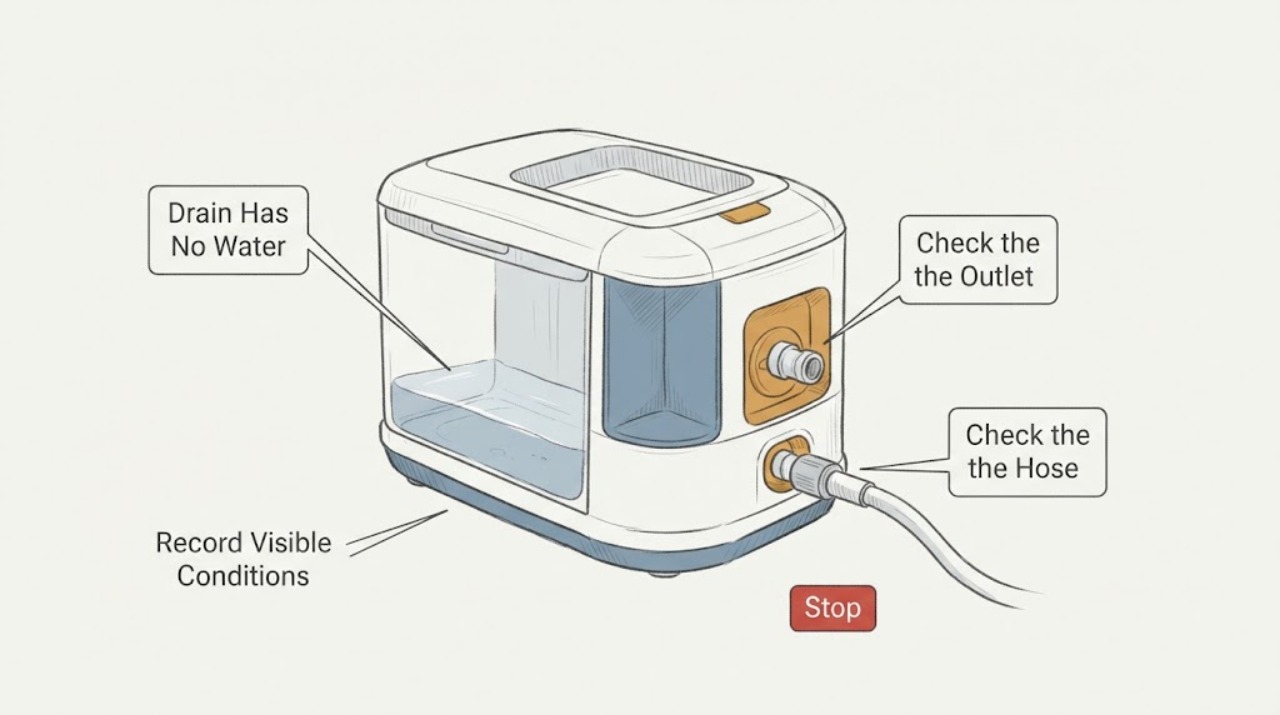
First clarify which part has no water: the tank or fixture is not filling, the drain opening receives water but it does not move, or the drain and trap are completely dry. With no leak, sewage, chemical, or electrical hazard, record the tank/fixture type and check the accessible supply, valve, level control, stopper or drain opening, and visible pipe path. A dry P-trap can allow sewer gas into the building, while water that stands in the tank or backs up at the opening points toward a blockage, closed valve, failed pump, or vent problem. Do not pour chemicals or open a concealed line. Stop for sewage, overflow, strong sewer-gas odor, chemical residue, water near electricity, or a tank that may be pressurized; isolate the hazard only when safe and call a qualified plumber.
Work through in order
Diagnostic checks
Use only checks that match the exact appliance or system and its official guide.
-
Check 1
Before adding water or opening a cover, check for sewage or contaminated water, overflow, a strong sewer-gas odor, chemical residue, a pressurized tank, or standing water near an outlet, pump, or other electrical equipment.
Expected result: Any of these hazards is present, or the water cannot be isolated safely.
Next step: Stop using the fixture or tank. Keep people away, isolate water or power only when safely accessible, ventilate only from a safe position, and arrange appropriate emergency, plumbing, poison, or electrical help.
Stop if: Stop immediately for sewage, strong sewer-gas odor, caustic product, uncontrolled overflow, pressurized equipment, or water contacting energized equipment.
Why this matters
Why: The priority is contamination, gas, pressure, chemical, slip, or electrical safety rather than restoring flow.
-
Check 2
Identify the exact fixture or tank and record whether “no water” means the tank never fills, water is present but will not drain, the drain opening is dry, or a trap under the fixture has no visible water seal. Note whether the problem is new, intermittent, or limited to one fixture.
Expected result: The tank/fixture is empty, the tank is full but discharge is absent, only the drain opening is dry, or multiple fixtures share the symptom.
Next step: Use the matching branch below and the exact equipment instructions. Do not assume a generic sink-trap procedure applies to a holding tank, appliance reservoir, sump, or pressurized system.
Stop if: Stop if the tank identity, pressure, liquid contents, or isolation method is unknown, or if access requires removing a cover or entering a confined space.
Why this matters
Why: An empty tank suggests supply or level control; a full tank suggests a discharge restriction; a dry drain suggests trap loss; multiple fixtures suggest a shared branch, vent, or downstream line.
-
Check 3
For an empty tank or fixture, check only accessible supply conditions: the normal water valve, visible supply hose or pipe, inlet screen if the equipment instructions identify it as user-accessible, float/level indication, and any external power indicator for a pump or control.
Expected result: A valve is closed, supply is weak or absent, a hose is kinked, a visible screen is restricted, a float is stuck, or the accessible supply appears normal.
Next step: Correct only an obvious valve or hose position when safe and permitted by the equipment instructions. Arrange a plumber or qualified service for a stuck float, failed valve/pump, pressure issue, or any internal access.
Stop if: Stop for a leaking/burst pipe, pressurized vessel, wet electrical equipment, uncontrolled filling, or any need to bypass a float or level control.
Why this matters
Why: An upstream supply or level-control condition can explain an empty tank; normal supply shifts attention to the level sensor, inlet valve, pump, or control system.
-
Check 4
For a tank or fixture that contains water but does not discharge, inspect only the visible drain opening, stopper, screen, and accessible outlet for a loose object, hair, sediment, closed stopper, kink, or visible blockage. Reduce further water input while checking.
Expected result: The visible opening is blocked or closed, a stopper is not opening, the outlet is kinked, or the visible path is clear but water remains.
Next step: Remove only loose, visible debris with safe tools and clean water when the fixture instructions permit it. If water remains, stop adding water and arrange plumbing service; do not force a hidden fitting.
Stop if: Stop for sewage, chemical residue, sharp fragments, a leak, a pressurized tank, standing water near electricity, or any need to open concealed piping.
Why this matters
Why: A near-opening restriction may be removable without opening the plumbing; a clear visible path with standing water points toward the trap, pump, vent, or deeper line.
-
Check 5
If the drain opening is dry and the fixture is seldom used, add a small amount of clean water only when the fixture is safe and not blocked, then observe whether the water remains in the trap and whether the sewer odor decreases. Do not do this when the drain may contain chemicals or sewage.
Expected result: The water stays in the trap and the odor improves, the water disappears immediately with odor returning, or the water backs up.
Next step: For a recurring dry trap, arrange a plumber to assess the trap/vent or a suitable maintenance solution. For backup, stop adding water and use the blockage branch; do not pour chemicals.
Stop if: Stop for strong or persistent sewer-gas odor, dizziness, headache, nausea, sewage, suspected vent failure, or water loss into a concealed space.
Why this matters
Why: A replenished seal supports a dry-trap condition; rapid loss can indicate evaporation, siphonage, a leak, or vent problem; backup indicates a blockage rather than simply no trap water.
-
Check 6
Use a small, controlled amount of clean water to compare nearby fixtures and drains, without running a large tank discharge or repeatedly flushing. Observe whether water drains normally, gurgles, rises elsewhere, or causes several fixtures to back up together.
Expected result: Only one opening is affected, or two or more fixtures show slow flow, gurgling, backup, or no discharge.
Next step: For multiple fixtures, discontinue use and call a plumber. For one fixture, continue only with the fixture's safe, visible checks; do not open a cleanout or concealed line without the right procedure.
Stop if: Stop for rising sewage, overflow, foul contamination, water near electricity, or a floor drain that begins collecting water.
Why this matters
Why: A single fixture points toward its stopper, trap, branch, or local pump; multiple fixtures point toward a shared drain, vent, or downstream blockage.
-
Check 7
If no safe visible cause is found, do not add chemicals or repeatedly cycle a pump or valve. Record the tank level, fixture, supply state, drain behavior, trap/odor observation, and any product already used, then arrange qualified plumbing service.
Expected result: The symptom is deep, recurring, inaccessible, shared by multiple fixtures, or requires a pump, vent, cleanout, tank cover, or concealed pipe to diagnose.
Next step: Keep the affected system out of use until service and tell the plumber whether the tank was empty or full, whether the trap was dry, and whether chemicals or sewage were involved.
Stop if: Do not use powered clearing equipment, enter a tank or confined space, remove a pressurized cover, mix chemicals, or work near energized equipment and water.
Why this matters
Why: The problem is beyond a low-risk visual check and may involve the drain line, venting, pump, tank control, or a hidden leak.
Use your observations
Decision map
Find the observation that best matches what you see, then follow the next safe action.
-
PATH 01Next step
What you see
The tank/fixture is empty and the accessible valve, hose, float, and supply conditions explain the lack of incoming water
Do this next
Correct only the obvious safe external condition; arrange service for persistent no-fill, pump, valve, pressure, or control faults.
Why this path and its safety boundary
Why it matters: An upstream supply or level-control condition is more likely
-
PATH 02Next step
What you see
The tank contains water but the drain opening is blocked, the stopper is closed, or the visible outlet is kinked
Do this next
Clear only loose visible debris or correct the safe visible position; stop adding water and call a plumber if flow does not return.
Why this path and its safety boundary
Why it matters: A local discharge restriction is more likely
-
PATH 03Next step
What you see
The opening is clear but water stands in the tank or backs up, especially at more than one fixture
Do this next
Discontinue use and arrange plumbing service; do not open a concealed line or use chemicals.
Why this path and its safety boundary
Why it matters: A trap, branch, vent, shared drain, pump, or downstream blockage is more likely
-
PATH 04Next step
What you see
The drain is dry, adding clean water restores the trap seal, and sewer odor decreases
Do this next
Run water periodically in seldom-used fixtures and arrange service if the seal repeatedly disappears or odor persists.
Why this path and its safety boundary
Why it matters: A dry-trap condition is more likely than a no-flow clog
-
PATH 05Next step
What you see
Water disappears immediately, the trap will not hold, or a sewer odor persists or returns
Do this next
Stop if the odor is strong or causes symptoms and arrange a plumber to investigate the trap and vent system; do not seal the opening with an improvised method.
Why this path and its safety boundary
Why it matters: A leak, siphonage, vent, trap, or concealed plumbing issue remains possible
-
PATH 06Next step
What you see
Chemical product, sewage, overflow, pressurized tank, or electrical equipment near water is involved
Do this next
Stop using the system, isolate hazards only when safe, and get appropriate plumbing, poison, electrical, or emergency assistance.
Why this path and its safety boundary
Why it matters: Immediate safety boundary
Helpful context
Understand the symptom
“Drain no water” describes several different symptoms
If a tank or fixture has no water, the problem may be on the supply side: a closed valve, low supply, blocked inlet, float or level control, or a pump that is not moving water. If water is present but the drain has no flow, the problem is on the discharge side: a stopper, trap, branch, vent, pump, or downstream line. If the drain is unused and dry, the missing water may be a lost trap seal rather than a clog.
Why the trap matters
A P-trap normally holds water to block sewer gas. CDC plumbing guidance explains that trap seals can be lost through evaporation, siphonage, or pressure, and Minneapolis Public Works advises periodically running water in seldom-used sinks and floor drains. A dry trap with a sewer odor is a safety and indoor-air concern; it should not be treated as proof that the drain line is clogged.
Use a flow test, not a flood test
Use only a small, controlled amount of clean water after confirming the area is safe. More water can turn a partial blockage into an overflow. Compare the tank or fixture with nearby drains and note whether water enters, stands, gurgles, drains, or disappears without a visible discharge.
Only after diagnosis
Potential parts
- tank float or level-control component
Consider only when a qualified diagnosis confirms that a tank or fixture level-control component prevents normal filling or discharge.
Confirm the exact tank/fixture design and manufacturer information before selecting a component. - drain trap or trap-seal component
Consider only when a qualified inspection finds a damaged trap, recurring seal loss, or a component that cannot maintain the required water seal.
Verify fixture type, dimensions, venting, and local plumbing requirements before replacement. - drain pump or discharge component
Consider only when the tank is full, the visible outlet is clear, and qualified diagnosis identifies a failed pump or discharge component.
Confirm the exact equipment model, liquid type, isolation procedure, and fit information before selecting a part.
Common questions
FAQ
What does “drain has no water” usually mean?
It can mean the tank or fixture never fills, water is present but cannot discharge, the drain opening is dry, or a P-trap has lost its water seal. Identify which condition exists before choosing a supply, blockage, or trap check.
Why is a dry trap a problem if the drain is not used?
A trap normally holds water as a barrier against sewer gas. If it dries or loses its seal, odors and sewer gases can enter the building; recurring loss may need a plumber to check venting, siphonage, leaks, or the trap.
Should I add water to a tank or drain with no water?
Only add a small amount of clean water when the fixture is safe, not blocked, not contaminated, and not pressurized. Do not add water to investigate chemical residue, sewage, an overflow risk, or an unknown tank.
What if several drains have no flow?
Several fixtures that gurgle, back up, or fail together point toward a shared drain, vent, pump, or downstream blockage rather than one stopper. Stop using the fixtures and arrange plumbing service.
When should I call a plumber?
Call when the tank stays empty or full without expected flow, the trap will not hold water, the issue recurs, multiple fixtures are affected, a leak or sewage is present, or diagnosis would require a pump, vent, concealed pipe, pressurized tank, or confined-space access.
Read the exact guide
Official sources
- Guidelines for Cleaning Safely After a DisasterCenters for Disease Control and Prevention · General public safety guidance; local emergency and electrical instructions apply.
- Safety and maintenance tipsCity of Minneapolis · General residential sewer and trap guidance; local plumbing conditions and codes apply.
- Drain opener poisoningMedlinePlus, U.S. National Library of Medicine · General medical safety information; use local emergency or poison guidance for exposure.
- Healthy Housing Reference Manual: Chapter 9, PlumbingCenters for Disease Control and Prevention · General plumbing reference; local codes and a qualified plumber control site-specific work.
- Household Hazardous Waste (HHW)U.S. Environmental Protection Agency · General U.S. household hazardous-waste guidance; follow product labels and local disposal rules.
- Prevent Blocked DrainsCity of Tampa · General residential drainage guidance; local wastewater procedures and plumbing conditions apply.
Community feedback
Share a repair observation
Share a plain-text repair observation. Accepted observations are published automatically; this page may take a moment to update.