
On this page
Start here
Quick answer
If a seldom-used drain is empty and you can see or smell an open drain path, its trap may have dried out and lost the water seal that blocks sewer gas. First distinguish an empty drain from a drain holding water that will not flow: the latter is a blockage or drainage problem, not a dry-trap fix. From safe access, identify the affected sink, shower, laundry, or floor drain, add clean water to refill the trap, and note whether the odor or symptom clears. If the water will not stay, the odor returns, multiple fixtures are affected, there is slow drainage or gurgling, or sewage backs up, stop experimenting and arrange qualified plumbing service.
Before you begin
Safety first
- The reader-level scope is visual observation and a clean-water refill of an empty, ordinary drain only. A qualified plumber must handle trap or vent disassembly, concealed access, sewer-line work, pressure or smoke testing, contaminated water, and component selection.
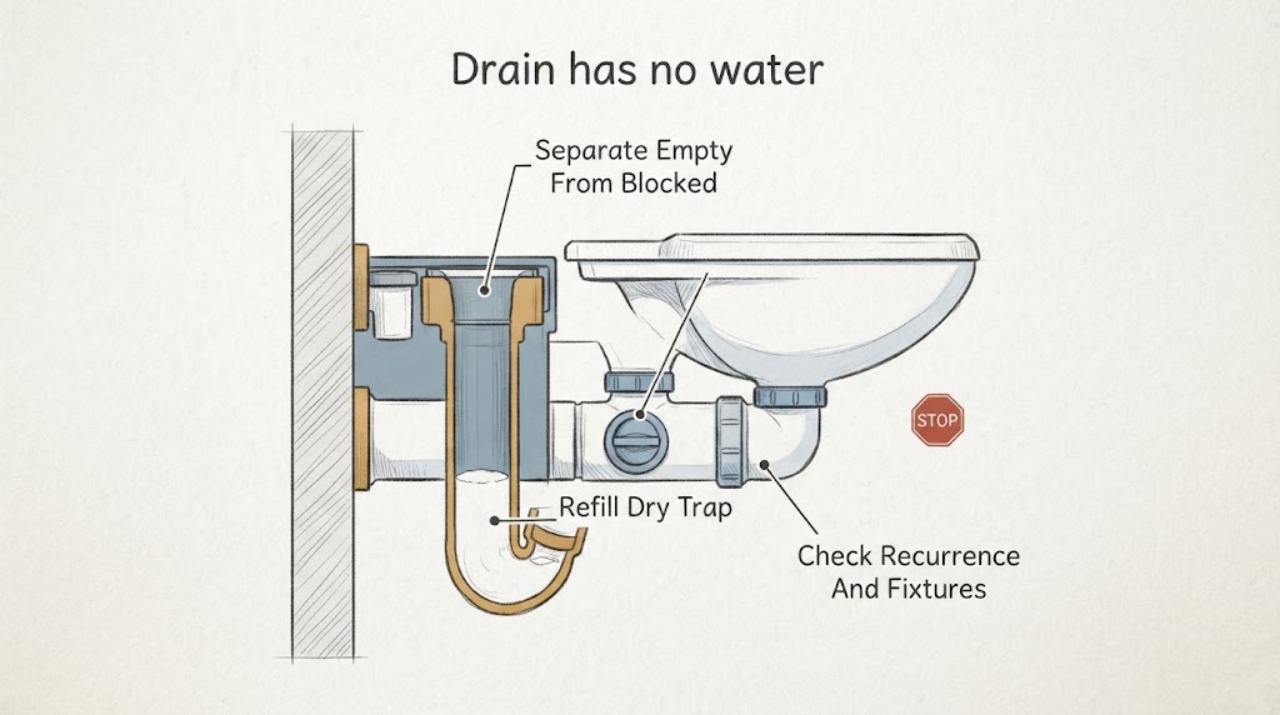
Work through in order
Diagnostic checks
Use only checks that match the exact appliance or system and its official guide.
-
Check 1
From a safe standing position, identify the affected sink, shower, laundry connection, or floor drain and observe the opening without reaching into it or removing covers.
Expected result: Record an empty opening with no standing water versus water that remains in the basin or around the grate; note sewer odor, gurgling, slow flow, sewage, staining, or nearby leaks.
Next step: Continue only with the clean-water refill check when the drain is empty, accessible, and free of sewage or contamination. Treat standing water, slow drainage, gurgling, or backup as a plumbing-service branch.
Stop if: Stop for sewage, contaminated water, flooding, strong or widespread sewer odor, eye or breathing irritation, unstable flooring, or any need to put a hand or tool into the drain.
Why this matters
Why: An empty, infrequently used drain is consistent with a dry trap and lost water seal. Standing water or slow drainage points toward a blockage, vent, line, or backup problem instead, so adding more water may worsen the condition.
-
Check 2
For an empty, ordinary drain with no contamination or backup, slowly add clean water from a safe position to restore the trap's water seal; use the fixture normally when practical, and do not add chemicals or force water into a restricted drain.
Expected result: The water may remain at the fixture's normal trap level, disappear without a backup, or rise and fail to drain; record any immediate change in odor or gurgling.
Next step: If the water remains and the odor clears, monitor the seldom-used drain and periodically keep its trap wet using the fixture or a safe clean-water refill. If it will not drain, the odor persists, or water disappears unusually fast, arrange a plumber's inspection.
Stop if: Do not continue adding water when it rises, backs up, spills, or could contact electrical equipment; stop immediately for sewage, strong odor, or any suspected cross-connection or contamination.
Why this matters
Why: Water that stays without backing up supports a dry-trap explanation, while water that rises or will not drain means the situation is not a simple empty-trap fix. A seal that cannot be maintained suggests leakage, siphonage, venting, or another plumbing condition.
-
Check 3
After the refill, observe the affected area over ordinary use and compare it with other drains without creating a large flow or disassembling any plumbing.
Expected result: Record whether the odor stays away, returns after the drain sits unused, returns quickly despite water, or appears at several fixtures; note gurgling, slow flow, water movement, or dampness around visible connections.
Next step: Keep a short timing and fixture log and request plumbing service for recurrence, multiple affected drains, visible leaks, or any flow problem. Do not infer a roof-vent or sewer-main repair from odor alone.
Stop if: Stop testing for backup, sewage, strong or widespread odor, dizziness, headache, breathing or eye irritation, visible pipe damage, or any access that requires a roof, crawlspace, wall, or ceiling entry.
Why this matters
Why: A symptom tied to long disuse supports evaporation. Quick recurrence or several affected fixtures raises concern for a leaking or damaged trap, venting or pressure issue, or a wider sewer problem that water alone will not correct.
-
Check 4
From the room entrance or another safe position, note whether the drain is in a seldom-used guest bath, basement, garage, laundry area, utility room, or mechanical space and whether ventilation equipment could spread an odor.
Expected result: Record vacant-room history, long periods without fixture use, hot or dry conditions, nearby heating or ventilation equipment, and whether the odor is confined to one room or travels through the building.
Next step: Keep people and pets away from a strongly affected area, ventilate only from a safe position, and request prompt plumbing or indoor-air help when the odor is strong, widespread, or not relieved by a safe refill.
Stop if: Do not enter a confined or poorly ventilated space, operate equipment that may spread a strong odor, or investigate a roof vent, crawlspace, or concealed pipe yourself.
Why this matters
Why: Long disuse makes trap evaporation more plausible, while a strong or spreading odor in a mechanical or occupied area raises the urgency of professional assessment and safe ventilation.
-
Check 5
Prepare a service record with the drain location, whether it was empty or blocked, refill result, odor timing, affected fixtures, recent vacancy or sewer work, and safe photos of visible surfaces.
Expected result: The record may show one unused drain with a one-time dry-trap symptom, a recurring loss of seal, or a multi-fixture flow or odor pattern.
Next step: Give the record to a qualified plumber and ask for the cause to be confirmed before installing a trap primer, trap assembly, vent device, or drain cleaner.
Stop if: Do not dismantle a trap, open walls, climb to a roof vent, use a camera or pressure jet, mix chemicals, or perform work in sewage or an unsafe area as part of this check.
Why this matters
Why: Location, recurrence, and whether water stays in the trap help a plumber separate simple evaporation from a trap leak, venting issue, line blockage, or wider sewer condition; they do not identify a replacement part by themselves.
Use your observations
Decision map
Find the observation that best matches what you see, then follow the next safe action.
-
PATH 01Next step
What you see
The drain was empty, had been unused, accepts clean water without backing up, and the sewer odor or open-drain symptom clears after the trap is refilled.
Do this next
Keep the trap wet through normal periodic use or a safe clean-water refill and monitor for recurrence; arrange service if the symptom returns quickly.
Why this path and its safety boundary
Why it matters: Evaporation and temporary loss of the trap seal are plausible, but the observation does not rule out a later leak or venting issue.
-
PATH 02Next step
What you see
Water is already standing, rises when added, drains slowly, or sewage comes back through the drain.
Do this next
Stop adding water and request qualified plumbing service. Keep people and pets away from contaminated water and do not use chemical drain products as a diagnostic test.
Why this path and its safety boundary
Why it matters: This is not a simple no-water-in-the-trap condition; a blockage, vent, branch, service line, or sewer-main issue may be involved.
-
PATH 03Next step
What you see
The trap loses water again soon after refill, the odor persists, or visible dampness or plumbing damage is present.
Do this next
Arrange a plumber inspection and provide the timing, fixture location, refill result, and visible evidence; do not open the wall or replace a trap without diagnosis.
Why this path and its safety boundary
Why it matters: A leaking or damaged trap, venting or pressure problem, or another concealed plumbing defect is more likely than ordinary evaporation alone.
-
PATH 04Next step
What you see
Several drains lose their seal, odor spreads through the building, or a strong odor causes eye, breathing, or other symptoms.
Do this next
Leave the strongly affected area, ventilate only when safe, and seek prompt plumbing and appropriate emergency or indoor-air assistance. Do not keep testing fixtures.
Why this path and its safety boundary
Why it matters: A wider vent, sewer, or indoor-air condition may be spreading beyond one dry fixture trap and needs faster assessment.
-
PATH 05Next step
What you see
The drain is empty but the symptom does not clearly improve after a safe refill, or the drain's trap and connections cannot be observed safely.
Do this next
Keep the area safe and request qualified plumbing diagnosis before selecting a part or attempting concealed access.
Why this path and its safety boundary
Why it matters: A dry trap is not confirmed; the cause may be a damaged seal, venting condition, line issue, or another source of odor.
Helpful context
Understand the symptom
Empty is different from blocked
A drain with no visible water may simply have an evaporated trap, especially after a room or floor drain has gone unused. A sink or shower holding water that drains slowly is a different symptom. Before adding anything, record whether the basin or grate is empty, whether water is standing, and whether the main symptom is sewer odor, gurgling, or backup.
Restore the water seal without chemicals
For an ordinary, accessible drain that is empty and not contaminated, add clean water to refill the trap. City of Phoenix guidance describes pouring about a quart into a problematic drain; the exact amount and fixture arrangement vary, so do not force water into a drain that is backing up. Do not mix cleaners or use chemical products as a substitute for identifying the problem.
Recurrence changes the diagnosis
If the odor clears after refilling and returns after the drain sits unused, evaporation is plausible. If the trap cannot hold water, the odor persists, or several fixtures lose their seal, a leaking or damaged trap, vent problem, pressure effect, or wider sewer issue needs a plumber's assessment. Do not open walls, climb onto a roof, or dismantle a trap to prove the cause.
Safety boundary
Stop conditions
- Stop adding water if it rises, backs up, spills, or could contact electrical equipment; keep away from sewage or contaminated water.
- For strong or widespread sewer odor, eye or breathing irritation, dizziness, headache, smoke, or another urgent symptom, leave the area and seek appropriate urgent help.
- Do not open walls, enter a crawlspace or confined area, climb onto a roof to inspect a vent, dismantle plumbing, pressure-jet a line, or perform a smoke or camera test yourself.
- Do not mix drain chemicals or choose a trap, vent, primer, or other component from the absence of water alone.
Only after diagnosis
Potential parts
- drain trap primer
Consider only when a plumber confirms that a frequently drying floor drain needs an automatic method to maintain its water seal.
Confirm the plumbing layout, water supply, local requirements, and manufacturer fit before selecting any device. - drain trap assembly
Consider only after inspection confirms a leaking, damaged, missing, or otherwise failed trap rather than ordinary evaporation.
Match the exact fixture, dimensions, materials, connections, and local code requirements before ordering.
When checks do not resolve it
Need a professional?
Call a qualified plumber when the trap will not hold water, the odor persists or quickly returns, visible leaks or damage are present, several drains are affected, drainage is slow, gurgling or backup occurs, or safe access cannot establish the cause. Seek prompt or urgent help for strong or widespread sewer odor, breathing or eye irritation, sewage backup, flooding, or water near electrical equipment.
Safety scope: The reader-level scope is visual observation and a clean-water refill of an empty, ordinary drain only. A qualified plumber must handle trap or vent disassembly, concealed access, sewer-line work, pressure or smoke testing, contaminated water, and component selection.
Common questions
FAQ
What does it mean if there is no water in a drain?
If the drain is seldom used and empty, water may have evaporated from its trap, removing the water seal that blocks sewer gas. If water is standing and will not flow, it is a different blockage or backup symptom.
Can I pour water into a dry floor drain?
For an ordinary, accessible, empty drain without sewage or backup, a safe clean-water refill is a reasonable first check. Stop if water rises or spills, and arrange plumbing service if the symptom does not clear or returns quickly.
Why does the drain lose water again after I refill it?
Fast recurrence can indicate a leaking or damaged trap, venting or pressure condition, or another plumbing defect rather than simple evaporation. Record the timing and have a plumber diagnose it.
What if more than one drain has no water or smells like sewer?
Multiple affected drains or a strong spreading odor raise concern for a wider vent or sewer condition. Stop repeated testing, keep people away from a strongly affected area, ventilate only when safe, and request prompt plumbing assessment.
Should I use drain cleaner to fix an empty drain?
No. An empty trap is not evidence of a clog, and chemicals can create a separate hazard. Use only a safe clean-water refill when the drain is empty and unobstructed; ask a plumber about any persistent symptom.
Read the exact guide
Official sources
- Controlling Pollutants and Sources: Indoor Air Quality Design Tools for SchoolsU.S. Environmental Protection Agency · EPA indoor-air guidance used for the mechanism and escalation boundary; the page is written for school buildings, so fixture-specific plumbing diagnosis remains with a qualified plumber.
- Waste Management - North Dakota Department of Environmental QualityNorth Dakota Department of Environmental Quality · State environmental agency guidance for indoor sewer-gas concerns; local plumbing conditions and a qualified plumber control the repair decision.
- Guidance Supplement 9: Sewer Odors in a Building or HouseCity of Phoenix Water Services Department · Municipal sewer-odor guidance used for household drain observations; it does not replace local code or a plumber's diagnosis.
Community feedback
Share a repair observation
Share a plain-text repair observation. Accepted observations are published automatically; this page may take a moment to update.