
On this page
Start here
Quick answer
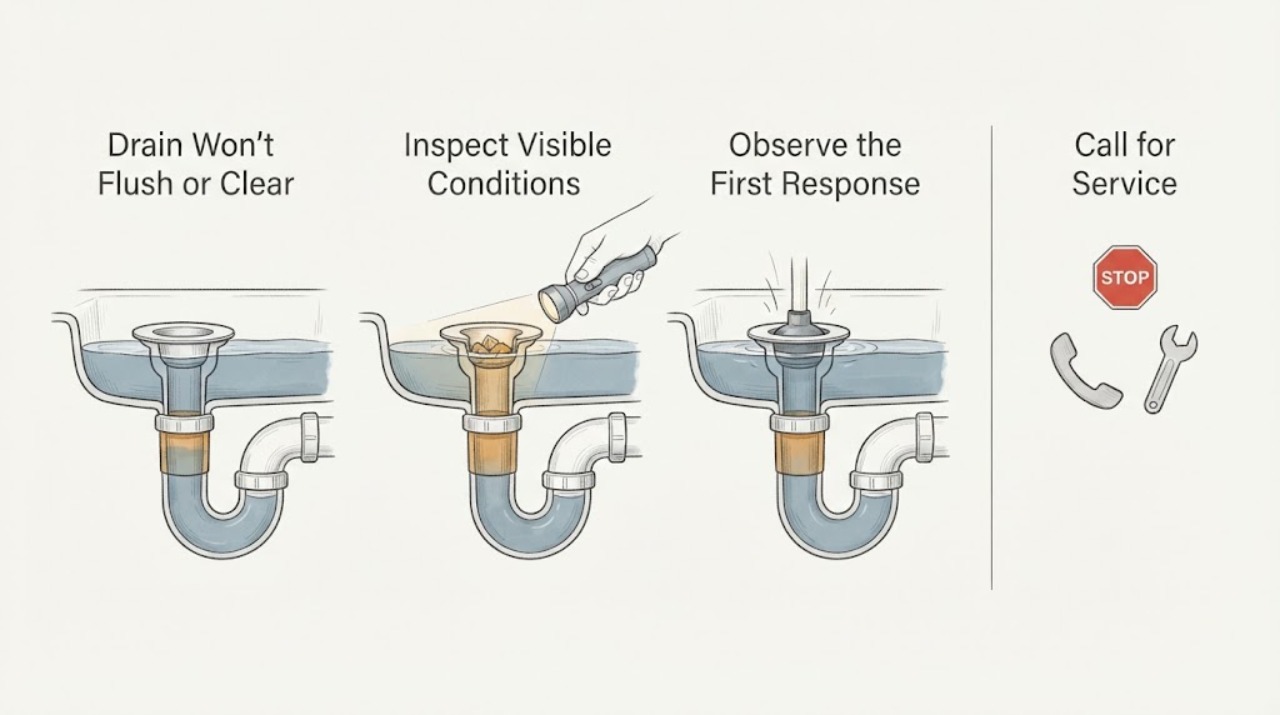
If a household drain will not flush or clear, water is usually being held by a local clog, a full trap, or a blockage farther down the branch or sewer line. First check whether one fixture is affected or several, and stop adding water if anything is backing up. For one sink, tub, shower, or floor drain with no sewage overflow, a correctly sealed plunger is a reasonable first check; if the water level does not improve, the problem recurs, or multiple fixtures are affected, stop using the plumbing and have a plumber or utility determine where the blockage is.
Work through in order
Diagnostic checks
Use only checks that match the exact appliance or system and its official guide.
-
Check 1
Check the affected fixture and briefly observe nearby sinks, tubs, showers, toilets, and floor drains without running more water than needed.
Expected result: Only one drain is slow or full, or two or more fixtures gurgle, drain slowly, or back up together.
Next step: For one fixture with no sewage overflow, continue to the visible-opening and plunger check. For multiple fixtures or a rising backup, stop water use and contact a plumber or the responsible utility.
Why this matters
Why: One affected fixture points toward a local opening, trap, or branch restriction; several affected fixtures point toward a shared building line, sewer lateral, septic system, or public main.
-
Check 2
Look at the drain opening, strainer, stopper, and overflow area for hair, lint, grease, wipes, or other loose material that is safely reachable without putting hands into contaminated water.
Expected result: Loose material is visible at the opening, or the opening is clear but water remains and the drain gurgles or backs up.
Next step: Remove only loose surface material with suitable gloves and dispose of it in the trash. Do not pour grease, wipes, or other waste into the drain, and continue only if there is no sewage overflow or chemical exposure.
Why this matters
Why: Visible material may be a local restriction; a clear opening with persistent standing water shifts suspicion to the trap or a deeper branch-line blockage. Grease, wipes, and other unsuitable items can cause blockages farther down the line.
-
Check 3
For a single sink, tub, shower, or similar drain with no sewage backup, place a plunger so its cup fully seals the opening; cover a nearby overflow or close the other basin opening when applicable, then use steady strokes without splashing.
Expected result: The water level drops and the drain flows, improves briefly and slows again, or does not change at all.
Next step: Rinse and monitor only after flow is restored. If there is no improvement, the drain repeatedly reblocks, or sewage appears, stop and arrange professional clearing; do not add caustic opener or escalate force.
Why this matters
Why: A sustained improvement supports a small nearby clog; brief improvement suggests material remains or the obstruction is farther along; no change makes a deeper restriction, unsuitable plunger seal, or non-clog problem more likely.
-
Check 4
Without opening a sewer cap or dismantling concealed piping, locate the property-line or exterior cleanout if one is safely visible and note whether it is dry, full, overflowing, damaged, or inaccessible.
Expected result: The cleanout is full or overflowing, the home-side drains back up but the cleanout is clear, or no cleanout can be found safely.
Next step: Do not remove a pressurized cap. Photograph the condition and contact the local sewer utility or a plumber to determine whether the public main or private lateral is responsible.
Why this matters
Why: A full or overflowing cleanout can indicate a blockage in the service line or a problem requiring utility coordination; a clear cleanout with a single fixture affected favors a localized or interior restriction, but it is not a complete diagnosis.
-
Check 5
Check for gurgling, sewage odor, standing water, damp ground, or wet spots near the building or septic drainfield, and record whether the problem occurs during rain or when the plumbing is idle.
Expected result: There is sewage odor or backup, standing or spongy water near a septic area, gurgling across fixtures, or none of these warning signs.
Next step: Stop water use and avoid contact with sewage. If on septic, contact a qualified septic professional or health authority; otherwise contact the sewer utility or plumber according to the cleanout and fixture pattern.
Why this matters
Why: These signs raise concern about a shared sewer, vent, septic, or drainfield problem rather than a simple opening clog; the absence of signs does not rule out a concealed branch restriction.
Use your observations
Decision map
Find the observation that best matches what you see, then follow the next safe action.
-
PATH 01Next step
What you see
Only one drain is slow or full, no sewage is present, and a correctly sealed plunger improves flow.
Do this next
Treat it as a likely local obstruction. Rinse cautiously, monitor for recurrence, and arrange professional clearing if the improvement is temporary.
-
PATH 02Next step
What you see
One drain remains blocked after a plunger attempt, or the water returns quickly.
Do this next
Stop adding water and call a plumber. The restriction may be in the trap or branch line; do not mix or add chemical drain products.
-
PATH 03Next step
What you see
Two or more fixtures drain slowly, gurgle, or back up together.
Do this next
Stop all nonessential water use and contact the sewer utility or a plumber. Treat it as a shared-line or main-line problem until the location is established.
-
PATH 04Next step
What you see
Sewage is backing up, an exterior cleanout is full, or wastewater appears when no fixture is being used.
Do this next
Keep people and pets away, avoid contact, and do not remove a pressurized cap. Contact the responsible utility or a qualified plumber for urgent diagnosis and cleanup guidance.
-
PATH 05Next step
What you see
The property uses septic and there is slow drainage with gurgling, sewage odor, or wet or spongy ground near the tank or drainfield.
Do this next
Conserve water and contact a qualified septic service provider or local health authority. Do not assume a household plunger can correct a failing septic or drainfield system.
-
PATH 06Next step
What you see
The user meant a toilet that will not flush rather than a sink, tub, shower, or floor drain.
Do this next
Use toilet-specific guidance and a toilet plunger, not a sink-drain assumption. If the bowl is rising or other fixtures are backing up, stop flushing and escalate to a plumber or utility.
Helpful context
Understand the symptom
A drain itself does not flush like a toilet; people usually mean that water will not go down, clears only slowly, or comes back up. The first useful split is scope: one slow fixture suggests a nearby restriction, while simultaneous trouble at several fixtures suggests a shared line or sewer backup.
Keep the first checks low-risk. Do not mix cleaners, add more water to a backed-up system, or keep plunging after sewage appears. A chemical product used earlier changes the safety boundary for any later work, so tell the plumber exactly what was used.
If the drain is in a basement or other low point, treat a rising or foul-smelling backup as contaminated wastewater. Keep children and pets away, avoid contact, and arrange professional cleanup and diagnosis rather than opening concealed piping.
Only after diagnosis
Potential parts
- replacement drain stopper or strainer
Only relevant if the visible stopper or strainer is damaged and is confirmed to be restricting the opening after the blockage path is clear.
Match the fixture type, opening dimensions, overflow arrangement, and drain assembly; a generic part is not assumed to fit. - matching drain trap or cleanout fitting
Only relevant if a plumber confirms a cracked, blocked, or non-serviceable trap or fitting after isolating the obstruction.
Confirm pipe material, connection type, dimensions, access, and local requirements before selecting a fitting. - backwater valve or drain backup protection component
Only consider after a qualified professional confirms recurring sewer-backup risk and verifies the building's drainage layout and requirements.
Sizing, placement, access, and maintenance are system-specific; do not treat a valve as a substitute for clearing or repairing a blockage.
When checks do not resolve it
Need a professional?
Arrange prompt service for recurring or complete blockage, multiple affected fixtures, sewage backup, a full cleanout, septic warning signs, or any situation where safe access is uncertain.
Have this ready
- Provide the affected fixture list, water level and flow behavior, gurgling or odor observations, photos of any visible backup or cleanout, whether the property is on septic, and any cleaner or tool already used.
Common questions
FAQ
What does it mean if only one drain will not clear?
A nearby opening, trap, or branch restriction is more likely than a whole-house sewer blockage, especially when other fixtures flow normally. Try one correctly sealed plunger check if there is no sewage or chemical exposure, then stop if it does not improve.
What if several drains back up at the same time?
Stop using water and treat it as a shared line, sewer lateral, septic, or public-main issue until located. Contact the responsible utility or a plumber and avoid contact with wastewater.
Should I pour chemical drain cleaner into a blocked drain?
Do not mix cleaners or use caustic products as a default. They may damage plumbing, create a hazard for anyone who later opens the trap or line, and do not address a sewer or septic failure. Tell the plumber if any product was already used.
Is a drain that will not flush the same as a toilet that will not flush?
Not necessarily. A sink, tub, shower, or floor drain has different openings and traps, while a toilet needs toilet-specific plunging and flushing checks. If the toilet bowl rises or other fixtures also back up, stop flushing and escalate.
Read the exact guide
Official sources
- Wastewater FAQFairfax County Public Works and Environmental Services · Municipal sanitary sewer backups, overflow hazards, and drain guidance
- Sewer BackupsNew York City Department of Environmental Protection · Municipal sewer-backup causes and sewage safety guidance
- Troubleshooting an after-hours sanitary back upCity of Jersey Village · Municipal sanitary backup and clogged-drain troubleshooting
- Resolving Septic System MalfunctionsU.S. Environmental Protection Agency · Septic-system malfunction signs and professional response
- The City of Apache Junction Home Maintenance ManualCity of Apache Junction · City home maintenance and household plumbing guidance
- Sewage Backup InformationCity of Annapolis · Municipal sewage backup response and cleanout responsibility guidance
Community feedback
Share a repair observation
Share a plain-text repair observation. Accepted observations are published automatically; this page may take a moment to update.