
On this page
Start here
Quick answer
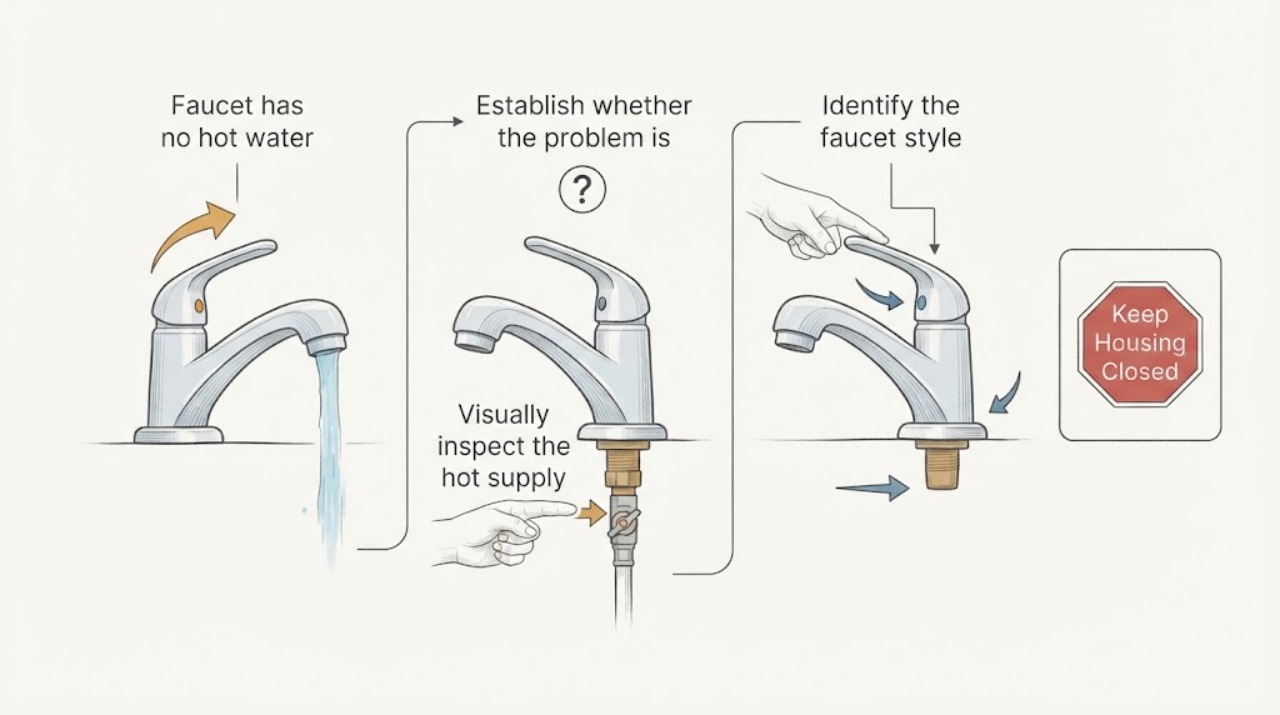
If one faucet has no hot water while other fixtures do, the water heater is probably not the first place to look. Compare this faucet with a nearby hot tap, then visually check the hot shutoff, the exposed hot supply hose, and the faucet's flow pattern without loosening fittings or opening the valve. Strong cold flow with no hot flow points toward the local hot supply path or the faucet's cartridge or mixing valve; weak flow on both sides points toward a shared restriction such as the aerator or a kinked supply. If every fixture is cold, water is leaking, the faucet is a smart or powered model, or the next check requires disassembly, stop and call a plumber.
Work through in order
Diagnostic checks
Use only checks that match the exact appliance or system and its official guide.
-
1. Establish whether the problem is local
Run the affected faucet briefly on its hot setting and compare it with the cold setting. Then check a nearby sink, shower, or tub that uses the same home's hot-water supply. Observe the flow and temperature without removing the aerator or touching plumbing connections.
Expected result: Other fixtures have hot water while this faucet is cold; every nearby fixture is also cold; or this faucet has little or no flow on both settings.
Next step: Use the matching branch below and record which fixtures were checked, the order in which they were tested, and whether cold flow was normal.
Stop if: Stop if water is scalding, discolored, leaking, or spraying, or if testing requires removing a screen, hose, handle, or fitting.
Why this matters
Why: Hot water elsewhere makes a local faucet supply or valve issue more likely. No hot water at several fixtures shifts attention to the water heater or a whole-home supply problem. Low flow on both sides may be an outlet, hose, or supply restriction rather than a hot-only fault.
-
2. Visually inspect the hot supply under the sink
With the cabinet light on, look at the hot-side shutoff and the visible flexible supply line. Compare the hot side with the cold side for an obviously closed valve position, a sharply kinked hose, a crushed line, corrosion, or moisture. Do not turn a stuck valve, loosen a compression nut, or disconnect the line.
Expected result: The hot stop appears closed, the hose is kinked or crushed, there is moisture or corrosion, or both sides look similar and dry.
Next step: Photograph the plumbing and give the observation to a plumber or the faucet manufacturer. If the stop is visibly closed but will not move freely, have it serviced rather than forcing it.
Stop if: Stop immediately for a drip, active spray, corroded connection, a valve that will not move normally, or any need to use tools.
Why this matters
Why: A visible stop or hose problem can interrupt hot flow before water reaches the faucet. Moisture or corrosion makes an unplanned adjustment risky. A normal-looking external path leaves the internal faucet valve, cartridge, or an upstream restriction as possibilities.
-
3. Identify the faucet style and symptom pattern
Without removing the handle or trim, note whether the faucet has one shared handle, separate hot and cold handles, a pull-out or touch control, or a temperature-limit feature. Record whether the hot side has normal flow but stays cold, has weak flow, or has no flow while cold remains normal. Photograph the model label or underside marking if it is visible.
Expected result: Cold flow is strong but hot flow is absent or weak; both temperatures have flow but the hot range is limited; or the faucet's controls or supply hoses do not match the expected layout.
Next step: Use the model information to consult the manufacturer's support material or give it to a plumber. Do not order a cartridge based only on appearance or force a handle to reach a hotter position.
Stop if: Stop if the faucet has electronic controls, a temperature-limiting or pressure-balancing valve you do not recognize, or any symptom that requires opening the valve body.
Why this matters
Why: Strong cold with missing hot flow is consistent with a local hot inlet, cartridge, stem, or mixing-valve restriction. Flow with a limited temperature range can involve a temperature stop or installation-specific control. A mismatched layout makes generic part advice unsafe; model identification matters.
-
4. Decide whether professional service is needed
Answer yes or no: Is hot water missing at multiple fixtures, is there a leak or corroded connection, is the faucet powered or touch-controlled, is the water dangerously hot, or would the next check require disconnecting a line or opening a cartridge or valve?
Expected result: If yes to any item, stop at the safe observation point and arrange plumbing service. If no, keep the photos and scope comparison and follow the faucet manufacturer's model-specific guidance without disassembly.
Next step: Tell the plumber which fixtures were hot, whether cold flow was normal, what the hot stop and hose looked like, the faucet style and model marking, and whether the symptom changed over time.
Stop if: Stop immediately for active water, scalding, electrical concerns, worsening leakage, or any need to loosen a plumbing connection.
Why this matters
Why: A yes indicates a whole-home supply, leak, electrical/control, scald, or internal-valve issue that cannot be safely diagnosed from a generic faucet page. A no means only that no escalation sign was seen; it does not prove a part is compatible or that the valve is repairable.
Use your observations
Decision map
Find the observation that best matches what you see, then follow the next safe action.
-
PATH 01Safety boundary
What you see
Other fixtures also have no hot water.
Do this next
Treat the faucet as a symptom of a broader hot-water supply problem. Check only whether the water-heating system appears powered and normal from its controls; do not open a gas appliance, electrical enclosure, relief valve, or water-heater plumbing.
Why this path and its safety boundary
Safety stop: Call a plumber or qualified water-heater professional for a whole-home loss, a leak, a relief-valve concern, or any gas or electrical symptom.
-
PATH 02Safety boundary
What you see
Cold flow is strong but the hot side has little or no flow.
Do this next
Prioritize the hot shutoff, visible hot supply hose, inlet screen, cartridge, stem, or mixing valve as possible local causes. Keep the inspection visual and use the model information for the next step.
Why this path and its safety boundary
Safety stop: Do not disconnect lines, flush through an improvised container, or open the cartridge as a generic fix.
-
PATH 03Safety boundary
What you see
Hot water flows but never reaches the expected temperature while other fixtures are hot.
Do this next
Record the handle position, faucet style, model marking, and whether a temperature-limit feature is visible. A limit stop, reversed supply, or internal mixing control may be involved; follow the manufacturer's model-specific support or call a plumber.
Why this path and its safety boundary
Safety stop: Stop before changing a temperature limiter if you cannot verify the faucet model and the safe temperature guidance for the installation.
Helpful context
Understand the symptom
Why one faucet can lose hot water
A faucet has a separate hot-water path even when hot and cold share one handle. The local shutoff, flexible hose, inlet screen, cartridge, stem, or mixing valve can restrict that path while the rest of the home remains normal. A faucet that flows but stays cool can have a temperature-control or supply-order issue instead. The safest diagnosis starts by separating a whole-home hot-water problem from a local faucet problem.
Do not turn a diagnosis into a leak
Do not force a stuck shutoff, loosen a supply connection, remove a cartridge, or open a water-heater enclosure just because one tap is cold. Water under a sink can damage cabinets quickly, and a powered or touch faucet adds control components that vary by model. Keep the checks observational and have a plumber handle disassembly when the model, shutoff condition, or water source is uncertain.
What to document for service
A useful service handoff includes the affected fixture location, whether it is single- or two-handle, which other fixtures were tested, hot and cold flow differences, the visible hot-stop and hose condition, any model marking, the timing of the failure, and photos taken before touching the plumbing. That record helps separate an upstream supply problem from a faucet-valve problem without guessing at a replacement part.
Only after diagnosis
Potential parts
- faucet cartridge
Consider only if hot flow is absent or weak at one faucet, the external hot supply path looks normal, and the identified faucet model supports a cartridge service path.
Confirm the exact faucet model, valve family, handle configuration, and manufacturer fit information before ordering; appearance alone is not enough. - angle stop valve
Relevant only when the visible hot-side shutoff is damaged, seized, leaking, or unable to supply the faucet after professional assessment.
Connection size, outlet type, piping material, and access vary; do not assume a replacement fits or attempt replacement without a safe water shutoff. - flexible faucet supply line
Relevant only when the visible hot hose is kinked, crushed, leaking, or otherwise confirmed as the restriction and the connection can be serviced safely.
Confirm length, end fittings, connection standard, and faucet/stop compatibility with the model and installation before ordering.
When checks do not resolve it
Need a professional?
Call a plumber when one faucet has no hot flow after the safe observations, when a shutoff or supply line is damaged, when multiple fixtures lack hot water, when the faucet is powered, or when disassembly would be required.
Have this ready
- Which fixture is affected and whether it is a kitchen, bathroom, or other faucet
- Whether cold flow is normal and whether other fixtures have hot water
- The visible condition of the hot shutoff and flexible supply line
- Single-handle, two-handle, touch, or other control style and any model marking
- Photos, timing, leaks, temperature changes, and any prior plumbing work
Common questions
FAQ
Why does only one faucet have no hot water?
When other fixtures still have hot water, the likely scope is local to that faucet: its hot shutoff, supply hose, inlet path, cartridge, stem, or mixing valve. Compare the hot and cold flow and inspect only the visible plumbing before calling for service.
Should I replace the faucet cartridge right away?
No. First confirm that the symptom is local, cold flow is normal, the visible hot supply path is not obviously closed or kinked, and the exact model is known. A cartridge can look similar across models but still be incompatible, and disassembly can create a leak.
What if hot water flows but is only lukewarm?
Record whether other fixtures reach the expected temperature and identify the faucet model. A temperature-limit feature, reversed supply, or internal mixing control may be involved; use model-specific guidance or call a plumber rather than forcing the handle or changing an unknown limiter.
When is no hot water at one tap urgent?
Call promptly for an active leak, a corroded or stuck shutoff, multiple fixtures without hot water, dangerously hot water, a powered faucet fault, or any need to disconnect a line or open a valve. Keep the cabinet dry and avoid tools until the water path is safely isolated.
Read the exact guide
Official sources
- Change a Kohler Ceramic Valve Cartridge from Hot to ColdKohler Assist · Supports the warning that cartridge orientation and valve behavior vary by model and that a hot/cold control symptom should not be addressed with generic part assumptions.
- Find Parts and Identify Your ProductDelta Faucet · Supports identifying the exact faucet model before selecting a cartridge or other service part and distinguishing faucet categories and issue types.
- No Water from tub/shower unitsMoen Solutions · Provides manufacturer guidance to verify hot and cold supply availability, visible stops, obstructions, and exact model identification before deeper service; the article applies these principles conservatively to a faucet symptom.
Community feedback
Share a repair observation
Share a plain-text repair observation. Accepted observations are published automatically; this page may take a moment to update.